
Bedside Rounds
86 episodes — Page 2 of 2

33 - Alexis and William
Alexis St. Martin and William Beaumont have one of the strangest relationships in the history of medicine -- a young French-Canadian fur trapper with a hole in his stomach from an errant shotgun blast and the American army physician who cared for him, and then made his own career by turning Alexis into a human guinea pig. Through the decades of their complicated relationship, they'd revolutionize our understanding of the physiology of the stomach, put American medicine on the map, and start a conversation about the ethics of human experimentation that goes on to this day. Plus there's a new #AdamAnswers about whether or not your body temperature and fevers can "run low". All this and more on the latest episode of Bedside Rounds, a tiny podcast about fascinating stories in clinical medicine. Sources: Beaumont W. Experiments and Observations of the Gastric Juice and the Physiology of Digestion. Plattsburgh, NY: FP Allen; 1833. Mackowiak PA et al, "A critical appraisal of 98.6 degrees F, the upper limit of the normal body temperature, and other legacies of Carl Reinhold August Wunderlich." JAMA. 1992 Sep 23-30;268(12):1578-80. Mackowiak PA, "Feel the heat: a short history of body temperature," BMJ. 2017;359:j5697 Markel H, "How William Beaumont and Alexis St. Martin Seized the Moment of Scientific Progress," JAMA, August 19, 2009—Vol 302, No. 7. Myers NA and Durham Smith E, "A Debt to Alexis: The Beaumont-St Martin Story," Aust NZ J Surg (1991) 67, 534-539. Numbers RL, "William Beaumont and the Ethics of Human Experimentation," Journal of the History of Biology, Vol. 12, No. 1 (Spring, 1979), pp. 113-135. Obermeyer Z et al, Individual differences in normal body temperature: longitudinal big data analysis of patient records. BMJ. 2017; 359: j5468. Osler W, "William Beaumont: A Pioneer American Physiologist," JAMA Vol XXXIX No 20, Nov 15, 1902.

Ep 3232 - The Humors
The Four Humors are probably the longest-lasting idea in the history of medicine, even though they've been more or less completely abandoned for the past century or so. In this episode, we'll explore how the ancient Greek idea of disease coming from imbalances in body fluids touched every aspect of medicine for two millennia, well into the modern era. And we'll discuss how humoral explanations likely hampered adoption of the first clinical trial in history, James Lind's famous scurvy study. Plus we have a brand new #AdamAnswers about germ theory. Listen to all this and more in Episode 32 of Bedside Rounds, a tiny podcast about fascinating stories in clinical medicine! Sources: Arikha N, Passions and Tempers: A History of the Humors. 2007. Baron JH, "Sailors' scurvy before and after James Lind--a reassessment," Nutr Rev. 2009 Jun;67(6):315-32. Bartholomew M, "James Lind and scurvy: a revaluation," Journal for Maritime Research. Published online: 08 Feb 2011. Lind J. A Treatise of the Scurvy in Three Parts. Containing an Inquiry into the Nature, Causes and Cure of that Disease, together with a Critical and Chronological View of what has been published on the subject. London: Miller, 1753 NLM's Turning the Pages on the Edwin Smith Papyrus (https://www.nlm.nih.gov/news/turn_page_egyptian.html) Nutton V, Ancient Medicine. Nutton V, "The Fatal Embrace: Galen and the History of Ancient Medicine". Science in Context 18(1), 111–121 (2005). Shoja MM et al, "Wrong theories on the origin of blood vessels: Polybus and De Natura Hominis." Int J Cardiol. 2008 Jun 6;126(3):313-5. Sutton G, "Putrid gums and 'dead men's cloaths': James Lind aboard the Salisbury." J R Soc Med. 2003 Dec;96(12):605-8. Trohler U, "Lind and Scurvy: 1747-1795," J R Soc Med. 2005 Nov; 98(11): 519–522. West JB, Galen and the beginnings of Western physiology Volume 307 Issue 2 July 2014 Pages L121-L128

31 - Malariotherapy
Malariotherapy -- infecting comatose syphilis patients with malaria to cure them of the disease -- was once the cutting edge of medicine, and earned its inventor Julius Wagner-Jauregg the Nobel Prize in Medicine or Physiology in 1927. In this episode, we're going to talk about the fascinating story behind this remarkable treatment, from the murky beginnings of syphilis through its sordid sexual connotations, to the birth of modern psychiatry and Nazi experiments. Plus, there's a brand new #AdamAnswers about whether or not ancient doctors thought hair served to store semen (seriously). Listen to all this and more in Episode 31 of Bedside Rounds, a tiny podcast about fascinating stories in clinical medicine. Sources: Crellato E et al, "The Hippocratic treatise 'On glands': the first document on lymphoid tissue on lymph nodes," Leukemia. Retrieved online at https://www.nature.com/articles/2404618 Farhi D, Dupin N, Origins of syphilis and management in theimmunocompetent patient: Facts and controversies. Clinics in Dermatology (2010) 28, 533–538 Frith J, "Syphilis – Its early history and Treatment until Penicillin and the Debate on its Origins," Journal of Military and Veterans' Health, 20(4), retrieved online at: http://jmvh.org/article/syphilis-its-early-history-and-treatment-until-penicillin-and-the-debate-on-its-origins/ Gelder MG, "Biological Psychiatry in Perspective," British Medical Bulletin. 1996;2 (No. 3H01-4G7) Howes OD et al, "Julius Wagner-Jauregg, 1857-1940," American Journal of Psychiatry, April 2009 Volume 166 Number 4, Volume 166, Issue 4, April, 2009, pp. 409-409. Karamanou M et al, "Julius Wagner-Jauregg (1857-1940): Introducing fever therapy in the treatment of neurosyphilis." Psychiatriki. 2013 Jul-Sep;24(3):208-12. Kent, ME and Romanelli F. Reexamining Syphilis: An Update on Epidemiology, ClinicalManifestations, and Management, The Annals of Pharmacotherapy. 2008 February, Volume 42 Kreston R, "Pyromania! On Neurosyphilis and Fighting Fire with Fire," Body Horrors blog on Discover. Retrieved online at: http://blogs.discovermagazine.com/bodyhorrors/2014/05/31/pyromania-syphilis-malaria/#.WnTvHKinE2x Martin TW, "Paul's argument from Nature for the Veil in 1 Corinthians 11:13-15: A Testicle Instead of a Head Covering," Journal of Biblical Literature, Vol. 123, No. 1 pp 75-84. Rothschild, BM, "History of Syphilis Clinical Infectious Diseases." 2005; 40:1454–63 Simpson WM, "Artificial fever therapy of syphilis," JAMA. 1935;105(26):2132-2140. Tampa M et al, "Brief History of Syphilis." J Med Life. 2014 Mar 15; 7(1): 4–10. Tsay CJ, "Julius Wagner-Jauregg and the Legacy of Malarial Therapy for the Treatment of General Paresis of the Insane," Yale J Biol Med. 2013;86(2): 245–254 Wagner-Jauregg J, "The history of malaria treatment of general paralysis." Am J Psychiatry. 1946;02: 577-582

Ep 3030 - The Orphan Vaccine
Two hundred years ago, a few doctors, a matron, and 22 orphans set sail in a gutsy attempt to spread the new invention of vaccination across three continents in the world's first attempt to eliminate smallpox. Learn about their epic journey, the Balmis-Salvany Expedition, as well as the medical context surrounding the invention of vaccination in "The Orphan Vaccine". Plus, a new #AdamAnswers about why you always get sick when you first go on vacation. You can find all this and more in the latest episode of Bedside Rounds, a tiny podcast about fascinating stories in clinical medicine! Sources: Domingo P, "Smallpox: The triumph over the most terrible of the ministers of death," Annals of Internal Medicine, November 1997. Fenner F et al, "Smallpox and its Eradication," World Health Organization, 1988, Franco-Paredes C, et al. "The Spanish Royal Philanthropic Expedition to Bring Smallpox Vaccination to the New World and Asia in the 19th Century", Clinical Infectious Diseases, Volume 41, Issue 9, 1 November 2005, Pages 1285–1289 Hammarsten JF et al, "Who discovered smallpox vaccination? Edward Jenner or Benjamin Jesty?" Trans Am Clin Climatol Assoc. 1979;90:44-55. Lipton RB et al, "Reduction in perceived stress as a migraine trigger: testing the 'let-down headache' hypothesis," Neurology. 2014 Apr 22; 82(16): 1395–1401. Mark C and Rigau-Peres JG, "The World's First Immunization Campaign: The Spanish Smallpox Vaccine Expedition, 1803-1813," Bulletin of the History of Medicine, Volume 83, Number 1, Spring 2009, pp 63-94. Morgan AJ and Poland GA, "The Jenner Society and the Edward Jenner Museum: Tributes to a physician-scientist," Vaccine, 295 (2011) D152-D154. Tuells J. "Francisco Xavier Balmis (1753–1819), a pioneer of international vaccination," Journal of Epidemiology and Community Health, 2002, 56:11.

Ep 2929 - Curse of the Ninth
Did the famous composer Gustav Mahler work his fatal heart murmur into his final ninth symphony? To try and answer this question, I'm joined by Dr. Kevin Nordstrom of the Great Composers Podcast. We'll delve into Mahler's diseases, a history of heart sounds, musical theory, his obsession with mortality, and the unfortunate circumstances of his own death. Classical music and medicine, in one podcast! What more could you want? And included (at no extra charge!) is a new #AdamAnswers about the origins of respiratory therapy. You can listen to Dr. Nordstrom's Great Composers Podcast on iTunes or on his website. Sources: Amenta C, "The Opening of Mahler's Ninth Symphony and the Bernstein "Heart-beat" Hypothesis by Charles Amenta," Naturlaut 4(1): 17-18, 2005. Cardoso F and Leese AJ. "Did Gustav Mahler have Syndenham's chorea?" Mov Disord. 2006 Mar;21(3):289-92. Christy NP et al, "Gustav Mahler and his illnesses," Trans Am Clin Climatol Assoc. 1971; 82: 200–217. Ferretti J et al, "History of Streptococcal Research." Streptococcus pyogenes : Basic Biology to Clinical Manifestations. Hannah IR and Silverman ME, "A history of cardiac auscultation and some of its contributors," Am J Cardiol. 2002 Aug 1;90(3):259-67. Levy D, "Gustav Mahler and Emanuel Libman: bacterial endocarditis in 1911," Br Med J (Clin Res Ed). 1986 Dec 20-27;293(6562):1628-31. Mangione S, "Mahler at 100: a medical history," Hektoen International. http://hekint.org/2017/01/30/mahler-at-100-a-medical-history/

Ep 2828 - Smallpox Blankets
The story of smallpox blankets offered as gifts to indigenous peoples as a weapon of war is ubiquitous -- but is it based in truth? And did our increased medical understanding of smallpox lead to its use as a biological weapon? In this episode, we confront these questions and explore the history of biological warfare, smallpox, and medicine. Listen to all this, a new #AdamAnswers, and more in this episode of Bedside Rounds, a tiny podcast about fascinating stories in clinical medicine. Sources: Barras V and Groub G, "History of biological warfare and bioterrorism," Clin Microbiol Infect 2014. Carus W, "The history of biological weapons use: what we know and what we don't," Health Security, Vol 13, No4, 2015. Fenner F et al, "Smallpox and its Eradication," World Health Organization, 1988, Chapters 5 and 6. Mayor A, "The Nessus Shirt in the New World: Smallpox Blankets in History and Legend," J Am Folklore, Vol. 108, No. 427 (Winter, 1995), 54-77. Mear C, "The origin of the smallpox outbreak in Sydney in 1789," Journal of the Royal Australian Historical Society, June, 2008. Skwarecki B, "What is the scariest disease?" PLoS Blogs, retrieved at https://gizmodo.com/what-is-the-scariest-disease-1653943826 Theves C, et al, "The rediscovery of smallpox," Clin Microbiol Infect 2014; 20: 210-218. Ranlet P, "The British, the Indians, and Smallpox: What actually happened at Fort Pitt in 1763?", Pennsylvania history: 427-442. Warren C, "Smallpox at Sydney Cove -- who, when, why?" J Aust Studies, 30 Oct 2013
Ep 2727 - The First Opiate Epidemic
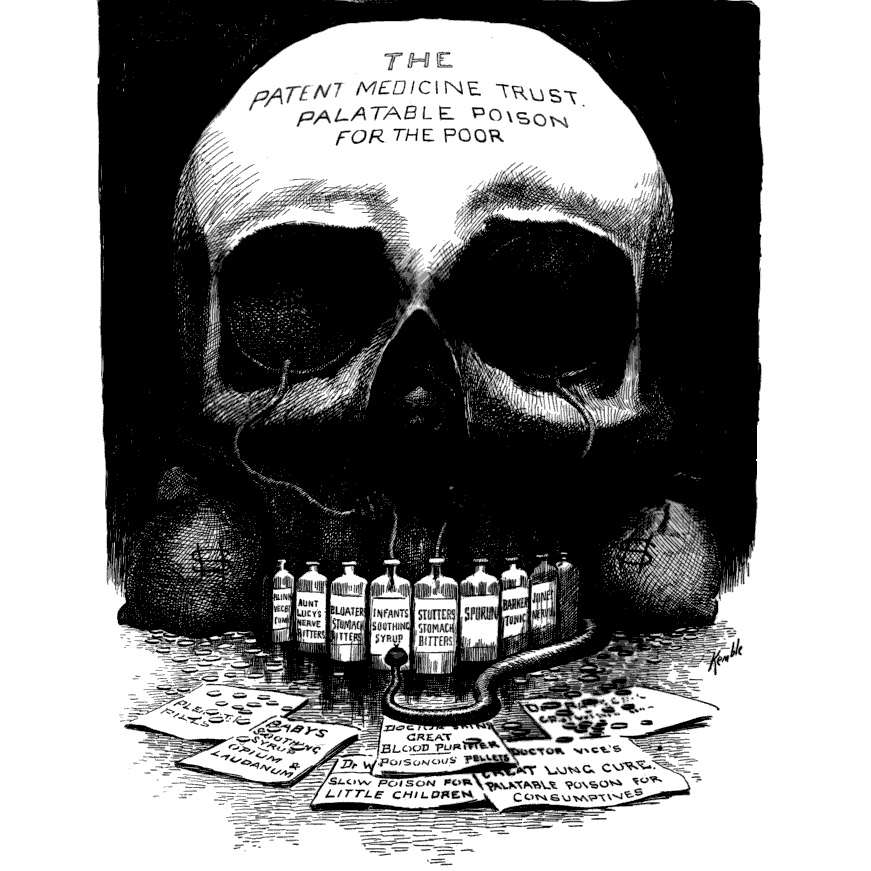
The United States is in the midst of an epidemic of addiction and overdose deaths due to opiate painkillers. Its causes are varied, but there's no question that physicians share a large part of the blame. Little discussed is that this is actually the second time this has happened. Almost a century ago, a remarkably similar epidemic struck the country. In this episode, called "The First Opiate Epidemic," I discuss what happened, the parallels to today, and the lessons we can learn from our forebearers. Learn about all this and a new #AdamAnswers in this month's Bedside Rounds, a tiny podcast about fascinating stories in clinical medicine! Sources: Courtwright DT. Dark Paradise: A History of Opiate Addiction in America. Harvard University Press, 2001. Meldrum ML, "The ongoing opiod prescription epidemic: historical context," Am J Public Health. 2016 August; 106(8): 1365–1366. Courtwright DT, "Preventing and treating narcotic addiction -- a century of federal drug control," N Engl J Med 2015; 373:2095-2097. Adams JFA, "Substitutes for opium in chronic diseases," Boston Med Surg J 1889; 121:351-356. Macht DI, "The history of opium and some of its preparations and alkaloids," JAMA. 1915;LXIV(6):477-481. Hamilton GR and Baskett TF, "In the arms of Morpheus: the development of morphine for postoperative pain relief," Can J Anesth. 2000;47:4, 367-374. Weiner JP, "A shortage of physicians or a surplus of assumptions?" Health Aff January 2002 vol. 21 no. 1 160-162. Gudbranson BA et al, Reassessing the Data on Whether a Physician Shortage Exists. JAMA. 2017;317(19):1945-1946. Kirch DG and Petelle K, Addressing the Physician Shortage: The Peril of Ignoring Demography. JAMA. 2017;317(19):1947-1948.

Summer Shorts #2 - Corrupted Blood
In 2005, a mysterious plague called Corrupted Blood hit the online denizens of World of Warcraft, ripping through cities and decimating player characters. After the smoke cleared, it became clear that this virtual plague shared many characteristics with real-world diseases and almost immediately attracted the attention of researchers. In this Summer Short, I go over the details of the in-game Corrupted Blood incident, and the very real-world epidemiological research that followed. Learn about all this and more on the latest short of Bedside Rounds, a tiny podcast about fascinating stories in clinical medicine. Sources: Bohannon J. Slaying monsters for science. Science 20 Jun 2008. Messner S. How Blizzard coped with World of Warcraft's blood plague and other early disasters. PC Gamer. Henderson M. Analysis: Absence of risk limits parallels with real life. Times Online. October 28, 2008 Oultram S. Virtual plagues and real-world pandemics: reflecting on the potential for online computer role-playing games to inform real world epidemic research. BMJ. Lofgren E, Fefferman N. The untapped potential of virtual game worlds to shed light on real world epidemics. Lancet Infect Dis 2007;9:625–9.

26 - The God Squad
The invention of dialysis -- essentially artificial kidneys for people with kidney failure -- revolutionized medicine. It also started a debate about medical rationing and ethics that rages to this day. Producer Cam Steele brings us a story about the God Squad, the group of lay people and doctors tasked with deciding who lived and who died in the early days of dialysis, and how it has informed every debate about medical rationing since. Learn about all this and more, plus a new #AdamAnswers in the latest episode of Bedside Rounds, a tiny podcast about fascinating stories in clinical medicine. Sources: Blagg CR, Development of ethical concepts in dialysis: Seattle in the 1960s. Nephrology, 1998.4, 235-238 Scheunemann L and White D, The Ethics and Reality of Rationing in Medicine, Chest, 140; 6. December 2011 White DB et al, Who should receive life support during a public health emergency? Using ethical principles to improve allocation decisions. Ann Intern Med. 2009 January 20; 150(2): 132–138. Jonson AR, The God Squad and the Origins of Transplantation Ethics and Policy, Journal of Law, Medicine, and Ethics. Levine C, The Seattle "God Committee": A Cautionary Tale; Nov 30 2009. Blagg, CR. The Early Years of Chronic Dialysis: The Seattle Contribution. Am J Nephrol 1999;19:350–354 Persad, et al. Principles for allocation of scarce medical interventions, Lancet 2009; 373: 423–31. Bryson, et al. Addiction and Substance Abuse in Anesthesiology. Anesthesiology. 2008 Nov; 109(5): 905–917. Hughes, et al. Resident Physician Substance Use, By Specialty. Am J Psychiatry 1992; 149: 1348-1354.

Summer Shorts #1 - The Eclipse
The eclipse is coming! Get out your eclipse glasses (or your camera obscura, if you didn't prepare like me), and enjoy a review of the medical literature on eclipses with our guest Dr. Avi O'Glasser in our first summer short. Beyond solar retinopathy (a very good reason to not look into the sun), are there health effects on humans? Is there anything to the widespread belief of an eclipse being a bad omen? Find out all this and more in our first Bedside Rounds Summer Short. And thanks so much to Dr. O'Glasser! References: http://www.asrs.org/patients/retinal-diseases/special-safety-edition-2017-great-american-eclipse A New Way to Look Up. Solar Retinopathy Risks and Methods of Prevention Prior to the 2015 Solar Eclipse Public health warnings of solar retinopathy risk in European newspapers prior to the 2006 solar eclipse. (http://www.oftalmo.com/seo/archivos/maquetas/C/1C6CE602-7C96-3DE8-336A-00001A483D3C/articulo.pdf) EFFECT OF ECLIPSE OF THE SUN IN 1999 ON THE PSYCHIC STATE OF PEOPLE http://www.prolekare.cz/en/general-practitioner-article/effect-of-eclipse-of-the-sun-in-1999-on-the-psychic-state-of-people-25088

Ep 2525 - Salt Water
Intravenous or IV fluids are a ubiquitous treatment in medicine, and one of the most cost-effective treatments that we have, costing less than a cup of coffee in the developing world. But it wasn't always this way. In this episode, called Salt Water, we go back to the second great cholera epidemic, where a young doctor developed IV fluids to help fight this mysterious disease, only to see his invention abandoned for over half a century. We also have a new #AdamAnswers about bloodletting. So join us for another rollicking adventure of Bedside Rounds, a tiny podcast about fascinating stories in clinical medicine! Sources: Foex B. How the cholera epidemic of 1831 resulted in a newtechnique for fluid resuscitation. Emerg Med J 2003;20:316–318. Gill G. William O'Shaughnessy and the forgotten cure for cholerain the 1832 British epidemic. Letter from Lord Cavendish: Online at: http://mssweb.nottingham.ac.uk/elearning/view-text.asp?resource=HealthHousing&ref=pwh287&theme=3&view=text&page=1 O'Shaughnessy, W.B. (1838–40). "Case of Tetanus, Cured by a Preparation of Hemp (the Cannabis indica.)". Transactions of the Medical and Physical Society of Bengal. 8: 462–469. Chan C, et al. Historical Epidemiology of the Second Cholera Pandemic: Relevance to Present Day Disease Dynamics. PLOS One: http://journals.plos.org/plosone/article?id=10.1371/journal.pone.0072498 BB4: Diary of an Epidemic. Online at: http://www.bbc.co.uk/radio4/history/longview/longview_20030415.shtml Kresta R. The Origin of IV Fluids. Discover Magazine. Online at: http://blogs.discovermagazine.com/bodyhorrors/2016/05/31/intravenous-fluids-cholera/#.WX9z4JdtmUl Prasad V and Cifu A, Medical Reversal: Why We Must Raise the Bar Before Adopting New Technologies. Yale J Biol Med. 2011 Dec; 84(4): 471–478. Further reading: r/AskHistorians thread: https://www.reddit.com/r/AskHistorians/comments/6nzbfz/if_bloodletting_was_rubbish_why_was_it_considered/ Ending Medical Reversal by Cifu and Prasad. On Amazon at: https://www.amazon.com/Ending-Medical-Reversal-Improving-Outcomes/dp/1421417723

#TipsforNewInterns and Introducing Summer Shorts (NOT AN EPISODE)
In this month's #AdamAnswers, he discusses his #TipsforNewInterns (seriously, it's trending on Twitter). And we introduce the Summer Shorts for this summer -- and discuss how you can contribute and be on the show! (#spoileralert -- Tweet me @AdamRodmanMD). This is NOT an episode! Make sure you listen to Episode 24.

24 - W56.22xA (The Making of A Disease)
What makes a disease? And who gets to decide? Producer Cam Steele brings us a story that spans migrating uteruses in ancient Egypt, a disease that makes slaves want to run away in the antebellum south, and the accidental discovery of an erection pill while trying to treat heart disease. Join us in our journey to disassemble the concept of disease in Episode 24 of Bedside Rounds, a tiny podcast about fascinating stories in clinical medicine! Sources: Bynum B. Discarded Diagnoses. The Lancet. Volume 356, No. 9241, p1615, 4 November 2000. Conrad P. The Medicalization of Society: On the Transformation of Human Conditions into Treatable Disorders. Drescher J. Out of DSM: Depathologizing Homosexuality. Behav Sci (Basel). 2015 Dec; 5(4): 565–575. Robison J. Look Me in the Eye: A Brief History of Nosology. Retrieved from: http://jerobison.blogspot.com/p/a-brief-history-of-nosology.html Shorter E. The history of nosology and the rise of the Diagnostic and Statistical Manual of Mental Disorders. Dialogues Clin Neurosci. 2015 Mar; 17(1): 59–67. Tasca C, et al. Women And Hysteria In The History Of Mental Health. Clin Pract Epidemiol Ment Health. 2012; 8: 110–119. Music credits: Sad Marimba Planet by Lee Rosevere Pookatori and Friends by Kevin MacLeod

23 - Bone Portraits
A darkened laboratory with an eerie green glow; a photograph of the bones of a woman's hand published on the front pages of newspapers throughout the globe; mysterious rays that promise to change medicine forever but also cause horrific disease in their champions and pioneers. In this episode, called Bone Portraits, I tell the story of two men -- Wilhelm Roentgen, the discoverer of x-rays who would later win a Nobel Prize, and Clarence Dally, the first victim of x-ray radiation. Listen to the thrilling conclusion of our to part series on the dawn of diagnostic imaging! We've got all this, plus a double-header #AdamAnswers, in Episode 23 of Bedside Rounds, a tiny podcast about fascinating stories in clinical medicine. Sources: Mahroo, et al. 'Dilatation' and 'dilation': trends in use on both sides of the Atlantic. Br J Ophthalmol. 2014 Jun;98(6):845-6. doi: 10.1136/bjophthalmol-2014-304986. Epub 2014 Feb 25. King, Gilbert. "Clarence Dally — The Man Who Gave Thomas Edison X-Ray Vision." Smithsonian.com, March 14, 2012. Goodman, et al. Medical Writing: A Prescription for Clarity. P37. Gagliardi, Raymond A. "Clarence Dally: An American Pioneer," American Journal of Roentgenology, November, 1991, vol. 157, no. 5, p. 922 Dunlop, Orrin. Deleterious effects of X-rays on the human body. Electrical Review 1896;29:95 Cheng, Tsung. Dilation vs. Dilatation. American Journal of Cardiology. February 15, 1994. Volume 73, Issue 5, Page 421 Brown, Percy. American martyrs to radiology. Clarence Madison Dally (1865-1904). 1936. Obrien, Frederick. In Memoriam: Percy Brown, MD. Radiology. December 1950Volume 55, Issue 6 Sansare K, et al. Early victims of X-rays: a tribute and current perception. Dentomaxillofac Radiol. 2011 Feb;40(2):123-5.

22 - The Assassination
A mortally wounded American president and the quest to find his assassin's bullet unexpectedly opened up a potentially new era of medical diagnostics in the late nineteenth century. In this episode, learn about the assassination of James Garfield and how the controversy surrounding his medical care led Alexander Graham Bell to develop an "induction balance" that could locate a piece of metal inside a human body. This is the first part of a two part series called "Sound and Light." Also included -- a new #AdamAnswers about … hiccups! All this and more in Episode 22 of Bedside Rounds! Sources: Bell AG. Upon the electrical experiments to determine the location of the bullet in the body of the late President Garfield; and upon a successful form of induction balance for the painless detection of metallic masses in the human body, Retrieved from: https://archive.org/details/uponelectricalex00bell Paulson G. Death of a president and his assassin--errors in their diagnosis and autopsies. J Hist Neurosci. 2006 Jun;15(2):77-91. Trunkey D, et al. Medical and surgical care of our four assassinated presidents. J Am Coll Surg. 2005 Dec;201(6):976-89. Epub 2005 Jun 16. Reyburn R. Clinical history of the case of James Abram Garfield. JAMA. 1894;XXII(13):460-464. Steger M et al. Systemic review: the pathogenesis and pharmacological treatment of hiccups. Aliment Pharmacol Ther. 2015 Nov;42(9):1037-50

21 - Renegades
Does medicine have a place for renegades who play by their own rules? Producer Cam Steele brings us a story about medical mavericks drinking toxic cocktails of their own creation, threading rubber tubes through their veins, and trying to disrupt entire industries, all in the attempt to change the world. Learn about all this and more, plus a new #AdamAnswers, in Episode 21 of Bedside Rounds!

20 - Buried Alive
The nineteenth century was struck by a collective panic about being buried alive, leading to a bevy of new laws, regulations, and inventions like the safety coffin. In this episode, we explore how medical science created and fueled this fear by blurring the line between life and death with the invention of new tests for death, developing life-saving technologies like rescue breathing, and even re-animating corpses. And just in case you thought the fear of premature interment was something of the past, we explore how issues raised in this panic still inform medicine today. Learn about all this, a brand new #AdamAnswers, and more in Episode 20 of Bedside Rounds, Buried Alive!

19 - Of Madness and Moons
Can the moon make you crazy? The superstition is rampant in medicine, but the idea that a full moon awakens psychiatric pathologies traces back thousands of years. In Episode 19 of Bedside Rounds, producer Cam Steele looks at evidence behind the belief and traces the origins of this cultural fossil that has managed to last until the 21st century. Learn about all this and more in Of Madness and Moons!

18 - Dr. Livingstone, I presume?
By the time that David Livingstone died on the banks of Lake Bangweulu, his name was already legend -- first, as a great explorer, becoming the first European to lay eyes on Victoria Falls and Lake Malawi, and second as a fierce advocate against the slave trade. But we often forget that he was a medical doctor, and made significant contributions to the nascent field of tropical medicine. In Episode 18 of Bedside Rounds, I recount his innovations in fighting malaria and discuss all the fun (by which I mean quite gross, and very deadly) tropical diseases that he described in his journals. Even though the phrase was almost certainly made up, you should still listen to "Dr. Livingstone, I presume?"

17 - The Iceman
In 1991, two hikers near the Austrian-Italian border discovered the 5,000 year-old mummified body of Otzi the Iceman buried in a glacier. What have we learned about medicine from the Iceman? From a fungus-based first aid kit, ancient acupuncture , analysis of paleofeces, hints about his violent demise -- and of course the good old fashioned physical exam -- the answer is more surprising than you might think. Learn more with Episode 17 of Bedside Rounds, a tiny podcast about fascinating stories in clinical medicine!

16 - Phineas
Everyone knows the story of Phineas Gage, the young man who had a tamping iron shot through his brain in a freak accident and miraculously survived, only to have extreme personality changes. But the true story is far more complex -- and more interesting. In Episode 16 of Bedside Rounds, I revisit the primary sources on Gage's injury, delve into modern research into what actually happened, and take a field trip to visit the man himself.

15 - Innumeracy
Understanding statistics has never been more important for the practice of medicine. Unfortunately, innumeracy plagues the medical field. Listen to Episode 15 of Bedside Rounds to learn more, and maybe find a way out of this statistical morass with this one weird trick...

14 - The First Trial
The Randomized Controlled Trial (RCT) is the gold standard for how we know something works in the world of medicine. But how did we get to this point? The answer involves vegetarians and orange juice, spans two thousand years, and stretches from ancient Babylon to the high seas of the British Empire and back to America. Find all these answers (and more!) in Episode 14 of Bedside Rounds -- the First Trial!

13 - The Oath
Doctors recite an oath, often the Hippocratic Oath, when they graduate medical school, swearing to serve their patients and to do no harm. The common perception is that physicians have sworn an oath for thousands of years, leading back to Hippocrates. But the origins are far more modern and buried in the greatest atrocity of the twentieth century. Learn more in Episode 13 of Bedside Rounds!

12 - P.I.M.P.
Pimping ain't easy, especially when it happens on rounds. Where did the peculiar medical tradition of "pimping" come from? How did it get its name? Is it even effective? And does it still have a place in modern medical education? Find out in Episode 12!

11 - Frank's Sign Redux
Celebrate ten episodes of Bedside Rounds with a rerecording (with new material) of the first episode, Frank's Sign! The most powerful man in the world, the Roman Emperor Hadrian, dies of a mysterious illness. Learn how the case was (sort of) cracked 2000 years later using the physical exam and just a little bit of math. If that can't get you to listen to this podcast, I don't know what will ...

10 - Car Talk
On episode 10, I discuss one of the best public radio shows of all time, Car Talk, and how it's an awesome example of clinical reasoning. I also talk a little bit about how doctors learn to think like doctors. Dedicated to Tom Magliozzi, who recently died.

9 - Laennec's Cylinder
In the beginning of a string of podcasts about sound in medicine, Bedside Rounds goes back to the beginning, with the invention of the stethoscope by Rene Laennec. How was the stethoscope invented? What are doctors listening for when they listen to their lungs? Who was Rene Laennec? Well, learn all the answers to these questions in Episode 9 of Bedside Rounds, Laennec's Cylinder!

8 - I will harm
In Episode 8 of Bedside Rounds, we explore the mysterious world of the nocebo effect, where words can literally hurt -- or kill. It's all in the mind, right?

7 - The Medicine of the Empire Strikes Back
In Episode 7, we take you to a galaxy far, far away to explore the medicine of the best Star Wars film, the Empire Strikes Back. How close are we to replicating their medical interventions? And what can Star Wars tell us about medicine back here on Earth? This is the first in (hopefully) a series of "Medicine in Science Fiction" podcasts.

6 - The Number Needed to Treat
In this episode of Bedside Rounds, we discuss how risks and benefits are communicated by scientists and physicians, and why those numbers you see in advertisements and newspapers might not be the clearest way to express risk.

5 - Beachside Rounds
In Episode 5, I present Beachside Rounds, a fun activity for the whole family this summer, and a brief introduction into interesting physical exam findings.
4 - Happy Birthday
In Episode 4, I wish a hearty 202nd birthday to the New England Journal of Medicine, and look at how much things have changed over the centuries by looking at the 1912 and 1812 editions. #spoileralert: the answer is a LOT

3 - Dark Winter
In episode 3 of Bedside Rounds, I talk about the human triumph of small pox vaccination, and discuss the government exercise called Dark Winter which simulated a bioterrorism attack on the United States.

2 - Full Code
In episode 2 of Bedside Rounds (though still technically untitled), I talk some about the myths and realities of cardiopulmonary resuscitation (CPR) in the hospital, and how the media influences how doctors and patients approach these important conversations.

1 - Frank's Sign
A re-recording of the very first episode of Bedside Rounds! Learn how we can use the physical exam to help solve the mysterious, 2000 year-old death of the Roman Emperor Hadrian! Learn about how biostatistics are used in every day clinical medicine! Start at the very beginning -- with Frank's Sign!