Cyberfeminism, Xenofeminism, & The Cyborg Manifesto
Based Camp | Simone & Malcolm Collins · Based Camp | Simone & Malcolm
Audio is streamed directly from the publisher (api.substack.com) as published in their RSS feed. Play Podcasts does not host this file. Rights-holders can request removal through the copyright & takedown page.
Show Notes
In this episode, Simone and Malcolm Collins dive deep into Donna Haraway’s 1985 “A Cyborg Manifesto” — a text Grimes called “one of the greatest things ever written” and a foundational (yet strangely forgotten) work that sparked cyberfeminism, xenofeminism, and black cyberfeminism.Why have so few people actually read the essay that’s cited more than almost any other in feminist theory and science & technology studies? How did a response to a socialist-feminist call during the Reagan era become a poetic, blasphemous celebration of blurred boundaries — human/machine, male/female, organism/technology — and a rejection of rigid identity politics?We explore:1. The Cyborg as a metaphor for post-gender, post-origin-story politics2. Haraway’s call for “affinity” coalitions over essentialist identities3. How the manifesto was twisted into new identity-based feminisms (cyberfeminism → xenofeminism → black cyberfeminism)4. Why the original text feels closer to pronatalist, post-identity futurism than to modern progressive frameworks5. The Santa Cruz / Bay Area cultural context that birthed this fever-dream masterpiece6“ Terra Nationalism,” 7. Post-cyberfeminism vs. xenofeminism.If you love Grimes, transhumanism, feminist theory, online culture, or just wild 1980s philosophy that predicted our AI-saturated present — this episode is for you.🔗 Full text of A Cyborg Manifesto: https://web.archive.org/web/20120214194015/http://www.stanford.edu/dept/HPS/Haraway/CyborgManifesto.html
Episode Outline
* I saw a post on X by Grimes recently in which she refers to A Cyborg Manifesto as “one of the greatest things ever written.”
* She added: “What’s crazy abt cyborg manifesto is even if you pretend it has nothing to do with feminism it’s still a masterpiece of general philosophy and is filled with banger poetry”
* So I checked it out
* Because she is also the person who turned me on to Iain Banks’ Culture series and it changed the way I view AI and the future of humanity
* And the rabbit hole commenced
* It turns out “A Cyborg Manifesto”—originally published in 1985—is so well known in certain academic circles, it is almost never discussed as it’s assumed to be such tacit knowledge
* As @ALilInternet puts it: “Its seen as a kinda cliche reference in academic contexts or lectures, because it’s assumed everyone has already read it, which is prob why u don’t encounter it — I think in general it’s a shame with this happens to important works, because young ppl etc might NOT know it.”
* It is considered to be one of the most influential essays in feminist theory, science and technology studies (STS), and posthumanities.
* And it is one of the most cited essays in the humanities and social sciences worldwide.
* Basically, it:
* Argues that the cyborg—a hybrid of machine and organism—is a powerful metaphor for breaking down rigid boundaries: human/animal, organism/machine, physical/non-physical, male/female, nature/culture.
* Rejects essentialist identity politics and traditional socialist-feminism in favor of “affinity politics” (coalitions based on shared interests rather than fixed identities).
* Embraces irony, partiality, and blasphemy against origin stories (both religious and secular).
* Key quotes that are endlessly repeated:
* “I would rather be a cyborg than a goddess.”
* “The cyborg is a creature in a post-gender world; it has no truck with bisexuality, pre-oedipal symbiosis, unalienated labor, or other seductions to organic wholeness.”
* “We are all chimeras, theorized and fabricated hybrids of machine and organism.”
* And this manifesto gave birth to cyberfeminism, which gave birth to xenofeminism, and both sound SUPER intriguing, so I thought we’d dig in!
A Cyborg Manifesto
A Cyborg Manifesto: Science, Technology, and Socialist-Feminism in the Late Twentieth Century By Donna Haraway
Context
Who is this woman?
* UC Santa Cruz professor, which, if you know Santa Cruz, explains everything.
* To me personally, Santa Cruz epitomizes a culture:
* Unmoored from history and origin stories (you’ve got modern and historical transplants of people who repeatedly rejected—and importantly, forgotten—the cultures of their homeland)
* E.g. From Germany to Ireland to New York to Chicago to California, losing culture with each move)
* Very crunchy
* Steeped in tech and normalized to its cutting-edge development
* Born in 1944 in Denver, Colorado
* As of 2025, she is Emerita Distinguished Professor of the History of Consciousness and Feminist Studies at the University of California, Santa Cruz (UCSC)
* Looks like a typical Santa Cruz lady
* Trained in biology (PhD in Biology from Yale, 1972), zoology, and philosophy.
* Deeply influenced by Marxist feminism, science fiction (especially authors like Joanna Russ, Samuel Delany, and Octavia Butler), Catholic symbolism (she grew up Irish-Catholic), and post-structuralism.
Why did she write this?
* The essay originated in response to a 1983 call from the Socialist Review (a West Coast leftist journal) asking feminists to reflect on the future of socialist feminism amid Ronald Reagan’s presidency, the rise of the New Right, the decline of traditional leftist movements in the US, and escalating Cold War tensions (including the Strategic Defense Initiative, or “Star Wars” program).
* Haraway aimed to revitalize socialist-feminism by addressing what she called the “informatics of domination”—how new technologies of communication, control, and production were reshaping power, labor, gender, and identity in ways that older feminist frameworks couldn’t fully grasp.
* So basically a Marxist publication wanted feminists to butthurt about conservatives, and instead she like… went off the reservation and it was glorious
* Like, instead of “Reagan wants me to become a housewife and spoonfeed jellybeans to my husband!” she’s like “LET’S BECOME CYBORGS AND FORM SPECIAL GROUPS AROUND OUR AUTISTIC SPECIAL INTERESTS!”
What’s the context in which she wrote this?
* It’s the 1980s
* It’s the Silicon Valley Bay Area
* Biotech and personal computing are beginning an insane upswing
* There’s a crisis on the Left as 1960s and 1970s social movements are fragmenting
* Second-wave feminism (emerging in the early 1960s, peaking in the 1970s):
* Often called the women’s liberation movement, it grew out of experiences in civil rights and anti-war activism. By the early 1980s, it fractured due to the “feminist sex wars” (debates over pornography, sexuality, and power), critiques of white/middle-class dominance excluding women of color and lesbians, and splits between liberal, radical, and socialist branches. Haraway explicitly critiqued how taxonomies of feminism policed “official women’s experience,” leading to endless splitting.
* The New Left (1960s–early 1970s):
* A broad student- and youth-driven movement encompassing anti-Vietnam War protests, free speech campaigns (e.g., at Berkeley), and demands for participatory democracy. It declined sharply after events like the 1970 Kent State shootings and the war’s end in 1975, fragmenting into sectarian groups or identity-focused politics. Many activists moved into feminism or other causes, but the overarching “New Left” coherence dissolved.
* Civil Rights/Black Liberation Movement (1950s–1970s):
* The nonviolent phase (e.g., led by MLK, SCLC, SNCC) transitioned in the late 1960s to Black Power (e.g., Black Panthers), emphasizing racial separatism and pride. By the 1980s, internal divisions (e.g., over integration vs. nationalism) and external repression (COINTELPRO) contributed to fragmentation, with some energy shifting to local community organizing or cultural expressions.
How is it framed by academics today?
They frame it as a canonized but contested classic
* It’s required reading in women’s/gender studies, Science and Technology Studies, media studies, literary theory, philosophy, anthropology, and art theory.
* It’s often paired with Judith Butler’s *Gender Trouble* (1990) as one of the twin pillars of 1990s “anti-essentialist” or “poststructuralist” feminism.
They present multiple, sometimes contradictory interpretations
* Posthumanist and transhumanist readings (e.g., Rosi Braidotti, Cary Wolfe, N. Katherine Hayles) celebrate it as an early manifesto for leaving the human behind.
* Critical race and decolonial scholars (e.g., Chela Sandoval, Jasbir Puar, Zakiyyah Iman Jackson) both use and criticize it for its relative silence on race and colonialism (Haraway herself later acknowledged this limitation).
* Disability studies scholars are divided: some see the cyborg as ableist, others (e.g., Alison Kafer) reclaim it.
* Marxist and materialist feminists (e.g., Sophie Lewis, Laboria Cuboniks/Xenofeminism) treat it as a key accelerationist or cyberfeminist resource.
It is framed as the origin text of Cyberfeminism and Xenofeminism
* It’s widely credited with launching 1990s cyberfeminism (VNS Matrix’s “Cyberfeminist Manifesto for the 21st Century,” Sadie Plant, Faith Wilding, Old Boys Network, etc.).
* Xenofeminism (Laboria Cuboniks, 2015) explicitly builds on it.
It inspired shifts and course adjustments in various fields:
* Feminist theory: It shifted feminism away from “women’s experience” or biological essentialism toward constructivist, coalition-based, “affinity” politics (“We do not need a totality in order to work together”).
* Posthumanism and critical animal studies: One of the earliest and most poetic arguments that the boundary between human and nonhuman is politically constructed and historically contingent.
* Queer and trans theory: Prefigured non-binary and fluid understandings of identity (even though Haraway herself was not writing from an explicitly LGBT perspective in 1985).
The Text
Its chapters provide a peek:
An Ironic Dream of a Common Language for Women in the Integrated Circuit
The ‘Homework Economy’ Outside ‘The Home’
Women in The Integrated Circuit
Cyborgs: A Myth of Political Identity
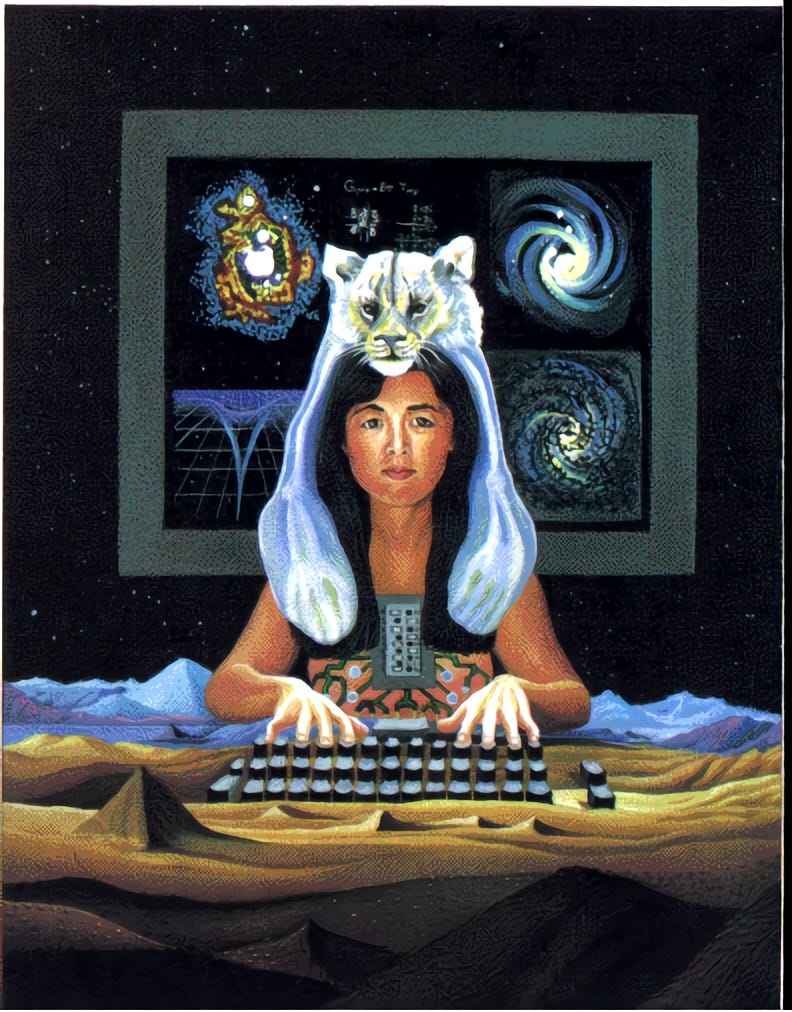
Also, right off the bat, it starts with this… illustration.
The picture: A woman sits in space with her back to a framed grid displaying galaxies, mathematical equations, and a 3D digital map, wearing a white, glowing, tiger cub on her head with its arms draped over her shoulders, arm bones glowing through its ectoplasmic flesh. On her chest cits a circuit breaker from which green lines emanate, terminating in blue nodes. Her fingers lay on typewriter keys set atop the diorama of an Egyptian desert, complete with pyramids in the foreground and a blue mountain range in the background. Her face strikingly resembles that of Neil from the movie The Santa Clause but she has the coloring and long dark hair of perhaps an indigenous American woman.
WAT.
* The text argues that in the late twentieth century, humans have become “cyborgs”: hybrids of organism and machine whose identities, bodies, and politics are shaped by information technologies and global capitalism.
* The cyborg is proposed as a mythic, political figure that rejects fixed essences (like “woman” or “nature”) and instead embraces partial, fractured, and coalition-based identities to build new forms of socialist-feminist politics.
* Haraway claims that advanced capitalism has shifted from an “organic” industrial order to an “informatics of domination,” where everything is understood as information, coding, and systems.
* In this world, boundaries between body and machine blur, control operates through communication and data flows, and women are deeply integrated and exploited within global circuits of production and reproduction.
* It almost feels as though the concept of women is shoehorned into this simply because the prompt from the Socialist Review explicitly asked for feminist reflections and it would have been rejected if she didn’t talk about women explicitly as a distinct class
* Communications technologies and biotechnologies are seen as tools that both enforce domination and open new possibilities for resistance.
* Haraway urges feminists to appropriate the cyborg figure to imagine non-natural, non-totalizing political unities—alliances based on affinity and shared projects rather than on a supposedly universal female nature.
* And I’m reading this as: “Can we just get over feminism please?” (and identity politics in general)
Analysis
* Haraway calls for “pleasure in the confusion of boundaries and for responsibility in their construction” and I love that—it also hints to a strong move away from identity politics. Like: Who cares if you’re a man or a woman or whatever; just do your thing.
* She’s kind of arguing for 4chan before 4chan
* No identity, just ideas and affinity groups
* Capable of organizing in order to do hilarious and wondrous things
* I like this but also therefore am amused that people invoke its name in the creation of new identity groups (rather than affinity groups, which is what the manifesto calls for)
So then why or how could the manifesto give birth to new forms of feminism at all??? What are cyberfeminism and xenofeminism???? Let’s find out.
Cyberfeminism
Cyberfeminism is a strand of feminist thought and activism that focuses on the relationship between gender and digital technologies, especially the internet and networked media. It looks at how technology can both reinforce existing power structures and be used to challenge patriarchy and create new possibilities for identity, embodiment, and political action.
* It treats cyberspace and information technologies not as neutral or inherently male domains, but as contested terrains where gender, race, and power are negotiated.
* This seems to run directly counter to Haraway’s Manifesto, which argues against both origin stories and identity politics
* Cyberfeminists aim to understand and intervene in how technologies are designed, who controls them, and how they shape everyday life, from work and surveillance to sexuality and social connection. They also explore how online platforms can support resistance, networked activism, and alternative forms of identity and community that disrupt rigid gender norms.
* In practice, cyberfeminism has included digital art, hacking and code-based interventions, online collectives, and analyses of social media movements such as hashtag campaigns against harassment and gender-based violence.
* PLEASE tell me that cyberfeminism was not behind #metoo
* Update [oh god no]: Scholars and commentators now often cite #MeToo as a major example of “digital feminist activism” or cyberfeminist practice, because it relies on networked platforms to amplify women’s voices and build transnational solidarity.
* Research and teaching under the label often examine topics like online abuse, AI bias, platform labor, pornography, gaming cultures, and the politics of data through a feminist lens.
* PLEASE tell me that cyberfeminism was not behind gamer gate
HOW DID THEY GET IT SO WRONG?
But wait, there’s more: Relation to other feminisms
Historically, cyberfeminism is usually linked to third-wave feminism, extending earlier struggles over rights and representation into digital environments. More recent currents, such as xenofeminism and Black cyberfeminism, build on and critique earlier cyberfeminist work by centering intersectionality, queerness, and global inequalities in how technologies are built and used.
EXCUSE ME WHILE I DIE ON THE INSIDE
Black Cyberfeminism
Early cyberfeminism often focused on utopian possibilities of the internet for gender subversion but was criticized for centering white, Western perspectives and overlooking race.
Black Cyberfeminism arose in the 2010s as a corrective, addressing how racial prejudices persist online and how Black women navigate, resist, and reshape digital spaces. It draws from Black feminist traditions (e.g., intersectionality from Kimberlé Crenshaw) and afrofuturism, recognizing that technology is not neutral but shaped by structural racism and patriarchy.
Black Cyberfeminism is described as an intersectional framework that extends cyberfeminism and Black feminist thought into digital spaces, emphasizing how race, gender, technology, and power intersect in online environments. It critiques the ways Black women and marginalized communities experience persistent oppression in cyberspace—such as misogynoir (anti-Black misogyny), algorithmic bias, and exclusion—while highlighting their agency, resistance, and cultural production through digital tools.
So basically Donna Haraway was like: Forget identity politics! Let’s use tech to forge a new path forward that’s better for everyone!
And Black Cyberfeminists were like: “SCREW YOU WHAT ABOUT MY IDENTITY I AM OPPRESSED”
Xenofeminism
Xenofeminism emerged in the 2010s around the manifesto “Xenofeminism: A Politics for Alienation” by the collective Laboria Cuboniks. It presents itself as a techno-materialist feminism that treats digital networks, biotech, and other technologies as tools that can be re-engineered to undermine patriarchy, capitalism, racism, and other entrenched hierarchies rather than as inherently oppressive.
Xenofeminism rejects biological determinism, insisting that gender roles and many so‑called “natural” differences are social constructs that can be reconfigured. It is also “gender abolitionist” in the sense of wanting a society where traits currently grouped under gender no longer map onto unequal power relations, while still allowing a proliferation of diverse, fluid gender identities.
* OK, this sounds broadly OK. Just… forget about gender. Screw gender. If biological sex limits you or if you have a problem with it, engineer a solution.
A distinctive feature is its embrace of “alienation”: instead of romanticizing the natural or the immediate, xenofeminism sees estrangement from given norms as a condition for constructing new, more just worlds. It also argues for a reworked, intersectional universalism that can include all who are currently othered—across gender, race, class, and species—rather than focusing on narrow identity categories.
* You could argue our family has very much embraced this approach with technopuritanism and advanced reprotec
Relation to other feminisms
Xenofeminism critiques strands of feminism that are suspicious of technology or that tie politics too closely to fixed identities. It builds on cyberfeminism and transfeminism but pushes further toward systematic use of science, rational planning, and global-scale infrastructures to dismantle gendered and other structural inequalities.
I think, therefore, this means I’ve found my feminism, though I’m wary of this alleged interest in dismantling structural inequalities, because it implies an ultimate desire for homogenization.
What is the Takeaway?
Donna Haraway realized that biotech and the internet could render gender wars and even identity politics, which are ultimately not very productive obsolete.
Some people found this inspiring
Others decided they preferred to cling to gender wars and identity politics.
It’s kind of clear which group is winning.
At least for now
If you look at people like C and like us… we’re above replacement in kids. Leaders in identity politics arguably don’t have very many kids. So perhaps there’s hope!
Episode TranscriptSimone Collins: [00:00:00] Hello Malcolm. I’m excited to be with you today because I just discovered cyber feminism and black cyber feminism and xeno feminism, and these are terms I had never heard before and they all apparently stem from this foundational text, which is so foundational that people have forgotten to mention it in academic context.
And so everyone thinks that everyone knows it, but they don’t know it. And so now there’s just, it’s like almost becoming this like forgotten Rosetta stone of like modern feminist ideology because it is lost and, and people have just forgotten to mention it and, and explain what it is. And this is just crazy.
Why have you read this? Well, it all started with a post on X by Grimes, as so many things do, right? Yeah. In, in, in, in this post, she refers to a Cyborg manifesto, this foundational text as quote, one of the [00:01:00] greatest things ever written. She added, what’s crazy about Cyborg Manifesto is even if you pretend it has nothing to do with feminism, it is still a masterpiece of general philosophy and is filled with banger poetry.
And so I checked it out because she’s also the person who turned me onto Ian Banks’ culture series, and it changed the way I view AI in the future of humanity. So like. I don’t know. She, she has a good track record of, of introducing like, really good ideas. And I actually, this is really funny because she, she has like a lot of like Marxist and socialist and, and Comy followers who are like hard line leftists who just really like, obviously her music and her musical style, but then also her philosophy in general is like really inspiring.
But then they get really mad because, ‘cause she had a kid with the bad man. And they, it just like, they, they’re so, they really struggle with it because she, she’s just, you can’t stay away from her even if you want to hate her. ‘cause she has so many great ideas. Although we, we never did hate her and we love her because she’s amazing.
Yeah. Friend of the show Anyway, though it turns out that a Cyborg Manifesto, which [00:02:00] was originally published in 1985, like I said, is so well known in academic circles. It’s almost never discussed as it’s assumed to be tacit knowledge. As at. A little internet puts it on x in the thread that, that that Grimes posted.
It’s seen as kind of cliche reference in academic context or lectures because it’s assumed everyone has already read it, which is probably why you don’t encounter it. I think in general it’s a shame with this when this happens to important works because young people, et cetera, might not know it. And I think that’s the case.
‘cause I don’t know, like I took philosophy classes. I, I, I, I was not, you know, I, I took a lot of uni classes that were more on like the humanities or social studies, like end of the spectrum. And this is actually like a foundational required reading in a lot of academic contexts. Like it is actually considered to be one of the most influential essays in feminist theory and science and technology studies and post humanities.
And I have a master’s in technology policy. Like I just, [00:03:00] how have I never heard of this? And it’s also just one of the most cited essays in the humanities and social sciences worldwide. But have you heard of this before?
Malcolm Collins: I have never heard of this. No. But I I, I have a feeling as like the urban monoculture emerged, there have been a number of pivotal works to it.
Like I’ve talked about the ones that mond’s dad wrote, right? Oh, yeah. Yeah. On like how the world can be devised into like colonizers and victims. Yes, yes. And the victims need to over, and it was going through these works that helped me better understand the way they actually see the world. Yeah.
And you’re like, wait, I realize, I was like, oh, now this makes sense and this makes sense. Like now colonial narrative,
Simone Collins: like where did that come from? And we should have thought, like when people are talking about colonizers and decolonization, that there was some kind of foundational text, but we didn’t think to like.
Go into it.
Malcolm Collins: Yeah. Yeah. I think when you get into these foundational texts, you can be like, oh, this is where all this, and I only hope that was the next social movement that comes along. [00:04:00] Based camp is seen as one of the foundational texts, so of our essays and stuff. Oh, no. Like, no,
Simone Collins: the, the tracks, the techno puritan tracks the track.
Malcolm Collins: Attracts. Anyway, we, I have like three more written that we haven’t done yet. I know.
Simone Collins: We, well, maybe we can, we can work on those over, over this, this sort of winter break that we have with the kids. Yeah. But so back to the Cyborg Manifesto. This particular foundational text, basically like the gist if you don’t wanna listen to this whole episode, argues that the cyborg, a hybrid of machine and organism is a powerful metaphor for breaking down rigid boundaries like human versus animal, or organism versus machine or physical versus non-physical, male female nature culture.
And it rejects essentialist identity politics and traditional socialist feminism in favor of affinity politics like coalitions based around shared interest. Rather than fixed identities. And it also embraces irony impartiality and blasphemy against [00:05:00] origin stories, both religious and secular, which is really interesting.
And then some key quotes that are endlessly repeated from this are, I would rather be a cyborg than a goddess. And the cyborg is a creature in a post gender world that has no truck with bisexuality, pre edible symbiosis, un alienated labor, or other seductions to organic wholeness. Also, we are all Kyra theorized in fabricated hybrids of machine and organism.
Just, God. This sounds like it was
Malcolm Collins: actually written in like a fever dream. Like
Simone Collins: I honestly, like, I’m gonna go into the origin stories of this and you’re gonna, like, everything’s gonna fall in place. Trust me. It sounds like
Malcolm Collins: one of our female listeners wrote this. This is like not that dissimilar from what ‘cause our female listeners are
Simone Collins: freaking awesome.
I love this, but no, trust me when I get into the origins, this is, it will all be explained. But this, this manifesto gave birth to cyber feminism, which gave birth to Xeno feminism and black cyber feminism. [00:06:00] And when I heard about that in, in the thread where Grimes brought this up in the first place, I was like.
Okay. This is so intriguing. We have to dig in. So we’re gonna start with the Cyborg manifesto and then, you know, explain to you so that you are an informed citizen of the world, what the, this manifesto, this foundational text is about, because people forgotten to explain this. Rosetta Stone of culture and philosophy, and also Cy feminism, Xeno feminism and black feminism Cyber.
Oh, Xeno
Malcolm Collins: Feminism and black cyber feminism. Black cyber feminism. Yeah. So, hold on. But you, and you liked Xeno feminism, which I think our audience is gonna have a problem with because those Xenos need to be burned in their dance.
Speaker 4: Guys, what if the bad guy.
Malcolm Collins: No, I think,
Simone Collins: no, you’ll see [00:07:00] Xeno Feminism is my feminism. I’ve decided, no, hold
Malcolm Collins: on.
Actually, I’m gonna, I’m gonna make an argument and actually we should do a separate episode on this because I think it’s a great idea and I just had it. Okay. Yeah. The concept of globalist nationalism. Or what’s a better way to say it? I call it tarn nationalism.
Simone Collins: Tarn nationalism.
Malcolm Collins: So Tarn nationalism is what you see in something like star strip troopers.
Oh, yeah. Where you have this idea of we as humans are great. I love humanity. I love the species, and the other is aliens or machines or something like that. Right. And in our fab, I have one of, one of my favorite, oh
Simone Collins: yeah. Current empire is one of the, the contents,
Malcolm Collins: the preset or the sons of man where, you know, it’s, it’s humanity and all the things that, that have come from our species, whether it’s AI and, and for
Simone Collins: context.
In, in reality fabricator that the ai like narrative engine and, and chatbot platform that Malcolm has built with, with Bruno friend of [00:08:00] the pod Bruno is. You, you can go through, like, if you don’t wanna sort of create your own prompts for stories or characters these amazing menus that Malcolm has created, where like you can choose the settings and the tropes.
Like, do you want, is Kai do you want vampires? Do you want like this kind of dynamic, like a power dynamic or whatever? And like Yeah. One of the settings is is Terra Empire. Oh. What? It’s like some other weird settings you have in there. Like, like, like aro Can space communism.
Malcolm Collins: What my favorite game to play is Tarn Empire versus Gay Space Communism.
Yeah. Oh yeah.
Simone Collins: Gay space communism. Yeah, yeah, yeah, yeah, yeah. So like, it’s, it’s, it’s fun. It’s, but anyway,
Malcolm Collins: yeah, because I think this idea of like Tarn Nash. Anyway, I’ll, I’ll get to it. I continue. Yeah.
Simone Collins: Let me, let me cook. Okay. Okay. So Cyborg Manifesto, because the people must be informed. So the full title of it is a Cyborg Manifesto Science Technology and Socialist Feminism in the late 20th century.
Donna Haraway. So who is this woman? Who is Donna? What is this fever dream of this poetic [00:09:00] banger poetry masterpiece that Grimes loves and that, that so many people love? Alright, well let’s, let’s start with it. And now I think you’re gonna see how, why and how this all makes sense and, and if not, I will explain to you because a little bit of cultural and locational context is needed.
So Donna Haraway, sorry, Donna Haraway is a uc Santa Cruz professor, which if, you know, Santa Cruz explains everything instantly she was on
drugs.
No, it’s, it’s more than that. So, so to me personally, and I think anyone who knows Santa Cruz will probably agree with me. Santa Cruz epitomizes a culture that is unmoored from history and origin stories, which is kind of a, a core point of her manifesto here of like origin stories.
Like get rid of them. No. Like what are we even, and anyway and, and here’s the thing is, is. In, in Santa Cruz, especially in California in general, you’ve got modern and historical transplants of people [00:10:00] who repeatedly rejected and importantly forgot the cultures of their homeland. So consider my family’s history by way of California, like twice over.
I mean, because different, you know, branches, but like one branch moved from like Norway to Germany, to Ireland, to New York, to Chicago, to California, and then multiple locations in California. Every time they’re getting up and moving, they’re kind of reinventing themselves and kind of intentionally unmooring themselves from their, in historical inherited cultures and roots and past.
They’re like, they’re not trying to bring it with them. Like I think that the Collins family is different. Like your family seems to have really clung to a very strong sense of Yeah, we lived in the same Marriot
Malcolm Collins: for seven generations, so my
Simone Collins: family like very intentionally. Like laundered its self and identity in California as a place in America.
People need to understand like, you know, we’ve talked about the [00:11:00] role of these foundational cultures, like the Scotts Irish versus the Quakers versus the Cavaliers. What we haven’t really talked about is the, the way that certain behavioral bottlenecks have played in, in forming some, some types of Californian culture and Bay area culture is and that that is to say San Francisco, Silicon Valley Bay area culture is uniquely one of people who have really intentionally kind of a flash bake to themselves so many times that they’ve forgotten where they’ve come from.
And that makes them a very interesting kind of cultural blank slate that is exactly the kind of cultural blank slate that would produce. This manifesto. So I just, I just wanna, but what makes Santa Cruz unique, even within this ecosystem of people who have like warped and, and, and completely cleaned away multiple times, laundered their, their culture and identity is, it’s also, it it is crunchy.
Very crunchy. We’re talking like, you [00:12:00] know, you’re wearing socks under Birkenstocks while walking through the redwood forests and then surfing in the morning, et cetera, right? Like, it’s, it, it’s the uc, San Santa Cruz where this woman teach taught and is now an emeritus professor teach, she, she teach she, it, it’s just, it’s, it’s this beautiful university campus that’s just embedded within a road forest with like some partial views of the ocean.
Like it’s very naturey. And very crunchy. Yeah. Okay. Yeah. Like, yes, there are drugs, but like, not in like a way that people are associated, like typically think of drugs. It’s more just like. Part of life. It’s not a thing you do, it’s, it’s the air you breathe. I don’t know how else to put it, you know?
It’s just like, so of course your life is gonna be colored by a strange daze. And even if you literally don’t do any drugs, which I never did as a kid, like I still had a very trippy childhood, if that makes sense. Yeah. So that, this is just some context. Okay. So she was born in 1944 in Denver, Colorado.
And then, you know, sort of herself, you know, [00:13:00] laundered her identity further. ‘cause Denver was already the kind of place that, you know, selected for people who are really running away from their past. You know, it’s like minors and other people who are like very high risk and just like, forget everything that I came from, I’m gonna rebuild.
And then she came to California as of 2025. Like I said, she, she’s not an active professor anymore. She’s an emerita distinguished professor. Of the history of consciousness and feminist studies at the University of California, Santa Cruz, UCSC. She looks very much like a Santa Cruz lady. I had, I I, I spent a lot of time in Santa Cruz as a kid because my grandparents and I, I, and, and aunt and cousin were there and, and were, we, we spent tons of, like, all my holidays were there.
But what’s interesting about her is she trained in biology. She has a PhD in biology from Yale and zoology and philosophy. So she’s kind of like you. And I think this is, you can kind of see, I think some of the most interesting thinkers philosophically have backgrounds in biology like you, like her because they’re able to think in a cross disciplinary [00:14:00] fashion that’s really that challenges a lot of the really trite norms.
And that is genuinely novel because when people have backgrounds in, in philosophy and then they contribute to philosophy, they’re really just kind of. Copying and pasting with slightly different words, you know? Yeah. Where it’s like someone with biology is gonna come in and be like, well I like, based on the way that like DNA double helixes work.
You know, like, I think that, you know what? I did not have a background in biology. I’m sorry. But she, she was also deeply influenced by Marxist feminism and science fiction and Catholic symbolism. ‘Cause she grew up I Irish Catholic and post-structuralism. So you just got like the perfect storm of a good manifesto in there.
And so yeah, we also need to think about the content. Of this piece, because I think a lot of people are like, well, this is amazing, like great poetry. Like, but no, like we have to, she it just to quote one Kamala Harris, or, you know, paraphrase, it didn’t just fall out of a, a coconut tree. You have to consider it within the [00:15:00] context of the world in which it exists.
So the essay originated in response to a 1983 call from the Socialist Review, which is a west coast leftist journal asking feminists to reflect on the future of socialist feminism amid Ronald Reagan’s presidency and the rise of the new right and the decline of traditional leftist movement in the US and escalating Cold War tensions, including the Strategic Defense Initiative or Star Wars program and, and Harway aimed to revitalize.
Socialist feminism by addressing what she called the informatics of domination. How new technologies of communication and control and production, which is really what, you know, anyone in Silicon Valley, which is roughly where Sanford Santa Cruz is, is experiencing, we’re reshaping power and labor and gender in, in identities, in ways that older feminist frameworks just couldn’t grasp.
And so she basically, what happened though, like, just to break it down for you, a Marxist publication wanted feminists to butt hurt about conservatives and [00:16:00] instead she like. Went off the reservation and it was glorious. Like instead of Reagan wants me to become a housewife and spoonfeed jelly beans to my husband, she’s like,
let’s become cyborgs and farm special groups around our artistic specialist, our autistic special interests.
I’m just like, yes.
Malcolm Collins: Go lady. She’s invited to the picnic. I know. She is. She is 100% like my, this is why we get along so well with Grimes. Yes. Because she’s into this shop. She gets
Simone Collins: it. She gets it. I’m like, the problem, and actually I feel, oh, crap. I’m realizing now like you’re gonna see the whole arc I have for this episode and for the, and for the Cyborg Manifesto.
The, the CUF that it undergoes is the same CUF of Grimes. And you’re gonna see why.
Malcolm Collins: Okay, go. No, I mean, I’m already seeing why it, it feels like Grimes wrote this to be honest.
Simone Collins: No, but also like the way it played out and was interpreted and was [00:17:00] appropriated is also like the same struggle and unfair treatment that Grimes has undergone.
Yeah. So, yeah. So, just so, so people understand ‘cause not a lot of our, more than half our audience is outside the us I just wanna make it clear the context of this. It’s the eighties when this was written. It was it was written one year before Malcolm was born, two year, two years before I was born.
This is the Silicon Valley Bay area at the very beginning of this period of biotech and personal computing, just having an insane upswing. And these are the first people who are smelling it. These are the canaries in the coal mine who are like, oh God. Like the whole world is about to change. And there’s this crisis also at the same time, on the left.
As the 1960s and seventies, social movements are beginning to fragment. So for example, second wave feminism, which emerged in the 1960s and peaked in the seventies was, was starting to falter it. It was often called the, the Women’s Liberation Movement as well, if that’s how you’ve heard of it more.
It grew out of [00:18:00] experiences in civil rights and anti-war activism. And, and then by the eighties, it fractured due to what people call the feminist sex wars, which were debates over pornography and sexuality and power. And there were also critiques of white middle class dominance, excluding women of color and lesbians.
And there were splits between liberal and radical and socialist branches. And, and in her, in her piece, in her manifesto, Haraway explicitly critiqued how taxonomies of feminism policed official women’s experience leading to endless splitting. Like she really, really, really hated identity politics. Unfortunately they’ve won. Right. But so the, also another, another movement that was sort of falling apart, and this is one thing that the, the socialist magazine that prompted this essay wanted to see addressed was the new left. Which was this broad student in youth driven movement encompassing in the anti-Vietnam war protests and free speech campaigns like at Berkeley.
Like, my dad went to those protests.
Malcolm Collins: No, my dad went to those too. He was, he was well known. It’s something they bonded
Simone Collins: over is so sweet. He,
Malcolm Collins: he, my dad went in [00:19:00] a would, would go in a suit to those protests. Everybody thought he was like the guy in a suit, the very posh guy at the anti-war first. That’s true.
My
Simone Collins: dad’s like vandalizing, et cetera. And your dad’s starting up. But it’s funny
Malcolm Collins: that he really wanted to go to the war in the beginning. Oh, I
Simone Collins: know. And that’s so funny that you, oh my gosh, your dad’s the only reason
Malcolm Collins: for people to know my dad actually got out of the war by being too eager to go into the war.
Yeah. Which is he applied really early in the war process. Like before they needed a draft or anything like that. Mm-hmm. So they were actually still incredibly selective with who they were taking. And, this was to during like the ROTC and stuff, but he had a, a, a, a medical issue tied to his leg.
His knees.
Simone Collins: He said they were rice Krispy knees or something. They snapped, crackled and posh. Well,
Malcolm Collins: he, he got them broken playing lacrosse as a kid. And oh, freaking
Simone Collins: posh.
Malcolm Collins: Can you be, I have to posh right? It broke
Simone Collins: my legs and
Malcolm Collins: lacrosse and I go to
Simone Collins: my protest
Malcolm Collins: to go. He tried to go super early into the war while they’re still being really picky and apparently he got like a permanent band from being able to outta the war.
Perma [00:20:00] band from war. Poor, poor baby. Oh,
Simone Collins: oh my god. No. No. But like truly honorable. I mean, I also appreciate that my dad was out there, you know, vandalizing stuff too. Very toasty. Yeah, now I know where he gets it. Anyway, but then, like basically after, there were a lot of clampdowns on these protests and like there were the Ken State shootings and then the, the Vietnam War ended in 1975 and the, the whole movement kind of fragmented into a bunch of sectarian groups and identity based politics again.
And then of course, then there was the Civil Rights and Black Liberation Movement in the fifties to the seventies, which also fell apart in the eighties. Because it sort of transitioned in the late 1960s into black power like the Black Panthers, and it emphasized racial separatism and pride. And by the eighties there were all these internal divisions over integration versus nationalism and, and external oppression contributed to a more fragmentation.
And it was, it just sort of [00:21:00] became like messy. So. How is this piece framed by academics today? Well, they frame it as a canonized, but contested classic, which is telling, because it’s required reading in women’s gender studies and science and technology studies and media studies and literary theory and philosophy and anthropology and art theory.
It, it’s often paired with Judith Butler’s gender trouble, which I’ve also never read. But it’s considered one of the twin pillars of 1990s anti-essentialist or post-structuralist feminism works. And it, it has like a lot of sort of contradictory interpretations. There are lots of post humanist and transhumanist readings, and they celebrated as this early manifesto for leaving humanity behind.
Mm-hmm. And then there’s some critical race and, and decolonial scholars who both use and criticize it for its relative silence on race and colonialism. But here’s where worlds collide, right? You’re talking about Mom Donny’s dad. And here we have the, you know, decolonial scholars being [00:22:00] like, well, well, I don’t like that she doesn’t talk about identity politics in her anti identity politics manifesto.
But it, again, it like, like I sort of going back to the, the premise of this, it is framed as the origin text of cyber feminism and xeno feminism which really rose in the nineties, sort of five years after this was originally published. Okay. We published again in 1991, and then it sort of picked up from there.
And it has genuinely inspired shifts and course adjustments in various fields. Like in feminist theory, it shifted feminism away from women’s experience or biological essentialism toward constructivist, coalition based affinity politics. Like we don’t need a totality in order to work together from posthumanism and and critical animal studies.
It was one of the earliest and most poetic arguments. That the boundary between human and non-human is politically constructed and historically contingent. And then when it comes to queer and trans theory, this also really played a foundational role because it prefigure the, [00:23:00] the sort of concept of being non-binary and fluid in, in terms of your understanding of identity.
Interesting. And, and, and to be clear, Haraway was not herself writing from a an LGBT perspective in 1985, but it, it would be obvious why people who were gender fluid would see what she’s talking about and be like, oh, this can apply to me. Like they, and, and, and I think this is where a lot of people may kind of misunderstand.
Like grime stance vis-a-vis like trans and everything. It’s not about identity politics. I think it more rhymes with I’m not gonna put words in her mouth though, but like, I just feel like she, she more has the, the, this manifesto in her heart than like any particular, like, I like this group, I like this group.
Let’s all do identity. But anyway, let’s, let’s talk about the actual text, which is fascinating. I’m not gonna go into it because it’s, it’s long and poetic and a little convoluted, but the chapters provide a peak, right? So here are the chapters of it. [00:24:00] One first chapter, an ironic dream of a common language for women in the integrated circuit.
And then fractured identities, and then the informatics of domination, and then the homework economy outside the home, and then women in the integrated circuit. And then cyborgs a myth of political identity. Then there’s bibliography, but I have to say it’s starts. Oh God. It starts with this illustration that it’s like, part of me was like, I, I just opened the video.
Are you sitting it to me? Okay. Yeah. Well, I’ll send you a link. And I will describe it for those who are listening audio only. So don’t worry. My, my description is gonna be highly accurate. So Malcolm, actually, I’m gonna have you listen to, you can tell me how accurate I am and then, and then the audience can either feel comforted or not.
But I’m just gonna, I’m gonna give my best here. So, oh God. It, it is a picture of a woman who’s sitting in space with her back to a framed grid displaying galaxies and mathematical [00:25:00] equations at a 3D digital map. She is on her head wearing a white, a white. I’m gonna send it, but you get to hear my description first because you can tell the listeners how accurate I am on her head.
She’s wearing a white glowing tiger cub, and its arms are draped over her shoulders with its arm bones glowing through its ectoplasmic flesh in on her chest. Sits a circuit breaker with green lines emanating from it. And, and they sort of terminate blue nodes and then her fingers are lying on what looked like typewriter keys.
Maybe like super old school computer keys. Set the top. T