
Barbarians at the Gate
Barbarians at the Gate
Show overview
Barbarians at the Gate has been publishing since 2016, and across the 10 years since has built a catalogue of 185 episodes. That works out to roughly 120 hours of audio in total. Releases follow a monthly cadence.
Episodes typically run thirty-five to sixty minutes — most land between 37 min and 47 min — and the run-time is fairly consistent across the catalogue. It is catalogued as a EN-language History show.
The show is actively publishing — the most recent episode landed 2 days ago, with 18 episodes already out so far this year. The busiest year was 2022, with 41 episodes published.
From the publisher
A semi-serious deep dive into Chinese history and culture broadcast from Beijing and hosted by Jeremiah Jenne and David Moser.
Latest Episodes
View all 185 episodesYou Must Remember This: Studying in China yesterday, today, and...tomorrow?
Chairmen, China, and the Tricky Translations of Political Terms in the PRC
Mao More Than Ever
The Last Emperor of China with author Paul French
Somerset Maugham's On a Chinese Screen: Missionaries, Taipans, and Expats Who Never Leave (but probably should)
Barbarian Remix: The Secrets and History behind Beijing's Forbidden City
Neysun Mahboubi on the past, present, and future of US-China Academic Exchanges
AI Slop, AI Detectors, and Authentic Voice: A China-Tech Insider on Writing and Working With AI
China Books Review x Barbarians at the Gate: The Private Life of Chairman Mao
This Was Funnier in China: Jesse Appell's Cross-Cultural Comedy Journey
The Business of Burgers in Beijing: What Fast Food Festivals Reveal About China's Economy
Barbarians Remix: Do you really need to learn to write characters to study Chinese?
The Many Lives of Da Shan: Mark Rowswell on Chinese Poetry, Performing Live, and Staging Shawshank in Mandarin
In this episode, we reconnect with an old friend of the podcast, Canadian performer Mark Rowswell—better known in China as Dashan, or “Big Mountain.” Mark reflects on his early career in China, where his remarkable fluency in Mandarin launched him from a young foreign newcomer into the world of xiangsheng (相声, crosstalk), and soon after into a highly sought-after TV host and cultural ambassador bridging East and West. He also shares insights into his latest creative project: a series of online videos featuring his recitations of classic Chinese poetry. What began during the pandemic with a relatively obscure Chu Ci (楚辞) poem that went viral has since grown to include well-known works by Li Bai and Su Shi, with Mark’s fresh approach—eschewing the traditional, formal style of langsong (朗诵) in favor of a more natural, conversational delivery—quickly gaining a wide audience. Over time, the project has grown increasingly ambitious, incorporating longer poems and rich musical collaborations, including performances with the Toronto and Winnipeg Symphony Orchestras. Finally, Mark offers a fascinating behind-the-scenes look at his role in adapting The Shawshank Redemption into a Chinese-language stage production performed by an all-foreign cast. He discusses recruiting Mandarin-speaking actors, translating and culturally adapting the script, and the production’s warm reception among Chinese audiences.
Lee Moore's China Backstory: Why Saying "History Proves" Actually Means "I Haven't Done the Reading"
ELee Moore's new book challenges both Chinese state propaganda and Western pundits on Taiwan, Xinjiang, the Chinese economy, and Hong Kong with 1400 endnotes, and a drinking game for beheadings. A historian who writes about Ming emperors getting stabbed in the balls, a drinking game for beheadings in Xinjiang, and why almost everything politicians say about Taiwan’s history is wrong. In this episode, we talk with Lee Moore about China’s Backstory: The History Beijing Doesn’t Want You to Read. It is often said that China is the most talked-about country that Americans know the least about. Lee’s book seeks to enlighten readers with a fresh perspective and a deep dive into four China-related topics that frequently appear in American media: Taiwan, Xinjiang, the Chinese economy, and Hong Kong. Despite his academic credentials, Lee has chosen to write the book in an accessible style that Jeremiah characterizes as “making the complex simple and the simple complex — complicating narratives without complicating the language, and simplifying complicated histories without dumbing them down.” With this lively and occasionally risqué prose style (one chapter is entitled “The Most Important Motherfucker in Taiwanese History”), Lee challenges the simplistic historical narratives that often dominate both Chinese state propaganda and Western commentary on China. Our conversation explores several of the historical questions raised in his book. Was Taiwan always a part of China? It did not even appear on Chinese maps until the 17th century, and the Qing Dynasty did not take control of the island until a year after William Penn founded Philadelphia. Were the Uyghurs the first inhabitants of Xinjiang? The answer is complicated, but the region’s earliest known inhabitants may actually have been Indo-European. And is the Chinese Communist Party’s tight state control over the economy really the “secret sauce” behind China’s rise? Lee takes direct aim at Western pundits who have argued exactly that. Lee also explains how he makes extensive use of Chinese poetry — from Tang Dynasty border verse to Qing-era colonial writing — translated into colloquial English, to convey the emotions and states of mind of the historical figures who populate his book. Lee Moore has a PhD in Chinese literature. He is the founder of the Chinese Literature Podcast and has written for The Economist, the China Books Review, and The China Project. China’s Backstory: The History Beijing Doesn’t Want You to Read is available from Unsung Voices Books wherever books are sold. Find the Chinese Literature Podcast wherever you get your podcasts. Warning/Advertisement: This episode contains explicit language.
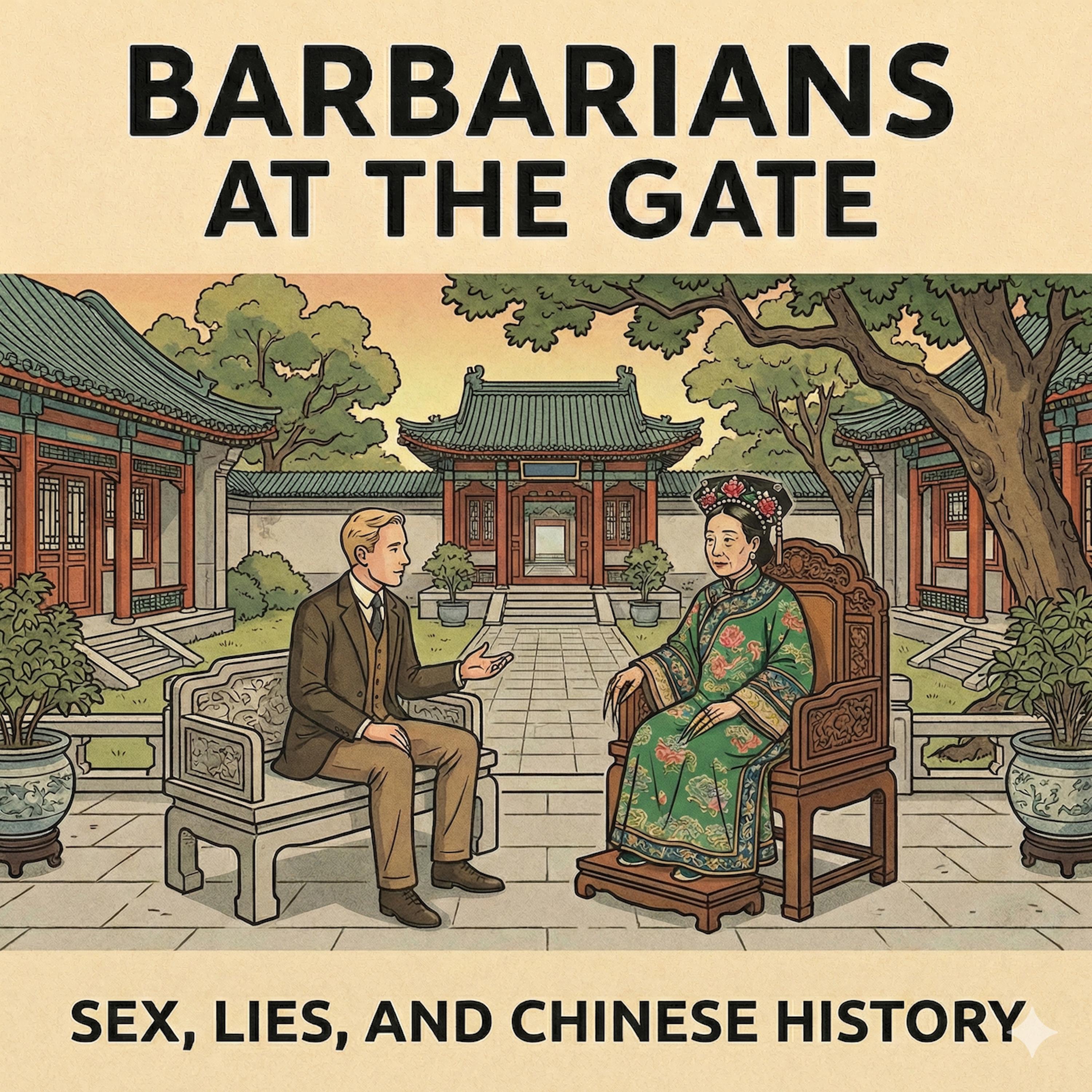
Décadence Mandchoue: The wild (and almost certainly fictional) affair between Sir Edmund Backhouse and Empress Dowager Cixi
EIt’s another Barbarians at the Gate crossover with China Books Review. This month’s China Archives column covers Decadence Mandchoue by Edmund Backhouse, edited and annotated by Derek Sandhaus. CBR Associate Editor Alexander Boyd and I sat down to talk about all things Backhouse and try to parse one of Sinology’s more controversial memoirs. Backhouse was the son of a British baronet who dropped out of Oxford, fled to Beijing in 1898, and spent the next four decades as a fixer, translator, and professional eccentric in the hutongs. He was also a forger, a fabulist, possibly a fascist sympathizer, and the author of what may be the most explicit expat China memoir ever written. His central claim: an extended sexual relationship with Empress Dowager Cixi. His central problem: almost nobody believed him. And there’s a good reason. He almost certainly invented the whole thing.The real question isn’t whether Backhouse was making stuff up. He was. A lot. The question is whether this gifted fabulist, writing from inside (or at least adjacent to) the world he’s fabricating, can still tell us something real about the fall of the Qing Dynasty. Join us as we explore the decadent world of sex, lies, and power during one of the most tumultuous periods of Chinese history.
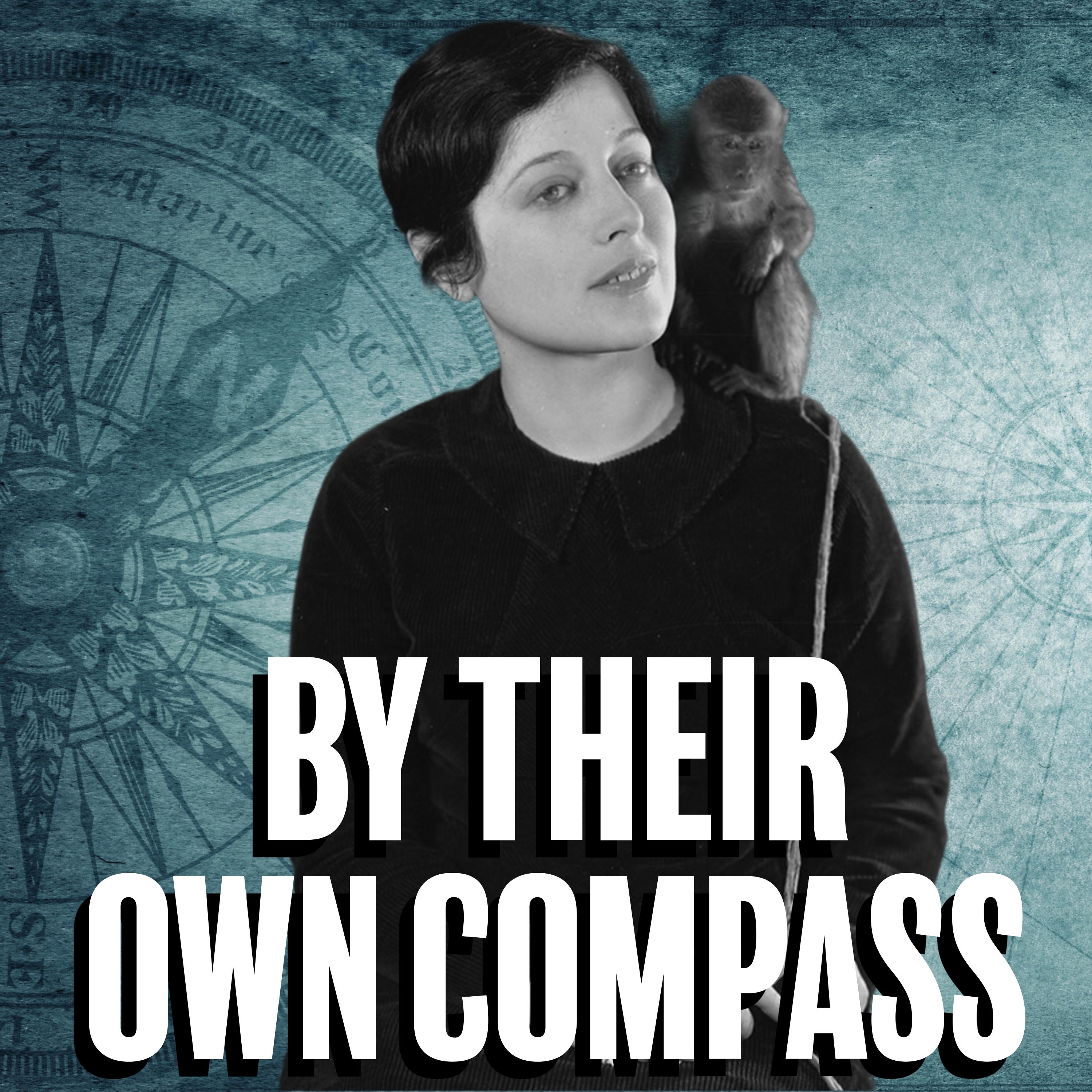
Barbarians at the Gate x By Their Own Compass: Emily Hahn's Shanghai
Welcome to a special episode of Barbarians at the Gate. David and Jeremiah are off this week preparing for Chinese New Year, but as a special gift to our listeners, we are cross-posting this bonus episode about the life and China travels of the American writer Emily "Mickey" Hahn. This episode is from By Their Own Compass, a podcast looking at historical travelers and past journeys co-hosted by Jeremiah with travel expert Sarah Keenlyside.Emily Hahn partied with poets (and her pet gibbon) at Shanghai soirees. Wrote biographies while dodging bombs in wartime Chongqing, and did her best to keep herself and her family alive in Japanese-occupied Hong Kong. Along the way, she became famous (some might add “notorious”) for her affairs, including with Chinese writer Sinmay Zau (Shao Xunmei 邵洵美) and the head of British intelligence in Hong Kong, Charles Boxer.Mickey lived through some of China’s most tumultuous moments. While many foreigners experienced these events, Mickey gave her readers an unvarnished look at what was happening, with a style all her own.We hope you enjoy this special bonus episode. Follow By Their Own Compass at bytheirowncompass.com or search for By Their Own Compass on Apple Podcasts, Spotify, or where you get your podcasts.Links: Books referenced in the episodeChina to Me by Emily HahnNobody Said Not To Go by Ken Cuthbertson (biography of Emily Hahn)I Wonder as I Wander: An Autobiographical Journey by Langston HughesThe Soong Sisters by Emily HahnTours & Resources:Historic Shanghai - walking tours (Patrick Cranley and Tina Kanagarathnam)Further Reading:Her Lotus Year: China, the Roaring Twenties, and the Making of Wallis Simpson by Paul FrenchHong Kong Holiday by Emily HahnNo Hurry to Get Home: A Memoir by Emily HahnMr Pan by Emily Hahn
Lost in Thailand: The New Chinese Diaspora from Bangkok to Addis Ababa
It’s high season in Thailand. The weather is perfect. But look around the hotel lobbies and the night markets, and you’ll notice something missing: the tour buses. For the last decade, Thailand bet the house on Chinese mass tourism. Now, that wager is looking shaky. The numbers are down, and the reasons go deeper than just a sluggish post-COVID economy. On this episode, David dials in from Addis Ababa and we are joined by travel writer Thomas Bird (author of Harmony Express), global strategist Yajun Zhang to try and figure out where everyone went and where Chinese travelers are going next. We look at the "scam center" panic that’s terrifying parents on WeChat, the shift from package tours to solo travel, and why a new generation of Chinese tourists might be skipping Bangkok for Singapore. Plus, we look at how the Chinese diaspora is changing the sound of the region—literally. From the streets of Bangkok to the markets of Addis Ababa, is Mandarin replacing English as the default second language of the Global South? In this episode: The Hangover: Thailand’s pivot from GI R&R spot to Chinese holiday destination—and the current crash. The Fear Factor: How viral stories about kidnappings and scam compounds are killing the vibe for mainland travelers. The New Traveler: Why the "flag-following" tour groups are being replaced by digital nomads and independent explorers. Diaspora Voices: Comparing the Chinese communities in Southeast Asia with the newer waves arriving in Africa.
Perilous Prognostications for China in 2026 with Yajun Zhang
Following a tumultuous 2025, we gallop into the Year of the Horse. Tradition says it should be a year of dynamism and progress, but which way is the stampede heading? To help us read the tea leaves, we welcome back our occasional co-host, Zhang Yajun. As a global strategist and former innovation lead at the World Economic Forum, Yajun has spent over 16 years translating complex shifts—from AI to cultural narratives—for international audiences. She joins us to look past the headlines and offer a reality check on where China’s policies, social fabric, and daily life are actually going in 2026. Topics include: The Student Exodus: After American student numbers hit historic lows, can China lure them back? Is the "China Dream" for foreign talent dead, or can the country overcome deep-seated geopolitical friction to become a destination for career-building again? The AI Reality Check: Beyond the state-level hype, how is Artificial Intelligence reshaping the rhythm of the street? We look at how aggressive government promotion of the sector is filtering down to everyday life. The Death of the Dining Room: The delivery apps are winning. As take-out replaces the communal table, restaurants are closing at an alarming rate. Are we witnessing the end of China’s boisterous, public food culture? Character Amnesia: As digital input methods proliferate, muscle memory is fading. With fewer people able to write by hand, will the Ministry of Education double down on rote discipline, or is the era of handwritten Chinese officially over? Yajun Zhang, Global Strategy & Innovation Leader | AI & XR for Policy | East–West Connector LinkedIn: https://www.linkedin.com/in/yajun-zhang-strategist/ YouTube: https://www.youtube.com/@yajun_zhang Substack: https://yajunzhang.substack.com/
Barbarians Remix: Horse Racing, History, and the Final Champion's Day in Old Shanghai
Champions Day in the city of Shanghai, November 1941. The world was at war, but the clubhouse at the Shanghai Race Club (now People's Park) was packed with owners and punters cheering on the pony. The funeral of Shanghai's richest widow, Liza Hardoon, was a spectacle that filled the streets of the International Settlement. Japanese occupiers and their Chinese collaborators came together in a bizarre ritual to celebrate the birthday of revolutionary leader Sun Yat-sen. The opening of a new movie featuring, of all subjects, Charlie Chan had folks lining up at the local cinema box office. The world had changed, but the "Lone Island" of Shanghai persisted, as it had since becoming a treaty port a century earlier. In this encore episode from 2020, historian James Carter joins us to discuss his fascinating book Champions Day: The End of Old Shanghai. Carter brings to life the vivid tableau of an era coming to an end. By the end of the year, Japanese authorities would take control of Shanghai and the city would never again be the same. What did the end of the colonial era mean for Shanghai and its residents? Why were race tracks such powerful symbols? Join us as we discuss the history of horse racing, colonialism, and the last days of Old Shanghai.
The Dowager and the Dynasty: How did Empress Dowager Cixi rule China and should we blame her for bringing down an empire?
How does a teenage girl from Beijing’s hutongs end up ruling the world’s largest empire—without ever technically sitting on the throne? In this episode, Jeremiah traces the improbable ascent of Empress Dowager Cixi, who entered the Forbidden City as a minor concubine and departed as the most powerful woman in Chinese history. The story begins in imperial catastrophe: the Xianfeng Emperor dies in the wake of the humiliating looting of the Summer Palace, leaving behind a four-year-old son and a power vacuum waiting to be filled. Cixi, her fellow empress dowager Ci’an, and Prince Gong move quickly to take control, using the child emperor as both symbol and shield. Jeremiah explains the peculiar constitutional fiction known as “ruling from behind the curtain” (垂帘听政), a political maneuver that allowed Cixi and Ci’an to steer the empire while officially remaining in the shadows. When Cixi’s own son, the Tongzhi Emperor, dies at eighteen, she executes another audacious maneuver—installing her young nephew, the Guangxu Emperor, ensuring that the throne remains occupied by someone conveniently underage. For a brief period—one hundred days, to be exact—Guangxu confers with intellectuals like Kang Youwei and Liang Qichao, planning an ambitious series of bureaucratic and military reforms. Cixi, unconvinced that constitutional monarchy and radical modernization were viable at the time, pulls the plug. Jeremiah and David examine the mystery surrounding the death of Zhenfei, the Pearl Concubine, as well as the lingering question of whether the Guangxu Emperor was poisoned by his aunt. Finally, we weigh the verdict of history: was Cixi a ruthless “Dragon Lady” who strangled China’s chances at modernity—or a pragmatic, formidable ruler judged by a double standard?