Aphantasia: How to Remember More Without Mental Pictures
Anthony Metivier's Magnetic Memory Method Podcast
Audio is streamed directly from the publisher (traffic.libsyn.com) as published in their RSS feed. Play Podcasts does not host this file. Rights-holders can request removal through the copyright & takedown page.
Show Notes
 Aphantasia.
Sounds like a magic word a magician would say before conjuring a rabbit from his hat, doesn’t it?
But let me ask you this:
Can you visualize the magician pulling out the rabbit by his ears?
For most of us, it will be easy to recall images inside our heads, using our mind’s eye.
However, if you could NOT see any image in your mind’s eye – no colors, no sounds, no smells, no textures, no flavors, nothing at all – you may have a condition called aphantasia or a blind mental eye.
Don’t freak out, though. Many people have aphantasia, even magicians.
Familiar with Penn Jillette (of Penn and Teller fame)?

He is a famous magician and entertainer, and, he is an aphantasic(!). This was according to his own words on his Sunday School podcast, Episode 174.
By his own admission, Penn says he cannot conjure a mental image of a person or a place to save his life.
Back when I was in university, both as a student and later as a professor at 3 different universities, I also couldn’t “see” images in my mind. But after learning what you’re about to discover on this page, everything changed for me.
What Is Aphantasia? A Detailed Definition
The term ‘aphantasia’ comes from the Greek words a, meaning “without”, and phantasia, meaning “a capacity to form mental images”.
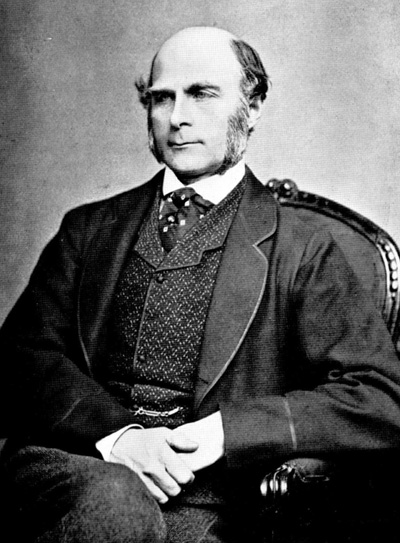
The phenomenon was first described by the controversial psychologist Francis Galton – one of the pioneers of eugenics – in 1880.
The interest in the phenomenon was renewed after the publication of a study conducted by a team led by Dr. Adam Zeman, a professor of cognitive and behavioral neurology, at the University of Exeter.
Zeman’s team published a paper in 2015 on what they termed “congenital aphantasia”, now known simply as aphantasia.
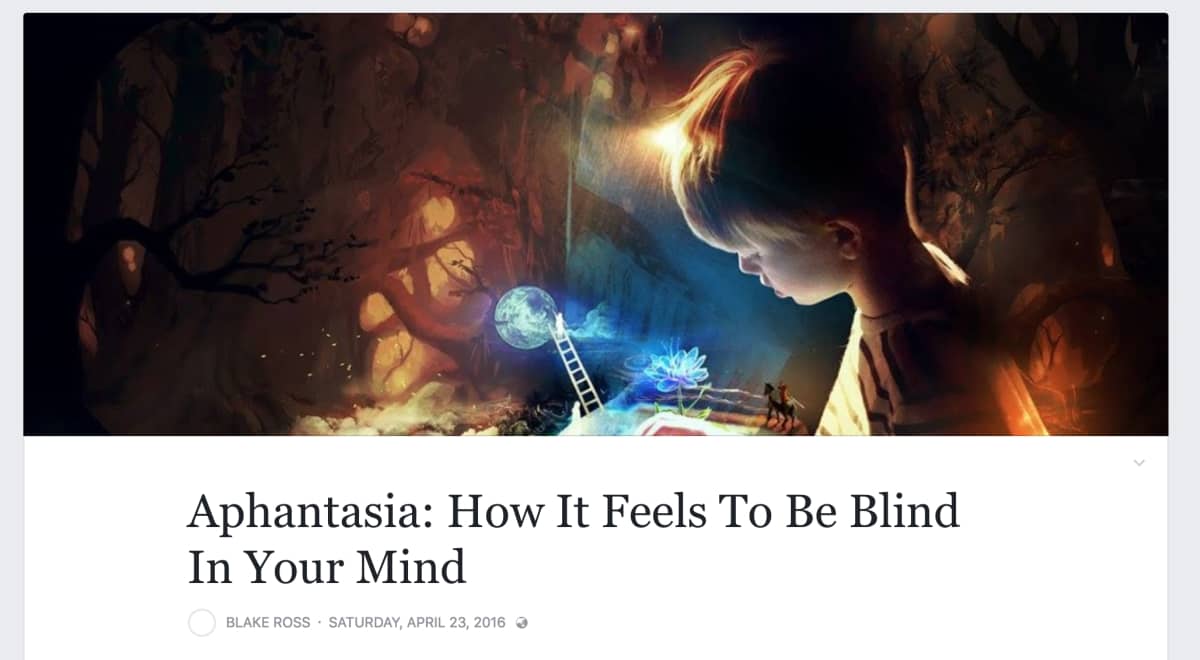
For Firefox co-creator Blake Ross it was a surprise revelation that other people could visualize things in the mind’s eye while he couldn’t. “I can’t ‘see’ my father’s face or a bouncing blue ball, my childhood bedroom or the run I went on ten minutes ago,” he wrote in a Facebook post.
According to Craig Venter, the biologist who created the first synthetic organism: “It’s like having a computer store the information, but you don’t have a screen attached to the computer.”
One of the main scientists researching aphantasia is Adam Zeman. He simply calls it living without imagery.
When I was a kid, they told me I had something quite similar. But back then my teachers called it “Imagination Deficit Disorder.”
But are these really the best possible terms and definitions for aphantasia? And what about the mental imagery you experience when you dream?
Can You Dream With Aphantasia?
It depends on what you mean by “dreaming”.
For example, I just told you about Gerrard. He’s never seen Mt. Everest, and yet he’s climbed it. He had to have a dream to do it.
Some people with this condition do report that they dream. Others say they don’t. But even people without this condition also report they don’t recall their dreams.
The only way to really know is take it case by case and visit a dream lab.
Personally, I dream very vividly, but not particularly visually. I never see faces when I dream, for example. Strangely, I tend not to see technology either, such as cellphones or computers.
I know this because I have journaled my dreams for many years. I made them more “visual” over time by placing them in writing so I could cross-index the dreams, chart patterns and observe the workings of this mind at rest.
What About Lucid Dreaming with Aphantasia?
Some people with aphantasia also report that they can lucid dream. I’ve had similar experiences, and the sensations all culminate as physical, rarely visual.
For example, when I go lucid, I often find myself piloting a spacecraft, balancing on a tight wire or even levitating as I write in my dream journal.
And my regular experience of finding myself journaling when I go lucid suggests a trick you can use:
By keeping a journal consistently, you’re likely to start dreaming about it. When it appears in your dreams, you may become aware that you’re dreaming. It’s quite wild!
Also, you can think verbally throughout the day about your dreams. You don’t have to approach them from a visual angle at all in order to explore the wonderful world of dreaming as an aphantasic.
The Role of Daydreaming
Then there’s the question of daydreaming.
I often think conceptually when daydreaming, and have also wondered about my ability to read fast and retain what I’m reading.
Could it be that the kind of reading-assisted “daydreams” I experience while going through novels without visualizing saves mental energy?
One point to consider is raised by Stephen King in On Writing: A Memoir of the Craft.
He basically says that he stopped putting much time into visually describing characters because his readers weren’t following his instructions anyway.
I think this point provides a major clue.
Because I couldn’t visualize the characters at all, my brain just skips over those parts of the story. Possibly to save energy, but the larger point is that all kinds of readers engage books on their own terms.
When King learned that about his audience, he himself started focusing differently on the construction of the daydreams he shares through the creation of fiction.
How Common Is Aphantasia?
How many people have aphantasia? While research on the subject is still in its nascent stages, neurologists believe approximately one in 50 people or 2-5% of the population are non-visual-imagers.
Sounds like a big number?
Don’t be surprised. Being an aphantasic is nearly as common as having a food allergy.
Neuroimaging has shown something surprising.
Mental imagery, although strongly associated with the left temporal lobe, requires the use of large networks of brain pathways.
This finding suggests that aphantasia could potentially occur in different ways in different individuals. It also suggests that there is likely an aphantasia cure, or at least a path to developing partial imagery.
The Three Likely Causes Of Aphantasia
However, the exact cause of aphantasia is still unknown. Even an exact definition remains elusive.
Nonetheless, according to Dr. Zeman, heredity and environment both are likely to be relevant causes.
Zeman has also speculated that aphantasia could result from brain lesions as well. Tther suggestions that have been floated around include:
- Congenital causes
- Environmental influences
- Brain lesions (especially in the hippocampus)
- Neurological differences
- Traumatic brain injury
- Stroke
- Psychological trauma
- Neurodegenerative disease
- Medication side-effects
- Different types of thinking
Interestingly, an aphantasic may have strong visual memory. They may be able to describe in detail about how things looked – the cat had blue eyes, the umbrella was pink and matched the skirt – even though they cannot see these visual images in their mind’s eye.
Moreover, many people who cannot form mental images can think in sounds, while others can remember physical sensations.
Penn says, when he dreams, he’s not sure if he sees visual images but has the sensation of knowing that “ideas wash over me”.
How Aphantasia Affects Memory
Our brain stores information in at least two different ways: verbally and visually.
Both these types of storage are independent of one another, and each can be used alone.
Therefore, even people with aphantasia can complete the “tests of visual imagery” without too much difficulty. They can also often (but not always) complete these non-visual sensory memory exercises.
Here’s a quick test:
Count the number of windows in your house.
Quick #memory improvement exercise: Mentally count all the windows in your home.Click To TweetEven if you can’t see a “mental” image of your house and locate each window in that image, you would have an awareness of being there and recall from factual information the number of windows in your house.
While aphantasics can remember things from their past, they experience these memories in a different way than someone with strong imagery. They often describe memories as a conceptual list of things that occurred rather than a video playing in their mind.
As Ross says, he can ruminate on the “concept” of a beach, but cannot flash to beaches he has visited.
“I know there’s sand. I know there’s water. I know there’s a sun, maybe a lifeguard. I know facts about beaches. I know a beach when I see it, and I can do verbal gymnastics with the word itself…But I have no visual, audio, emotional or otherwise sensory experience.”
The brain has many unique ways of storing visual information than just as a picture.
Here’s your key takeaway:
Even without mental imagery, you can remember and reason just as effectively by using verbal, spatial, and conceptual cues.
Multiple Ways To Create Visual Imagery In Your Mind
Neuroscientists believe that the brain constructs visual imagery in more than one way. There are separate circuits for things like shape, size, color and spatial relationships, and when these are accessed together, we form an image of a memory.
As AphantasiaMeow and I suggest in these videos, it might have to do with how the brains of some people develop:
https://www.youtube.com/watch?v=LA0ZUj7Wtmc&lc
https://www.youtube.com/watch?v=k0F9gOgGOqc
There are still a lot of unknowns, that’s for sure. But it’s great that someone is doing such good work to help people create a mind’s eye.
Back to the source of the problem:
Experts think that aphantasics piggyback on neurons involved in controlling physical movements rather than using the visual brain circuitry to “visualize” or recall information.
For instance, you can trace the letter B of the alphabet in your brain to know it has curves or you can use your mind’s eye to see its image.
Does Aphantasia Hamper “Visualization” Memory Techniques?
Not in the least.
Tansel Ali and I talked about your multiple options in a recent interview.
And I have written at length about how easy it is to use the Memory Palace technique without visualization.
In sum:
Memory techniques involve more tools than just visualization. You have many options, including not visualizing at all.
Memory techniques involve more tools than just visualization. You have many #mnemonic options.Click To TweetWhen you use a memory technique like the Memory Palace use all the Magnetic Modes, you can memorize a very large amount of information relatively quickly without necessarily seeing the Memory Palace in your mind.
Here’s an infographic that tells you all about the different ways that your brain perceives information:
 Personally, I don’t have aphantasia.
However, I am low on the visual threshold.
As a result, it took me a long time to understand techniques like mind mapping, let alone developing mind map mastery (which is still a work in progress, to be honest).
Most of what I do in the world of memory techniques involves thinking about strange combinations of images in words and sounds, not high-definition imagery. I would call this being audio-conceptual.
So, if you are worried that the inability to see visual images in your mind will stop you from using the Memory Palace technique…
Don’t be. Just follow the steps I teach in this complete guide to using the Memory Palace technique.
Over the years, I’ve invested in myself so that I can “see” something like visuals in my mind.
But even to this day, the best results I get from memory techniques don’t require constant streaming of high-definition images in my head. I’m not trying to develop eidetic memory, after all. I just want to remember more.
Here’s my discussion on this issue:
https://youtu.be/2l1DJXZyHmM
In any case, if you want to visualize bright, vivid pictures in your mind’s eye, you can try image streaming.
Image Streaming Vs. Aphantasia?
Image streaming is a simple process that enables you to open up your mind’s eye to visuals.
Here’s how it works:
- Close your eyes and describe what you see.
- If you don’t see anything (which would exactly be the case if you have aphantasia) help your brain start seeing visual images.
- Start by gently rubbing your closed eyes like a sleepy child. Then describe the bright sparkly light that you see behind your closed retina.
- Or look at a bright light like a candle for a half minute, or a window which has strong light/dark contrast. Then when you close your eyes, you should be able to see after-images, like a blob of light or color, at back of the eye. Describe that blob of light.
- You can also describe a memory that you cannot “see” but remember from the past.
- The important thing is to use all senses to describe your blob of light or memory: sight (vision), hearing (audition), taste (gustation), smell (olfaction), and touch (somatosensation).
- While you are examining and describing your after-images or visual memory events, keep a look out for experiencing some other kinds of image. It could be a momentary face, landscape, or whatever. Notice when this happens, and switch to describing that new image.
- Remember to describe all images to an external focus – quickly and loudly. The external focus can be a friend or a dictaphone (voice recorder), anything or anyone you can talk to.
- Practice image streaming for only 10-20 minutes a day to enable your mind’s eye to see pictures. Then move on and try these multi-sensory brain exercises.
Frequently Asked Questions About Aphantasia and Memory
I’ve received hundreds of questions about aphantasia over the fifteen years I’ve been publishing books and courses about memory improvement.
This livestream about aphantasia and and memory I held on YouTube has hundreds of comments as well.
For your convenience, let me condense the most common questions and answers for you to read at a glance.
Can people with aphantasia visualize anything at all?
Some people report that they experience faint outlines, colors or concepts of images without seeing them vividly.
I’ve sometimes experienced what I describe as “ghostly outlines.”
But mostly, when I close my eyes, I only see darkness.
Does aphantasia affect memory or intelligence?
No. In fact, many people who report this condition can reason and remember even better than those with exceptionally strong visual imagination skills.
The point to understand is that some kind of mental representation is taking place.
Learn to use how your mind already works well and soon you’ll find ways to expand your intelligence almost naturally.
And if you want to improve your recall specifically, make a complete study of mnemonics. Check out my guide on mnemonic images for the full rundown.
Can you cure or reverse aphantasia?
I believe the first step is to stop approaching aphantasia as either a “condition” or a “problem.”
Focus instead on expanding your awareness of how mental imagery is defined.
Most people don’t practice thinking enough, and for that journaling is key.
Can people with aphantasia still use the Memory Palace technique?
Absolutely.
Memory competitor Lynne Kelly identifies as someone with aphantasia and has established impressive records for herself.
But you should also know that power-users of Memory Palaces like the USA memory champions Nelson Dellis and John Graham have both remarked that they simply don’t have time to visualize during competition.
Yet, they still use Memory Palaces?
The takeaway?
If some of the most accomplished memory champions use Memory Palaces without visualizing them, so can you.
How do artists or writers with aphantasia create visual work?
I love this question because for years I believed I could not draw.
Then I took a Riven Phoenix course where he talks about memorizing the formulas used by Da Vinci.
Although I didn’t take my drawing skills very far, I did improve simply by memorizing the words of the formulas in Phoenix’s course.
I recently did the same by memorizing the opening of Euclid’s Geometry.
Then, while looking at architecture and design, I revisit those words.
These simple activities have helped me write more visually interesting novels, design better thumbnails and even enjoy art that I see with greater pleasure.
A key takeaway is to understand that there are all kinds of visual artists and many of them approach art conceptually first. They never see anything they create until they get the materials for image-making in their hands and start applying formulas they’ve learned verbally.
Can people develop partial imagery over time?
Yes, and this has happened to me.
But ultimately, it’s the changed attitude and definitional relationship to the idea of mental imagery that helped me the most.
As you can see in my tutorial on how to visualize clearly and effectively, I ultimately don’t find that “seeing” images is exactly what’s going on in the brain when we use our imagination.
This is likewise true when it comes to visualization meditation.
Indeed, the point of many such meditations is to actually stop thought altogether so you can enjoy perfect stillness. Some of Damo Mitchell’s books are quite good on this point, such as his Comprehensive Guide to Daoist Nei Gong.
Although it might seem like I’m taking a detour to the question by not simply answering, “yes,” that’s because the more complex answer is important.
Often when we achieve a goal, we still wind up feeling empty. And that’s a contradiction at the heart of chasing after the idea of seeing images in the mind:
You’re already experiencing some kind of mental representation and it’s perfect the way that it is. The idea of some people experiencing imagery while others do not leads to games of comparison and dead ends.
Remember: we live in a world where thousands of years of spiritual tradition have tried to get rid of thinking and mental images altogether so that you can enjoy the mental state you do have, just as it is.
So by all means, work on developing mental imagery in part or whole over time. But avoid turning your goal into a trap.
How to Use A Memory Palace With A Blind Mind’s Eye?
Here’s the basic idea behind the Memory Palace Technique, which as I’ve mentioned, you can use without actually seeing anything in your mind:
You associate pieces of information with a location you are familiar with, like placing a new word in a house.
The technique does not require you to visualize your house. You can “know” factually where your bedroom is in your home or where to find the kitchen window or the attic.
Or you can sense it physically or simply navigate the Memory Palace by using logic. In other words, you can verbally think through the stations (first there is the couch, then the coffee table, the TV, etc.).
You then use your knowledge or the layout to imagine a funny or interesting association taking place on a spot in your home.
For example, you could merely think conceptually about having a statue of the magician Penn Jillette weighed down with small silver trees in your living room. Merely considering this concept in a specific part of your home can help you remember that Pennsylvania means “Penn’s small forest.” (Silva means forest in Latin.)
Keeping the full range of the Magnetic Modes in mind, you can apply the Memory Palace principle to any home or location with which you are familiar. You can also explore different ways of navigating your Memory Palaces with these 5 examples.
At the end of the day, the effectiveness of the Memory Palace technique is based on the scientific fact that your brain and spatial memory perceive space as a kind of image.
Check out this lecture for more information about how that works:
https://youtu.be/FkhU7i8hRK4
Want to try aphantasia-friendly memory techniques?
Here’s what I suggest you do next.
Explore my guide on using a Memory Palace without visualization. The very first exercise makes visualization completely unnecessary and you’ll love how my counterintuitive approach immediately helps you start enjoying better memory.
Here’s where to grab it:

Remember: Memory Is More Than Just Visual Memory
Memory is many things. It includes facts, figures and figments of information stored in various regions of your brain.
But more than that, memory is the ability to communicate these kinds of information to others and recognize them when they are being communicated to you.
When it comes to how you get information to play with in the first place, there are many ways. Some are faster than others.
Using an effective, dedicated memory strategy system like Magnetic Memory Method, you can easily retrieve those memories faster and with predictable and reliable permanence.
Add to it a balanced diet, meditation, and sleep and you will be able to enhance your memory, concentration and focus in a way that improves your entire life.
Doesn’t that make a pretty picture?