
AMSEcast
159 episodes — Page 3 of 4
AMSE Science Report with Giulio Boccaletti
In this Science Report we speak with Giulio Boccaletti about his book, Water: A Biography which shows how water has helped shape our lives and our civilizations. This has always been the case as seen vividly in the example of ancient Egypt and the mighty Nile River.

AMSE Science Report with Jon Gertner
Our home of Oak Ridge, and indeed all East Tennessee, is a hotbed of innovation. To learn more about the history of innovation and how it has been cultivated in the past, I spoke on our podcast, AMSEcast, with Jon Gertner about his book, The Idea Factory: Bell Labs and the Great Age of American Innovation. We discussed some of the amazing breakthroughs that Bell Labs produced - just to name a few, those included the transistor, semiconductors, integrated circuits, lasers, photovoltaic cells, fiber optic and satellite communications, even modern information theory. Jon shared how Bell Labs approached its work to produce such an incredible number of breakthroughs with real world applications.
AMSEcast with guest Saul David
Doctor Saul David is a graduate of Edinburgh and Glasgow University's were obtained his masters and PhD degrees in history. He's an award winning author now of 15 books, including just for example, history such as The Indian Mutiny 1857 and Victorious Wars The Rise of Empire, as well as three historical novels. He is also a sought after broadcaster, as well appearing often on channels such as the BBC and that barometer of true success, Netflix, and he is a popular lecturer and history tour guide. On top of all that and more. He served as Professor of Military History at the University of Buckingham for some 12 years. Today we're going to talk with Sal about his extraordinary book titled Crucible of Hell The Heroism and Tragedy of Okinawa, 1945.

AMSEcast with Sally Adee
On this episode Sally Adee, a science and technology journalist based in London joins us. Sally has written for publications like the Economist, the New York Times and BBC Future, and was the technology, features and news editor at New Scientist. Today we're going to talk with her about her wonderful book, We Are Electric The New Science of Our Bodies, Bioelectric Code and What the Future Holds.

Alcohol's Ancient Medicinal History with Camper English
In this episode of AMSEcast, we explore the historical use of alcohol for medical purposes. Camper English, an accomplished writer and educator on cocktails and spirits, joins Alan to discuss how ancient peoples and monks utilized drinks like beer, wine, and spirits to treat illnesses such as digestive issues, bruising, malaria, and scurvy. Camper shares fascinating insights from his book, "Doctors and Distillers: The Remarkable Medicinal History of Beer, Wine, Spirits, and Cocktails," including the origins of carbonated water. Finally, Camper shares his innovative method for making clear ice cubes, enhancing the aesthetic of modern cocktails. About Camper English Camper English is a celebrated writer and speaker specializing in cocktails and spirits. With over 15 years of experience, he has contributed to more than 50 international publications including Popular Science, Saveur, Details, Whisky Advocate, and Drinks International. Camper is known for his comprehensive exploration of the technical aspects of mixology, from the history of carbonation to the science behind making clear ice cubes. His expertise has earned him the title of International Cognac Writer of the Year by the Bureau National Interprofessionnel du Cognac and Best Cocktail Writer at the Tales of the Cocktail Spirited Awards. Recognized as one of the 100 most influential people in the global drinks industry, Camper continues to shape the craft cocktail movement with his detailed and nerdy approach to drink science. Show Highlights (00:00) - Introduction to AMSEcast and Camper English (01:43) - The definitive Process of Distillation (02:28) - Alchemy and Distillation (03:56) - The History of Paracelsus (05:45) - The Bizarre Use of Mummies in the Medicine (09:24) - The Role Monks Played in the Development of Distilled Medicine (12:10 ) - The Medicinal Origins of Carbonated Water (16:05) - Louis Pasteur's Research on Fermentation (19:01) - Absinthe's Infamous Reputation and Medical Use (23:56) - Medical Uses of Whisky and Bourbon (27:01) - Patent Medicines (29:07) - How Prohibition Affected The Medical Use of Alcohol (33:30 ) - The Julep's Medical Origins (35:50) - Reflecting On The Medical Benefits of Alcohol Vs. The Risks (37:53) - Directional Freezing For Clear Ice (40:16) - Camper Shares His Future Projects And Interests (42:43) - Closing Thoughts

AMSEcast with guest Steve Olson
This episode welcomes award winning science writer Steve Olson. Having written for publications such as Science, The Atlantic, Wired, and Scientific American, just to name a few. Additionally, he has been a consultant writer for organizations like the National Academy of Sciences and the President's Council of Advisors on Science. Continuing his writing acumen Steve includes a collection of books, including Mapping Human History, genes, race, and Our Common Origin. Countdown. Six Kids Vie for glory at the World's Toughest Math Competition. And Anarchy, Evolution, Faith, Science and Bad Religion in a World without God, Eruption the Untold story of Mount Saint Helens and the focus of our discussion today: The Apocalypse Factory plutonium and the making of the Atomic Age.

On the Frontiers of Physics with Dr. Jon Butterworth
We're joined by Dr. Jon Butterworth as we delve into two fascinating books he's written—Atom Land: A Guided Tour Through the Strange (and Impossibly Small) World of Particle Physic and Most Wanted Particle: Inside the World's Biggest Experiment. In Atom Land, Jon guides us through the minute world of particle physics, explaining fundamental forces, quarks, and leptons. Most Wanted Particle explores the mission of the Large Hadron Collider, focusing on the quest to find the Higgs boson. Dr. Butterworth shares his involvement with the machine and the importance of basic research for technological and economic advancement. About Dr. Jon Butterworth Dr. Jon Butterworth is a distinguished physicist with undergraduate and graduate degrees from Oxford University. He is a professor of physics at University College London and has served as the head of the Department of Physics and Astronomy. At CERN's Large Hadron Collider, Jon is the scientific adviser for the UK delegation. He received the Chadwick Medal in 2013 for his contributions to high-energy particle physics. In addition to his academic achievements, Jon is a prolific author and blogger, making complex scientific concepts accessible to a broader audience. Show Highlights (2:00) What forces are and how they underly everything (8:47) What bosons are and how they fit into the Standard Model (11:33) The importance of symmetry in physics (13:40) Which concepts Dr. Butterworth found most difficult to present in Most Wanted Particle (16:39) The mission of the Large Hadron Collider (20:23) How scientists interpret data from the Large Hadron Collider with certainty (22:47) What makes the Higgs boson special (27:01) Why searching for the Higgs boson and other basic research is so important Links Referenced Atom Land: A Guided Tour Through the Strange (and Impossibly Small) World of Particle Physics https://www.amazon.com/Atom-Land-Through-Impossibly-Particle/dp/1615193731/ Most Wanted Particle: Inside the World's Biggest Experiment https://www.amazon.com/Most-Wanted-Particle-Inside-Physics/dp/161519245X/

Improving the Food Chain with Richard Munson
In his latest book, Tech to Table: 25 Innovators Reimagining Food, Richard Munson explores how new technologies are revolutionizing agriculture—a traditionally slow-to-modernize industry. In this episode, we explore specific innovations like lab-grown meat and Impossible Foods' use of the heme molecule, along with regulatory challenges these innovations face. We also discuss vertical farming in urban centers and the ability to reduce food spoilage with natural coatings. Along the way, we cover 3D printing food, soil microbe analysis, gene editing for plants, and reducing methane emissions from livestock. About Richard Munson Richard Munson has been a leader in clean energy and environmental issues, holding key positions like Senior Director at the Environmental Defense Fund and coordinator at the Northeast-Midwest Institute. He also serves on the board of the Illinois Environmental Council. Munson is an acclaimed author, known for books such as Tesla: Inventor of the Modern, Cousteau: The Captain and His World, and his latest work, Tech to Table: 25 Innovators Reimagining Food. Richard is also set to release a new biography of Benjamin Franklin, titled Ingenious, focusing on Franklin's scientific contributions. Show Highlights (3:18) Using animal cells to create meat and Impossible Foods using the heme molecule to give plants a meaty flavor (9:18) Vertical farming (11:32) Addressing food spoilage (13:14) How robots, satellites, and drone technology is being utilized in agriculture (16:39) 3D printing in food production (19:53) Analyzing soil microbes to advance efficiency and sustainability (21:21) Using gene editing to modify plants and how it differs from genetic engineering (24:11) Reducing methane production in livestock Links Referenced Tesla: Inventor of the Modern https://www.amazon.com/Tesla-Inventor-Modern-Richard-Munson/dp/0393635449 Cousteau: The Captain and His World https://www.amazon.com/Cousteau-Captain-World-Richard-Munson/dp/0688074502 Tech to Table: 25 Innovators Reimagining Food https://www.amazon.com/Tech-Table-Innovators-Reimagining-Food/dp/1642831905

The Past, Present, and Future of the TVA With Joe Hoagland
The TVA has been tackling some of the South's biggest problems since 1933. What started as a solution to poverty, flooding, and depleted farmlands now works on nuclear power and clean energy. In this episode, Joe Hoagland joins us in the studio to discuss how the TVA got started, what it's doing now, and where it's going in the future. We delve into TVA's current energy portfolio, future small modular reactors, and economic development. Joe also discusses the push for nuclear leadership in Tennessee, grid capacity challenges, and the importance of engaging future generations in STEM to support the growing energy sector. About Joe Hoagland Joe Hoagland is the Tennessee Valley Authority's Vice President of Innovation and Research. He earned his BS in Chemistry from Southern Utah University and an MS and PhD in Physical Chemistry from Washington State University. Joe has been with TVA since 1993, spearheading numerous key initiatives. He is also the Chair of Tennessee's Energy Policy Council, an adjunct professor at the Howard Baker School at the University of Tennessee, and serves on the board of directors for the American Museum of Science and Energy Foundation. Show Highlights (0:35) Introducing Joe Hoagland (1:37) When TVA was created, what area it covers, and its primary missions (6:31) TVA's current energy portfolio percentages and how it's changing (9:51) The amount of electricity TVA distributes every year and how it gets to consumers (13:15) Understanding the TVA flood control system (17:19) The TVA's focus on economic development (20:07) Joe Hoagland's role as Chair of the Tennessee State Energy Policy Council (25:03) How energy storage systems are changing (29:16) Energy disruptors the TVA currently faces (37:39) Engaging this and future generations in STEM to be part of the growing energy sector

AMSE Science Report with guest Ernest Freeberg
As part of our STEM of History series, done with support from Humanities Tennessee and the National Endowment for the Humanities, I interviewed Dr. Ernest Freeberg about his book The Age of Edison: Electric Light and the Invention of Modern America. We first talked about why America during Edison's time was a hotbed of invention.

AMSE Science Report_ with guest Steve Olson
Thanks to a grant from Humanities Tennessee and the National Endowment for the Humanities, we created a series of interviews at the AMSE Foundation about the connections of science, engineering, and history, suitably called The STEM of History. One guest I interviewed was Steve Olson, the author of many terrific books including Mapping Human History: Genes, Race and our Common Origins.

AMSEcast with guest Kate Winkler Dawson
Kate Winkler Dawson's years of research and thousands of never-before-published primary source materials shapes, American Sherlock to capture the life of the man who pioneered the science our legal system now relies upon–as well as the limits of those techniques and the very human experts who wield them. Host of @buriedbonespod, @tenfoldmorewicked, Wicked Words on @exactlyright. Author of All That Is Wicked and American Sherlock.

AMSEcast with guest Dr. Aarathi Prasad
This episode of AMSEcast features Dr. Aarathi Prasad talking about silk, a very special and beautiful material. Dr. Prasad explains why people have loved silk for so long and how it's made, mainly by silkworms. She also talks about different kinds of silk from around the world and how silk was used in the past for things like making clothes and even in wars as armor. She also discusses how silk can be used for new, remarkable technologies in the future. The episode helps us learn much about silk's history and what makes it so important and exciting. Dr. Aarathi Prasad is a researcher, broadcaster, and writer who specializes in the intersection of science, history, and culture. She has contributed to major publications and has been involved in groundbreaking research on ancient DNA. Her latest work, "Silk: A World History," examines the impact of silk on human civilization and its potential future applications.

AMSE Science Report with Charles Wheelan
Welcome to the AMSE Science Report. It seems that we are bombarded every day with a lot of statistics, but for many of us, the meaning of all those numbers, and how they were compiled, can be a bit mysterious. That's why I was glad to speak on our podcast, AMSEcast, with Charles Wheelan about his book Naked Statistics: Stripping the Dread from the Data. Charles makes the complicated world of statistics quite understandable and relatable. For example, we often hear the terms median and mean, or average. But what is the difference between those terms?

AMSE Science Report with Jim Holt
Welcome to The AMSE Science Report. What is nothingness? Why is there something rather than nothing? I spoke on our podcast, AMSEcast, with Jim Holt, the author of Why Does the World Exist? An Existential Detective Story, about those mind-bending questions. They have been responded to many ways over the years – answers were found in God, in philosophy, in mathematics. Some say that the universe came into existence due to the laws of quantum physics, but then the whole idea of the nature of laws comes into question.

AMSEcast with guest Dr. Eric Jay Dolan
Dr. Eric Jay Dolin wanted to be Jacques Cousteau as a child, but he changed his plans in college when he realized he wasn't very good at science. Fortunately, he was able to pivot into environmental management, policy, and planning. Eric has written numerous books including A Furious Sky: The Five-Hundred-Year History of America's Hurricanes. In this episode, Alan talks with Dr. Dolin about the history of studying hurricanes in the United States, the advances that have been made in predicting and tracking them, as well as what we can expect from them in future due to our changing climate. Dr. Eric Jay Dolan attended Brown University where he earned a bachelor's degree in Biology and Environmental Studies. He then completed a master's in environmental management at Yale and a PhD in environmental policy and planning at MIT. Dr. Dolan has worked with institutions like the Environmental Protection Agency and the National Marine Fisheries Service. However, his true passion is storytelling. Eric has been widely published and is an award-winning author of books such as Rebels at Sea: Privateering in the American Revolution, Leviathan: The History of Whaling in America, and today's featured book, A Furious Sky: The Five-Hundred-Year History of America's Hurricanes.

AMSEcast with guest Dr. Richard Ellis
Dr. Richard Ellis has been a major part of astronomy since he was an undergrad in the 1960s when he served on committees for the creation of the Hubble Telescope. Since then, he has worked in observatories across the globe and published a book titled When Galaxies Were Born: The Quest for Cosmic Dawn, which explores the moment in the history of the universe when galaxies first emerged from darkness. In this episode Alan talks with Dr. Ellis about his experiences and what he hopes the future will bring for the field of astronomy. Dr. Richard Ellis is a professor of astrophysics at University College London where he studied before earning his doctorate at Oxford. His career includes roles at the University of Durham, Royal Greenwich Observatory, Cambridge, Caltech, and the European Southern Observatory, and as director of the Palomar Observatory. He has received numerous awards, such as the Michael Faraday Gold Medal, the Royal Medal, and the Gruber Cosmology Prize. Dr. Ellis was also made a Commander of the Order of the British Empire. His recent book is When Galaxies Were Born: The Quest for Cosmic Dawn.

AMSE Science Report with Laurence Smith
In Rivers of Power, geographer Laurence C. Smith explores the timeless yet underappreciated relationship between rivers and civilization as we know it. Rivers are of course important in many practical ways (water supply, transportation, sanitation, etc). But the full breadth of their influence on the way we live is less obvious. Rivers define and transcend international borders, forcing cooperation between nations. Huge volumes of river water are used to produce energy, raw commodities, and food. Wars, politics, and demography are transformed by their devastating floods. The territorial claims of nations, their cultural and economic ties to each other, and the migrations and histories of their peoples trace back to rivers, river valleys, and the topographic divides they carve upon the world. And as climate change, technology, and cities transform our relationship with nature, new opportunities are arising to protect the waters that sustain us. Beautifully told and expansive in scope, Rivers of Power reveals how and why rivers have so profoundly influenced our civilization and examines the importance this vast, arterial power holds for the future of humanity.

AMSE Science Report with Ben Goldfarb
Ben Goldfarb is an independent conservation journalist. The author of Crossings: How Road Ecology Is Shaping The Future of Our Planet, named one of the best books of 2023 by the New York Times, and Eager: The Surprising, Secret Life of Beavers and Why They Matter, winner of the 2019 PEN/E.O. Wilson Literary Science Writing Award.

AMSEcast with guest Jim Holt
In this intriguing episode of AMSEcast, Alan is Joined by Jim Holt to discuss the captivating question: Why does the universe exist? Jim Holt, an esteemed author known for his explorations into the depths of existence, navigates through the realms of science, philosophy, and mathematics to seek answers. From the possibilities of nothingness to the complexities of cosmic laws and the mysteries behind the Big Bang, this episode offers a comprehensive yet accessible look into the theories and thoughts that deliberate about the universe's very foundation. Join us on a fascinating journey to explore the existential detective story of our cosmos.

AMSEcast with guest Guru Madhavan
Speaking to us during a visit for our Energy and Elements 2024 Gala the Norman R. Augustine Senior Scholar and Senior Director of Programs, National Academy of Engineering spoke to us about his most recent book: Wicked Problems: How to Engineer a Better World.

AMSE Science Report with Angela Creager
Dr. Angela Creager is the Thomas Siebel Professor in the History of Science at Princeton University and a member of AMSEF's National Advisory Committee. She spoke with us about her book Life Atomic: A History of Radioisotopes in Science and Medicine.

AMSE Science Report David Rooney
AMSE Science Report David Rooney David chairs the Electrical Timekeeping group and acts as pass steward of the Worship- ful Company of Clockmaker. David has authored several books, including Spaces of Congestion and Traffic, Politics and Technologies in 20th Century London Mathematics How It Shaped Our World.

AMSE Science Report with guest Dan Falk
Dan Falk is an award winning freelance writer and broadcaster specializing in science stories, and was a 2011/12 Knight Science Journalism Fellow at MIT.

AMSE Science Report with guest Andrew Chaikin
Acclaimed science journalist and space historian Andrew Chaikin has written extensively about our exploration of space including his book, A Man on the Moon, which became the basis for HBO's miniseries, From the Earth to the Moon.

AMSE Science Report with guest Will Carroll
I grew up watching the Big Red Machine, the wonderful Cincinnati Reds of the 1970's, and have kept my love of baseball since those glory days. I was excited to talk on an episode of AMSEcast, our podcast, with Will Carroll about his books The Science of Baseball: The Math, Technology, and Data Behind the Great American Pastime, and The Science of Football: The Math, Technology, and Data Behind America's Game. One area we talked about was the use of data in sports, including the incredible detail now possible in analyzing each and every baseball pitch.

AMSE Science Report with guest Alanna Mitchell
Remember playing with magnets when you were a kid and wondered what brought the opposite poles together and especially what kept the like poles apart. It turns out the force experienced is one of the most fundamental in the universe – electromagnetism. Along with gravity and the strong and weak nuclear forces, it comprises the foundation for, well, everything. We spoke about this topic on the podcast, AMSEcast, with Alanna Mitchell, author of The Spinning Magnet: The Electromagnetic Force that Created the Modern World – and Could Destroy It.

AMSE Science Report Bethany Brookshire
Welcome to the AMSE Science Report. I'm Alan Lowe, Executive Director of the American Museum of Science and Energy, and the K-25 History Center, both located in Oak Ridge, Tennessee. On an episode of our podcast, AMSEcast, I had the pleasure of talking with Bethany Brookshire about her book Pests: How Humans Create Animal Villains. In our discussion Bethany emphasized that defining a creature as a pest, whether it is something smaller like a rat or snake, or larger, like a coyote or an elephant, is based in large part on our culture. It is a subjective perspective, and because of that, Bethany argues that we can examine and change our views - if not eliminating our fears, at least gaining respect for many so-called pests. Here is Bethany:

AMSE Science Report with guest Raphael Rosen
Today I want to discuss mathematics! I'm sure some of you love math and see not only its usefulness but also its beauty. I have not counted myself among that number. Ever since bouts with trigonometry and calculus, I have steered as clear as possible from math. But as the executive director of two museums devoted to teaching STEM, I feel hypocritical in not embracing the last part of that acronym. So I calculated that by talking to experts on our podcast, AMSEcast, about this topic, I would find a new appreciation of math and that was indeed the case when I spoke to Raphael Rosen about his book, Math Geek: From Klein Bottles to Chaos Theory, a Guide to the Nerdiest Math Facts, Theorems, and Equations.

AMSEcast with guest Joel Levy
Renowned author and science historian, Joel Levy, shares his expertise on consciousness, intelligence, and the delicate dance between nature and nurture. Through his latest work, "Psychology for Busy People," the discussion traverses psychology's extensive history, from its origins to contemporary challenges and applications. Joel offers captivating perspectives on thought experiments, the core of consciousness, the nature-nurture debate, and the subtleties of mental health. Tune in as Alan and Joel guide us through the intriguing and complex realm of psychology.

AMSEcast with guest Peter Alagona
Peter Alagona is a professor of environmental studies, with an affiliation in Geography, at the University of California, Santa Barbara. He received his Ph.D. from UCLA and completed postdoctoral fellowships at Harvard and Stanford. His work explores what happens when humans share their space and resources (habitats) with other species: how we interact with non-human creatures, how we make sense of these interactions, why we fight so much about them, what we can learn from them, and how we might use these lessons to foster a more just, humane, and sustainable society.

AMSEcast with guest Kathy McCarthy
Working at Oak Ridge National Laboratory McCarthy works on the integration and deployment of next-generation fission technology, from concept to industry and regulatory adoption.

AMSEcast with guest Dr. Andrew Knoll
Dr. Andrew Knoll is a professor of Natural History and Earth and Planetary Sciences at Harvard University, renowned for his research on the evolution of life and Earth's surface environments. His work, particularly focused on the Archean and Proterozoic eons, delves into paleontology, biogeochemistry, and the critical transitions in life's history, such as the rise of eukaryotic organisms and complex life forms. Additionally, Dr. Knoll explores the causes and effects of mass extinctions and the development of early microbial life. His expertise extends to astrobiology, where he contributes to Mars exploration, applying his understanding of Earth's ancient life to the search for life on other planets. Through his research and publications, Dr. Knoll plays a pivotal role in advancing our comprehension of life's intricate history on Earth and beyond.

AMSEcast with guest Catherine Musemeche
A pediatric surgeon for over three decades Catherine Musemeche is also the award winning author of Hurt The Inspiring Untold Story of Trauma, Small Life and Death on the Frontlines of Pediatric Surgery. Our discussion covers her book is Lethal Tides, Mary Seers and the marine scientist who helped win World War Two.

AMSEcast with guest Dr. Paul Kearns
Join us for a thrilling journey into the future of science with Dr. Paul Kearns, Director of Argonne National Laboratory, on this episode of AMSEcast. Discover Argonne's historic contributions to nuclear energy, biosciences, and quantum computing, and delve into how they're tackling global challenges like climate change.This episode is not just a conversation; it's a gateway to the future of scientific exploration and discovery. Join us for an insightful and inspiring journey through the world of scientific innovation with a true visionary in the field.
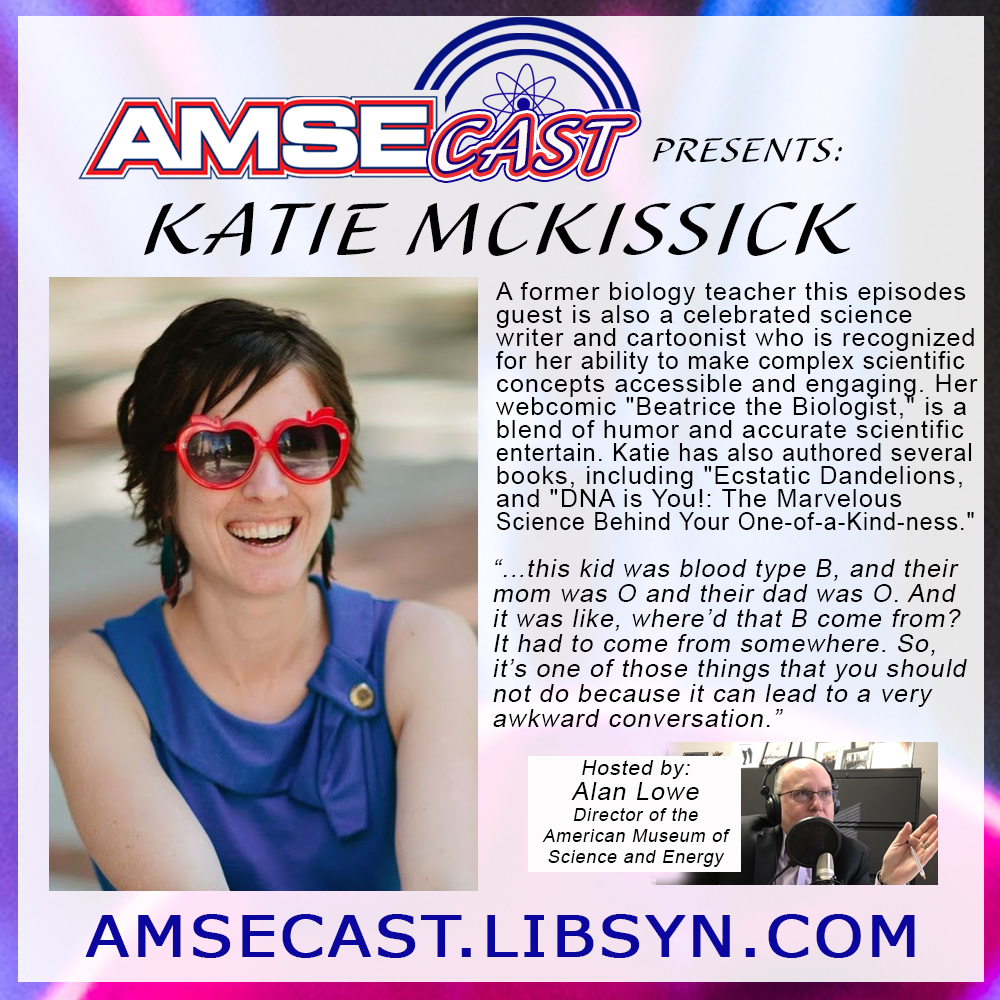
AMSEcast with guest Katie McKissick
Explore the fascinating world of genetics with Katie McKissick, as she takes us on a journey through the wonders of genetics in this episode of AMSEcast. Using her unique blend of expertise and humor, Katie walks us through the complex fundamental elements of genetic structure, including DNA and RNA, and through the fascinating mechanisms behind genetic traits and inheritance. Join us for an entertaining learning experience!

AMSE Science Report with Stefano Sandrone
AMSE Science Report with Stefano Sandrone

AMSE Science Report with Sam Kean
AMSE Science Report with Sam Kean

AMSE Science Report with Clifton Truman Daniel
AMSE Science Report with Clifton Truman Daniel

AMSE Science Report with Michael Hiltzik
AMSE Science Report with Michael Hiltzik

AMSE Science Report with Simon Winchester
AMSE Science Report with Simon Winchester

AMSE Science Report with Matt Richtel
AMSE Science Report with Matt Richtel

ASME Science Report with John Tresch
ASME Science Report with John Tresch

AMSE Science Report with James Poskett
AMSE Science Report with James Poskett

AMSE Science Report with Heino Falcke
AMSE Science Report with Heino Falcke

AMSE Science Report with Gino Segre
AMSE Science Report with Gino Segre

AMSE Science Report with Doug Tallamy
AMSE Science Report with Doug Tallamy
AMSE Science Report with Brian Clegg
AMSE Science Report with Brian Clegg

AMSE Science Report with Andrew Maynard
AMSE Science Report with Andrew Maynard

AMSE Science Report with Paul Sen
AMSE Science Report with Paul Sen