Alt Goes Mainstream
192 episodes — Page 3 of 4

[Repost] 🎙Animal Spirits: Alt Goes Mainstream with Michael Sidgmore
I went into The Compound and came out alive.Recently, I joined Michael Batnick and Ben Carlson of Ritholtz Wealth Management on their Animal Spirits podcast by The Compound. It is a fantastic show that produces frank and thoughtful conversations on markets and the wealth management world. They invited me on their show to discuss why alts are going mainstream.We had a great conversation on the animal spirits of alts and we unpacked the opportunities and challenges ahead for private markets, wealth managers, and the alternative asset managers looking to work with the wealth channel. We covered:* Why I don’t like the term “downstreaming of alts.”* The size and scale of the opportunity with the wealth channel.* Why and how it can make sense for the wealth channel to allocate to alts.* The changing nature of asset allocation from slices of a pie to buckets and spectrums.* The concept of liquidity.* The attractiveness of evergreen funds for both GPs and LPs.* Are private markets in a bubble?* Why GP stakes are a compelling investment opportunity given structural trends in private markets.* Can private markets be indexed (and should they be)?Thanks Michael and Ben for having me on the show. Really enjoyed the conversation and it was a pleasure to join you. Michael and Ben are fantastic and thoughtful asset allocators and commentators in investing and wealth management. If you don’t already listen to their podcast or read their commentary on markets, you can check out their blogs below:Michael Batnick’s The Irrelevant Investor.Ben Carlson’s A Wealth of Common Sense.Join over 5,800 thought leaders from top private markets firms like Blackstone, Apollo, Goldman Sachs, Ares, KKR, Carlyle, Fidelity, iCapital, Franklin Templeton, and more. This is a public episode. If you would like to discuss this with other subscribers or get access to bonus episodes, visit altgoesmainstream.substack.com
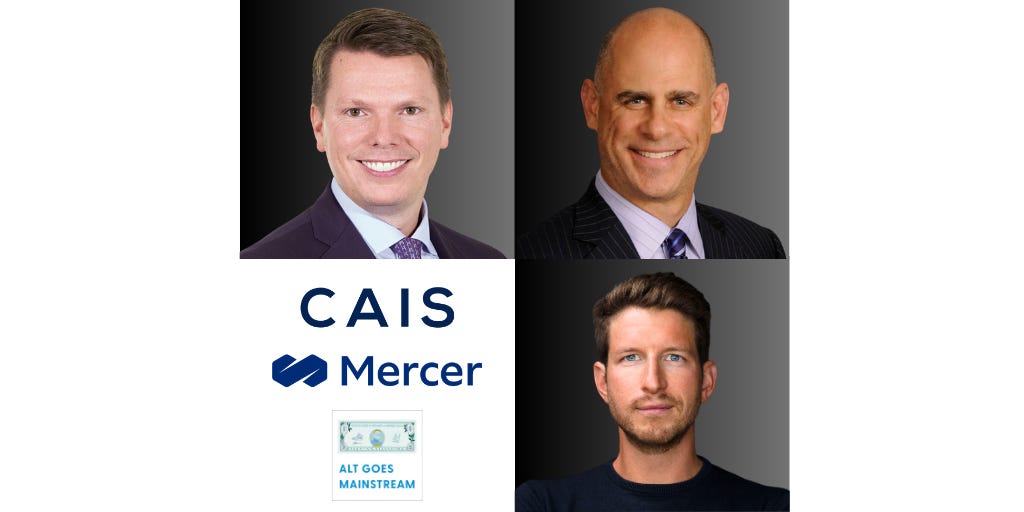
🎙Mercer Investments' Gregg Sommer & CAIS' Neil Blundell - following the fast river of alts
Welcome back to the Alt Goes Mainstream podcast.On today’s episode, we are joined by Mercer Investments’ US Financial Intermediaries Leader Gregg Sommer and CAIS’ MD and Head of Investments Neil Blundell.Gregg and Neil bring deep experience and backgrounds in private markets to discuss how alternatives can be further adopted by the wealth channel.Gregg is Mercer’s US Financial Intermediaries Leader, serving US wealth management and family office clients. He is a member of Mercer’s Wealth Leadership Team, Wealth Management Strategic Research and Investment Committees, and the Investment Policy Committee. He joined Mercer’s Investments business in 2009 and is based in Denver. Gregg began his career at U.S. Trust and over the last 35 years has held several executive positions in the investment industry. He has a comprehensive investment, business, and risk management background and has managed many successful investment teams focused on risk assessment, asset allocation, due diligence, portfolio management, organizational evaluation, and financial analysis across both private and public investment strategies. Gregg served as Chief Financial and Operating Officer of a firm that managed real estate and private equity and debt portfolios and has been a Principal and Portfolio Risk Officer for RCM, a Commodity Trading Advisor. Additionally, he was a founding Partner at Global Trading Partners, a trading firm focused on global market relationships.Neil brings over 20 years of experience in private markets to CAIS. He recently worked at Invesco as the Global Head of Client Solutions and Alternatives for the Investment Solutions team. He was responsible for developing and managing over $90B in customized multi-asset investment strategies spanning both traditional and alternative solutions and was a member of the team’s executive committee, investment committee, and chair of the alternative investment committee. Prior to Invesco, Neil was at BlackRock for 10+ years, where he was most recently Managing Director and Alternatives Platform Head within the Institutional Client Business.Gregg, Neil, and I had a fascinating discussion about how the wealth channel can approach alternatives and how they can think about both diligence and customization. We covered:* The case for alternatives.* How advisors currently approach alternatives and how they can think about it differently going forward.* How to think about portfolio construction that includes alternatives.* How alts can help advisors differentiate their practice and attract clients.* Following the fast river in a career and why alternatives are “the fast river.”* The meaning of “structure over strategy.”* The rise in popularity of evergreen funds.Thanks Gregg and Neil for coming on the show to share your views and experience in private markets. We hope you enjoy.A word from AGM podcast sponsor, Ultimus Fund SolutionsThis episode of Alt Goes Mainstream is brought to you by Ultimus Fund Solutions, a leading full-service fund administrator for asset managers in private and public markets. As private markets continue to move into the mainstream, the industry requires infrastructure solutions that help funds and investors keep pace. In an increasingly sophisticated financial marketplace, investment managers must navigate a growing array of challenges: elaborate fund structures, specialized strategies, evolving compliance requirements, a growing need for sophisticated reporting, and intensifying demands for transparency. To assist with these challenging opportunities, more and more fund sponsors and asset managers are turning to Ultimus, a leading service provider that blends high tech and high touch in unique and customized fund administration and middle office solutions for a diverse and growing universe of over 450 clients and 1,800 funds, representing $500 billion assets under administration, all handled by a team of over 1,000 professionals. Ultimus offers a wide range of capabilities across registered funds, private funds and public plans, as well as outsourced middle office services. Delivering operational excellence, Ultimus helps firms manage the ever-changing regulatory environment while meeting the needs of their institutional and retail investors. Ultimus provides comprehensive operational support and fund governance services to help managers successfully launch retail alternative products. Visit www.ultimusfundsolutions.com to learn more about Ultimus’ technology enhanced services and solutions or contact Ultimus Executive Vice President of Business Development Gary Harris on email at [email protected] thank Ultimus for their support of alts going mainstream.Clip #1: How are advisors allocating to alts?Clip #2: How much does brand matter in private markets?Clip #3: What are advisors worried about in private markets?Clip #4: What goes into evaluating alternatives managers?Show Notes00:00 Introduction to Sponsor, Ultimus Fund Solutions01:17 Podca
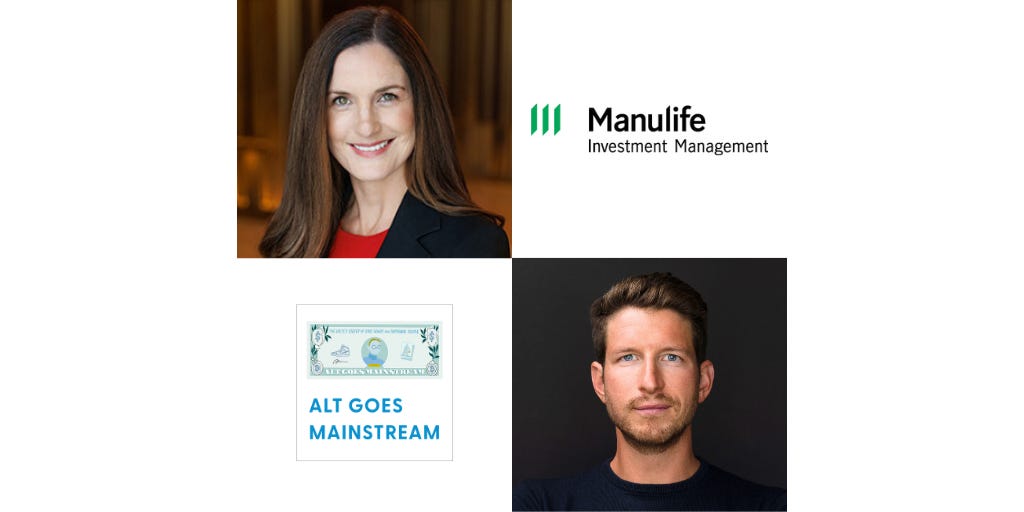
🎙Manulife's Anne Valentine Andrews - connecting real assets with real money and the world of infrastructure investing
Welcome back to the Alt Goes Mainstream podcast.Today’s episode features a guest who has consistently and astutely figured out the growth areas in private markets.We are joined by Manulife’s new Global Head of Private Markets Anne Valentine Andrews. She’s responsible for the strategy, business development, and growth of Manulife Investment Management’s private markets business. Manulife has a platform that spans real estate, infrastructure, timber, agriculture, private equity, and credit.Anne has a comprehensive and informed purview of both private markets trends and of the different asset classes. She brings together the CIOs from each asset class in the Manulife business and works with the global product group to drive private markets product innovation across the institutional, retail, and retirement channels.Anne has a wealth of experience in private markets and in infrastructure in particular. She joined Manulife from BlackRock, where she was most recently Global Head of Infrastructure and Real Estate. Previously, she was Co-Head and Chief Operating Officer for the Morgan Stanley infrastructure platform and was a Director at Macquarie Bank.Anne and I had a fascinating conversation about the evolution of private markets and how to build out a private markets investment platform and its brand. We discussed:* How to approach building a private markets investment platform at an industry behemoth.* Why culture matters at an investment firm.* The continued consolidation of alternative asset managers.* What it means to connect real assets with real money.* How to build a brand and educate investors.* How to bring private markets investment opportunities into retirement accounts.* The opportunity in infrastructure investing.Thanks Anne for coming on the show to share your experience and wisdom on private markets. We hope you enjoy.A word from AGM podcast sponsor, Ultimus Fund SolutionsThis episode of Alt Goes Mainstream is brought to you by Ultimus Fund Solutions, a leading full-service fund administrator for asset managers in private and public markets. As private markets continue to move into the mainstream, the industry requires infrastructure solutions that help funds and investors keep pace. In an increasingly sophisticated financial marketplace, investment managers must navigate a growing array of challenges: elaborate fund structures, specialized strategies, evolving compliance requirements, a growing need for sophisticated reporting, and intensifying demands for transparency. To assist with these challenging opportunities, more and more fund sponsors and asset managers are turning to Ultimus, a leading service provider that blends high tech and high touch in unique and customized fund administration and middle office solutions for a diverse and growing universe of over 450 clients and 1,800 funds, representing $500 billion assets under administration, all handled by a team of over 1,000 professionals. Ultimus offers a wide range of capabilities across registered funds, private funds and public plans, as well as outsourced middle office services. Delivering operational excellence, Ultimus helps firms manage the ever-changing regulatory environment while meeting the needs of their institutional and retail investors. Ultimus provides comprehensive operational support and fund governance services to help managers successfully launch retail alternative products. Visit www.ultimusfundsolutions.com to learn more about Ultimus’ technology enhanced services and solutions or contact Ultimus Executive Vice President of Business Development Gary Harris on email at [email protected] thank Ultimus for their support of alts going mainstream.Clip #1: How infrastructure has “become a real allocation in investors’ portfolios.”Clip #2: Building a comprehensive private markets investment platform at Manulife.Clip #3: Connecting real assets to real money and building the world that we live in.Show Notes00:00 Introduction and Sponsor Message from Ultimus Fund Solutions01:18 Podcast Opening and Guest Introduction03:39 Anne Valentine Andrews' Career Journey04:42 Evolution of the Infrastructure Investments05:41 Infrastructure’s Resilience and Growth06:27 Building a Private Markets Platform14:28 Challenges and Strategies in Making Acquisitions17:12 Evaluating Culture and Integration in Asset Management18:47 Building a Comprehensive Platform20:20 Educating Investors and Expanding Access23:29 Future of Alternatives in Retirement Accounts26:43 Platformization of Alternatives28:01 Building and Marketing a Trustworthy Brand in Financial Services29:30 Learning from Other Industries: Amazon's Influence31:15 The Evolution of Asset Management31:57 Adapting to Market Changes and Mega Trends33:34 The Importance of Long-Term Investment Strategies34:33 Decarbonization and Natural Capital35:32 The Importance of Long-Term Thinking40:02 Connecting Real Assets to Real Money45:42 Risks and Opportunities in Infrastructure Invest
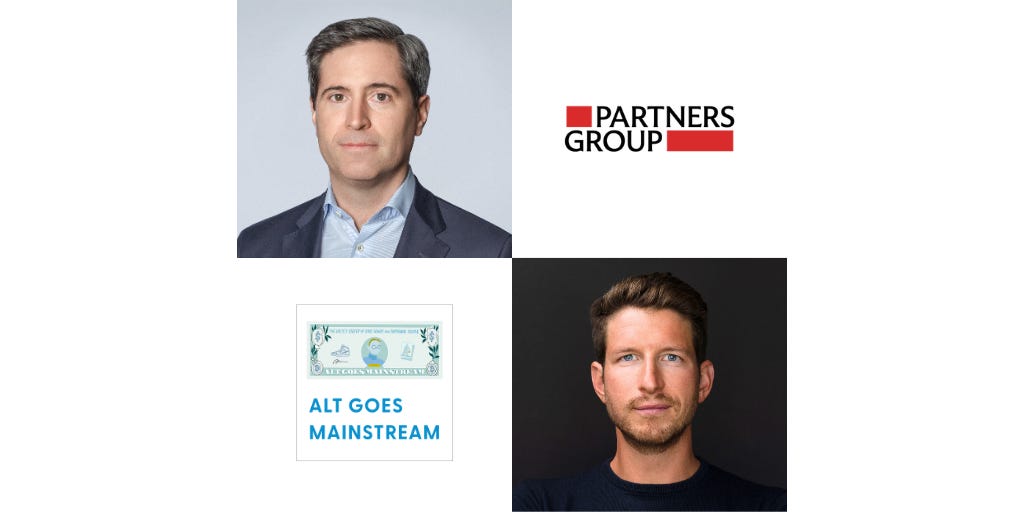
🎙Partners Group's Rob Collins - The how and why of evergreens: one of the most exciting trends in private markets
Welcome back to the Alt Goes Mainstream podcast.Today’s episode is one of evergreen importance. We talk with one of the pioneers in the evergreen fund space.Rob Collins, a Partner, Co-Head of Private Wealth, and Head of the New York office and a member of the Global Executive Board at Partners Group, a $147B+ AUM alternative asset manager, joins the podcast to discuss how Partners Group started the evergreen fund space in the early 2000s.Rob has deeply evolved perspectives on both evergreen funds and working with the wealth channel. He leads Partners Group’s US private wealth and defined contribution practice and is President, Portfolio Manager, and Member of the Board of Managers of Partners Group Private Equity (Master Fund), LLC. He also chairs Partners Group USA’s Investment Committee. He joined the firm in 2005, only 4 years after Partners Group was the first firm to launch an evergreen private equity structure.Rob and I had a fascinating conversation about what evergreen funds are, the mechanics of how they work, and why they can make sense for investors — both individual and institutions. We discussed:* What Partners Group saw in the early 2000s that made them decide to create the evergreen private equity fund structure.* Why it’s taken the industry time to adopt evergreen funds.* How to think about returns with evergreen funds.* Why institutions — in addition to wealth advisors — have used evergreen funds.* Why the time, money, and liability questions of private equity fund investments make evergreens a fit for many advisors.* The importance of compounding and how it relates to evergreen funds.* The challenges and nuances with managing evergreen funds.* Why “life is too short for capital calls.”* How does private equity go from being sold to being bought?* What can the industry do to continue to remove pain points for the wealth channel?Thanks Rob for coming on the show to share your thoughts and wisdom on private markets and the importance of one of the biggest trends in private markets, evergreen funds. We hope you enjoy.A word from AGM podcast sponsor, Ultimus Fund SolutionsThis episode of Alt Goes Mainstream is brought to you by Ultimus Fund Solutions, a leading full-service fund administrator for asset managers in private and public markets. As private markets continue to move into the mainstream, the industry requires infrastructure solutions that help funds and investors keep pace. In an increasingly sophisticated financial marketplace, investment managers must navigate a growing array of challenges: elaborate fund structures, specialized strategies, evolving compliance requirements, a growing need for sophisticated reporting, and intensifying demands for transparency. To assist with these challenging opportunities, more and more fund sponsors and asset managers are turning to Ultimus, a leading service provider that blends high tech and high touch in unique and customized fund administration and middle office solutions for a diverse and growing universe of over 450 clients and 1,800 funds, representing $500 billion assets under administration, all handled by a team of over 1,000 professionals. Ultimus offers a wide range of capabilities across registered funds, private funds and public plans, as well as outsourced middle office services. Delivering operational excellence, Ultimus helps firms manage the ever-changing regulatory environment while meeting the needs of their institutional and retail investors. Ultimus provides comprehensive operational support and fund governance services to help managers successfully launch retail alternative products. Visit www.ultimusfundsolutions.com to learn more about Ultimus’ technology enhanced services and solutions or contact Ultimus Executive Vice President of Business Development Gary Harris on email at [email protected] thank Ultimus for their support of alts going mainstream.Clip #1: It’s “an infinite responsibility.”Clip #2: Why is the evergreen structure incredibly powerful for the mass affluent investor?Clip #3: What are the right characteristics of a top distribution professional for the wealth channel?Show Notes00:00 Introduction to Ultimus Fund Solutions01:18 Podcast Opening and Theme Song01:52 Welcome to Alt Goes Mainstream01:59 Introducing Rob Collins and Evergreen Funds02:24 Rob Collins' Background and Role at Partners Group04:18 Growth and Innovation at Partners Group05:46 Evergreen Solutions for Clients07:02 The Importance of Flexibility in Evergreen Funds09:56 Evergreen Funds vs. Traditional Structures11:38 The Rise of Evergreen Funds29:48 Challenges and Risks of Evergreen Structures30:01 Balancing Growth and Performance in Evergreen Funds34:57 Challenges for General Partners35:40 Expanding with New Products36:23 Trends in Private Markets36:56 Evergreen Funds and Private Companies37:27 Life is Too Short for Capital Calls38:52 Shift from Public to Private Markets40:24 Liquidity in Evergreen Funds41:50 Building a Resilie

🎙NEA's Peter Barris - From operator to VC legend, how Peter transformed NEA into a venture juggernaut
Welcome back to the Alt Goes Mainstream podcast.His career started when someone said to him, “well, have you thought about venture capital? We don’t think that you’d be any good at it.”The rest is history.Today’s episode features one of the legends of the venture capital industry.Peter Barris joined New Enterprise Associates in 1992 after a storied operating career as President and COO at Legent Corporation and an executive at GE Information Services. He served as Managing General Partner and Chairman of NEA from 1999 to March 2024. Under Peter’s leadership, NEA saw tremendous success, growing into one of the world’s largest venture capital firms and raising the largest-ever venture capital fund a number of times. Today, NEA’s AUM stands over $25B.Peter was responsible for investing in a number of foundational and industry-transforming technology companies, including Salesforce.com, UUNET, Groupon, WebMD, Workday, CareerBuilder, Tempus, and more.It was an honor to talk with Peter, who has such rich perspectives as both an operator and investor.We had a fascinating discussion about the early days of venture capital and how the industry has evolved. We covered:* The inside story of how almost every other Partner said no but Peter's investment turned out to be a 75x return.* What's the “best characteristic and the death characteristic” of an entrepreneur?* In today's hypercompetitive market do VCs have enough time to make good decisions?* Why the world of venture capital is about influence.* What does it mean to earn an entrepreneur’s trust as a VC?* Why VCs with operating backgrounds can bring unique value to startups.* How NEA came up with the term "Venture Growth Equity."* How can a VC tell that a founder is good at experimentation and that they have the good judgment?* Why specialization and domain expertise are prerequisites in today’s venture industry.* The importance of relying on instinct to make great investments.* Why the business plan that is bet on is not always the business plan that ultimately succeeds.Thanks Peter for coming on the show. It was an honor and a pleasure to hear your views on the evolution of an industry and for you to share your wisdom and experiences.A word from AGM podcast sponsor, Ultimus Fund SolutionsThis episode of Alt Goes Mainstream is brought to you by Ultimus Fund Solutions, a leading full-service fund administrator for asset managers in private and public markets. As private markets continue to move into the mainstream, the industry requires infrastructure solutions that help funds and investors keep pace. In an increasingly sophisticated financial marketplace, investment managers must navigate a growing array of challenges: elaborate fund structures, specialized strategies, evolving compliance requirements, a growing need for sophisticated reporting, and intensifying demands for transparency. To assist with these challenging opportunities, more and more fund sponsors and asset managers are turning to Ultimus, a leading service provider that blends high tech and high touch in unique and customized fund administration and middle office solutions for a diverse and growing universe of over 450 clients and 1,800 funds, representing $500 billion assets under administration, all handled by a team of over 1,000 professionals. Ultimus offers a wide range of capabilities across registered funds, private funds and public plans, as well as outsourced middle office services. Delivering operational excellence, Ultimus helps firms manage the ever-changing regulatory environment while meeting the needs of their institutional and retail investors. Ultimus provides comprehensive operational support and fund governance services to help managers successfully launch retail alternative products. Visit www.ultimusfundsolutions.com to learn more about Ultimus’ technology enhanced services and solutions or contact Ultimus Executive Vice President of Business Development Gary Harris on email at [email protected] thank Ultimus for their support of alts going mainstream.Clip #1: How Peter became a venture capitalist.Clip #2: The world of venture capital is about influence.Clip #3: The inside story of how almost every other Partner said no but Peter's investment turned out to be a 75x return.Clip #4: How can a VC earn the trust of a founder?Clip #5: How NEA found the white spaces in the VC industry to grow into a multi-billion dollar firm.Show Notes00:00 Introduction and Sponsor Message from Ultimus01:55 Guest Introduction: Peter Barris01:59 Peter Barris' Career Beginnings as an Operator03:43 How Peter decided to join NEA04:31 Early Days at NEA12:30 First Investment Experience – The world of venture capital is about influence15:07 How to Influence a Company when You Don’t Control the Company21:48 Scaling Businesses: When Scale Can be a Moat - The Groupon Example26:41 The Art of Experimentation29:16 The Most Important Characteristic of Successful Entrepreneurs and the Death Charac

🎙NewEdge's Rob Sechan and Cameron Dawson - growing a cutting edge $44B platform to serve the wealth channel
Welcome back to the Alt Goes Mainstream podcast.Today’s episode features the architects behind one of the industry’s faster growing wealth management platforms, NewEdge.We welcome NewEdge CEO, Managing Partner, and Co-Founder Rob Sechan and NewEdge CIO Cameron Dawson.Both Rob and Cameron have a wealth of experience in both wealth management and private markets. Rob has over two decades of experience in financial services, beginning his career as a financial advisor at Morgan Stanley, before running a family office business as a Managing Director at Lehman Brothers. He later joined UBS as a Managing Director and Head of the Intellectual Capital Subcommittee, where he helped guide the firm’s tactical investment process for wealthy families and institutional clients before founding NewEdge in 2020. Cameron was the Chief Market Strategist at Fieldpoint Private Securities and a Senior Equity Analyst at Bank of America before joining NewEdge as CIO.Since its founding in 2020, NewEdge has grown to over $44B AUM, supports over 300 financial advisors. NewEdge has built a platform that combines wealth management, technology, custody, research, and alternatives capabilities. They’ve built out a sophisticated private markets investment practice, which we unpacked in detail on today’s podcast.Rob, Cameron, and I had a fascinating discussion. We covered:* The transformation in wealth management and the approach that NewEdge has taken in the independent wealth channel.* The evolution of Super RIAs.* The role of alternatives in wealth management. * Navigating client psyche and market cycles.* The importance of due diligence and why fee discipline matters in private markets.* The importance of liquidity in a client's portfolio.* Why portfolio construction is key in the wealth channel.Thanks Rob and Cameron for coming on the show to share your thoughtful views on wealth management and private markets.A word from AGM podcast sponsor, Ultimus Fund SolutionsThis episode of Alt Goes Mainstream is brought to you by Ultimus Fund Solutions, a leading full-service fund administrator for asset managers in private and public markets. As private markets continue to move into the mainstream, the industry requires infrastructure solutions that help funds and investors keep pace. In an increasingly sophisticated financial marketplace, investment managers must navigate a growing array of challenges: elaborate fund structures, specialized strategies, evolving compliance requirements, a growing need for sophisticated reporting, and intensifying demands for transparency. To assist with these challenging opportunities, more and more fund sponsors and asset managers are turning to Ultimus, a leading service provider that blends high tech and high touch in unique and customized fund administration and middle office solutions for a diverse and growing universe of over 450 clients and 1,800 funds, representing $500 billion assets under administration, all handled by a team of over 1,000 professionals. Ultimus offers a wide range of capabilities across registered funds, private funds and public plans, as well as outsourced middle office services. Delivering operational excellence, Ultimus helps firms manage the ever-changing regulatory environment while meeting the needs of their institutional and retail investors. Ultimus provides comprehensive operational support and fund governance services to help managers successfully launch retail alternative products. Visit www.ultimusfundsolutions.com to learn more about Ultimus’ technology enhanced services and solutions or contact Ultimus Executive Vice President of Business Development Gary Harris on email at [email protected] thank Ultimus for their support of alts going mainstream.Clip #1: Rob - we want to be cutting edge.Clip #2: Cameron - how does NewEdge do things differently?Clip #3: Rob - embracing change in the wealth management industry.Clip #4: Cameron - how funds can engage with the wealth channel.Show Notes00:00 Introduction and Ultimus Sponsor Message01:21 Welcome to the Podcast02:03 Introducing NewEdge Wealth and the Guests02:20 Rob Sechan's Journey in Wealth Management07:46 Cameron Dawson's Perspective on NewEdge11:45 The Role of Alternatives in Wealth Management20:09 The Evolution of Super RIAs24:10 Investment Strategies and Client Focus31:31 Balancing Proactivity and Client Sensitivity31:56 The Importance of Transparency and Differentiation32:30 Navigating Client Psyche and Market Cycles33:33 The Role of Alternatives in Portfolios36:05 Private Equity Opportunities and Challenges38:00 Fee Discipline and Alpha Generation51:57 Engaging with Wealth Channels56:52 Favorite Alternative Investments59:27 Conclusion and Final ThoughtsJoin over 4,900 thought leaders from top private markets firms like Blackstone, Apollo, Ares, KKR, Carlyle, Blue Owl, Goldman Sachs, J.P. Morgan, BlackRock, Fidelity, iCapital, Franklin Templeton, and more. This is a public episode. If you would like
🎙Ritholtz Wealth Management's Michael Batnick - real talk on private markets
Welcome back to the Alt Goes Mainstream podcast.On today’s show, we turned the tables. We welcomed famed podcast co-host of Animal Spirits and The Compound and Friends and writer at The Irrelevant Investor, and Managing Partner and Director of Research at $4B AUM Ritholtz Wealth Management Michael Batnick to come on the show to share a wealth manager’s perspective on private markets.Michael’s career has taken a number of fascinating turns. He started selling insurance, before a chance meeting on the platform of the subway station with Josh Brown of Ritholtz Wealth Management after a New York Knicks loss led to a job offer to work with Josh at RWM. At Ritholtz, Michael has been an integral part of the team that has helped to drive the firm’s growth, leading with content and education. Each of the firm’s Partners have built impressive content platforms across blogs, books, and podcasts. Their thoughtful approaches to investing come through in their work — and it’s translated to how they think about private markets. Michael provided interesting viewpoints on why alternatives have yet to be adopted by many advisors and the challenges with adopting alternatives products.Michael and I had a fascinating discussion at the intersection of wealth and alts. Michael and I covered:* His journey into wealth management and the lessons he has learned along the way.* The importance of education and networking in the wealth management industry.* How he thinks about risk in public and private markets.* The evolution of wealth management as a business.* Why alternatives products are still sold and not bought.* The importance of staying focused on fundamentals and long-term investing.* The workflow challenges that alternative investments have for a wealth management firm.* How and why content can develop views, educate, and build brand in wealth management and private markets.Thanks Michael for coming on the show to share your thoughts and wisdom on investing.A word from AGM podcast sponsor, Ultimus Fund SolutionsThis episode of Alt Goes Mainstream is brought to you by Ultimus Fund Solutions, a leading full-service fund administrator for asset managers in private and public markets. As private markets continue to move into the mainstream, the industry requires infrastructure solutions that help funds and investors keep pace. In an increasingly sophisticated financial marketplace, investment managers must navigate a growing array of challenges: elaborate fund structures, specialized strategies, evolving compliance requirements, a growing need for sophisticated reporting, and intensifying demands for transparency. To assist with these challenging opportunities, more and more fund sponsors and asset managers are turning to Ultimus, a leading service provider that blends high tech and high touch in unique and customized fund administration and middle office solutions for a diverse and growing universe of over 450 clients and 1,800 funds, representing $500 billion assets under administration, all handled by a team of over 1,000 professionals. Ultimus offers a wide range of capabilities across registered funds, private funds and public plans, as well as outsourced middle office services. Delivering operational excellence, Ultimus helps firms manage the ever-changing regulatory environment while meeting the needs of their institutional and retail investors. Ultimus provides comprehensive operational support and fund governance services to help managers successfully launch retail alternative products. Visit www.ultimusfundsolutions.com to learn more about Ultimus’ technology enhanced services and solutions or contact Ultimus Executive Vice President of Business Development Gary Harris on email at [email protected] thank Ultimus for their support of alts going mainstream.Clip #1: How did a Knicks loss lead to Michael’s career in wealth management?Clip #2: “Who’s saying we need to invest in privates?”Clip #3: Why are advisors afraid of private markets?Clip #4: Public markets vs. private markets tension and “calling it what it is.”Show Notes02:03 Introduction to Alt Goes Mainstream 02:43 Guest Introduction: Michael Batnick 03:00 Michael's Early Career and Challenges 07:26 Meeting Josh Brown and Career Breakthrough 08:35 Lessons from the Insurance World 09:20 Creating Content and Building a Brand 10:58 Investing Philosophy and Market Insights 14:27 Young Investors and Market Psychology 19:13 Public vs. Private Markets 29:25 Advisors and Private Investments 34:21 Customization and Differentiation in Private Markets 34:50 Challenges in Pitching Investments to Clients 35:09 Operational Hurdles in Alternative Investments 35:34 The Role of Relationship Managers 36:16 Building and Managing Alts Portfolios 43:04 Market Dynamics and Investment Strategies 53:43 Content Creation in Wealth Management 58:53 The Future of Wealth Management with AI 01:01:46 Quick Fire Round: Market Predictions and Insights 01:05:19 Conclusion and Final
🎙HgCapital Trust's Chairman of the Board Jim Strang - a masterclass in private markets
Welcome back to the Alt Goes Mainstream podcast.Today’s episode features a masterclass in private markets from a guest who has seen it all.Jim Strang is a deeply experienced private equity professional who has been part of the industry as a GP, LP, investor, consultant, and now a teacher, board member, and advisor to a number of firms.I’d probably have to spend a good few pages going through everything that Jim has done and is currently doing in private markets. He’s a practitioner and a teacher, an expert and an operator. After an illustrious career that was punctuated as Chairman EMEA of Hamilton Lane, one of the largest LPs in private markets globally, he now serves in a number of board and advisor roles, which include Chairman of the Board at HgCapital Trust plc, Senior Advisor to CVC Capital Partners, Advisor at Bain & Company, and Director at Pictet Alternative Advisors.Jim and I had a fascinating conversation about the evolution of private markets and what the future holds for large and small funds alike, as well as LPs. We discussed:* The step function changes that take private markets from $15T to $30T of AUM.* Why traditional asset managers may struggle to replicate the capabilities of alternative asset managers in private markets.* The importance of partnerships having a clear ambition and alignment if they want to build a scaled platform.* The challenges that managers in the middle face as large platforms and specialist managers are the differentiated firms in the eyes of LPs.* Why GPs need to find innovative solutions to address the needs of different types of investors.* Why building a strong brand is crucial to success in the wealth channel.Thanks Jim for coming on the show to share your wisdom and experience on private markets.A word from AGM podcast sponsor, Ultimus Fund SolutionsThis episode of Alt Goes Mainstream is brought to you by Ultimus Fund Solutions, a leading full-service fund administrator for asset managers in private and public markets. As private markets continue to move into the mainstream, the industry requires infrastructure solutions that help funds and investors keep pace. In an increasingly sophisticated financial marketplace, investment managers must navigate a growing array of challenges: elaborate fund structures, specialized strategies, evolving compliance requirements, a growing need for sophisticated reporting, and intensifying demands for transparency. To assist with these challenging opportunities, more and more fund sponsors and asset managers are turning to Ultimus, a leading service provider that blends high tech and high touch in unique and customized fund administration and middle office solutions for a diverse and growing universe of over 450 clients and 1,800 funds, representing $500 billion assets under administration, all handled by a team of over 1,000 professionals. Ultimus offers a wide range of capabilities across registered funds, private funds and public plans, as well as outsourced middle office services. Delivering operational excellence, Ultimus helps firms manage the ever-changing regulatory environment while meeting the needs of their institutional and retail investors. Ultimus provides comprehensive operational support and fund governance services to help managers successfully launch retail alternative products. Visit www.ultimusfundsolutions.com to learn more about Ultimus’ technology enhanced services and solutions or contact Ultimus Executive Vice President of Business Development Gary Harris on email at [email protected] thank Ultimus for their support of alts going mainstream.Clip #1: Private markets are like Hotel California.Clip #2: Is it better to be private or public as an alternative asset manager?Clip #3: Is scale a defensible moat? … and “Consulting is about what you know, investing is about what you think”Clip #4: What characterizes the current state of private markets?Clip #5: Are partnerships the right governance model for alignment?Show Notes00:00 Introduction and Sponsor Message02:06 Podcast Theme Song02:44 Guest Introduction: Jim Strang02:52 Jim Strang's Career Overview05:35 State of Private Markets: Challenges and Opportunities08:04 Fundraising Dynamics in Private Equity11:25 European Private Equity: Evolution and Insights15:01 Scaling Challenges and Ambitions in Private Equity25:41 Technology and Innovation in Private Equity32:47 Challenges in Organizational Analysis33:56 Psychological Assessments in Investment Decisions35:48 Effective Questioning Techniques for LPs36:29 Transparency and Culture in Investment Firms37:34 Evolution of Asset Management38:41 Public vs. Private Asset Managers40:27 Generational Shifts in Private Equity Firms44:12 Growth and Democratization of Private Markets48:40 Liquidity Challenges in Private Markets54:45 Quick Fire Round: Insights on Private Markets01:00:10 Entertainment Investments: Music Royalties and Sports01:04:02 Conclusion and Final ThoughtsJoin over 4,800 thought lead

🎙3i Members' Mark Gerson - building engaged investing communities
Welcome back to the Alt Goes Mainstream podcast.Today’s podcast is a special show with 3i Members co-founder Mark Gerson.Alt Goes Mainstream’s first sponsor is 3i Members, an investing network built on community, collaboration and capital that was co-founded by Mark Gerson, Billy Libby, and Teddy Gold. 3i Members is a global deal network for accomplished private investors. Members uncover, share, and diligence high-quality investment opportunities in private markets. The network offers more than just investment opportunities, providing access to expert databases, legal services, international events and retreats, masterclasses, asset allocation workshops, and other resources.Mark is a serial entrepreneur who has built a number of communities that have revolved around some form of crowdsourcing.In addition to founding 3i Members, Mark founded Gerson Lehman Group, a knowledge brokerage and primary research firm, that figured out how to use the power of community to serve its customers. He also founded United Hatzalah, a crowd-sourced system of volunteer first response that enables Israelis to be treated within the moments separating life from death following any medical trauma. He also co-founded and is the Chairman of African Mission Healthcare, which enables Christian medical missionaries to provide clinical care, training, and medical infrastructure for people throughout Africa. From co-founding United Hatzalah of Israel to building a unique community in the private markets space with 3i Members, Mark shares his experiences and the profound impact of community and crowdsourcing in both philanthropy and private markets. The episode dives into the intricacies of building capable, engaged communities, the conceptual differences between a network and a community, and the unique approach of 3i Members in creating a collaborative investing landscape. We discussed:* Mark’s journey and the significance of pro-social behaviors and intellectual curiosity among investors. * How 3i Members facilitates a space for private investors to share, scrutinize, and engage with high-quality investment opportunities. * The importance of asking the right questions in investment. * ROI-based philanthropy* The value of non-transactional relationships within communities.Thanks Mark for coming on the show to share your stories and wisdom.Chapters00:00 Welcome to the Mainstream: The Alt Goes Mainstream Podcast Intro00:42 Introducing 3i Members: A New Era of Investing01:11 Mark Gerson's Journey: Building Communities and Crowdsourcing Success02:59 The Power of Community in Crowdsourced First Response07:59 3i Members: Crowdsourcing in the Investment World09:44 The Art of Building and Maintaining Quality Networks12:02 The Philosophy of No-Selling in Building Trust and Community14:59 Engineering Serendipity: Fostering Organic Growth and Engagement19:59 Investment Strategies and Learning from the 3i Community24:40 The Future of Investing with 3i Members34:51 ROI in Philanthropy: A New Approach to Giving40:09 Closing ThoughtsJoin over 4,700 thought leaders from top private markets firms like Blackstone, Apollo, Ares, KKR, Carlyle, Blue Owl, Goldman Sachs, J.P. Morgan, BlackRock, Fidelity, iCapital, Franklin Templeton, and more. This is a public episode. If you would like to discuss this with other subscribers or get access to bonus episodes, visit altgoesmainstream.substack.com

🎙Marc Rubinstein of Net Interest - an in-depth tour of financial markets with an expert in finance and history
Welcome back to the Alt Goes Mainstream podcast.Today’s podcast provided us with an in-depth tour of financial markets with a student of both finance and history. And what a tour guide we had. Marc Rubinstein, an investment professional with 25 years of experience researching and investing in financial services joined us on the show.Marc started his career as an equity research analyst, where he ultimately became a MD at Credit Suisse, leading the European banking sector equity research group before joining Lansdowne Partners. Lansdowne was one of Europe’s largest hedge funds, where he was a Partner and managed the award-winning $4B global long/short financials equity fund.Clip #1: The rules of thumb with systemic risk and excessive growth in financial services.He retired from Lansdowne in 2016 and, after going back to school to obtain his MBA from LBS, he launched Net Interest, a wildly popular and incredibly thoughtful newsletter on financial sector themes. I find Marc’s thoughts and views on Net Interest equal parts insightful and digestible. Marc is also an active value investor and early-stage fintech investor, where he was an early investor in Revolut. He’s also a contributor to Bloomberg Opinion.Clip #2: Zuckerman’s Curse and the story of John PaulsonMarc and I had a fascinating conversation about a number of themes that are defining private markets. We discussed:* Why most businesses are marketplaces and what that means for how one should evaluate a business.* Whether or not private credit is a systemic risk.* Why the Silicon Valley Bank crisis occurred and why private credit firms are filling the void.* Where to look for new asset classes and how they become institutionalized.* The nuts and bolts of alternative asset managers as businesses.* Why pod shops have featured in the hedge fund world and why PE and VC will have different versions of pod shops.* Why content is key for financial services businesses.* How financial media has evolved and why the narrative arc of companies is a perspective that Marc enjoys covering.Thanks Marc for coming on the Alt Goes Mainstream podcast to share your wisdom.Clip #3: The evolution of media in financial services.ChaptersIntroduction and BackgroundGetting into the World of FinanceBanks Today and the Rise of Alternative Asset ManagersRegulatory Concerns and Private CreditSystemic Risk and Excessive GrowthIdentifying Risks in Private CreditScale and Returns in Asset ManagementThe Growth of Large Platforms in Private MarketsThe Equilibrium of Scale and ReturnsThe Convergence of Traditional and Alternative Asset ManagementThe Trend of Evergreen Funds in Private MarketsThe Acquisition of GIP by BlackRockThe Competition Between BlackRock and BlackstoneThe Merging of Traditional and Alternative Asset ManagementThe Future of Active ManagementLessons from the Financial CrisisThe Impact of Media on Financial ServicesThe Trend of Permanent Capital in Private MarketsThe Evolution of Media in Financial ServicesThe Role of Content in Financial ServicesThe Importance of Understanding Financial Services HistoryThe Relevance of Deep Analysis in Financial ServicesValue Creation through ContentDifferent Paths for Content BusinessesPurity of Content in Financial ServicesThe Future of Content in Financial ServicesThe Impact of AI on Investment RecommendationsThe Value of Artisanal Work and IntelligencePod Shops in Private MarketsGP Stakes as an Analogy to Pod ShopsThe Psychology of Discounting Private MarketsThe Growth and Sustainability of Private MarketsInfrastructure as an Interesting Alternative InvestmentJoin over 4,600 thought leaders from top private markets firms like Blackstone, Apollo, Ares, KKR, Carlyle, Blue Owl, Goldman Sachs, J.P. Morgan, BlackRock, Fidelity, iCapital, Franklin Templeton, and more. This is a public episode. If you would like to discuss this with other subscribers or get access to bonus episodes, visit altgoesmainstream.substack.com
🎙Braughm Ricke of Aduro Advisors - building a fund administration business
Welcome back to the Alt Goes Mainstream podcast.Today’s episode features an enabler of the micro VC movement who has now scaled his business into one of the industry’s larger fund administrators. Braughm Ricke is the Founder and CEO of Aduro Advisors, a leading fund administrator that has carved out a sterling reputation in the VC world.He's grown the business to over $114B+ AUA and over 450+ customers, that counts many of the leading VC funds, including Lowercarbon, Cowboy Ventures, Ahoy Capital, Craft, Haystack, Boost VC, and others, as customers. They've also managed to combine a high-quality service with innovative technology and a partnership strategy that has enabled them to differentiate from other fund admins.Clip #1: Starting Aduro to solve for the next big trend in VC.Prior to founding Aduro, Braughm was the founding CFO of True Ventures, a leading Silicon Valley VC fund. Braughm is incredibly knowledgeable about the private markets space more generally and is also an active investor in the private markets startup ecosystem, investing early in the likes of Carta, Allocate, Passthrough, Arch, and others.Clip #2: Is AI going to change fund administration?Braughm and I had a fascinating conversation about the evolution of fund administration. We discussed:* Why Braughm started with emerging managers and the unmet need he saw to serve them.* Why he believed the emerging manager landscape would grow.* How he’s moved upstream beyond venture capital clients.* How fund admin can integrate technology.* Will AI change fund administration?* Advice Braughm would give to founders building in private markets.Thanks Braughm for coming on the Alt Goes Mainstream podcast to share your wisdom on building a core infrastructure provider for private markets.Clip #3: What is missing from a technology perspective that takes fund admin to the next level?Clip #4: Will Aduro always be a services first business?Join over 4,500 thought leaders from top private markets firms like Blackstone, Apollo, Ares, KKR, Carlyle, Blue Owl, Goldman Sachs, J.P. Morgan, BlackRock, Fidelity, iCapital, Franklin Templeton, and more. This is a public episode. If you would like to discuss this with other subscribers or get access to bonus episodes, visit altgoesmainstream.substack.com

🎙Yieldstreet's Michael Weisz on unlocking access to alternatives
Welcome back to the Alt Goes Mainstream podcast.Today’s episode is with a fintech founder who has scaled one of the larger private markets investing platforms for individual investors.Michael Weisz is the Founder and CEO of Yieldstreet, a leading private markets investing platform, with more than 450K members and $3.9B invested (as of October 2023). An award-winning entrepreneur, he co-founded Yieldstreet in 2015 with the ambition to provide individual investors with access to curated private market assets typically reserved for institutions. As CEO, Michael leads Yieldstreet’s strategic vision to make alternatives a fundamental piece of investor portfolios.Clip #1: Opening up the “billionaire’s playground.”Before Yieldstreet, Michael held a variety of positions across the specialty finance spectrum, including founding Soli Capital. Previously, Michael was Vice President at a New York-based credit opportunities hedge fund with $1.2B under management.Clip #2: The Yieldstreet experienceMichael and I had a fascinating conversation about the evolution of private markets and how to deliver investment opportunities directly to consumers. We discussed the business evolution of Yieldstreet, how they work with both individuals and advisors, and what he thinks is important when it comes to providing investors with access to private markets.Thanks Michael for coming on the Alt Goes Mainstream podcast to share your thoughtful views on private markets.Clip #3: “We don’t want to be Blackstone with a website.”Clip #4: “It always starts and ends with the customer.”Join over 4,500 thought leaders from top private markets firms like Blackstone, Apollo, Ares, KKR, Carlyle, Blue Owl, Goldman Sachs, J.P. Morgan, BlackRock, Fidelity, iCapital, Franklin Templeton, and more. This is a public episode. If you would like to discuss this with other subscribers or get access to bonus episodes, visit altgoesmainstream.substack.com

🎥 Steve Case, Chairman & CEO of Revolution and Co-Founder of America Online, on revolutionizing the world on purpose with passion
Welcome back to the Alt Goes Mainstream podcast.Today’s episode with an internet legend provides an illuminating window into how the past can help inform us about the future.Steve Case is a pioneer and a visionary. He built one of the foundational companies of the internet, AOL, that brought America and the world online. As one of America’s best-known and most accomplished entrepreneurs, Steve has spent the past 39 years building, investing in, and shaping business policy for many industry-defining companies.His entrepreneurial career began in 1985 when he co-founded America Online. Under Steve’s leadership, AOL became the world’s largest and most valuable internet company. AOL was the first internet company to go public, and one of the best performing stocks of 1990s, delivering 11,616% return to shareholders. At its peak, nearly half of internet users in the U.S. used AOL.Clip #1: Building an internet company when only 3% of people were online 1 hour / week.Steve has since built another successful company, Revolution, a Washington, D.C.-based investment firm that backs entrepreneurs at every stage of their development. Revolution Growth has invested nearly $1 billion in growth-stage companies including Sweetgreen, Tempus, Tala, DraftKings, and CLEAR. Revolution Ventures has invested in almost 30 companies, including Framebridge and SRS Acquiom. Revolution’s Rise of the Rest Seed Fund has invested in over 200 startups in 100 US cities, building critical ecosystem development for entrepreneurship across the country.Clip #2: What happens when the internet meets the real world?Steve’s passion for helping entrepreneurs has extended to the policy world. He was the founding chair of the Startup America Partnership, an effort launched at the White House in 2011 to accelerate high-growth entrepreneurship around the country. He was also the founding co-chair of the National Advisory Council on Innovation & Entrepreneurship, and a member of President Obama’s Council on Jobs and Competitiveness, where he chaired the subcommittee on entrepreneurship. He was also instrumental in passing the JOBS (Jumpstart Our Business Startups) Act and the Investing in Opportunities Act. He’s also the Chairman of the Case Foundation, which he established with his wife, Jean, in 1997 and together in 2010 they joined The Giving Pledge.Steve is also the author of the New York Times bestselling book, “The Third Wave: An Entrepreneur’s Vision of the Future and The Rise of the Rest: How Entrepreneurs in Surprising Places are Building the American Dream,” which has ended up serving as a fantastic blueprint for the next wave of the internet.Steve and I had a fascinating and illuminating conversation, full of lessons learned from building the first wave of the internet that can be applied to building and investing in companies today.We discussed:* How Steve and his team built AOL into the world’s largest and most valuable internet company at a time when 3% of people were using the internet for 1 hour a day.* How revolutions happen in evolutionary ways.* The three waves of the internet and why Steve believes that the third wave is much more complex and will require the ability to navigate policy and partnerships.* Lessons he learned as a founder to build a successful and diversified investment firm in Revolution.* How emerging technology ecosystems can build thriving startup communities, starting with “tentpole companies.”* How the things that happen to you shape how you live your life and on “living a life that’s full with passion and urgency.”Thanks Steve for coming on the Alt Goes Mainstream podcast to share your wisdom, lessons learned, and visionary views of the future. It was an honor and a pleasure to have you on the show.Clip #3: Revolution, “investing where the puck is going.”Clip #4: Giving rise to the rest.Join over 4,400 thought leaders from top private markets firms like Blackstone, Apollo, Ares, KKR, Carlyle, Blue Owl, Goldman Sachs, J.P. Morgan, BlackRock, Fidelity, iCapital, Franklin Templeton, and more. This is a public episode. If you would like to discuss this with other subscribers or get access to bonus episodes, visit altgoesmainstream.substack.com
🎙Hamilton Lane's Griff Norville on how private markets are moving from the Stone Age to the digital age
Welcome back to the Alt Goes Mainstream podcast.Today’s episode takes us into the world of technology with an expert in private markets tech.Griff Norville is a Managing Director and Head of Technology Solutions at Hamilton Lane, the $903B AUM (*Inclusive of $120.2B in discretionary assets under management and $782.9B in non-discretionary assets under management, as of December 31, 2023) global alternative asset manager. Griff leads the firm’s tech-enabled analytics, forecasting, and investment diligence platform, Cobalt LPTM and related portfolio reporting services, and co-heads the firm’s Technology Committee.Griff focuses on building proprietary tools and strategically partnering or investing into private markets fintech companies as part of the firm’s efforts to drive digital transformation within the industry. Griff also leverages his background on the investment side to help inform how he thinks about technology transformation within private markets. He previously co-led Hamilton Lane’s research team, where he was responsible for leveraging data to assess market trends and advice clients on investment and portfolio construction strategy. Clip #1: The potential and promise of tokenization in private markets.Griff and I had a fascinating conversation about the evolution of private markets technology and why it’s an exciting time for innovation in the space. We discussed:* How private markets are moving from the Stone Age and Excel age to the digital age.* Why most GPs are still underinvested in technology.* How Griff approaches the build, buy, invest question.* Why Cobalt was so foundational to Hamilton Lane’s work in private markets.* How technology innovation has driven product innovation when working with the wealth channel.* What comes next for technology in private markets.Thanks Griff for coming on the show to share your thoughts and wisdom on how technology is impacting private markets and for the work you’re doing to invest in technology that’s transforming the space.Clip #2: How technology innovation can reduce friction for the wealth channel.Clip #3: What separates the winners from the losers in private markets?Clip #4: What are wealth managers worried about with private markets?Join over 4,400 thought leaders from top private markets firms like Blackstone, Apollo, Ares, KKR, Carlyle, Blue Owl, Goldman Sachs, J.P. Morgan, BlackRock, Fidelity, iCapital, Franklin Templeton, and more. This is a public episode. If you would like to discuss this with other subscribers or get access to bonus episodes, visit altgoesmainstream.substack.com
🎙Lessons from a leading operator: Growing ECi Software Solutions to $500M revenue and $200M EBITDA with Net Health CEO & Carlyle Operating Partner Ron Books
Welcome back to the Alt Goes Mainstream podcast.Today we have the operator’s view on the show. We bring in someone who rose up the ranks of a private equity-backed software company to be CEO of that company — ECi Software Solutions — that now generates over $500M in revenue and $200M in EBITDA.We welcome Ron Books, now an Operating Partner at Carlyle and the CEO at Net Health, a Carlyle portfolio company. He also sits on a number of boards for Carlyle.He is now the Chairman and is the former CEO of ECi Software Solutions, a leading global provider of cloud-based software for SMEs, which he successful sold to Leonard Green & Partners for a multi-billion dollar exit. Ron started with ECi when it was a startup company and rose in the organization to serve as VP Sales, then COO, and then CEO, a position which he held from 2009 to 2021. While serving as CEO, Ron and his team developed and executed a strategic plan that included overseeing 46 M&A transactions and a successful software license to cloud migration across nearly a dozen platforms. They received investment from — and sold the business to — Insight Partners, Carlyle, Apax Partners, Goldman Sachs, and most recently, Leonard Green & Partners. Under his leadership as CEO, ECi grew from less than $50M in revenue to over $500M and a sale of the company in 2020 at a multi-billion dollar valuation.Ron has all the hallmarks of a successful entrepreneur — energetic yet thoughtful, a tireless work ethic, the ability to connect with customers and employees, and loyalty to both customers and employees.Clip #1: Developing discipline in process and team when bringing in private equity.Ron and I had a fascinating conversation about what it takes to build a great company and culture and how to work with private equity given that he’s been on both sides of the table. We discussed:* Lessons learned from growing a business to $500M in revenue and $200M in EBITDA.* How he built and grew ECi through acquisitions and globalizing the business.* Why culture matters and how to vet for culture in the hiring process.* Stories from the challenges and successes of integrating 41 companies via M&A.* How founders should think about working with private equity firms.* How founders can get the most out of their board members and operating partners.* The transition from CEO to Operating Executive back to CEO.Thanks Ron for coming on the show to share your wisdom and experiences that are an invaluable source of learnings for both founders and investors.Clip #2: Venture vs. Private Equity - who to bring in to help your company.Clip #3: Lessons learned from doing 46 M&A transactions.Clip #4: The value of working with an Operating Partner.Join over 4,300 thought leaders from top private markets firms like Blackstone, Apollo, Ares, KKR, Carlyle, Blue Owl, Goldman Sachs, J.P. Morgan, BlackRock, Fidelity, iCapital, Franklin Templeton, and more. This is a public episode. If you would like to discuss this with other subscribers or get access to bonus episodes, visit altgoesmainstream.substack.com
🎙Blue Owl Capital's Global Private Wealth President & CEO Sean Connor on working with the wealth channel
Welcome back to the Alt Goes Mainstream podcast.Today’s episode takes us inside the world of wealth from the perspective of one of the industry’s largest alternative asset managers.We are joined by Sean Connor, the President & CEO, Global Private Wealth at Blue Owl Capital, a firm with over $160B in AUM. Sean highlighted a number of key insights for navigating and working with the wealth channel as he shared lessons learned from building a successful private wealth business at a large alternative asset manager.Clip #1: The opportunity to “do it differently” in the wealth channel.Sean is responsible for bringing the breadth of the Blue Owl investment platform to the global private wealth market. He’s at the forefront of Blue Owl’s private wealth initiatives globally and oversees fund formation, product structure innovation, capital raising, and client servicing. He also oversees business development, marketing, and operations for Private Wealth at the firm. Prior to his current role, Sean was one of the first employees at Owl Rock (now the Direct Lending division of Blue Owl) and was responsible for building out the private wealth business.Prior to joining Blue Owl and Owl Rock, Sean served as a Managing Director of CION Investment Management for over 10 years. Sean was a member of CION’s Investment Committee and was responsible for all aspects of CION’s business including originating, underwriting, negotiating, and corporate finance transactions globally. In 2020, Sean was recognized by Private Debt Investor as one of the industry’s Rising Stars.Sean and I had a fascinating conversation about what it’s like to work with the wealth channel. We discussed:* How and why it’s so difficult to work with the wealth channel.* Why the wealth channel is not a new phenomenon, yet why it’s still relatively untapped in terms of alternative asset managers understanding how to work with the wealth channel.* How Blue Owl’s wealth business works across its three different investment platforms.* Why scale matters in certain areas of private markets.* Why the wealth channel is not one channel, but rather an agglomeration of different customer types and geographies.* How the market is evolving where a one-stop-shop type firm may be how much of the wealth channel interacts with private markets.* What it means for distribution professionals to understand their client and the daily demands of a wealth manager's business when educating the wealth channel on alternatives products.* Why education of the wealth channel should focus more on holistic education and less on selling product.* Why the wealth channel matters when it comes to alternative asset managers acquiring other alternative asset managers.Thanks Sean for coming on the Alt Goes Mainstream podcast to share such actionable and thoughtful insights on how firms can work with wealth.Clip #2: Why scale matters in private markets.Join over 4,300 thought leaders from top private markets firms like Blackstone, Apollo, Ares, KKR, Carlyle, Blue Owl, Goldman Sachs, J.P. Morgan, BlackRock, Fidelity, iCapital, Franklin Templeton, and more. This is a public episode. If you would like to discuss this with other subscribers or get access to bonus episodes, visit altgoesmainstream.substack.com

🎙Blackstone Chief Technology Officer John Stecher on how technology is transforming private markets
Welcome back to the Alt Goes Mainstream podcast.Today’s episode takes us inside the mind of a tech titan who is at the forefront of shaping the market structure evolution in private markets.John Stecher is the Chief Technology Officer at Blackstone. He’s responsible for all aspects of technology across the firm and advises the firm’s investment teams as well as acts as a resource to portfolio companies on technology-related matters. John and the team at Blackstone have invested in iCapital, Canoe, 73 Strings, LemonEdge, amongst others.Clip #1: How technology creates leverage points for investors.It’s also his background in other areas of technology and consumer financial services that stands out – and provides insights and lessons learned for how to build technology within private markets. Prior to joining Blackstone, John was a Managing Director, the Chief Technology Officer, and the Chief Innovation Officer at Barclays. He was also a member of the Barclays Technology Management Committee. Prior to joining Barclays in 2017, he worked at Goldman Sachs, where he held a variety of senior management and engineering roles across the firm’s capital markets and technology divisions, and most recently built their Marcus-branded consumer finance division. He also worked at IBM, where he was appointed an IBM Master Inventor, where he delivered / created over 45 patents across several diverse problem spaces.John and I had a fascinating conversation about how technology is core to both the business Blackstone is building and the businesses they invest into. We discussed:* How Blackstone leverages technology internally and externally to create value.* Why alts are still sold, not bought.* Why he sees the biggest evolution happening in the finance and accounting space within private markets — and what innovations are being built there.* Why the front office of private markets will still require human intervention despite technology advancements.* Why the alts space needs systematization.* How product structure innovation (i.e. evergreen funds, etc.) is driving technology innovation.* How private markets are becoming more consumer oriented.Clip #2: Hear John share his views on AI.Thanks John for coming on the Alt Goes Mainstream podcast to share your wisdom and experience of building core technology for capital markets and private markets.Join over 4,200 thought leaders from top private markets firms like Blackstone, Apollo, Ares, KKR, Carlyle, Blue Owl, Goldman Sachs, J.P. Morgan, BlackRock, Fidelity, iCapital, Franklin Templeton, and more. This is a public episode. If you would like to discuss this with other subscribers or get access to bonus episodes, visit altgoesmainstream.substack.com
🎥 Chris Long on building $29B credit investment firm Palmer Square and a winning NWSL soccer team, KC Current
Welcome back to the Alt Goes Mainstream podcast. Today we have an incredible discussion that spans the world of private credit and the growth of women’s sports — and how those two topics intersect in the guest’s daily life.Chris Long founded Palmer Square Capital Management, an approximately $29B+ asset manager focused on corporate and structured credit with offices in Kansas City and London, in June 2009. Currently, he serves as Chairman, CEO, and Portfolio Manager. Since inception, Chris has been successful in building one of the premier credit investment firms in the world that includes clients across institutions, family offices, RIAs, bank / trust, and broker dealers. Prior to starting Palmer Square, Chris built a deep investment background at some of the top financial firms in the world, including Morgan Stanley, TH Lee Putnam Ventures, and JP Morgan.In December 2020, Chris added the title of Professional Sports Team Owner, as he joined Co-Founder and Owner Angie Long and Co-Owner Brittany Mahomes in bringing a National Women’s Soccer League franchise to Kansas City. The KC Current launched on an extraordinary timeline, playing its first professional match just 124 days after the franchise was announced. As owners, Chris, Angie, Brittany, and recent addition to ownership Kansas City Chiefs star Patrick Mahomes, have had a clear vision for not only establishing the best women’s soccer club in the world, but also having the KC Current serve as a model for all of women’s sports, which was no more apparent than with the recent completion of their new stadium, a $124M project that is the first soccer stadium specifically for a women’s professional soccer team.Chris serves on the National Women’s Soccer League’s (NWSL) Board of Governors and Expansion Committee as well as on the Executive Committee of the Kansas City 2026 World Cup Bid. Chris was recently recognized for winning the prestigious Kansas City Sports Commission’s 2022 Sports Executive of the Year and Sports Business Journal’s 2022 Power Players — Women’s Sports. He and his wife Angie were inducted into the 2023 Junior Achievement of Greater Kansas City Business Hall of Fame.Chris and I had a fascinating conversation that spanned the world of credit and sports team ownership and investing — and how those two worlds are coming together. We discussed:* How Chris and his team built a $29B asset manager in the credit space.* Why he believes that private credit’s growth does not represent a systemic risk despite a more lax lending environment due to increased capital inflows and increased competition for good deals.* Why he believes the one-stop-shop will emerge in credit for both borrowers and LPs.* Why a background in credit and investing has been invaluable in understanding how to navigate the business side of building and running a sports franchise.* How Chris decided to buy a NWSL team with his wife and co-founder Angie.* Why Chris believes investing in women’s soccer in the US is like “buying the Boston Celtics in the 1960s.”* Why owning your own facilities as a sports team is a huge lever to increase revenues and drive enterprise value.* How driving business initiatives for a sports team can help build the community and build the roster.Thanks Chris for coming on the show to share invaluable insights into building elite performers in both the world of finance and the world of women’s soccer. Good luck this season with the Current — I’ll be rooting for you, except when you play Angel City FC 😉.Join over 4,100 thought leaders from private markets firms like Blackstone, Apollo, Goldman Sachs, KKR, Carlyle, Ares, Blue Owl, Fidelity, iCapital, Franklin Templeton, Vanguard, & more.This material is for informational purposes and is prepared by Palmer Square Capital Management LLC (“Palmer Square”), is not intended to be relied upon as a forecast, research or investment advice, and is not a recommendation, offer or solicitation to buy or sell any securities or to adopt any investment strategy. The opinions expressed are as of date of publication and are subject to change. The information and opinions contained in this material are derived from proprietary and nonproprietary sources deemed by Palmer Square to be reliable and are not guaranteed as to accuracy or completeness. This material may contain ’forward looking’ information that is not purely historical in nature. There is no guarantee that any forecasts made will come to pass. Reliance upon information in this material is at the sole discretion of the reader. Past performance is not indicative of current or future results. This information provided is neither tax nor legal advice and investors should consult with their own advisors before making investment decisions. Investment involves risk including possible loss of principal. This is a public episode. If you would like to discuss this with other subscribers or get access to bonus episodes, visit altgoesmainstream.substack.com

🎙$28B Sanctuary Wealth on working with the wealth channel
Welcome back to the Alt Goes Mainstream podcast.Today’s episode dives deep into one of the fastest growing independent wealth platforms in the US — Sanctuary Wealth — and how alternatives is a major ingredient to the growth of their firm and the RIA space more broadly.We have Sanctuary’s MD and Head of Alternative Investments, Patrick McGowan, and Director of Strategic Partnerships, Oksana Poznak, on the show to discuss why they believe alternative investments are a key driver of their growth and why they are so important to the development of advisor’s practices.Patrick and Oksana both bring valuable perspectives on private markets to bear.Patrick was previously a SVP and Head of Product Management at Azimut Alternative Capital Partners, the NY based GP stakes arm of Azimut Group, one of the largest independent wealth management companies in the world. This background gives him a great understanding of the GP stakes world, where he's spent a bunch of time thinking about this in terms of how it relates to the wealth channel. Prior to Azimut, Patrick was part of the Invesco Private Capital team, the $1B PE and VC arm of Invesco, where he focused on their efforts for CalSTRS SMA and a fund of funds that invested in a number of high-performing, generally smaller and emerging managers. He also worked at OC Private Capital, a JV between Carlyle and OppenheimerFunds, the advisor to a $1B close-ended interval fund focused on private credit. Prior to this role, he was a Senior Director at AI Insight, which was acquired by iCapital. He started his career at OppenheimerFunds and then worked at Altegris Investments, which was a pioneer in bringing alts to the wealth channel.Oksana brings over 20 years of experience in business development, marketing, and relationship management to Sanctuary. She was most recently Segment Marketing Director at CAIS, where she promoted alternative investment fund managers. Prior to CAIS, she held senior positions at Atria Wealth Solutions, BNY Mellon Pershing, Ladenburg Thalman, and Advisor Group.We had a fascinating discussion about the intersection of wealth and alts. We discussed: * What it will take to grow Sanctuary to a $100B Super RIA.* Why the wealth channel is so interested in alternatives.* Why alternative asset managers are interested in working with the wealth channel.* How alternative asset managers can best approach working with and educating the wealth channel.* The biggest mistake alternative asset managers make when trying to work with the wealth channel.* How smaller funds can partner with wealth advisors.Thanks Patrick and Oksana for coming on the show to share your thoughts and wisdom about the intersection of wealth and alts. We hope you enjoy.Join over 3,900 thought leaders from top private markets firms like Blackstone, Apollo, Goldman Sachs, Ares, KKR, Carlyle, Blue Owl, Fidelity, iCapital, Franklin Templeton, J.P. Morgan, and more. This is a public episode. If you would like to discuss this with other subscribers or get access to bonus episodes, visit altgoesmainstream.substack.com
[Repost] 🎥 How Everyday Investors Can Access Blackstone, Apollo, and KKR?
A few weeks ago, the tables were turned and I sat down with David Weisburd of the 10X Capital Podcast to talk about the ongoing transformation of private markets. The wealth channel is becoming a centerpiece of the LP universe. Every alternative asset manager either has — or has to have — a strategy for working with the wealth channel in today’s private markets.We discussed:* Why the wealth channel will become a prominent LP for many funds over time.* How infrastructure solutions like iCapital are enabling the wealth channel to efficiently access private markets.* Why GP staking will become part of the LP solution set for their exposure to private markets.Thanks David for having me on your show to discuss how private markets are rapidly changing before our eyes.Join over 3,700 thought leaders from top private markets firms like Blackstone, Apollo, Goldman Sachs, Ares, KKR, Carlyle, Fidelity, iCapital, Franklin Templeton, and more. This is a public episode. If you would like to discuss this with other subscribers or get access to bonus episodes, visit altgoesmainstream.substack.com

🎙Building a $3B real estate hospitality investment platform with Carlos Rodriguez Jr. of Driftwood Capital
Welcome back to the Alt Goes Mainstream podcast.On today’s episode, we travel around the world of hospitality investing. We talk with Carlos Rodriguez Jr., the Founder, President, and COO of Driftwood Capital, one of the US’s leading hospitality sponsors with over $3B in hospitality assets under management. They’ve found a way to do both the traditional things in real estate investing and development well and compliment that with an innovative strategy to bring over 1,200 accredited investors on their platform as they find ways to improve how sponsors can access deals and capital.Carlos and I had a fascinating discussion about real estate and private markets. We covered:* How hospitality investing was impacted by Covid and how Driftwood weathered the storm.* Lessons learned from operating through Covid.* Why location, location, location rings true in real estate investing.* How the millennial traveler and work from home have impacted hospitality investing.* The most surprising things in real estate investing over the past few years.* How technology is impacting real estate investing.Thanks Carlos for coming on the show to share your insights and wisdom about hospitality investing. We hope you enjoy.Join over 3,450 thought leaders from top private markets firms like Blackstone, Apollo, Goldman Sachs, Ares, KKR, Carlyle, Blue Owl, Fidelity, iCapital, Franklin Templeton, J.P. Morgan, and more. This is a public episode. If you would like to discuss this with other subscribers or get access to bonus episodes, visit altgoesmainstream.substack.com
🎙J.P. Morgan Asset Management's Tyler Jayroe on how one of the world's largest financial institutions approaches private equity
Welcome back to the Alt Goes Mainstream podcast.On today’s show, we welcome a senior member of the team at the world’s 3rd largest alternatives manager. Tyler Jayroe is a MD and Portfolio Manager in the Private Equity Group at J.P. Morgan Asset Management, which manages over $2.4 trillion of assets on behalf of a diverse group of global institutions and individual investors. Tyler’s team, the Private Equity Group, has a 40 year history of investing across private markets, covering the alternative investment spectrum and investing over $42B of capital. Tyler helps spearhead a team that invests into funds, co-investments, and secondaries across private equity, growth equity, and venture fund strategies.Tyler and I had a fascinating conversation about how an industry behemoth allocates capital across funds and strategies. We discussed:* What they look for when investing into funds.* Why middle market private equity is an area they have focused on.* The opportunity for secondaries in the current market.* The differences between a first-time investor and a first-time fund manager.* What a scalable and replicable process really means when it comes to evaluating fund managers.Thanks Tyler for coming on the podcast to share your deep experience in private markets. Hope you enjoy.Join over 3,350 thought leaders from top private markets firms like Blackstone, Apollo, Goldman Sachs, Ares, KKR, Carlyle, Blue Owl, Fidelity, iCapital, Franklin Templeton, J.P. Morgan, and more.Contact JPMorgan Distribution Services, Inc. at 1-800-480-4111 for a fund prospectus. You can also visit us at www.jpmorganfunds.com. Investors should carefully consider the investment objectives and risks as well as charges and expenses of the mutual fund before investing. The prospectus contains this and other information about the mutual fund. Read the prospectus carefully before investing.This document is a general communication being provided for informational purposes only. It is educational in nature and not designed to be a recommendation for any specific investment product, strategy, plan feature or other purpose. Any examples used are generic, hypothetical and for illustration purposes only. Prior to making any investment or financial decisions, an investor should seek individualized advice from personal financial, legal, tax and other professionals that take into account all of the particular facts and circumstances of an investor’s own situation.Risk SummaryThe following considerations, which summarize some, but not all, of the risks of an investment in the representative strategy, should be carefully evaluated.General Investment RisksThere is no assurance that the investments held by the Fund will be profitable, that there will be proceeds from such investments available for distribution to Shareholders or that the Fund will achieve its investment objective. An investment in the Fund is speculative and involves a high degree of risk. Fund performance may be volatile and a Shareholder could incur a total or substantial loss of its investment. There can be no assurance that projected or targeted returns for the Fund will be achieved.Financial Market DevelopmentsVolatile conditions in the capital markets may cause limitations on the ability of companies in which the Portfolio Funds will invest to obtain capital, or subject such companies to higher costs of capital for financing. This lack of available credit could impede upon the ability of such companies to complete investments and higher costs of capital could reduce the returns of the Fund or Portfolio Funds. Changes in interest rates may adversely affect the investments held by the Fund. Changes in the general level of interest rates can affect the value of the Fund’s investments. Interest rates are highly sensitive to many factors, including governmental, monetary and tax policies, domestic and international economic and political considerations, fiscal deficits, trade surpluses or deficits, regulatory requirements and other factors beyond the control of the Fund and the companies in which the Portfolio Funds invest. Although it is expected that the Fund’s borrowings, if any, will be short-term in nature, the companies in which the Portfolio Funds invest may finance a significant portion of their activities with both fixed and floating rate debt. By financing the acquisition and development of an investment with floating rate debt, such companies and Portfolio Funds, and indirectly the Fund, will bear the risk that in the event of rising interest rates and a lack of concomitant growth in income, or any increase in underwriting standards that might limit the availability of credit, it could become difficult for such companies and Portfolio Funds to obtain refinancing. In such a case, a company or Portfolio Funds could be forced to take actions that might be disadvantageous at the time in question, such as refinancing on unfavorable terms or selling an asset. Any rise in interest rates

🎙Stride VC's Fred Destin on how to build trust in a competitive, chaotic world
Welcome back to the Alt Goes Mainstream podcast.On today’s show, we welcome a long-time VC investor who brings the perspective from both sides of the pond. Fred Destin, the founder of Stride VC, a seed fund operating out of London and currently investing out of its second £123M fund, shares his views on the venture capital industry.Prior to Stride, Fred was a General Partner at Accel and Accomplice (fka Atlas Venture). He’s invested in some of venture’s big winners, including Deliveroo, Pillpack, Cazoo, Zoopla, Secret Escapes, Integral Ad Science, and more, generating over $1.4B in value to investors and a blended multiple in excess of 7x. Fred has been featured on the Forbes European Midas List a number of times. Fred and I had a fascinating conversation about the hows and the whys of early-stage venture. We discussed:* How VCs can navigate the difference between decision points and discovery zones.* Why a positive bias towards people can be a driver of returns in venture.* Why venture capital is often a poor experience for founders.* Why trust, truth, and empathy make for a strong and enduring founder relationship.* Why Fred thinks that the most product of a venture capital organization is decisions.* Why and how simplicity can be core to company-building.* How to evaluate risk versus reward at early-stage.* How younger investors can hone their craft.* The future of early-stage venture.Thanks Fred for coming on the podcast to share your wisdom on early-stage investing.Join over 3,160 thought leaders from top private markets firms like Blackstone, Apollo, Goldman Sachs, Ares, KKR, Carlyle, Blue Owl, Fidelity, iCapital, Franklin Templeton, and more. This is a public episode. If you would like to discuss this with other subscribers or get access to bonus episodes, visit altgoesmainstream.substack.com

🎙Master of micro VC, Chris Douvos of Ahoy Capital, on why there's always room for a Bugatti in a market full of Fords and Toyotas
Welcome back to the Alt Goes Mainstream podcast.On today’s show, we welcome a veteran of venture, a champion of portfolio concentration, a master of micro VC. Chris Douvos has taken a mosaic of experiences as an allocator at both endowments and funds that worked on behalf of institutional investors to found Ahoy Capital in 2018, an intentionally right-sized firm focused on working with smaller, emerging VC managers. A pioneering investor in the micro VC movement, Chris has been a mainstay in venture capital for decades. At Ahoy, he discovers and partners with smaller VC funds to help drive returns for his LPs, being seen as a “bird dog in the Valley” for many institutional investors who lack the access, network, and knowledge of the early-stage venture landscape to Chris’s degree.Chris has been embedded in the venture world for years, dating back to the early 2000s. Prior to Ahoy Capital, Chris spearheaded investment efforts at Venture Investment Associates and The Investment Fund for Foundations. He initially learned the craft of private markets investing at Princeton’s University endowment, although he earned his BA and MBA from Yale.Chris and I had such a fun discussion about venture and the emerging VC landscape. We discussed:* How the business of venture has changed.* Why there’s always room for a Bugatti when the market has a lot of Fords and Toyotas.* What he learned from Doug Leone at Sequoia in his early days as an allocator at Princeton and how it’s informed how he invests today.* Why it’s tough to be a midsized fund in today’s venture market.* Why he believes that concentration is key as a LP – and that diversification can lead to “diworseification.”* Why he believes smaller fund sizes can lead to outperformance.Thanks Chris for coming on the podcast to share your wisdom and lessons learned from decades in venture.Join over 3,000 thought leaders from top private markets firms like Blackstone, Goldman Sachs, Apollo, Ares, KKR, Carlyle, Blue Owl, Fidelity, iCapital, Franklin Templeton, and more. This is a public episode. If you would like to discuss this with other subscribers or get access to bonus episodes, visit altgoesmainstream.substack.com

🎙How Shannon Saccocia, the CIO of $67B AUM Neuberger Berman Private Wealth, thinks about the changing role of alternatives in client portfolios
Today’s show brings us inside the mind of a top allocator and CIO in the private wealth world.We talk with Shannon Saccocia, the CIO of Neuberger Berman Private Wealth, a division of NB that has almost $70B of assets under management. With over 24 years of experience, Shannon brings a wealth of knowledge on private markets to bear. At NB Wealth, she works closely with investment leadership to establish market views, asset allocation, and portfolio recommendations tailored specifically for NB Private Wealth clients.Prior to joining NB, she was the CIO for 5 years at SVB Private and Boston Private Wealth, which SVB acquired in July 2021. In this capacity, she oversaw all investment management functions, including portfolio construction, asset allocation, third-party manager selection, equity and fixed income portfolio management, performance and trading.Shannon and I had a fascinating conversation on the evolution of private markets and how both allocators and GPs can think about this changing landscape. We discussed:* The definition of alts and what “true alternatives” are.* The changing nature of asset allocation and why alts are such a critical part of an investors’ portfolio.* The evolution of fees and what investors should be paying for.* Why specialized managers can win.* The importance of geopolitics and macro in a world where deglobalization has an increasing impact on asset allocation.* Why secondaries are an important onramp to private markets for the HNW channel.* What it means to get comfortable with being uncomfortable as an investor.* What the institutional investor world can learn from HNW investors.Thanks Shannon for coming on the Alt Goes Mainstream podcast to share your thoughts and wisdom on private markets.Join over 2,700 thought leaders from top private markets firms like Blackstone, Goldman Sachs, Apollo, Ares, Fidelity, iCapital, Franklin Templeton, and more. This is a public episode. If you would like to discuss this with other subscribers or get access to bonus episodes, visit altgoesmainstream.substack.com

🎙How private equity and the NIL are changing the game for sports with UCLA QB and NIL National Male Athlete of the Year, Chase Griffin
Welcome back to the Alt Goes Mainstream podcast.Today’s show dives into the collision of culture, sports, and finance. We talk with Chase Griffin, a student-athlete and QB at UCLA, who has become a pioneer in the college athletics Name Image Likeness (NIL) movement and is the 2x winner of the NIL Male Athlete of the Year awards from the NIL Summit and Opendorse.Chase has excelled on and off the field, so he’s no stranger to success. In high school, he was the Texas Gatorade Player of the Year, and he turned down Ivy League offers to commit to UCLA. At UCLA, he’s played behind NFL draft pick Dorian Thompson-Robinson and put up strong performances on the field. Off the field, he’s been a leader in the NIL movement and an exemplary scholar-athlete, to the point where his coach at UCLA, Chip Kelly, has said, “if you could buy stock in a human, buy stock in Chase Griffin.”Chase has deftly navigated the rapidly changing landscape of the NIL to secure over 30 NIL brand deals and launched the community / charity giving platform #NILforGood. He recently joined Range Media Partners as Athlete/Creator in Residence and contributes to Range business operations across Sports, NIL, Film, TV, Music, and Social Impact.Chase and I had a fascinating discussion about how the NIL could change college sports as we know it and how it will coincide with more investment into college athletics. At a time when private equity firms are investing into companies that are part of the developing NIL ecosystem and possibly even investing into collegiate athletics conferences, Chase shares his views on the impact that the NIL and financialization of sports has on athletes, colleges, pro sports, and broader student bodies.Congrats on all the accomplishments in your young career thus far, Chase. Thanks for coming on the Alt Goes Mainstream podcast to share your experiences and wisdom on the NIL.Join over 2,500 thought leaders from top private markets firms like Blackstone, Goldman Sachs, Apollo, Ares, Fidelity, iCapital, Franklin Templeton, and more. This is a public episode. If you would like to discuss this with other subscribers or get access to bonus episodes, visit altgoesmainstream.substack.com

🎙Jamie Rhode, Principal at family office Verdis Investment Management, on how to drive the most meaningful returns in early-stage venture as a LP
Welcome back to the Alt Goes Mainstream podcast.On today’s show, we bring the institutional family office perspective to private markets. We talk with Jamie Rhode, a Principal at Verdis Investment Management. Verdis is a single family office based in Philadelphia that was built on the rich legacy of the family, a major business family, that has spanned over three centuries.At Verdis, Jamie is focused on venture capital, private equity, and hedge fund investment sourcing and due diligence. She joined Verdis from Bloomberg, where she held roles in both equity research and credit analysis. Verdis is an active investor in the venture capital ecosystem, leveraging a data-driven investment approach that Jamie spearheads to allocate to mainly smaller and emerging managers. They’ve taken a very thoughtful approach to asset allocation, particularly venture, and have had a number of valuable insights on asset allocation come out of that process.Jamie and I had a fascinating discussion about the allocator’s perspective on venture capital and smaller fund managers.We discussed:* Why Jamie believes that 90% of investment returns come from asset allocation strategy.* Why smaller funds often drive the best returns.* Why illiquidity and duration are so critical to producing outsized returns, with Verdis finding that the last 20% of the hold period of a fund producing 46% of the returns.* Why Verdis believes in the strength of the YC network.* The perfect fund size and portfolio construction.* Why former operators may not make the best fund managers in Jamie’s view.Thanks Jamie for coming on the Alt Goes Mainstream podcast to share your wisdom and data-driven perspectives.Join over 2,500 thought leaders from top private markets firms like Blackstone, Goldman Sachs, Apollo, Ares, Fidelity, iCapital, Franklin Templeton, and more. This is a public episode. If you would like to discuss this with other subscribers or get access to bonus episodes, visit altgoesmainstream.substack.com

🎙Taking the pulse of seed investing and creating an actively managed index of early-stage innovation with Maelle Gavet, CEO of Techstars, one of the world’s largest pre-seed investors
Welcome back to the Alt Goes Mainstream podcast.Today we bring on one of the world’s largest pre-seed investors to cover what the state of early-stage investing looks like.We welcome Maelle Gavet, the CEO of Techstars, a leading accelerator and global investment business that works with early-stage startups. Maelle has taken a background where she’s been a CEO, COO and operator at the likes of Priceline and Compass to run Techstars as they continue to transform their business. Techstars has invested in over 3,700 early-stage startups that have collectively achieved over $98B in all-time accelerator portfolio market capitalization.With a global reach and an early-stage perspective across ecosystems and sectors, Maelle was in a great position to share views on: * Why being relentless makes a great founder.* Why, even despite more seed funds than ever, there’s still been an increase in applications to Techstars by over 2.5x.* Why Techstars can be seen as the ultimate fund-of-funds in her view.* Why an actively managed index of early-stage innovation can make sense for many allocators.Thanks Maelle for coming on the Alt Goes Mainstream podcast to share your wisdom and perspectives on early stage investing.Join over 2,500 thought leaders from top private markets firms like Blackstone, Goldman Sachs, Apollo, Ares, Fidelity, iCapital, Franklin Templeton, and more. This is a public episode. If you would like to discuss this with other subscribers or get access to bonus episodes, visit altgoesmainstream.substack.com
🎙Why now is Europe's time, according to Joe Schorge, Co-Founder & Managing Partner of Isomer Capital, one of Europe's most active VC fund-of-funds
Welcome back to the Alt Goes Mainstream podcast.Today, we travel to London to talk with someone who has seen the evolution of the European tech ecosystem up close.We discuss the rise of Europe with Isomer Capital’s Co-Founder and Managing Partner Joe Schorge. Isomer is a pan-European fund-of-funds, co-investment, and secondaries platform that is on its way to €1B AUM. They’ve invested in 70 VC funds, including the likes of Seedcamp, Hoxton Ventures, Atlantic Labs, and leading European companies like Sorare, Refurbed, Zenjob, and more.Joe has a fascinating perspective on the European’s tech ecosystem on a number of dimensions. He’s an American who moved to Europe in the late 1990s to work in tech before moving to the allocator and investor side. He worked as an investment consultant at Cambridge Associates, where he advised institutional investors in Europe and MENA on strategy, planning, and implementation that amounted to over $2B of capital across 75 transactions in private markets. He was then a Managing Director at Pomona Capital in Europe, where he focused on secondaries, fund investing, and co-investments, which paved the way for him to found Isomer as one of the early institutional pan-European fund-of-funds based in Europe.Joe and I had a rich conversation about the past, present, and future of the European tech ecosystem. We discussed:* Why Europe is a great place to invest right now.* Perspectives on how to build a tech ecosystem, given Joe’s deep experience and history in Europe.* How they uncovered two local funds which invested in one of Europe’s biggest tech successes, UiPath.* Why availability of capital is not the issue for the European ecosystem.* The biggest opportunities in the ecosystem.* Why local funds will still win in their respective regions at pre-seed and seed.* Why there are different skillsets that both investors and founders need to have to succeed in Europe.* What the current market environment means for European venture.* Why more institutional investors should be allocating to European venture.Thanks Joe for coming on the Alt Goes Mainstream podcast to share your wisdom and experiences about European venture and thanks to the EUVC team, Andreas Munk Holm and David Cruz e Silva, for the intro to Joe, where they together have a fantastic partnership between Isomer and EUVC.Join over 2,400 thought leaders from top private markets firms like Blackstone, Goldman Sachs, Apollo, Ares, Fidelity, iCapital, Franklin Templeton, and more. This is a public episode. If you would like to discuss this with other subscribers or get access to bonus episodes, visit altgoesmainstream.substack.com
🎙How "tech's most unlikely venture capitalist," Pear VC's Pejman Nozad, has built a seed investing powerhouse
Welcome back to the Alt Goes Mainstream podcast.Startup stories are often stuff of dreams — and today’s podcast is a story about one of tech’s most unlikely venture capitalists.Journalist and professional soccer player turned immigrant turned self-proclaimed “best carwasher in San Jose” turned Persian rug salesman turned top Silicon Valley seed investor Pejman Nozad, the Co-Founder & Founding Managing Partner of Pear VC comes on the show to chronicle his journey that has crossed continents to back many of tech’s top companies. While his story has taken him many places, one thing has stayed constant — his ability to build relationships and connect with people. And that talent has enabled him to succeed in building a top seed fund in Pear with his partner and serial entrepreneur Mar Hershenson, where they have backed the likes of DoorDash, Gusto, Guardant Health, Aurora, and many more.Pejman shares everything from how to build relationships to how to build a seed fund.We discussed so many fascinating topics:* What he looks for in founders.* Why family is so important.* How and why building relationships is so critical in early-stage investing.* How Pear has built out a multitude of products and services for founders across pre-seed and seed.* How companies can go from zero to product-market fit.* Why some of the largest institutional LPs are interested in a dedicated pre-seed and seed strategy. * I also learned that he makes some really good Persian tea, which is apparently even better than Sadaf.It was a pleasure to have you on the show, Pejman, to share a story for the ages and one that is still being written.Join over 2,300 thought leaders from top private markets firms like Blackstone, Goldman Sachs, Apollo, Ares, Fidelity, iCapital, Franklin Templeton, and more. This is a public episode. If you would like to discuss this with other subscribers or get access to bonus episodes, visit altgoesmainstream.substack.com
🎙How $9B OCIO Capricorn Investment Group has proven that doing well and doing good don't have to be mutually exclusive: A conversation with Partner Bill Orum
Welcome back to the Alt Goes Mainstream podcast.Today’s episode features a pioneer in the sustainable investing world. Bill Orum, who is a Partner at Capricorn Investment Group, has proven that investors can do well and do good at the same time. Bill and his Partners have led Capricorn, a $9B AUM sustainable investment platform serving families, foundations, and institutional investors for over 20 years as a full service OCIO and investment platform.Capricorn has been an innovator for a number of years and has evolved into a firm with three distinct but related investment strategies: an OCIO, a GP stakes business that backs asset managers focused on sustainable investing, and the Technology Impact Fund, a VC fund that manages both Capricorn capital and outside capital and is focused on backing companies providing climate solutions.Capricorn has managed to navigate a complex investing strategy — impact or sustainable investing — and the many geopolitical and governmental challenges associated with climate focused investing in order to generate impressive investment results.Bill and I had a fascinating conversation. We discussed: * The evolution of impacting investing.* How and why generating impact and strong financial returns aren’t necessarily mutually exclusive.* How to find and seed managers.* Why it’s so important to allocate capital to solving the climate challenge. * How they’ve helped normalize sustainable investing.Thanks Bill for coming on the show to share your wisdom and knowledge and for being a pioneer in the sustainable investing space, something so important for the future of our planet.Join over 2,200 thought leaders from top private markets firms like Blackstone, Goldman Sachs, Apollo, Fidelity, iCapital, Franklin Templeton, and more. This is a public episode. If you would like to discuss this with other subscribers or get access to bonus episodes, visit altgoesmainstream.substack.com
🎙Wealth management industry titan Haig Ariyan of Arax Investment Partners on the private equity opportunity in wealth management and the intersection of wealth and alts
Welcome back to the Alt Goes Mainstream podcast.On today’s show, we dive into the world of wealth management with one of the industry’s leaders, Haig Ariyan, the CEO of Arax Investment Partners.Haig has seen it all. He went from someone who grew up in the advisory world as a wealth manager at Dean Witter Reynolds to ultimately becoming President and CEO of Alex Brown, America’s first investment banking firm. At Alex Brown, he oversaw 220 financial advisors and $70 billion in client assets. When Alex Brown sold to Raymond James Financial, Haig became the Head of Global Wealth Solutions. Prior to Alex Brown, Haig was Head of Deutsche Bank Wealth Management in the Americas.Haig is taking his expertise to build Arax Investment Partners. Together with RedBird Capital, an $8.6 billion private equity firm focused on financial services and sports and media, Arax is partnering with wealth and asset management firms and teams to build a differentiated platform that takes lessons learned and deep experience from running wealth management businesses.Haig and Arax are well-capitalized and off to a flying start. They’ve already acquired their first few wealth businesses as well as a $1 billion AUM broker-dealer that will give them the foundation to build on as a hybrid platform.Haig and I had a fascinating conversation about the evolution of wealth management and how alts are playing a big role in shaping the future of wealth.We discussed: * What it means to be an advisor.* Why Modern Portfolio Theory was such an important innovation for the industry.* Why the hybrid brokerage and advisory model makes sense.* How the wealth management space will continue to evolve.* How alts can be a differentiator for advisor practices.* How to build a platform that incentivizes advisor teams.Thanks Haig for coming on the Alt Goes Mainstream podcast to share your wealth of wisdom.Join over 2,200 thought leaders from top private markets firms like Blackstone, Goldman Sachs, Apollo, Fidelity, iCapital, Franklin Templeton, and more. This is a public episode. If you would like to discuss this with other subscribers or get access to bonus episodes, visit altgoesmainstream.substack.com
🎙A masterclass in investing and VC: Investing legends John Burbank and Ken Wallace of Nimble Partners on why the winners will win big and how to find them
Welcome back to the Alt Goes Mainstream podcast.On today’s show, we have a fascinating episode that combines the macro and the micro.Nimble Partners Founder John Burbank and Partner Ken Wallace come on the show to share their unique perspectives and discuss both the nuances and intricacies of investing in private markets and early-stage venture.Nimble Partners is a technology investment platform that invests into early-stage fund managers through their manager selection program and as well as direct and co-investments into breakout performers from their fund manager relationships.John and Ken have had illustrious careers in both public markets and private markets, investing in many of the biggest technology trends and many top early-stage managers over the past 15 years.John was a top macro investor from founding Passport Capital in 2000, where he was amongst the best hedge fund managers of his time. He’s been investing into early-stage fund managers for the past decade. As a long-time macro investor, he has consistently focused on sectors and investments where technology can be disruptive and accelerate change. He’s also an investor in the Golden State Warriors, the championship winning NBA team.Ken joined John to build Nimble after a stellar career at Industry Ventures, backing a number of emerging managers, most notably Chris Sacca’s first-time Lowercase Capital fund, which at over 200x+ returns, was amongst the best performing venture funds in history. At Industry Ventures, he specialized in hybrid fund of funds strategy, originating, valuing, and managing primary fund commitments, early secondary LP investments, and direct co-investments.We had a fascinating conversation that spanned a number of topics: * Why this is not the end of venture capital — and why the winners are still to going to win and win big.* How global macro impacts venture capital.* The framework that John and Ken use to evaluate technology trends and emerging managers.* How the “portfolio manager” model can be applied to venture capital.* How information is a huge edge.* Why duration is the most important thing an investor can have.Thanks John and Ken for coming on the Alt Goes Mainstream podcast to share your wisdom.Join over 2,000 thought leaders from top private markets firms like Blackstone, Goldman Sachs, Apollo, Fidelity, iCapital, Franklin Templeton, and more. This is a public episode. If you would like to discuss this with other subscribers or get access to bonus episodes, visit altgoesmainstream.substack.com

🎙Live from Allocate's Beyond Summit: $40B AUM Cresset's Avy Stein and Jordan Stein on how private markets are changing wealth management
Welcome back to the Alt Goes Mainstream podcast.Recently, I had the pleasure of hosting a live podcast at the Allocate Beyond Summit, where I interviewed Avy Stein and Jordan Stein from Cresset.Allocate’s founders Samir Kaji and Hana Yang brought together a fascinating and thoughtful group of allocators, family offices, and VCs for an engaging two days of discussion about private markets.At the event, I interviewed father and son duo from Cresset. Avy Stein, the Co-Founder and Co-Chairman of Cresset, and Jordan Stein, Director of Private Capital at Cresset Partners, joined me on stage to discuss how their firm has achieved astronomical growth over the past few years, largely due to their business building acumen and in part powered by their focus on private markets.Cresset is a client and family-owned award-winning multi-family office with over $40 billion in AUM that was built by founders and private equity professionals.We had a fascinating discussion that covered everything from how and why Avy and Jordan built Cresset to the evolution of the wealth management space and how private markets is playing a large role in that.Thanks Avy and Jordan for sharing your wisdom and thanks Samir and Hana for hosting such a fantastic event.Join thought leaders from top private markets firms like Blackstone, Goldman Sachs, Apollo, Fidelity, iCapital, Franklin Templeton, and more. This is a public episode. If you would like to discuss this with other subscribers or get access to bonus episodes, visit altgoesmainstream.substack.com
🎙Enabling everyone to invest into alternatives with IRAs featuring Alto CEO Eric Satz
Welcome back to the Alt Goes Mainstream podcast.Today’s episode dives into an important and growing part of the alts ecosystem: how investors can access and invest into alternatives through their retirement funds.We have Eric Satz, the CEO of Alto, a self-directed IRA custodian, with us today to discuss how he’s on a mission to provide everyday Americans with the same investment opportunity long favored by institutional investors.Alto provides custody for a wide array of alternative assets, including private companies, real estate, crypto, loans, and securitized collectibles. Alto has streamlined the process for companies, funds, and SEC registered investment platforms to include IRA investors in their offerings. They’ve partnered with firms across the alts space, including AngelList, Coinbase, EquityZen, Republic, Masterworks, and others, to enable investors to invest into private markets with their IRA.Eric is a serial entrepreneur and former investment banker. He worked at DLJ / Credit Suisse First Boston before co-founding Currenex (acquired by State Street for $564M), Plumgood Food, and Tennessee Community Ventures. His passion for entrepreneurship led him to serve on the Board of the Tennessee Valley Authority from 2015 to 2018 and he teaches an entrepreneurship class to high school students.On today’s podcast, Eric teaches us all about the merits of a self-directed IRA. He shares why and how it makes sense to use an IRA to invest into private markets investments and how he’s taking lessons learned from prior IRA businesses to build Alto.Thanks Eric for coming on the show to share your knowledge and passion for alternatives.Join thought leaders from top private markets firms like Blackstone, Goldman Sachs, Apollo, Fidelity, iCapital, Franklin Templeton, and more. This is a public episode. If you would like to discuss this with other subscribers or get access to bonus episodes, visit altgoesmainstream.substack.com
🎙How Phil Huber, the award-winning CIO of $18B AUM Savant Wealth, approaches investing in private markets
Welcome back to the Alt Goes Mainstream podcast.Wealth managers are increasingly participating in private markets, and for good reason. Today’s podcast is with an expert allocator in the alts space, Phil Huber, who has not only been actively investing in private markets as the CIO of $18B Savant Wealth, but has also authored a book about how advisors can approach private markets.This podcast is a must-listen for any allocator, particularly in the wealth management space, as Phil shares actionable insights for how LPs can go about building a strategy for investing in private markets and how GPs and alternative asset managers can work with the private wealth space.Phil is the CIO of $18B Savant Wealth. He comes onto the show to discuss how he approaches allocating to alts on behalf of their clients. Phil has spent much of the past 15 years thinking deeply about alts. The has culminated in him authoring a book, The Allocator’s Edge, A Modern Guide to Alternative Investments and the Future of Diversification. Phil is a Certified Financial Planner professional, has attained his Chartered Financial Analyst (CFA) designation, and is a member of the CFA Society of Chicago. Phil has been featured in a number of notable media outlets, including the WSJ, New York Times, and Bloomberg TV, and Phil recently won RIA Intel’s CIO of the Year award. He produces his own investing blog, bps and pieces, in addition to authoring his book.Thanks Phil for coming on the show to share your wisdom.Join thought leaders from top private markets firms like Blackstone, Goldman Sachs, Apollo, Fidelity, iCapital, Franklin Templeton, and more. This is a public episode. If you would like to discuss this with other subscribers or get access to bonus episodes, visit altgoesmainstream.substack.com

🎙AngelList CEO Avlok Kohli on building the company of companies that is powering private markets
Welcome back to the Alt Goes Mainstream podcast.Today we peer into one of the most fascinating companies in private markets, AngelList, and talk with AngelList’s CEO Avlok Kohli.AngelList is building the operating system for modern startups and tech innovation, and as such, they see themselves as building a company of companies. AngelList has had almost 19,000 startups raise capital from syndicates and funds on their platform, they support over $15B in assets, and 40% of all US unicorns have had a GP invest in them through AngelList.To date, AngelList's GP business has largely been known for its marketplace and fund admin product. That changes this week when they begin to release a series of software products available to any venture firm, even if they don't run a fund on AngelList, which automates and adds intelligence to the most onerous and ambiguous parts of running a fund. It all starts with the most comprehensive and tailored banking product, built specifically for venture funds.Avlok has an impressive background as a tech founder and operator and gives us an insight into how AngelList is building their business.Avlok is the CEO at AngelList and the Founder and CEO of LegalReach. He is also the former Founder and CEO at Fairy. He created Fastbite, a food delivery service, which was acquired by Square a few months after launch and was integrated into Square’s delivery product as Fastbite by Caviar.Avlok and I had a fascinating discussion about how AngelList’s product driven culture has enabled them to evolve with customer needs and build all sorts of products and services for GPs, startups, and LPs. We discuss: * What makes AngelList a n-of-1 company.* How his experience at Square has informed his company building strategy at AngelList.* How AngelList's data can track relative health of companies and what will make a “sustainable unicorn.”* Why it’s almost impossible to compare them to a single traditional financial services company given the breadth and depth of their product offerings.Thanks Avlok for coming on the Alt Goes Mainstream podcast to share your wisdom and experiences and for all the work you're doing to power private markets.Join thought leaders from top private markets firms like Blackstone, Goldman Sachs, Apollo, Fidelity, iCapital, Franklin Templeton, and more. This is a public episode. If you would like to discuss this with other subscribers or get access to bonus episodes, visit altgoesmainstream.substack.com

🎙Revolutionary changes in private markets with John Avery of fintech giant FIS
Welcome back to the Alt Goes Mainstream podcast.Today we talk with John Avery, an executive who is leading the charge for private markets, Web3, and tokenization at one of the largest publicly traded financial services companies, FIS.FIS is one of the world’s leading financial services companies. Over 95% of the world’s banks work with FIS. Their asset management technology processes $40 trillion on an annual basis. And their products and services reach 20,000 clients globally. In the alts space, they work with the majority of the world’s largest private equity funds and alternative asset managers.FIS has a focused initiative on Web3 and digital assets. John is responsible for that initiative. John’s background spans both technology, where he was a developer in the 1990s, and financial markets, where he built capital markets software that was acquired by SunGard, which was acquired by FIS.John believes in the infrastructure promise of blockchain technology and how it can create efficiencies in private markets, so we had a fascinating conversation as we delved into how digital assets can transform private markets and how a set of evolutionary changes might deliver transformation on a revolutionary scale.Thanks John for coming on the Alt Goes Mainstream podcast to share your wisdom and experiences.Join thought leaders from private market firms like Blackstone, Goldman Sachs, Apollo, Fidelity, iCapital, Franklin Templeton, and more. This is a public episode. If you would like to discuss this with other subscribers or get access to bonus episodes, visit altgoesmainstream.substack.com

🎙Dealing with the realities of today's venture market: A conversation with top allocator StepStone's Seyonne Kang
Welcome back to the Alt Goes Mainstream podcast.On today’s episode, we talk with Seyonne Kang, a Partner at StepStone, which acquired her former firm, Greenspring Associates. StepStone is a global private markets firm that provides customized investment and advisory solutions to some of the world’s most sophisticated investors. StepStone has a total capital responsibility of $602B of assets and has $134B of assets under management across the spectrum of private markets investments, giving them incredible purview into the current private markets landscape.At StepStone, Seyonne is a member of the private equity team, where she focuses on venture capital fund and growth equity investments.Prior to StepStone, Seyonne was a Partner at Greenspring Associates, a venture capital and growth equity firm that merged with StepStone in 2021. She spent the 7 years prior in investment management, with a focus on private capital, working at Jasper Ridge Partners and Commonfund. She also spent a decade on Wall Street in institutional equities.Seyonne and I had a fascinating conversation about the current state of venture capital and what it means for LPs and GPs. We discussed: * How GPs can weather the storm.* How LPs can navigate the current venture environment.* Advice for emerging managers.* Why secondaries might be an interesting investment opportunity right now.* How newer allocators to private markets can approach investing into venture and growth.* Why subject matter expertise matters for fund managers.* Why Seyonne is excited about innovation and venture in the US in the current market.Thanks Seyonne for coming on the Alt Goes Mainstream podcast to share your wisdom and experiences.Join thought leaders from private market firms like Blackstone, Goldman Sachs, Apollo, Fidelity, iCapital, Franklin Templeton, and more. This is a public episode. If you would like to discuss this with other subscribers or get access to bonus episodes, visit altgoesmainstream.substack.com
🎙Sheel Mohnot of Better Tomorrow Ventures on the challenges and highlights of building a first-time fund into a first call FinTech VC
Welcome back to the Alt Goes Mainstream podcast.On today’s episode, we have Sheel Mohnot, the co-founder and Partner of FinTech VC fund Better Tomorrow Ventures.Sheel is a career fintech investor and operator. He has built Better Tomorrow Ventures into an active pre-seed and seed stage fintech VC that has grown to over $225M AUM. Prior to founding BTV, he was the GP at 500 FinTech, where he was the first institutional investor in Albert, Kin, Indio, Chipper Cash, Ethic, and others. He was also an early investor in Stripe and Flexport. He also co-founded two fintech startups – FeeFighters, which was acquired by GroupOn, and Innovative Auctions.Sheel and I had a fascinating conversation about the evolution of FinTech, how to build and scale an emerging manager, the challenges of raising a first time fund, and why smaller funds can outperform.We didn’t have a chance to discuss the experience of his Taco Bell wedding in the metaverse, but congrats Sheel and Amruta on your marriage and wishing you happiness in both life and the metaverse.Thanks Sheel for coming on the Alt Goes Mainstream podcast to share your wisdom and experiences.Join thought leaders from top private markets firms like Blackstone, Goldman Sachs, Apollo, Fidelity, iCapital, Franklin Templeton, and more. This is a public episode. If you would like to discuss this with other subscribers or get access to bonus episodes, visit altgoesmainstream.substack.com

🎙LACERA's Daniel Joye on investing in infrastructure that builds cities and nations
Welcome back to the Alt Goes Mainstream podcast.Today’s show was recorded live from AltsLA 2023 in partnership with CAIA. CAIA is the leading global professional body dedicated to alternative investment credential programs.On this episode, we speak with Daniel Joye, where he oversees Infrastructure investing at LACERA, the $58 billion AUM Los County Employees Retirement Association.Daniel and I had a fascinating conversation about how an institutional investor like LACERA approaches investing in infrastructure, the benefits of infrastructure investing, particularly in the current market environment, how to think about risk / return of infrastructure assets in a portfolio, and why investing in infrastructure is so critical to the development of cities and nations.Prior to moving back to Los Angeles and joining LACERA (he is an LA native), Daniel worked in London for Morgan Stanley, Vitol and BP with a focus on energy trading and investing.He started his career in the French Navy as a gunnery officer where he navigated the 7 seas and participated in Operation Enduring Freedom.He holds a Masters in Engineering from l'Ecole Navale (the French Naval Academy) and an MBA (with honors) from Wharton.Thanks Daniel for coming on the Alt Goes Mainstream podcast to share your views and knowledge.Join thought leaders from private markets firms like Blackstone, Goldman, Apollo, iCapital, Franklin Templeton, and more. This is a public episode. If you would like to discuss this with other subscribers or get access to bonus episodes, visit altgoesmainstream.substack.com

🎙Commonfund CIO & CEO Mark Anson on finding alpha in a more crowded private market
Welcome back to the Alt Goes Mainstream podcast.Today’s show was recorded live from AltsLA 2023 in partnership with CAIA. CAIA is the leading global professional body dedicated to alternative investment credential programs.On this episode, we speak with Mark Anson, the CEO and CIO of Commonfund ($28B AUM). Mark and I had a fascinating discussion on private markets. We discussed:* Why size discipline and sector focus defeat the explosion of capital in private markets.* Why multi-manager strategies or commingled vehicles make sense for wealth managers (particularly in VC).* How allocators can invest in the next Sequoia. * Why the concept of lagged beta matters for allocators.* How ESG and impact investing can be integrated into an investor’s portfolio.Mark Anson is the Chief Executive Officer and Chief Investment Officer of the Commonfund and Chairman of the Board of Commonfund Capital Inc. and Commonfund Asset Management Company.Previously, he was the President and Chief Investment Officer for the Bass Family Office. He was the President and Global Head of Investment Management at Nuveen Investments, a full-service asset management company with over $900 billion in assets under management.Prior to Nuveen, Mark served as the Chief Executive Officer and Chief Investment Officer for the British Telecom Pension Scheme (BTPS), the largest institutional investor in the UK with assets of £55 billion.In addition, Mark was the CEO of Hermes Pensions Management in London, a £60 billion asset management company that is wholly owned by the BTPS. Prior to joining BTPS, he served as the Chief Investment Officer of the California Public Employees' Retirement System.Thanks Mark for coming on the Alt Goes Mainstream podcast to share your views and knowledge.Join thought leaders from private markets firms like Blackstone, Goldman Sachs, Apollo, iCapital, Franklin Templeton, and more. This is a public episode. If you would like to discuss this with other subscribers or get access to bonus episodes, visit altgoesmainstream.substack.com

🎙A conversation with $300B CalSTRS CIO Christopher Ailman, one of the world's largest institutional investors
Welcome back to the Alt Goes Mainstream podcast.Today’s show was recorded live from AltsLA 2023 in partnership with CAIA. CAIA is the leading global professional body dedicated to alternative investment credential programs.On this episode, we speak with Christopher Ailman, the Chief Investment Officer of one of the world’s largest institutional investors, CalSTRS. Chris and I had a fascinating conversation about all things private markets. We discussed: * How one of the world’s largest institutional investors manages a portfolio with 40% exposure to private markets.* How many institutional investors are really managing an 80/20 portfolio (80% equity / equity-like, 20% fixed income / fixed income-like), not a 60/40 portfolio.* The current state of private markets.* Why alternative investments make sense in an investors’ portfolio.* The importance of “catching the wave” and investing in megatrends, like decarbonization.* How the retailization of alts impacts institutional investors like large pensions and endowments.He leads an investment staff of more than 200 and oversees a portfolio valued at $307 billion as of March 31, 2023.He has more than 37 years of institutional investment experience, including tenures as CIO of the Washington State Investment Board and the Sacramento County Employees Retirement System.He represents institutional investors on the MSCI Index Editorial Advisory Board, the PRI Asset Owners Advisory Committee, the Sustainability Accounting Standards Board (SASB) Investor Advisory Group and the Toigo Foundation.He is the chair of the 300 Club and co -chair of the Milken Global Capital Markets Committee. Ailman is recognized as one of the top CIOs both in the U.S. and globally. He has received numerous awards and recognitions, including the Institute for Fiduciary Education’s CIO of the Year in 2000.Thanks Christopher for coming on the Alt Goes Mainstream podcast to share your views and knowledge.Join thought leaders from private markets firms like Blackstone, Goldman Sachs, Apollo, iCapital, Franklin Templeton, and more. This is a public episode. If you would like to discuss this with other subscribers or get access to bonus episodes, visit altgoesmainstream.substack.com

🎙Insights on investing and geopolitics from the 44th Vice President of the United States and Chairman of Cerberus Global Investments Dan Quayle
Welcome back to the Alt Goes Mainstream podcast and hello from AltsLA.Today’s show was recorded live from AltsLA 2023 in partnership with CAIA. CAIA is the leading global professional body dedicated to alternative investment credential programs.On this episode, we speak with the 44th Vice President of the United States Dan Quayle, the Chairman of Cerberus Global Investments. We discussed the intersection of politics, private equity, people, and patience: * The current state of private markets.* How geopolitics plays an important role in investing.* The impact of social media on financial markets.* How Cerberus grew into the firm it is today.* The power of patience in investing.Vice President Quayle is Chairman of Cerberus Global Investments and a member of the Firm’s senior leadership team, joining when the firm was $14B in AUM and playing a role in overseeing its growth to over $60B AUM.Prior to joining Cerberus in 1999, he served as the 44th Vice President of the United States of America to President George H. W. Bush from 1989 through 1993. In 1976, Vice President Quayle was elected to the U.S. House of Representatives and re-elected in 1978.In 1980, he was elected to the U.S. Senate and was the youngest Senator from Indiana. He was re-elected to the U.S. Senate in 1986.Following his vice presidency, Vice President Quayle authored three books, including Standing Firm: A Vice-Presidential Memoir, which was on The New York Times’ Best Seller List.He was a distinguished visiting professor at Arizona State University ’s Thunderbird School of Global Management for two years. He was also active for many years on the lecture circuit in the United States and internationally.Thanks Vice President Quayle for coming on the Alt Goes Mainstream podcast to share your views and knowledge.Thanks for reading Alt Goes Mainstream by The AGM Collective! Subscribe for free to receive new posts and support my work. This is a public episode. If you would like to discuss this with other subscribers or get access to bonus episodes, visit altgoesmainstream.substack.com
🎙Lessons from Filip Dames, Founding Partner at Cherry Ventures, on building one of Europe's top seed VC funds, entrepreneurship, and life
Welcome back to the Alt Goes Mainstream podcast.On today’s episode, we go to Europe, and specifically Berlin, a region where some of the most exciting activity in the VC world is occurring.We have Filip Dames, a Founding Partner at Cherry Ventures, a top pan-European early-stage VC fund that has around $700M AUM, lead us in a discussion about why Europe is such a compelling place to invest and why it’s on the precipice of an incredible decade in tech.Filip has the founder DNA. Prior to Cherry, he started his first company in 2008, which was a digital marketplace for art and collectibles long before NFTs existed. He then joined Zalando as a member of the founding team, where he led business development and international expansion efforts. He founded and was the CEO of the group’s shopping club, Zalando Lounge, and left Zalando after a successful IPO in 2014 to fully focus on Cherry.In Cherry, Filip has strived to build the firm that he would have wanted as a founder. They’ve backed the likes of AUTO1 Group, FlixBus, Forto, Flink, SellerX, Infarm, and Bunch amongst others.Filip also shares a passion for helping entrepreneurs build businesses outside the tech world, as an active supporter of the Ashoka network and forming a family foundation with his wife to support education and access to entrepreneurship for families from disadvantaged backgrounds. Filip also serves on the boards of KfW Capital, a subsidiary of the German state owned investment and development bank, and the Bundesverband dt. Startups (BVDS).Filip and I had a fascinating conversation. We discussed: * The evolution of the European venture ecosystem and why it’s such a compelling region to build and invest into category defining companies. * How his experience as a founder informed how he’s built Cherry.* How to build a VC from a business perspective.* Why Filip is so excited about private markets as he shares his investment thesis in Bunch.* What the future of European VC looks like.We also surprised Filip with a few questions from friends who have known him at different stages of his life, with thoughtful questions from:* Steve Cherundolo, former Bundesliga professional footballer at Hannover 96 and the US Men’s National Team and Head Coach of LAFC in the MLS.* Mario Goetze, current Bundesliga professional footballer at Eintracht Frankfurt and the German National Team, active investor in VC funds and startups at his firm, Companion-M, and Cherry Ventures LP.* Levent Altunel and Enrico Ohnemuller, the co-founders of Bunch, where Filip and Cherry led a 7.3M EUR Seed round last summer.Thanks Filip for coming on the Alt Goes Mainstream podcast to share your wisdom and experiences.Thanks for reading Alt Goes Mainstream by The AGM Collective! Subscribe for free to receive new posts and support my work. This is a public episode. If you would like to discuss this with other subscribers or get access to bonus episodes, visit altgoesmainstream.substack.com
🎙 How private equity can weather the storm with industry expert Graham Elton, Partner & Chairman of EMEA Private Equity at Bain & Company
Welcome back to the Alt Goes Mainstream podcast.On today’s show, we have a private equity expert who is as thoughtful and sharp as they come.Graham Elton is the Chairman of Bain & Company’s EMEA Private Equity practice, where he’s helped many of the largest PE and alts firms navigate a growing market and build successful businesses.Graham has also spearheaded the industry standard in reports — the Bain PE Practice Report — which is read by many across the industry.Many of the world’s largest GPs often turn to Graham for advice on their business due to his background as an operator, investor, and strategic consultant. He previously ran multiple media businesses — he was the CEO at Miller Freeman UK, was a MD at The Financial Times Business, a strategy director at Pearson, and a Partner at Evolution Global Partners.He serves on a number of boards, including Lane Clark & Peacock, Pageant Media, Capital Economics, SLR Consulting, and Now Teach and National Youth Centre.He was awarded a MBE for his services to the economy in the Queen’s 2020 Birthday Honours List.Graham and I had a fascinating conversation about the evolution of private equity — and what the growth of the industry has meant for GPs and LPs alike. We discussed:* How the $3.7 trillion in dry powder in private equity will get put to work.* The business of private equity and how funds have evolved into platforms.* How the growing size of PE has paved way for the opening up of the retail channel for fundraising.* What the future of private equity looks like.* The narrowing differences between public and private markets.Thanks Graham for coming on the Alt Goes Mainstream podcast to share your wisdom.Thanks for reading Alt Goes Mainstream by The AGM Collective! Subscribe for free to receive new posts and support my work. This is a public episode. If you would like to discuss this with other subscribers or get access to bonus episodes, visit altgoesmainstream.substack.com
🎙 Special Episode: Alt Goes Mainstream x Venture Unlocked - The future of venture capital and private markets with Allocate Co-Founder & CEO Samir Kaji
Welcome back to the Alt Goes Mainstream podcast.We have a special episode today – it’s a collaboration between Alt Goes Mainstream and Venture Unlocked: Samir Kaji, the Co-Founder & CEO of Allocate and the Venture Unlocked Podcast, and I have a back and forth discussion about the future of private markets and venture. If you are an allocator to private markets or a VC fund manager, you won’t want to miss this.Samir co-founded Allocate to enable the wealth management community to be able to access high quality venture funds in the same way institutions have for years.He draws upon a background of 22 years in venture banking at First Republic and SVB, where he worked closely with and advised over 700 venture capital and private equity firms. He completed over $12B in structured debt transactions and has invested in a number of funds and companies.Samir completed the Kauffman Fellows venture program and is an active writer and podcaster with Venture Unlocked.We cover:* Where is venture now and what the future looks like.* Alpha vs. Beta in venture.* Why VC should be included in many investors’ allocations.* How LPs can approach venture in this dynamic market.* How VC funds have turned into platforms, much like private equity, and what this means for the industry. Note that the podcast was recorded before the Silicon Valley Bank news, so we did not cover the topic of the banking system and its impacts on the venture ecosystem on this show.Thanks Samir for collaborating to have a rich conversation on the complexities of venture capital and the current environment. Thanks for reading Alt Goes Mainstream by The AGM Collective! Subscribe for free to receive new posts and support my work. This is a public episode. If you would like to discuss this with other subscribers or get access to bonus episodes, visit altgoesmainstream.substack.com
🎙 How the digitization of fund accounting will take alts into the mainstream with LemonEdge CEO & Co-Founder Gareth Hewitt
Welcome back to the Alt Goes Mainstream podcast.On today’s podcast, we have an expert in alternative assets and fund accounting. We welcome Gareth Hewitt, a fund accounting veteran and co-founder of LemonEdge, to the show.Gareth is the CEO and Co-Founder of LemonEdge, where they are building a better, more efficient fund accounting software platform.With backing from Blackstone, Lauren Iaslovits, the founder of pioneering fund accounting software Investran (acq by SunGard), Sidekick Partners, and others deep in the PE and alts world, Gareth has been building a next generation fund accounting solution for GPs, fund admins, and investment platforms.LemonEdge’s solution has a modern core infrastructure, full multi-currency partnership accounting, system-aware fund structures and integrated waterfall technology. They've built a platform that is used by a number of the industry's largest GPs and asset managers.Gareth is an expert in alternative assets — he was Head of UK Product Development & Sales for eFront, a unicorn focused on software for alternative investment funds, which sold to BlackRock and he then founded and ran a fund solutions business.Gareth and I had a fascinating conversation about private markets. We discussed: * Why innovation in fund accounting is so critical to the evolution of private markets.* How LemonEdge is on the cutting edge of the transformation in fund accounting.* How to take a problem that’s historically been solved by spreadsheets to a low code / no code platform.* How the fund accounting space can be digitized and customized.* When and how strategic investors can be valuable in the alts space.Thanks Gareth for coming on the show to share your wisdom and experience in private markets and let everyone know about the exciting business you’re building at LemonEdge. Thanks for reading Alt Goes Mainstream by The AGM Collective! Subscribe for free to receive new posts and support my work. This is a public episode. If you would like to discuss this with other subscribers or get access to bonus episodes, visit altgoesmainstream.substack.com
🎙Betterfront Co-Founder & CEO Michel Geolier on how data and software can drive better investment decisions and fundraising success
Welcome back to the Alt Goes Mainstream podcast.Today’s episode of Alt Goes Mainstream features someone who is building a vertical SaaS solution for fund managers and LPs.Today’s guest is Michel Geolier, the Co-Founder and CEO of Betterfront, a b2b company dedicated to private markets. He’s building a comprehensive solution to enable fund managers to more efficiently and effectively fundraise and trade secondary market fund interests.You can listen to this episode of Alt Goes Mainstream on Apple Podcasts here, on Spotify here, and on Transistor here.Betterfront’s mission is to transform the way alternative fund managers engage, win, and retain investors by using technology, data, and analytics. Betterfront is already trusted by a number of top European VCs, including Cherry Ventures, Partech, Episode 1, and more.Michel comes at the problem of fundraising with a very unique perspective. He was previously on the LP side, where he led due diligence and fund manager selection for the Siemens’ pension fund in Germany. And he started Betterfront out of frustration for poor solutions for analyzing alternative investment funds.Michel and I had a thought-provoking conversation about the current challenges that GPs have with fundraising and how Betterfront was built to provide better solutions for GPs. We discuss how much of private markets technology is ripe for disruption and why historically it’s been difficult to build modern specialized software for private markets. We then look to the future about how Michel believes that the placement agent and secondaries businesses can be disrupted with technology and data. You can read more about Betterfront’s secondary marketplace that enables LPs to buy and sell fund interests here.Thanks Michel for coming on the AGM podcast. We hope you enjoy.Thanks for reading Alt Goes Mainstream by The AGM Collective! Subscribe for free to receive new posts and support my work. This is a public episode. If you would like to discuss this with other subscribers or get access to bonus episodes, visit altgoesmainstream.substack.com
🎙Wrexham AFC & English Football Executive Shaun Harvey on how a dash of Hollywood has spurred success on and off the pitch to create the "Wrexham Effect"
Welcome back to the Alt Goes Mainstream podcast and Welcome to Wrexham.On today’s show, we go to Wrexham, the town in North Wales that has become a football (soccer) mecca due to a blend of its rich history as home to the 3rd oldest club in the world and a recent injection of Hollywood with Ryan Reynolds and Rob McElhenney buying the club.We talk with Shaun Harvey, the Advisor to the Board at Wrexham AFC, and a highly experienced football club and league CEO to discuss how teams can have success on and off the pitch.Shaun is the CEO of Wantaway Limited, where he advises football clubs, organizing bodies, and companies on all things related to the business of football. His current clients include Wrexham AFC, FIFA, Inner Circle Sports, and Macron.He’s taken his experiences as the MD at Bradford City FC, which he led to Premier League promotion, the CEO at Leeds United, and the CEO of the English Football League to Wrexham AFC, where he and the team are working to secure promotion back into the Football League and bringing a successful club back to the town of Wrexham.And they are well on their way to building a global brand in a number of respects — they are performing well on the pitch, they have created a show, Welcome to Wrexham, that has been a hit on Hulu, and their recent FA Cup home match vs Sheffield United was the most followed soccer game across ESPN’s website and digital platforms in the US.Shaun and I had a fascinating discussion. We talked about:* How clubs balance on the field performance and off the field business success in a world where the evolution of entertainment and social media have turbocharged the concept of monetizing engagement.* How important it is to think about the community when investing in a sports team.* Why Shaun believes “the Wrexham effect” has been a huge driver of success for their club.* How lifting up a club financially and on the pitch can create tremendous economic and social benefits for the town that they play in.Thanks Shaun for coming on the Alt Goes Mainstream podcast to welcome us to Wrexham — and share why this is such an exciting and impactful project that we can all learn from.It’s always sunny in Wrexham.You can listen to this episode here on Apple Podcasts, here on Spotify, and here on Transistor.Thanks Steve Horowitz at Inner Circle Sports for the kind introduction to Shaun to make this episode possible.Thanks for reading Alt Goes Mainstream by The AGM Collective! Subscribe for free to receive new posts and support my work. This is a public episode. If you would like to discuss this with other subscribers or get access to bonus episodes, visit altgoesmainstream.substack.com