
AI to ROI (fka Metrics that Measure Up)
266 episodes — Page 4 of 6
When to introduce SaaS Spend Management - with Cledara co-founder and COO, Brad Van Leeuwen
Over February and March 2023, we spoke with several founders, CEOs, and executives at SaaS Spend Management vendors.In this episode of the Metrics that Measure Up podcast, we discussed the evolution, best practices, and ideas on how to introduce a SaaS Spend Management program with Brad Van Leeuwen, Co-Founder and COO at Cledara.Brad stated that his own experience as an entrepreneur with the challenges associated with SaaS spend was the catalyst to founding Cledara. When a company is small, a manual process such as using the founders' credit card for all expenses is fine, but when you scale to 100+ employees that process does not provide the level of control and capital efficiency required to build a sustainable, durable growth company.Spend management solutions have been around for 20+ years - why is SaaS Spend Management so popular in 2023? First, the technology solutions have evolved significantly, and are much easier to use. Secondly, almost every company requires technology (software) to operate efficiently so the demand for SaaS solutions has exploded. Third, no longer is IT guarding the "data center or servers" so the procurement of software has become a decentralized process.SaaS Spend Management goes far beyond issuing a "corporate credit card" for all purchases, and includes a more proactive identification and then usage monitoring of the most relevant and used SaaS solutions in a company - thus providing centralized visibility and control.When should a company evaluate introducing a SaaS Spend Management solution - early on the focus needs to be 100% focused on developing and selling your product to establish Product Market Fit. Then, as a company evolves to 30 -50 companies, a general spend management tool centered on corporate credit cards is a good place to start. Once a company hits 50 - 100 employees, the SaaS Spend sprawl becomes harder to control and is a good time to consider introducing a corporate SaaS Spend Management solution.One of the key benefits of a SaaS Spend Management solution is that decentralized buyers can now have access to a pre-approved list of solutions. This empowers the employee to engage with the solution category of their choice, and the approved vendors without having to deal with a difficult procurement process. One of the trends in SaaS pricing and billing is the increased use of "Usage-Based Billing". One of the benefits of using a SaaS spend management solution is to have real-time insights into billing trends measured against budget and provide an early warning signal or even stop the use of a specific solution when the costs exceed the budgeted or contracted amount.One other benefit of SaaS Spend Management is to provide a pre-vetted list of vendors and the associated "realized pricing" that should guide a new solution purchase and/or renewal.If you are interested in learning more about how your company could gain increased visibility, control and reduced costs of your SaaS Spend while improving your employee experience in buying new SaaS software - this discussion with Brad Van Leeuwen is a great listen.See Privacy Policy at https://art19.com/privacy and California Privacy Notice at https://art19.com/privacy#do-not-sell-my-info.
CFO lessons learned in planning and forecasting - with Dan Fletcher, CFO Planful
Planning in 2020 continues to be chalked full of uncertainty based on the current macroeconomic reality. Assuch, being a finance leader in 2023 is even more challenging, and unpredictable - but developing an operating plan and budget is an important and critical component of the CFO's job.First, is being "hyper-realistic" is the theme of the year, especially on top-line revenue. Understanding revenue drivers like pipeline generation and conversion is critical to informing the 23' budget and operating plan. Factoring in longer sales cycles closed lost - no decision and buyer hesitancy is part of the art in building the 23' plan.Second is being "hyper-responsible" in managing costs. Third is "running multiple scenarios" highlighting the goal of profitable growth, which should always be in style, but even more imperative in 2023. Though Net Income is always interesting, in the B2B SaaS industry revenue growth is still a key driver, while EBITDA and Free Cash Flow are key indicators of profitable growth.Fourth is "obsessing on the leading indicators" impacting revenue trends.How have the relationships between CFOs and CROs changed heading into 2023? Dan highlighted he is lucky as both his head of revenue and head of customer success are metrics focused, and they collaborate closely on planning and forecasting - using over 80 metrics to continuously monitor their progress toward their operating plan.Next, we discussed the challenges of forecasting - especially in today's uncertain environment. Dan shared that hitting a +/- 5% accuracy is probably best in class, while Planful targets 3% - 5% forecast accuracy. Then we discussed the "triangulation methodology" which evolved into using Machine Learning and Artificial Intelligence. However, Dan started by ensuring front-line sales professionals need to see forecast accuracy as a priority. Dan shared a few tips to improve forecast accuracy. First, sales managers should provide a weekly forecast update as they are the closest to the pipeline, Second, Finance should be monitoring pipeline generation and conversion rates to continuously update the forecast. Third, using AI to capture the signals that impact opportunity conversion rates to provide an automated forecast to be combined with the first and second manual forecast management processes.What are the top 3-5 performance metrics that Dan is focusing on in 2023? Dan highlighted ARR growth is still a top metric. However, Dan focused on "leading indicators" including outbound pipeline development trends - including the pipeline from SDRs. Other leading indicators Dan tracks include outbound connect rates, conversation rates, opportunity conversion rates, and sales team acceptance rates. Start by looking for "trends" which can serve as very important pipeline trend insights. Next, looking at the opportunity funnel conversion rates in concert with analyzing conversational intelligence insights is very helpful to understanding "early signals" impacting revenue growth.A strong financial operations capability starts with instrumenting the infrastructure that can quickly surface leading and lagging indicators to inform decision-making. Dan highlighted the importance of technology to compress time from activity to insights to a decision. Being buttoned up on the CRM infrastructure and data are table stakes to fully leverage automated planning, forecasting and reporting.At what stage of company evolution should a SaaS company start the "instrumentation and automation" journey for planning, forecasting, and metrics reporting. "Complexity" of business operations is a critical factor to determine when to begin the automation journey. If you are considering how to increase your planning and forecasting accuracy, the conversation with Dan is very insightful and full of great ideasSee Privacy Policy at https://art19.com/privacy and California Privacy Notice at https://art19.com/privacy#do-not-sell-my-info.
SaaS Spend Management - with David Campbell, Founder and CEO Tropic.ai
How does writing a 400-page novel lead to founding a SaaS Spend Management company? It was the start of David Campbell's journey which including breaking into B2B technology sales where he saw the challenges companies of all sizes have with buying technology.What is the definition of "SaaS Spend Management" according to David? David defines it as "spend management for the most important asset category in business today and tomorrow". Most companies are becoming software companies, and thus why SaaS spend management will become the top spend in most companies.Where investors focused primarily on revenue growth over the last few years, today the focus is now on efficiency and profitability, and as such "procurement and efficiency is the new Sales". A hot take, but a comment that is intentionally provocative to move the pendulum closing to an equal balance of revenue growth and profitability.Over the past 12 months, Tropic has grown over 3x, due to the outsized demand for "efficiency levels" beginning in 2022 and continuing into 2023. One of the trends David has seen, is that company CEOs and CFOs were so focused on revenue growth, that they were comfortable with outsourcing SaaS procurement management to a third party.There are three components to a successful SaaS Spend Management deployment:1. Identify SaaS products in use today and optimize current spend2. Deploy an infrastructure and process to increase visibility and control 3. Ensure the process uses automation to make the SaaS procurement process easier not more difficult for employeesMaking the process of buying a SaaS tool needs to continue to be decentralized and easy, but powered by a process and infrastructure that also centralizes control and visibility into the SaaS purchase and usage analytics.When should a company implement a SaaS Spend Management program? David suggests 100 employees is a good place to start. By implementing a solution early, the culture of a structured SaaS procurement process is much easier to scale as companies hit 500 and 1000 employees. Attempting to introduce a formal SaaS Spend Management below 50 employees is most likely to meet significant resistance..In today's evolving world, software is often either the number two or number three expense category after compensation and benefits. For companies in this category, introducing a SaaS spend program prior to a full fledge "procurement function" can provide early financial wins without needed to invest in a larger purchasing infrastructure and organization.SaaS spend management does often include a "managed buying service" and technology to automate SaaS purchasing while simulatenousy increasing ease of purchasing and control the on-going expense and risk of SaaS sprawl.Procurement Paradise is the primary goal of Tropic.ai and is a unique approach to gaining company wide adoption of a process targetted at providing greater control of the SaaS spend, while empowering every employee to purchase sofware that increased their job productivity within the approved framework and process of a well defined SaaS Spend Management program.If you are responsible or interested in controlling SaaS spend in your company, or a B2B SaaS sales professionals looking to sell into companies with a formal SaaS Spending Management program in place - this conversation with David Campbell provdies a good lens into procurement paradise.See Privacy Policy at https://art19.com/privacy and California Privacy Notice at https://art19.com/privacy#do-not-sell-my-info.
Corporate Spend Management - with Oded Zehavi, Founder and CEO Mesh Payments
Oded Zehavi has global payment experience from his time as an executive at leaders including PayPal and Payoneer.With Spend Management, especially SaaS Spend Management, becoming such a hot topic in 2023 - we wanted to start our conversation with Oded to understand his definition of "Spend Management"?Oded defines spend management as enabling finance teams to automate, control, and increase visibility into non-payroll spending. Spend Management has been around for 20+ years - why is it trendy again? Before Covid - spend management was primarily about travel and entertainment, including how to collect manual receipts and reimburse employees for those expenses incurred. During Covid, travel and entertainment expenses were reduced materially and provided finance a chance to pivot to new strategic financial control opportunities. Covid also increased the decentralization of the majority of employees and added another level of complexity to traditional expense receive collection, review, and payment processes.Finally, the maturation of SaaS adoption across all sizes of companies introduced new challenges for finance teams to gain visibility into the distributed procurement, usage, and individual expensing of cloud-based software.Oded also highlighted that traditionally the expense submission, reporting, and payment processes were not integrated. Specifically, first-generation expense management solutions were not integrated with the financial payment infrastructure. With today's more sophisticated spend management technology, companies can identify in real-time expenses and even expense payment attempts and ensure they are adhering to internal expense policies and controls.Next, we pivoted to "when should a company consider implementing a spend management program"? In a company's early days, there are general-purpose tools that can handle the majority of financial transactions, including non-payroll expenses. Beginning at 50 employees is when finance processes being to have more complexity and is a good time to begin considering a spend management program. At 150 employees implementing a spend management program becomes more important and at 1,000 employees a more sophisticated spend management program that integrates expense management and financial payment infrastructure becomes imperative.98% of US-based companies are not using advanced technology and process to manage and control expenses. A growing trend is the evolution of dedicated, vertical spend management solutions such as "SaaS Spend Management". One of Oded's "aha" moments was when he was speaking with a CFO when a corporate credit card linked to 40+ SaaS vendors expired, and one by one SaaS vendors started to terminate their access to their platform. As such, SaaS Spend Management was an area of top focus for Mesh Payment early in their evolution.If you are evaluating spend management in your company, or just want to better understand how next-generation spend management solutions can increase visibility and control of all your non-payroll expenses, including your SaaS expenses, this episode with Oded Zehavi is a highly informative listen.See Privacy Policy at https://art19.com/privacy and California Privacy Notice at https://art19.com/privacy#do-not-sell-my-info.
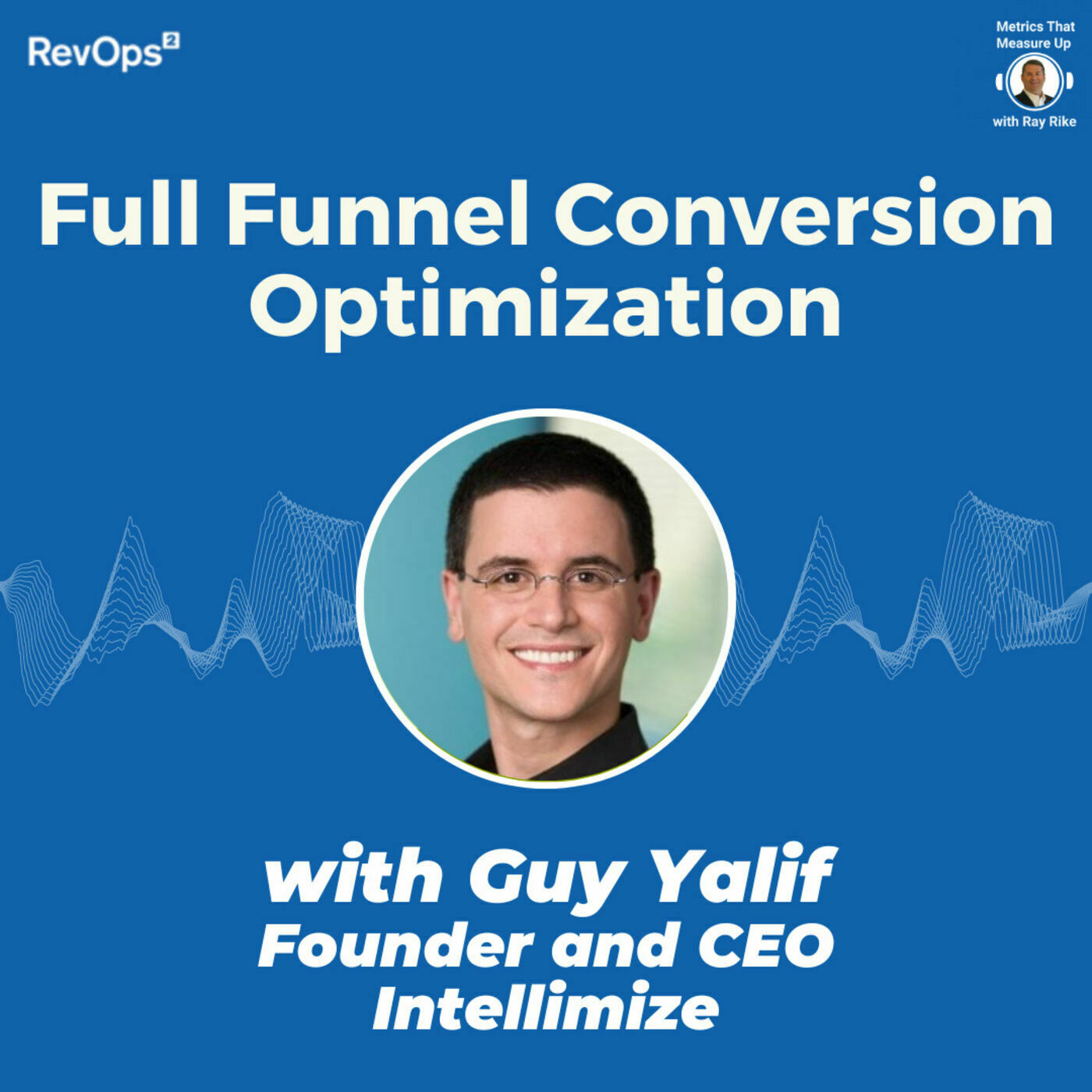
Full Funnel Conversion Optimization - With Guy Yalif, Founder and CEO - Intellimize
Have you ever met someone in their "early career" that you just knew was going to be successful? That was my feeling when I first met Guy Yalif, Founder and CEO of Intellimize almost 20 years ago!Guy has been both a Marketing and Product leader, which led to his creation of a company focused on optimizing full funnel conversion. Guy's vision is to personalize each website visit at the moment to create high-converting websites to optimize conversion and revenue. 1:1 web personalization has been discussed and evangelized as the holy grail of web experiences for over 20 years - so why is it just happening now? First, the technology is finally available to make this vision a reality, second marketers have been conditioned to create "segments" and then create custom lead routing rules for each segment due to the limitations of the technology.The reality is that humans max at 10-20 different business rules, and we cannot scale to the ultimate goal of 1:1 marketing which can combine thousands of different signals to show a user, in real-time content that is highlighted relevant to a market of one.The common trends of the day include defining Ideal Customer Profile segments and then combining that with different content and paths for each buyer persona(s). Third-party information such as "intent data" has been a recent development to further "segment" content to visitors based upon their intent, but still does not get us down to a unique website experience for each and every visitor - resulting in increased conversion rates.When asked if the technology is now available to convert this vision into reality, Guy said that before Intellimize the technology did not yet exist. Couple that with the need for scale and volume of traffic to train the machine learning, the infrastructure, and capabilities were not yet available for the masses.Large scale B2C companies, such as Amazon and Netflix have the resources and scale to build their own highly personalized 1:1 engagement methods. Unfortunately, smaller scale companies did not have access to a similar capability with similar capabilities but bundled as an easy-to-use, out-of-the-box solution for B2B Marketers.The conversation pivoted to the signals being used to enhance full-funnel, continuous conversion optimization? Signals can include data from any source including internal sources such as the marketing automation system, CRM system, and external signals such as time of day, day of week, location, previous activity/behavior on the website, and what content has previously led to conversion and revenue.Next, we discussed the measurements (metrics) that B2B Marketers should be measuring - limited to the top three. First, pipeline ($) generated, second was "cost per Lead (actually cost per MQL) and third was "share of voice". MQL to opportunity and MQL to Closed-Won conversion rates should also be a high priority. When I pushed on "cost per $ revenue", Guy highlighted that this was a great "quality" measurement to determine the quality of Marketing Qualified Leads and their conversion rates to revenue generated.I had to go to my favorite topic - and that is the time spent on "attribution". Guy said Marketers must be able to highlight the value that Marketing delivers, and though the ultimate focus needs to be placed on the ultimate outcomes of pipeline ($) and revenue ($), it is important to understand the touch points and engagement levels that lead to new customers. If you are interested in how to optimize the conversion rate starting at the first point of engagement on your website, this conversation with Guy Yalif is a great listen!See Privacy Policy at https://art19.com/privacy and California Privacy Notice at https://art19.com/privacy#do-not-sell-my-info.
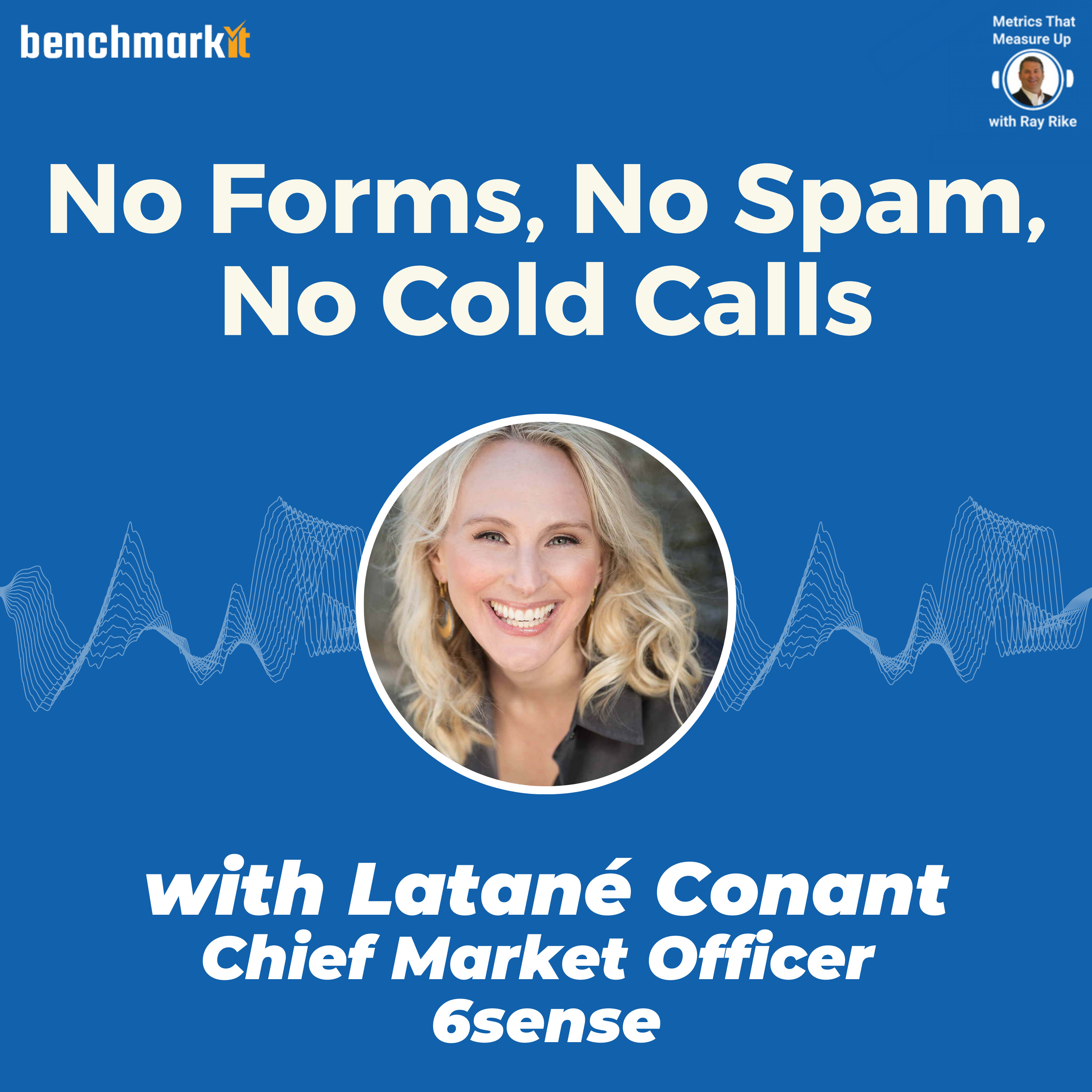
No Forms - No SPAM - No Cold Calls - with Latane Conant, Chief Market Officer 6sense
How many times have you visited a B2B website and cringed at being asked to provide your contact information, including your email just to download a white paper or watch a video?Why is this a reality in 2023 on most B2B SaaS websites? Because "leads" are still a primary measurement of Marketing success and marketers have not yet invested in the processes and instrumentation to focus on both the "pre-opportunity process" and then the ultimate outcomes of pipeline and revenue.One of the first topics we discussed was the "buying journey" which in the 6sense land is focused on the "pre-buying" or pre-opportunity journey which is often the area that is understood the least. A majority of the pre-opportunity journey is anonymous, most B2B companies will have multiple resources touching the early phase of the journey and there is real friction and resistance for buyers to reveal their identity early in the process.However, by understanding the pre-opportunity journey, a company is better positioned to engage with potential buyers in a more personalized and impactful way. Latane' defines the pre-opportunity buying journey into 5 phases including:- Target- Awareness- Consideration- Decision- Purchase (meaning they are ready to enter the active opportunity phase)Once a company moves into the "decision" of which company a buyer wants to engage in a sales process is the best time for B2B marketers to proactively reach out to a potential future customer. The concept of "IICP" takes the Ideal Customer Profile to another level by introducing the "in-market" Ideal Customer Profile. By understanding that an account is actively researching and evaluating a specific market category that your company plays in. Taking this concept to something that "Sales" cares about includes being able to provide the Sales organization with real-time leads that are actively "in-market" and thus have a much higher conversion rate to qualified opportunities.Next, we double-clicked into why a minority of B2B companies are not actively using "intent data" to determine when an "ICP" account is actively in-market. Latane highlights that a major obstacle is that a well-defined "workflow" is not often in place to ensure that the Sales Development team comes in each morning with a complete, prioritized list available for them to start the day off productively...versus spending their time researching and building a prioritized list for outreach.If you are responsible for engaging a target market and buyer to generate high-quality leads, and/or are interested in how to take advantage of intent data, account-based programs, and the dark web to increase pipeline quality - Latane is a great listen and her book NO FORMS, NO SPAM, NO COLD CALLS is a great read!See Privacy Policy at https://art19.com/privacy and California Privacy Notice at https://art19.com/privacy#do-not-sell-my-info.
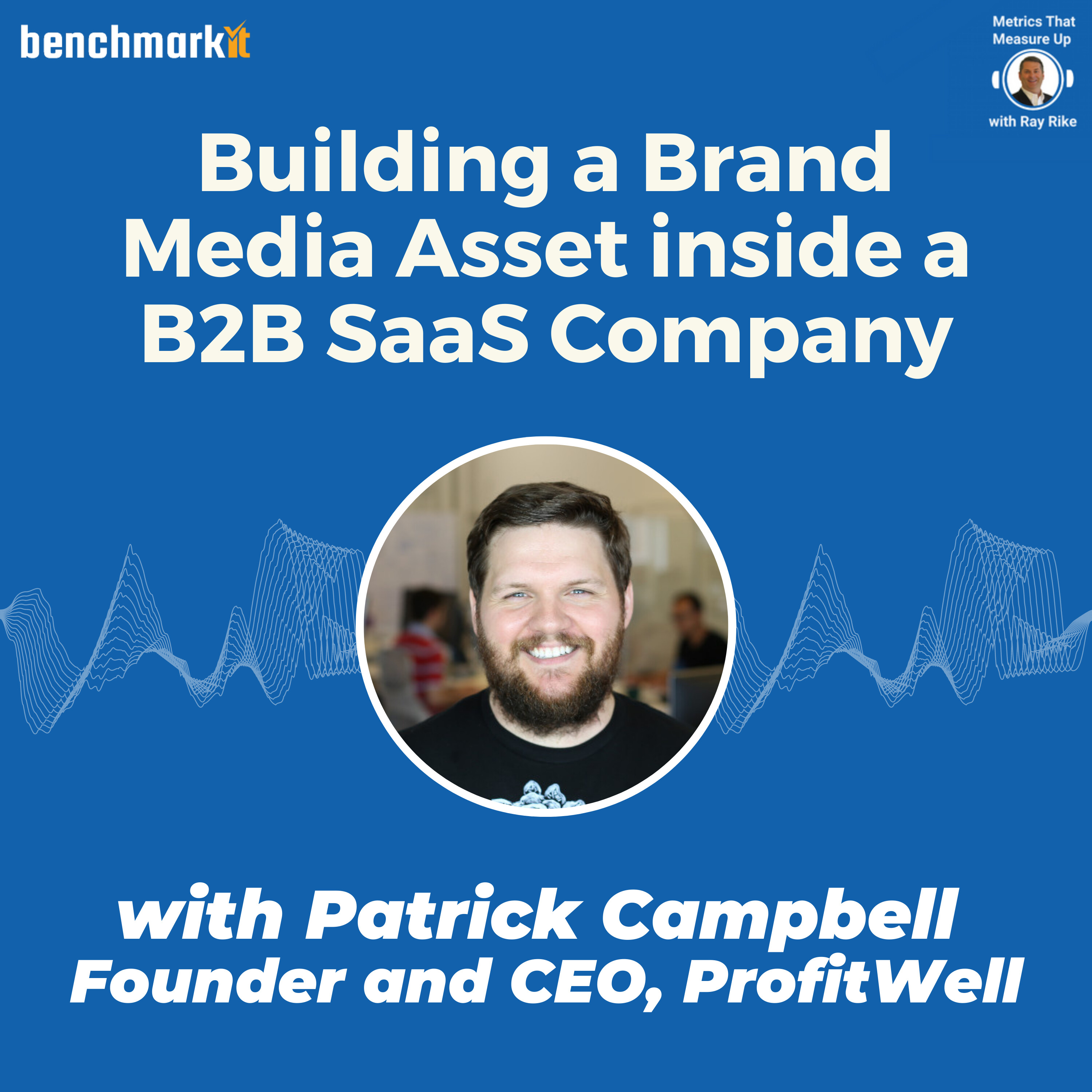
Building a media asset inside a B2B SaaS company - with Patrick Campbell, Founder and CEO ProfitWell (Paddle)
Media-Led Growth (MLG) is a term first introduced here on the Metrics that Measure Up podcast and the central theme of this episode.Who better to discuss this topic than Patrick Campbell, Founder, and CEO of ProfitWell, recently purchased by Paddle for an unofficial $180M+Patrick was a pioneer in building brand media assets inside a B2B SaaS company at ProfitWell - what led to the decision to invest in media properties?ProfitWell was facing a common challenge that most B2B SaaS companies face, how to sustain growth and generate "outsized" gains in a very competitive landscape. Eight (8) years ago the macro-level environment was different. Early on, email open rates were much higher, Google ads were much lower, and social media channels were just beginning to gain relevance. Over the last 3 - 5 years, those digital channels become noisy and much less effective.Resultantly, Patrick was looking for a more innovative, and more efficient marketing channels. ProfitWell was bootstrapped, which made efficient growth an even higher imperative. Early on, Patrick started posting information on churn rates, retention rates, and pricing which was a less saturated topic.Quickly, Patrick found the content was resonating, and based upon research discovered that traditional inbound marketing strategy (blogs/ebooks/whitepapers) averaged 1.6 touches per week from a qualified lead and traditional media companies average 5+ touches per week. With Customer Acquisition Cost increasing, Patrick had a hypothesis that media might be a "marketing secret weapon" within ProfitWell.On an economic basis, Patrick discovered they could produce a media asset like a podcast or video series with 13 episodes for the same or even less money than a traditional content marketing asset. As such - ProfitWell created multiple media assets - a media company inside a B2B SaaS company. Moreover, this "pool" of media properties provided an opportunity to engage potential buyers and influencers weekly. Additionally, Patrick didn't stop at a single media asset, at one point in time ProfitWell had 9 different media properties that engaged different buyers with different subjects.Patrick framed the value like this "imagine having 500 people attend a webinar you sponsor every week!" Having "shows based on the "problem and/or role" that ProfitWell was trying to reach as potential buyers of their SaaS product was the primary focus. This resulted in a "grid" of content and buyer personas that informed the decision to create multiple media properties. Patrick also highlighted the importance to measure performance early and continuously to end any properties that are not producing positive returns as measured listeners, downloads, and engagement.I asked Patrick "is audio or video the best place to start?" Patrick highlighted that audio is an easier and cheaper way to start, but introducing a video asset is a natural evolution.Finally, we pivoted to ProfitWell's use of "benchmarks" as another asset. Patrick started with his belief that benchmarks are not used properly. Benchmarks provide a "focus" on which metrics to review and where to prioritize focus. Those areas where your internal metrics are far off the benchmarks are a great place to start. If you are a B2B SaaS founder/CEO, Chief Marketing Officer, or other Go-to-Market executive looking for innovative and differentiated ways to reach your target audience and increase the frequency of engagement, this podcast is a GREAT listen that is chalked full of thought-provoking ideas from an expert!!!See Privacy Policy at https://art19.com/privacy and California Privacy Notice at https://art19.com/privacy#do-not-sell-my-info.

Product Analytics and Metrics that Matter - with Todd Olson, Founder and CEO Pendo
Product-Led Growth is one of the hottest topics and trends in the B2B SaaS industry. Heading into 2023, most company will be evaluating their usage of every SaaS tool, and as a vendor understanding how customers are using your product is foundational to understanding and forecast customer retention metrics.Todd Olso founded Pendo, the leading Product Analytics solution provider, over 9 years ago. His vision was to combine product analytics and product utilization to enhance the user experience.Todd highlighted that as "software eats the world" the Pendo customer base has expanded far beyond software companies to mainstream industries such as retail.The first macro industry term we discussed was "Product-Led Growth". Todd re-framed the question to be a "product-centric" company and that product-led growth is just one aspect of a company's culture. Todd explained that when selling to highly regulated industries like governmental entities, that product-centric may be more about enhancing the user's experience in a digital-led model, even though the sale of the product was executed by and with humans.Todd highlighted the phrase "is this a feature or a bug". The context of the phrase is that when the user experience requires a human being to train users, this is a bug that needs to be fixed by being a product-led company.Pendo has recently launched a "product-led certification course", to teach professionals, including product managers and any other leader looking to learn more about how to introduce product-led concepts into their company.We pivoted to the concept of the Chief Product Officer (CPO) and their role in a product-centric organization. The CPO should own the strategic goals of how the product directly drives the company strategy and goals including how to connect the product to market/customer needs.Todd's personal belief is that a product-led company requires having both a Chief Technical Officer and a Chief Product Officer. The primary difference is the CTO is more conservative and focuses on the "-bilities" of technical products while the CPO is looking for strategic growth advantages that have a higher risk profile. This differentiation provides a healthy friction between the two different primary goals.If you are currently using a product-centric, customer facing process, or considering a product-led growth strategy, this conversation with Todd Olson, Founder, and CEO of Pendo is a great listen!See Privacy Policy at https://art19.com/privacy and California Privacy Notice at https://art19.com/privacy#do-not-sell-my-info.
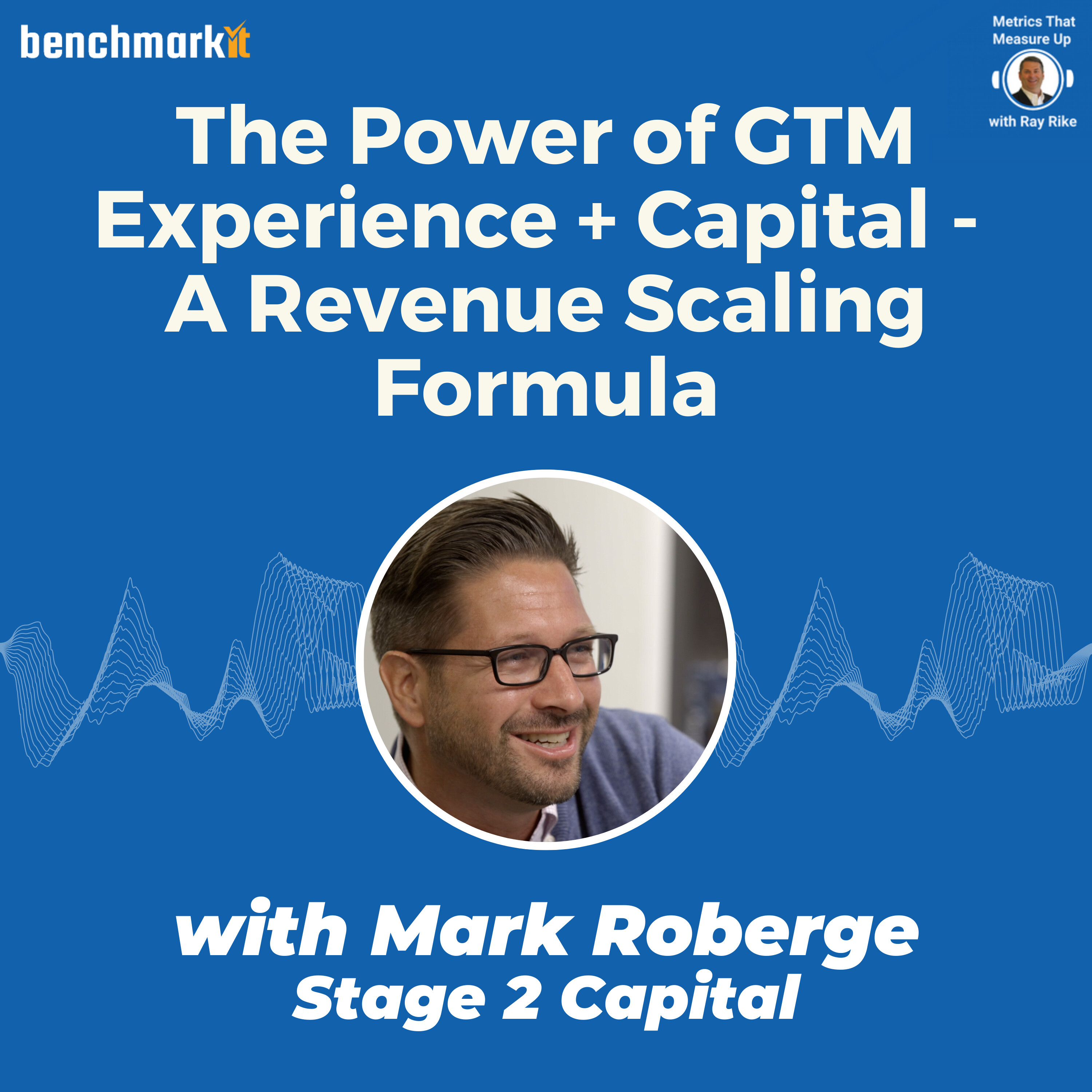
The Power of Go-to-Market Experience + Capital - with Mark Roberge, Stage 2 Capital
Mark Roberge is the founder and Managing Director of Stage 2 Capital and previously was the Chief Revenue Officer at HubSpot from 2007 to 2016. Mark is also the author of the best-selling book "The Sales Acceleration Formula".The lessons learned over his nine years leading revenue at HubSpot have led to several new endeavors including creating a Sales curriculum being taught at Harvard Business School and founding Stage 2 Capital. We started the podcast by discussing "The Sales Acceleration Formula" which was first published in 2015. The bool was stimulated by a breakfast between Mark and enterprise sales influencer and author, Jill Konrath. It evolved from a concept called "The Art and Science of Sales" to become the basis for the book. The Sales Acceleration Formula is essentially an autobiography of how Mark built and scaled the revenue organization at HubSpot.The presence of Customer Relationship Management (CRM) systems enabled Sales to become more data-driven, and changed how Mark leveraged that data to inform how he built and managed the sales organization. One of the most interesting perspectives Mark shared was how he and his management team used the data being generated from the CRM. Using the insights from the CRM data changed how HubSpot Sales Managers were able to better coach sales reps based on the "signals" being generated. Foundational to capturing those insights was the need to develop a very well-defined and structured sales process that generated performance metrics at each stage of the sales process.We quickly pivoted to a leading sales technology of the day, Conversational Intelligence. I asked Mark why with the ability to capture and listen to every Sales conversation has not made full sales funnel performance a more data-driven, sale management and coaching process.Mark highlighted one reason is that Sales organizations are often so focused on "chasing the number", that they do not carve out the time to step back, take a strategic planning approach to the future based on historical performance metrics and incorporate that into the planning process. This "reactive mode" cascades and impacts the organizational culture to one of high urgency - low value reactions versus one of high value - low urgency strategic activities leading to increased performance.Another topic we discussed was the 360 lead review process at HubSpot, which lead to the concept of the SMarketing SLA (Service Level Agreement). Marketing and Sales co-owned the pipeline generation and lead development process, and as a result consistently led to analysis of pipeline generation performance. Far too often, there is significant friction between Sales and Marketing, which can be addressed by leading into the data. This starts with defining what a "lead" really is and starting to measure lead performance and conversion across the entire lead-to-customer process.Finally, we discussed the catalyst for founding Stage 2 Capital. Stage 2 Capital is unique in that the Limited Partners (investors) are primarily successful B2B SaaS Go-to-Market executives who can provide both capital and applied operating experience across each stage of a B2B SaaS company's growth. One of the important findings was the failure rate to scale across different stages of growth is much too high. The Science of Scaling was based on research that Mark conducted across several early-stage companies, and then he applied the "challenges of scale" to the formation of Stage 2 Capital.If you are considering raising funding for your SaaS company, or are just looking at how to more efficiently scale your revenue generation engine at the next phase of growth, the conversation with Mark Roberge is extremely instructive based upon the experience and success of Mark and hundreds of other GTM executives involved in Stage 2 Capital.See Privacy Policy at https://art19.com/privacy and California Privacy Notice at https://art19.com/privacy#do-not-sell-my-info.

A Chief Revenue Officer's learnings from $0 - $100M+ ARR - with Mark Kosoglow, CRO Catalyst and SVP Sales, Outreach
Imagine having your founder and CEO working weekends to develop leads and a calling list for the VP Sales in an early-stage B2B SaaS company. That was Mark Kosoglow's experience when he first joined Manny Medina, the founder, and CEO at Outreach - the leading Sales Engagement Platform company in the industry.I asked Mark about the reality of leading Sales at an early-stage B2B SaaS company, and if he could share a couple of lessons he would share. The importance of building pipeline was priority #1 and is something he is living with in his new role as the CRO at Catalyst Software. In fact, Mark said pipeline cures most ills of an early-stage B2B SaaS company.When we double-clicked on pipeline, I asked Mark about the importance of identifying the Ideal Customer Profile early in the journey. Mark said this was critical to focus the outbound demand generation efforts early on, and to also build a buyer persona map to identify the different key members of the buying team, and create messaging that resonates with each buyer. Mark requires Sales Development Representatives to conduct at least 50 activities per day, and add 15 new contacts into a cadence every day while ensuring there are no outstanding to-do activities at the end of every day.What is the role of Account Executives in creating pipeline? Mark has a standard operating model which depends on the profile of the actual average contract value. But, as a rule, he uses the goal of 25 opportunities in the pipeline. Once that opportunity goal is hit the goal of outbound pipeline generation activities is reduced from 50 activities and 10 people sequenced per day to 50 activities and 10 people sequenced per week. Once the number of active deals in the pipeline reduces back to 15, then the activity goals increase back to 50 activities per day.Cold calling is a lower value for Account Executives in the early stage but is a reality of the role until the active pipeline is to a point where 100% of an AEs time can be allocated to the highest value activity of turning opportunities into revenue.Next, conversion becomes a top priority. One is a well-defined, stage-based deal management sales process, and second a strong deal review and management process to help the AE successfully move from opportunity to revenue. How a rep can "guide" the buyer through the buying process is a top priority in how sales management should be coaching an AE in the early days.Mark does not believe stage-by-stage conversion is a priority early on, as there is not enough data to provide statistically valid feedback. However, at each stage of the Sales process there should be a primary "question" that should be answered such as:- Do they have problems we can solve?- Are the problems big enough to solve?- Will the buyer agree "how to buy"?- Will their investment be worth it? - Will they buy?A key to his success is encapsulated in the quote: "process makes you great, but documentation makes you legendary". This was discussed in the context of when to introduce a Sales Enablement function. Are there any signals that suggest when to invest in a Sales Enablement function? Mark highlighted that Sales Enablement is responsible for onboarding and not ongoing coaching or figuring out Sales Process, that is the Sales leader's role.If you are considering a Sales leadership role at an early-stage B2B SaaS company, or are a founder/CEO looking to scale beyond founder-led sales, this conversation with Mark is a great listen!See Privacy Policy at https://art19.com/privacy and California Privacy Notice at https://art19.com/privacy#do-not-sell-my-info.
The Different Buying Team Profiles - with Brent Adamson, author the Challenger Customer
Heading into 2023 companies are preparing for larger buying teams, and increased scrutiny on every purchase. I could not think of a better backdrop to speak with Brent Adamson, the author of The Challenger Sale and The Challenger Customer.The Challenger Customer is based on research focusing on the different "profiles" of the buying team in a considered "SaaS" purchase. This is one of my all-time favorite books focusing on how to understand the buying process and charting the sales process accordingly.We started the conversation with a comment Brent recently made on another podcast, and that was "the SaaS industry has broken sales". As we double-clicked on this comment, what Brent was highlighting was that due to the large influx of capital and thus the number of companies increased so quickly, sales became more of a volume-centered process versus the more traditional, value-based, solution selling that traditional software companies used before the "growth at any cost" phase of the SaaS industry evolution.Another variable that impacted the volume-centric approach was the rapid evolution of "Sales Technology" which automated many of those processes that were traditionally executed manually by a sales professional. As a result, many sales professionals over-indexed activity and volume and lost some level of attention to what makes each target account and the individual members of the buying team unique.When Brent conducted the initial research to write The Challenger Sale, one consistent truth uncovered was that no single buyer, not even the executive decision maker wants to make a decision isolated from the broader team. Their driving need is to gain team agreement or consensus on strategic purchases - such as SaaS solutions.In the initial book, it was discovered that there were 5.4 individuals in every strategic purchase decision, and that number has consistently increased over the last few years - hitting 11 or even more in 2022. Though even though this number is significant, the more important aspect of this reality is the "diversity" of the profiles, functions, roles, and decision criteria for a strategic purchase. The above was the basis for Brent's second book, The Challenger Customer. The first topic we discussed was the different profiles of members of the buying team who are "mobilizers".What is a mobilizer? Based upon a survey of 2,000+ B2B Sales Professionals, the top performers identified that the most important attribute of a buyer persona was their ability to build consensus and willingness to drive change in their organization. This is much different than the standard, find a coach, champion, or executive decision-maker in the sales process. What are the different types of "mobilizers":- Skeptic- Go-Getter- TeacherSkeptics typically are the most difficult to accept the value proposition of your solution and how it will work in their environment. However, once the skeptic is won over, they will be the best advocate for your solution being purchased and implemented. On the other hand, the "friends and the guides" may want to talk with you more than anyone else at the potential customer, but are not good at mobilizing change in their company.Next, we discussed the importance of tapping into the "emotions" of the buyer. It comes down to the concept of "Identity Value" and goes beyond company value or professional value. Identity Value is the value that sponsoring a purchase will impact how a person feels they are viewed and how they view themselves. Once a person feels your solution impacts their "identity value" it will dramatically increase their desire advocate purchasing your solution.As we enter 2023 and encounter a "cautious capital" approach to purchasing new solutions, I cannot think of a better use of time than listening to Brent AND reading The Challenger Sale!See Privacy Policy at https://art19.com/privacy and California Privacy Notice at https://art19.com/privacy#do-not-sell-my-info.
Marketing Metrics that Matter to the CFO - with Chris Golec, Founder and CEO Channel99 and Demandbase
Heading into 2023, B2B SaaS CFOs are doubling down on using performance metrics to guide the 2023 operating budget. A key question is what metrics they use to help evaluate the Marketing budget, and what metrics they wish they had from Marketing to help inform budget allocation and investment decisions.Chris Golec, the founder, and CEO of intent data and account-based program platform leader Demandbase has recently launched his new company, Channel99 which is purpose-built to help bridge the gap between Marketing performance metrics that Marketing is currently capturing and those performance metrics that Finance leaders would like to see that help inform their budget allocation and investment analysis.We started the conversation with Chris on the evolution of B2B Marketing over the last ten years. In the early 2010s, Marketing Automation platforms enabled broader and more frequent outreach to their target buyers, and then Account-Based programs started to evolve in the 2015 - 2020 timeframe to increase the "quality of Marketing outreach. Chris predicts that moving into 2023 and beyond, B2B Marketing organizations will be held to more "performance-centric" measurements that focus on the ultimate outcomes of pipeline and revenue ($) that the CFO uses to evaluate return on investment for all Marketing program investments.We dove into the megatrends that Chris mentioned early in the podcast, and the impact of Marketing Automation, Intent Data, and Account-Based Marketing programs. Chris highlighted, though self-admittedly from a biased perspective that these investments did increase the Return on Marketing investment, but most companies do not have the infrastructure to measure the impact of Marketing investments down to the last mile of pipeline and revenue ($).When asked if Marketing is using metrics to inform decisions, Chris highlighted that the majority of Marketing performance measurements (metrics) are primarily department focused, and not linked to the ultimate outcomes that CFO and CEO are most interested in - Pipeline and Revenue generated. One quick action to change this reality is for the CEO and CFO to require Marketing leaders to measure the ultimate outcomes in dollars...not activity, engagement, and leads.Chris shared his premise that one reason that Marketing does not provide more granular "finance performance metrics" to the CFO is the lack of easy-to-use infrastructure that can measure dollars invested in high-priority target accounts that fit the Ideal Customer Profile (ICP) through to revenue generated.Another key requirement to capturing and generating good Marketing ROI performance metrics is to start with understanding discretionary program spending on things like paid and organic search and understanding not only the engagement levels, but the engagement levels with accounts in their target market (ICP) and then pulling the thread all the way through to revenue.If you are a "performance" centric B2B Marketer or a Finance leader trying to better understand the return on Marketing investment, the conversation with Chris Golec is highly informative and thought-provoking!!!See Privacy Policy at https://art19.com/privacy and California Privacy Notice at https://art19.com/privacy#do-not-sell-my-info.
The journey from FP&A to SaaS CFO - with CJ Gustafson, CFO PartsTech
Mergers and Acquisition analyst to FP&A professional to SaaS CFO. This is the path that CJ Gustafson took on his journey to becoming the CFO at Parts Tech.The common thread across each step of his journey was metrics, a perfect subject for CJ's appearance on the show. CJ developed his excel and financial chops during his first role as an M&A analyst, which served as the foundation for his success in modeling financial plans and budgets.What are the critical experiences and learnings CJ learned in his FP&A role that prepared him for being a SaaS CFO. A unique opportunity in FP&A is being in the room with senior executives, and learning how successful leaders organize their resources for success. Building upon that, being able to ask questions of the senior leadership team provided him access and insights that most roles do not afford.Having cross-functional insight across Marketing, Sales, Products, and Operations provided a holistic view of how businesses plan, make decisions and manage. When asked what the most surprising part of being a CFO, was the sheer number of vendor agreements that required review and approval, and the associated skills required to negotiate strategic agreements that directly impact the operational and financial performance of the company.Mostly Metrics is the newsletter CJ launched about 2 years ago. What was the motivation to create a newsletter focused on metrics? First, being able to document and reference his learnings in previous roles. Secondly, the newsletter provided CJ the opportunity to ask thought leaders and successful executives, and investors about topics directly related to his newsletter. Third, CJ finds writing things down is key to him remembering and thus being able to recall previous learnings when required in the current working environment.Heading into 2023, many CFOs are scrutinizing revenue and expense budgets at another level of granularity. So I asked CJ for his advice to other first-time CFOs as they prepare their first annual budget. First, CJ recommended the value of experiments before committing the annual budget to new ideas and investment areas. Secondly, make sure the headcount plan is very detailed by month, and use a "max" headcount model versus incremental headcount centric, as attrition is hard to forecast. Finally, CJ recommended no more than one new software platform be implemented per quarter. Limiting new software implementations is as much about the organization's ability to implement, train users and ensure effective utilization of the new software to gain the benefits, as it is to control the expenses.What are the "metrics" that CJ is focusing on heading into 2023? CJ highlighted the need for a CFO to understand the metrics that departmental leaders use to inform their decisions. An example is going beyond CAC Payback Period to learn something like the importance of "activation rate" in a PLG motion and how that ultimately impacts the company-level financial metrics. Understanding the departmental top priority metrics also informs CJ's understanding of the budget requests the department executives are making, and how they will measure the ROI. We also went into those "metrics" that are specific to a company, maybe even a North Star metric. CJ highlighted the shopping cart abandonment rate as key to understanding the PartsTech user, and how that one metric provides both product priority, and also a key performance metric to improve that has a direct impact on revenue growth. A North Star metric that CJ now uses is Gross Merchandise Value which is critical to understand, as it's at the center of forecasting.If you are interested in the path to becoming a CFO, this episode with CJ is a great listen.See Privacy Policy at https://art19.com/privacy and California Privacy Notice at https://art19.com/privacy#do-not-sell-my-info.
Kind Folks Finish First - Sam Jacobs, Founder and CEO Pavilion
STOP if you do not think that the concept of "Kind Folks Finish First" is applicable in corporate America!Sam Jacobs, the founder, and CEO of Pavilion realized that getting fired for the third time was the catalyst for finally understanding that pursuing his real passion "to help others" was the key to finding both success and fulfillment.Sam credits a shift in "mindset" as foundational to creating a company and a passion that enable him to find happiness and success. The Power of Failure are the first four words in Chapter 1 of Sam's best-selling book - Kind Folks Finish First. As Sam's CEO shared that his services were no longer needed, he realized that believing you are a failure, you are a failure. Rather, if you think about failure as learning, experience, and wisdom your path to success will become much easier. Why is it so hard to stop being a "victim of your situation" versus the master of your destiny? The common emotion is "fear" because they are afraid. Often this mindset provides the motivation to identify why what you experience is unfair and not due to your own decisions and actions. Admitting to yourself that you are responsible for your experiences and outcomes can be liberating and the foundation for real growth.What do you stand for was the opening to Chapter 3. Sam highlighted that this was not a question he asked himself, it was a question that his coach forced Sam to answer for himself. Being in New York City, Sam felt that "making money" was his primary goal and motivation. Sam's coach said is that where you find energy, and after a few week's Sam realized he stood for "helping people to cared about to meet their professional goals". This clarifying moment was the catalyst for the "what and how" of building Pavilion.Getting by Giving, was a central theme throughout the book and is also a key Pavilion value. Sam said being very selective in investors and employees who share that mindset and value is key to ensuring the culture of a company lives by those values. Being able to focus on the long-term goals and building the culture, means you might sacrifice growth rates to build a long-term, durable growth company that uses its values to guide its journey.Every crisis is an opportunity, another key phrase Sam shared in the book. Sam's primary advice is that you must look outside of yourself. The instinct in a difficult environment is to focus on yourself - but in times of challenges focus first on your "customer's" challenges and situation and allow that to be your guide for decision-making. With that mindset and focus, the investment you make in your customers now will provide returns over time that cannot be measured with a short-term orientation focused on "your needs" versus "your customer's needs".Sam's transformation which started once he realized "his true calling to help others" is an inspirational story and message for anyone looking for happiness and success in their professional life.See Privacy Policy at https://art19.com/privacy and California Privacy Notice at https://art19.com/privacy#do-not-sell-my-info.
Saas Metrics for Investors and Execution Decision Making - with Nick Franklin, Founder and CEO ChartMogul
Nick Franklin is the Founder and CEO of ChartMogul, a leading SaaS Metrics Reporting, and Subscription Analytics Platform. Nick worked for five years at ZenDesk, where he led both Europe and then Asia-Pacific before founding ChartMogul eight years ago.With 2,500 B2B SaaS companies as customers, Nick's insights around how companies use metrics to inform decision-making are unmatched. Nick's perspective is that during the earliest days of a B2B SaaS company's evolution, the importance of being able to track metrics begins. An example early on is how pricing and packaging impact customer acquisition and growth. Another example Nick highlighted is if a founder is considering raising external funds, having a grasp on the key financial performance metrics is critical to gaining investor confidence.Nick highlighted the importance of providing access to company performance metrics to all employees is critical to creating a metrics-centric culture. When I asked Nick "why companies do not provide performance metrics transparency to their employees?", Nick shared that many of their customers simply say they prefer to keep company financial information "on a need-to-know basis". Nick could not explain why that is beyond history and an old-fashioned mentality.Nick responded that they wanted to ensure that even the earliest-stage companies could develop a metrics culture, and use ChartMogul as that infrastructure. That is why ChartMogul provides a free version of its platform to companies with less than $10,000 MRR. Over fifty percent of their customers are paying customers up to $100M ARR. Some companies decide to use a metrics and subscription analytics platform in preparation for an impending financing event, which begged the question of what are the top metrics investors want to see a founder truly understand. Nick highlighted early customer retention, revenue and product engagement growth, and eventually dollar-based customer retention and expansion.Double clicking on the "engagement" measurement, what are the common metrics to measure? How many users, how many times do they log into/use the platform on a daily/weekly/monthly basis, and then almost always there is a product-specific "North Star Metric" such as messages, API calls, documents sent, etc...During our discussion on "engagement", I asked Nick what the aha moment, often referred to as the "activation point" is for ChartMogul. He shared that integrating into a subscription management platform is the first activation point, but more importantly the "high-value activation point" is when the user gains insight or perspective on a metric that was not previously available, understood, or even considered as a critical business metric.If you are evaluating how best to capture, calculate, publish and use metrics to inform your B2B SaaS journey and decisions, this conversation with Nick is a great listen.See Privacy Policy at https://art19.com/privacy and California Privacy Notice at https://art19.com/privacy#do-not-sell-my-info.
Revenue Operations Outsourcing Strategy - with Cliff Simon, CRO Carabiner Group
Revenue Operations - the buzz has continued in 2022 but how to introduce and then maximize the return on investment is still a work in process.Cliff Simon, the Chief Revenue Officer at Carabiner Group, an early leader in Revenue Operations stopped by to share his insights into how to maximize the return on RevOps.First, we discussed if Revenue Operations is viewed and delivering as a Strategic function or being relegated to tactical activities such as data management, revenue technology administration, integration, and report development. Cliff shared that Revenue Operations MUST be a strategic, data-driven organization that surfaces and highlights opportunities for increased revenue growth in partnership with the C-Suite.One large risk, despite the best intentions, RevOps often gets so overwhelmed with daily, reactive activities that they forget to take the time to step back and take a more holistic, strategic approach to the insights they are gaining from the data, metrics and process improvement opportunities they see every day. One reality is that RevOps as a profession has grown so quickly, as highlighted by the increase from 5,600 to 17,000 RevOps titles on LinkedIn today, and the 30K+ open positions being promoted online today. This increase in demand for RevOps professionals has led to the current lack of experienced Revenue Operations leaders who understand the strategic impact of Revenue Operations.How is a strategic Revenue Operations function be measured to show the return on investment? Though it is hard to benchmark the impact RevOps has on financial performance metrics, RevOps should be responsible to surface the insights, metrics, and benchmarks for internal revenue performance metrics to the executive team, including highlighting the opportunities for increasing revenue growth and revenue efficiency. One recent research program highlighted that companies with a centralized Revenue Operations function grow 30% faster than those without the function.Today's reality is that the majority of Revenue Operations departments are still primarily focused on tactical activities, and only at $50M ARR and above do companies have the resources and capacity to have a Revenue Operations leader is truly strategic. However, companies should invest early in a RevOps function, and that includes having Sales Ops and Marketing Ops as roles that report into a broader Revenue Operations organization.Another topic Cliff highlighted is that RevOps owns the process to "document" the processes that underly and support the entire Revenue lifecycle. This supports the growth of the company, and as new leaders and resources enter the organization, they can quickly under the "current state" of revenue-generating processes and the associated performance (in the form of metrics) to better inform their decisions on how to evolve the organization and accelerate revenue performance.What metrics should RevOps be measuring: 1) Revenue Growth; 2) Sales Cycle Time; 3) Win Rate; 4) Pipeline Generation Metrics; 5) Net Dollar Retention (including churn)If you are a SaaS CEO, CFO, CRO, or Revenue Operations leader, this conversation with Cliff Simon provides some great knowledge nuggets on increasing the impact that Revenue Operations can make in your company.See Privacy Policy at https://art19.com/privacy and California Privacy Notice at https://art19.com/privacy#do-not-sell-my-info.
RevOps as a Strategic Revenue Planning Partner - with Toni Hohlbein, Growblocks
As a Chief Revenue Officer, Toni has had a front-row view on scaling revenue engines, and one major challenge he faced was that too much time was spent on financial planning and budgets, versus how to best make money.The first question we discussed was the difference between FP&A and Revenue Operations. Toni's perspective is that Revenue Operations is much closer to the revenue generating process, and thus has a deeper insight into how revenue is generated, and as such should be a key part of the revenue planning process.Next, we discussed how being involved in the revenue planning process makes RevOps a more strategic partner to the executive team. RevOps top three responsibilities are data, process, and tools but only the start. The trick is to take the insights from the aforementioned three responsibilities and becoming the primary purveyor of insights into how the revenue engine is performing on an end-to-end basis.Potential strategic activities starts with revenue planning, which starts with how to generate revenue efficiently. Next, RevOps should be the "mission control" through regular meetings with the commercial (revenue) leaders, and discuss the insights from the dashboards and reports they are providing. Key to the value of these discussions is how to overcome the issues that the data is surfacing.One of the opportunities in today's business culture is becoming data-driven without becoming data overwhelmed. Revenue Operations should take the lead on determining how the data, reports, and dashboards they are creating inform the decisions on how to increase the probability of making the number and even forecasting how the current "data" predicts the revenue future.How can a company ensure that Revenue Operations does not become so reactive to the daily requests, that they cannot carve out the time to be strategic partners to the CRO? First, RevOps leaders should ensure there are good "outcome goals" for how the data and reports will be used, and prioritize time to analyze the data in the context of "how does this data and metrics inform our future revenue outcomes".What are the top "5" metrics that a RevOps leader should own? First, the mindset needs to be that they own the revenue number along with the CRO. Second, CAC Payback Period by cohort including regional, customer segments, and even product level in larger companies. Third, Customer Lifetime Value is a great metric, but since it is so multi-variate in nature, it must be broken down into the input metrics (variables) to isolate which leading indicators are impacting CLTV - a classic outcome metric.If you are a Revenue Operations professional or a senior executive evaluating how to increase the business impact of RevOps, this conversation with Toni is a great listen!See Privacy Policy at https://art19.com/privacy and California Privacy Notice at https://art19.com/privacy#do-not-sell-my-info.
Customer Lifecycle Metrics - With Craig Rosenberg
Craig Rosenberg has worked with hundreds, if not thousands of B2B SaaS companies as the co-founder of TOPO, Distinguished analyst at Gartner, and now as Chief Platform Officer at Scale Venture Partners.Across Craig's roles, he was able to take an expensive view across each stage of a SaaS company's growth including strategy, people, process, technology, tactics, and over time METRICS!Craig highlighted that the best companies in the world were/are "metrics" driven, and as Craig started to work with larger, enterprise-class companies beyond SaaS being "metrics and data" driven was even more critical to decision-making."End to End" Customer Journey is an often discussed subject, but what is it really? Craig's perspective is most customer journey mapping is too generic and needs to be very focused on how the customer buys starting with using third-party internet activity to marketing interactions to Sales Development to Sales and then ending at "Closed-Won". Going beyond Closed-Won to include customer engagement, retention, and expansion,Going beyond mapping and understanding the entire customer journey including acquisition, retention, and expansion, companies need to "SEGMENT" the metrics by customer cohort, such as SMB vs Mid-Market vs Enterprise. Another view should be based upon "HOW" the prospect/customer came into the customer lifecycle process, such as lead source and/or lead channel.When I asked "who" in a company should map the customer lifecycle, Craig's response was quite pragmatic: "whoever is best at mapping the customer lifecycle in your company". Craig added that Revenue Operations is a perfect organization to take the lead on customer journey mapping, and building a "coalition" across Marketing, Sales, and Customer Success. An important caveat is that without the support and involvement of the CEO it becomes less significant and strategic.Another topic we discussed, was if a company should involve customers in the "journey mapping" process. Craig said of course, but you only need to include a few customers in the process as talking with more than 10 customers will provide diminishing returns.Next, I asked Craig about what metrics are priorities to measure the efficiency of the customer lifecycle across acquisition, retention, and expansion. Craig started with the Four Vital Signs Framework to track in a SaaS company:- Growth- Efficiency- Churn- BurnNext, we discussed if any of the Vital Signs are more important at each stage of a company's evolution. Craig's first recommendation was to instrument and begin capturing metrics for all four vital signs early in the journey. Certain metrics like churn/Customer Retention will become more important as a company grows beyond the first and second renewal cycles, but identifying and instrumenting for metrics should begin earlier than most companies believe are required.No matter what stage of growth your SaaS company is currently in, this discussion with Craig Rosenberg provides many interesting, insightful perspectives on the importance and priority of metrics across the customer lifecycle.See Privacy Policy at https://art19.com/privacy and California Privacy Notice at https://art19.com/privacy#do-not-sell-my-info.
Metrics Require Context - with Scott Stouffer, founder and CEO scaleMatters
Have you ever looked at all of the reports, dashboards, and data presented across your company and felt overwhelmed and under-informed?Today's data-driven world far too often results in a lot of data but not better decision-making or company performance.Scott Stouffer founded his first company in 1993 and has lived the reality of how Go-to-Market Strategy is not a one-time thing, but a series of iterations over time. Scott compares today's need to continuously evolve your GTM strategy much as Agile did for software development. Basically an "Agile Go-to-Market" model.The above reduces the amount of investment wasted on strategies and tactics that never provide the required return. By definition, the majority of companies will not nail the Go-to-Market motion on the first try. Examples include identifying the top Ideal Customer Profile, creating the perfect messaging and positioning strategy, or even the best sales motion to engage, interest and acquire new customers.One key to successfully using an "agile" GTM model is to limit the number of new variables you introduce at any given time. One example Scott provided was an experiment that uses "new messaging" as the only new variable and measures how that performs as measured by activity to conversation to meeting to opportunities.A key to identifying which GTM motion is working is to ensure you instrument and measure the performance metrics that provide real market feedback on the efficacy of your GTM tactic(s). This applies not only when you first enter a market with a new product, but when you enter a new market with an existing product that was successful in a different market. The next topic we covered was the "DEFINING" moment in the podcast (11:40 in the podcast). Scott started with an analogy on how a cholesterol measurement of 50 is meaningless without context, but if you know the measurement was 45 six months ago AND the appropriate benchmark for the patient is 20-35 there is CONTEXT to the measurement (metric) and requires attention.Scott's point on "Go-To-Market Metrics Require Context" was defined by using one if not all of the following variables: 1. Time - how is the metric trending over time 2. Plan - how is the metric performing against the plan 3. Causality - what variable(s) impacts the metric 4. Significance - How does this impact our business 5. External Industry Benchmarks - how do I compare to the external marketAnother topic we discussed was WHEN and HOW to instrument your Go-To-Market systems to capture and then use the GTM metrics to inform decisions. Scott suggested that when a company moves beyond "Founder Led Growth" into Sales Led Growth is the time to instrument GTM metrics. One caveat was metrics become more instructive once Product Market Fit is established, and it is appropriate to scale Marketing and Sales investment.Growth efficiency, a trending topic in 2022 becomes more important once Product Market Fit is achieved and the investment in Marketing and Sales continues to increase..even in $1M - $5M ARR companies.If you are looking for ways to increase Go-to-Market efficiency and increase the value of metrics in decision-making, this conversation with Scott is amazingly informative for first-time founders and the most experienced GTM leaders.See Privacy Policy at https://art19.com/privacy and California Privacy Notice at https://art19.com/privacy#do-not-sell-my-info.

Metrics that Matter to a CRO - with Bill Binch, Operating Partner at Battery Ventures
Bill Binch has led revenue teams at highly successful B2B SaaS category creators, including Marketo and Pendo.Having real-life, applied experience and success at scaling high-growth companies, while also having broad insights into several Battery Ventures portfolio companies provides Bill with a unique perspective on how Chief Revenue Officers use metrics to inform their journey.Bill's journey over 29 years has informed how his use of metrics to lead a revenue team has evolved, alongside the advancement of revenue technology options. Though Sales has always been the ultimate function to be measured by metrics (quota achievement), today's CRO can have much better insight into the "signals" or "leading indicators" that directly impact quota achievement.Today's Sales leaders are reviewing and asking deep conversations about pipeline trends, which sources are delivering the most, and highest quality leads that result in Closed-Won revenue. But what metrics does Bill think are most important for each stage of a B2B SaaS company's growth:$𝟬 - $𝟭𝟬𝗠 𝗔𝗥𝗥:- Customer logo count which provides Sales team confidence and future customer confidence- Average Contract Value- Average Sales Cycle> $ 𝟭𝟬𝗠 𝗔𝗥𝗥- Net Revenue Retention (NRR) measures how much ARR a current customer delivers year over year. Example if $50K ARR this year and $60K ARR next year = 120% NRR- Predictive metrics that forecast future revenue performance including Pipeline Performance and Quota CapacityHow does Bill define the CRO's responsibility? Bill's perspective is the word "REVENUE" defines the CRO's responsiblity to including: 1) New Revenue; 2) Expansion Revenue; 3) Retention Revenue. Bill does not believe that the CRO should include the Marketing function.Bill firmly believes that Sales and Marketing should co-own the qualified pipeline goal, not just leads, Marketing Qualified Leads, or other Marketing centric objectives that do not directly impact the pipeline. The "intersection" of Marketing and Sales is PIPELINE. Far too often in board meetings, Bill sees Marketing and Sales present data, metrics, and reports that have little to no direct correlation and definitely no causation.What are the "pipeline metrics" Bill thinks are most important? Bill likes "Pipeline Coverage Ratio" which calculates how much qualified pipeline is required to achieve $X in revenue. Bill also introduced his pipeline "MOJO" dashboard which includes a dashboard that tracks daily pipeline trends including:1. Deals created2. Deals lost3. Deals expanded4. Deals decreased5. Deals pulled forward6. Deals pushed backBill shared that since the CRO should own all revenue inputs, including acquisition, retention and expansion they should also be responsible for the Customer Success function. However, once a company scales to greater than $50M - $100M the role of the Chief Customer Officer should report directly to the CEO and not the CRO.I also asked Bill if the CRO should own revenue efficiency metrics, such as CAC Payback Period or Customer Lifetime Value? Bill's perspective is that the CRO should be aware of how their performance metrics impact company level metrics that the CFO should own, including CAC Payback Period, Customer Lifetime Value and Rule o 40 (as examples).Lastly, I asked Bill what are the core metrics that the CRO should report to the board. They include: 1) ARR Growth - trend over 5 quarters; 2) ACV - 5 Qtr trend; 3) Average Sales Cycle - 5 Qtr trend; 4) New vs expansion split - 5 Qtr trend; 5) Average Revenue Per Account - 5 Qtr trends; 6) Logo adds - 5 Qtr trend; 7) Segmented based metrics as a company scalesBill's experience as the CRO that led growth at two incredibly successful and market creating SaaS companies and now as an Operating Partner at Battery Ventures makes this a must listen conSee Privacy Policy at https://art19.com/privacy and California Privacy Notice at https://art19.com/privacy#do-not-sell-my-info.

Traversing the Traction Gap Framework - with Bruce Cleveland
It's hard to imagine being a key part of three industry-defining product categories, which is exactly what Bruce Cleveland has experienced in his Silicon Valley software career. First, Bruce was an early executive leader at Oracle (first 100+ employees) as they re-defined relational databases, then on to Apple where he led the object-oriented engineering division, next he led the business development and alliances team at Siebel Systems before he took over products as they defined Customer Relationship Management (CRM), and then again at C3.ai in defining Enterprise AI. Three of those experiences resulted in IPOs. Bruce then became a VC, first at InterWest Partners where he invested in early-stage B2B SaaS startups such as Marketo (acquired by Adobe), and then he started Wildcat Venture Partners with two other people, again focused on early-stage startups such as Vlocity (acquired by Salesforce). Based uponthe above experiences, Bruce wanted to create an easy-to-understand and prescriptive framework to help entrepreneurs move through each stage of a start-up's journey. The result was the Traction Gap Framework. The different stages of the Traction Gap Framework include: Minimum Viable Category (MVC): Does the market segment already exist or is there an opportunity to create and lead a new product category - creating your own category (e.g., Gainsight) presents more risk but the returns are much higher. Initial Product Release (IPR): The first version of the product beyond prototypes and wireframes that serves as the feedback mechanism to refine and evolve the product to present to multiple new customers. Minimum Viable Product (MVP): The product state that is required to acquire several new customers and provide tangible value while using early customers feedback to prioritize feature/function refinement and enhancement Minimum Viable Repeatability (MVR): This is the point where external investors (VCs) are most interested in investing in an early-stage SaaS/Cloud company and become seriously interested as the initial referenceable customers are in place, and the ability to leverage the learnings from early customers can now be used to rinse and repeat the customer acquisition process Minimum Viable Traction(MVT): This is after a company has “crossed the chasm” and is ready to materially scale a business to $20M - $50M while establishing market leadership. I asked Bruce about the secrets to creating a new product category. Bruce highlighted that not everyone wants to be the spokesperson leading the creation of a new category. He used the example of Marketo, where the founders decided that Jon Miller, a co-founder, would be positioned as "the father of marketing automation" while the other co-founder and CEO, Phil Fernandez chose to primarily focus on leading strategy and operations. Bruce coined the term "Market Engineering" to help frame the content in his book. The basic concept is developing the positioning and messaging of the company to a few innovative and provocative concepts that everyone can easily understand and clearly differentiates the company from others. Steve Jobs at Apple is a great example of a category creator. Bruce shared the four pillars the Traction Gap Framework including: 1) Team; 2) Product; 3) Revenue; 4) Systems. Each pillar takes a point of prominence at various stages when traversing the Traction Gap - though TEAM is the common foundation at each stage across the journey If you are a student of Silicon Valley and the SaaS start-up world, starting or already on your own entrepreneurial journey, this discussion with Bruce Cleveland, who has been there and done that is a must listen. See Privacy Policy at https://art19.com/privacy and California Privacy Notice at https://art19.com/privacy#do-not-sell-my-info.
The Role of FP&A vis a vis Revenue Operations - with Paul Barnhurst, The FP&A Guy
You may have heard the acronym FP&A many times, but always wondered what it stood for? Financial Planning and Analysis is the function, typically present in more mature companies responsible that is responsible for financial planning, modeling and analysis.Paul has a summarized view of what FP&A professionals are responsible for which is: "FP&A is responsible to maximize shareholder return by helping businesses to best deploy and allocate future dollars".Where does FP&A start and end, versus the Revenue Operations function? Well, the answer was clear as mud. Paul shared that each company defines FP&A and RevOps differently, Some companies have "operations" report to the CFO and some to the Chief Revenue Officer. The primary answer was "planning and modeling" goes into FP&A, and the rest of operations depends on the culture and competency within a company.Forecasting was another topic that is sometimes responsible for forecasting and others FP&A simply validates the Sales provided forecast, but not to create and share the forecast. Basically, can FP&A use historical financial data toreview and validate the forecast.I drilled down into how FP&A departments become involved with "SaaS Metrics" in the SaaS industry. Paul likes to see CFOs as the primary owner of the data that drives SaaS Metrics to ensure that the input data and the enterprise value creating metrics are standardized. Basically, not having the Go-to-Market functions own the SaaS Metrics formula definition, but can collaborate with FP&A in the calculation of the metrics using the "Finance" approved definition and calculation formula.If you are involved in the financial planning, modeling and reporting process in your SaaS company, and already have or are evaluating introducing a FP&A function that will work closely with the GTM operations teams (Sales Ops, Marketing Ops, CS Ops and/or RevOps) this conversation is a great listen!See Privacy Policy at https://art19.com/privacy and California Privacy Notice at https://art19.com/privacy#do-not-sell-my-info.
Evolution of Customer Success by the Numbers - Kellie Capote, Chief Customer Officer Gainsight
How has Customer Success evolved over the past ten years? What better place to start than discussing the latest Customer Success Benchmarking Index with Kellie Capote, Chief Customer Officer at Gainsight.Kellie has invested the last five years developing her perspectives on Customer Success at Gainsight in a broad array of Customer Success leadership roles, including becoming the Chief Customer Officer in 2021.What were some of the top findings from the 2022 CS Benchmarking Index? Kellie first highlighted that 41% of companies recently invested in forming a Customer Success Operations function and is currently present in 61% of companies. This highlights the operational rigor and excellence being developed in Customer Success.63% of Customer Success organizations are tracking Net Revenue Retention (NRR), proving that CS is being viewed as a revenue growth engine, not just a churn reduction department. 45% of CS organizations have subscription renewal responsibilities and will continue to grow as CS departments mature.One interesting topic discussed was that only 20% of CS organizations have primary responsibilities for up-sells and cross-sells. Thus how does a CS organization assume responsibility for NRR? Kellie highlighted that even though CS may not own the opportunity management process, 49% of the time, they are responsible for identifying potential up-sell and cross-sell opportunities while also ensuring customer satisfaction and product engagement which will organically impact existing customer expansion ARR. Kellie also highlighted the Customer Success Qualified Lead (SQL) as a sign that CS is actively focused and engaged on existing customer revenue expansion.What tools are the leading CS organizations using to drive customer success? Customer Success plans are used by 63% of companies to facilitate the definition and attainment of customer-specific success. One area of opportunity is to use "customer value measurements," which are a key part of CS plans. The best companies use a "business value framework" during the sales process and then continue to inform how the CS organization engages with customers to continue measuring and reporting the customer value promised and delivered!Whether you are a customer success professional or a SaaS executive investing in Customer Success to drive customer satisfaction, customer value, and increase Net Revenue Retention Rates, this conversion with Kellie is highly informative and instructive.See Privacy Policy at https://art19.com/privacy and California Privacy Notice at https://art19.com/privacy#do-not-sell-my-info.
The SaaS Ecosystem in Canada - with Lauren Thibodeau, SaaSCan
How vibrant is the SaaS industry in Canada? Who better to ask that question and discuss how the SaaS industry is trending in Canada other than Lauren Thibodeau, founder and CEO SaaSCan. Saadian is the leading market research and benchmarking company for the SaaS industry across Canada.There are 38 Million people in Canada. Leading SaaS companies like Shopify, OpenText, and Constellation Software are all headquartered in Canada.There is also a growing ecosystem in Canada with 3,170 VC-backed SaaS companies in Canada, and that does not include boot-strapped or angel-funded companies. One of the common challenges for Canadian SaaS companies is expanding distribution beyond Canada to scale the company. The first need is to find avenues to expand its network outside Canada. Secondly, one of the more interesting challenges is that moving into the U.S. can crush a Canadian company that has not prepared its infrastructure for the 10x increase in addressable market that the U.S. represents.I asked Lauren what a U.S. based SaaS company needs to know if they want to enter the Canadian marketplace. Understanding the Canadian business culture is critical to success for U.S. companies selling in Canada. Listen first and talk second, and displaying a sense of humility are crucial aspects of the Canadian business environment.Having a North Star metric specific to your product and your customer's value is a great metric. Lauren suggested the following metrics to help measure and validate Product-Market Fit. The first is customer on-boarding and activating early customers; the second is understanding product usage metrics such as Daily Active Users (DAU)and Monthly Active Users (MAU).Lauren shared a new metric I had not heard before; the Sean Ellis test is a survey-based metric asking, "how disappointed would you be if this product went away ."If 40% or more of companies say they would be disappointed, that is a good proxy for Product-Market Fit.Unit economics, such as CAC Payback Period, Gross and Net Dollar Retention, and CLTV:CAC are good metrics to understand. However, they do not provide much insight or value until a company prepares to scale its investment in Sales and Marketing once a repeatable and scalable customer acquisition motion is established.Lauren recommends prioritizing focus on churn and retention on a dollar basis are a priority. The growth rate is always a key metric, especially if a company is entertaining external investment. Lauren also mentioned the "Burn Multiple" which measures how much cash is burned compared to Contracted ARR (CARR).Lauren Thibodeau is a great listen if you are interested in learning more about the Canadian SaaS ecosystem, or just learning more about SaaS metrics for early-stage companies.See Privacy Policy at https://art19.com/privacy and California Privacy Notice at https://art19.com/privacy#do-not-sell-my-info.

A Venture Capital Index Fund - with Marcelino Pantoja, founder and CEO Measurement
Venture Capital - a hallmark of the B2B SaaS start-up industry has evolved over the past twenty years - but how have the primary value and responsibilities evolved?Marcelino Pantoja has had a front-row seat in many positions, starting as an analyst at the investment office at Stanford University. Then Marcelino worked with Greg Sands to help stand-up Costanoa Ventures. These views provided insights over six years from over 500 start-ups founded by Stanford alumni.The most surprising component of our conversation was that Marcelino believes that attaining Product Market Fit is a VC firm's first and primary role. What is Product Market Fit - Marcelino defines it using Andy Rachleff's (Co-Founder Benchmark Ventures) definition, as when you build a product that people desperately want and organic word of mouth is the primary source of new customers.VCs need the skill and experience to help a company during the Customer Development Phase of the journey to find Product Market Fit. Finding Product Market Fit is the most challenging and risky phase of the entrepreneurial journey. I pushed Marcelino on why "VCs" primary role is to help founders find Product Market Fit. He responded that capital has become a commodity and that the best VCs deliver company-building experience and expertise to complement the founder's efforts. Other than that, VCs are like any other capital source and should be viewed as such - HOT TAKE!One fundamental change today versus 10-15 years ago is the amount of accessible information on company building from successful founders. Another fundamental change in the technology start-up ecosystem is the number of start-ups that have scaled to become large enterprises. A by-product of this success is the number of people with the experience to help today's founders build and scale their idea and business...experiential advice is much easier to leverage than conference room theory.Another fundamental difference to starting a B2B SaaS start-up today is the low cost of building and delivering the product. Thus "experience" from proven founders and operators who have been there, done that, and possess their own capital from previous successes are a great source of CAPITAL and KNOWLEDGE at the early stages of a founder's journey.Marcelino's experience and perspectives motivated him to create a Venture Capital Index Fund, which simply stated is applying the concepts of traditional asset management to allow institutional investors access to a portfolio of VC funds. A VC Index fund is especially applicable to "early stage funds" which are harder to access for a traditional Limited Partner (LP), such as a University endowment or family office.The value of a VC Index Fund to the entrepreneur? The primary benefit is to reduce the amount of time a founder needs to invest in fundraising by working with a fund comprised primarily of previous founders, who have the capital and operational experience that many traditional VCs cannot provide.If you are a student of, or founder in the B2B SaaS industry, Marcelino provides a unique perspective on gaining access to two of the primary assets every first-time founder requires - capital and experience...in a single source.See Privacy Policy at https://art19.com/privacy and California Privacy Notice at https://art19.com/privacy#do-not-sell-my-info.

B2B SaaS Cash Management and Metrics - with Brandon Metcalf, Founder and CEO Place Technology
Cash Management is not one of the top subjects B2B SaaS founders want to discuss, but critical to start-up survival and success.Brandon Metcalf learned the in's and out's of Cash Management as a multiple-time founder and CEO. As a result, he recently founded Place Technology to help early-stage CEOs and CFOs use automation and technology to better manage cash across every stage of growth and every function in a company."Cautious Capital" is a reality of any capital market that has experienced the momentum and euphoria of the B2B SaaS and Cloud industry over the last five years. Brandon learned the importance of Cash Management and Cash forecasting at Talent Rover, where they had independent P&Ls in eight countries. Cash is always a consideration for strategic decisions in any company. In 2022, growth at any cost is a relic of the past, and today the question is how to optimize every dollar investment to build a sustainable, growth company.An investor's relationship with a founder is built upon confidence and trust, as such, Brandon errors in telling his investors everything and even oversharing what is going on in the company - especially around cash usage, cash burn, and cash forecasts. Brandon prefers to raise capital in smaller tranches to ensure he and the investors feel comfortable with the previous capital invested and used to grow the business.Brandon uses an investment analysis firm to gain independent, externally validated company valuation outside the current investors. Then Brandon prefers to raise money at "lower valuations," which provides more comfort to investors and reduces the risks associated with down-round valuations.Cash Burn is a metric that every CEO, CFO, and investor understands. Cash Burn equals the money brought into a company versus the money spent to run the company. In venture-backed companies, the Cash Burn is almost always negative as a company invests in acquiring and growing customers at a rate much higher than possible in a self-funded, bootstrapped model.One of Brandon's favorite metrics is the "Burn Multiple" The Burn Multiple measures net cash burned divided by net new ARR. David Sacks, Craft Ventures first popularized this metric. A burn multiple less than 1x is amazing, greater than 3x is bad, and targeting 1x - 2x is good to great.I asked Brandon, what are the best metrics to track to manage cash management and cash efficiency. Beyond Burn Multiple, # months to cash flow break-even, operating cash burn to forecast/plan, cash to qualified lead - by source, variance analysis on customer payments (contract to actual), cash impact via discounting, cash impact via hiring.If you are a B2B SaaS founder, CEO, or CFO or considering launching a start-up in the future, understanding the importance and techniques to optimize cash management is a concept that Brandon provides excellent ideas and insights throughout our conversation.See Privacy Policy at https://art19.com/privacy and California Privacy Notice at https://art19.com/privacy#do-not-sell-my-info.

Intelligent Revenue - With Chris Cabrera, Founder and CEO Xactly
Incentive Compensation and Sales Performance Management - two key ingredients to scaling a successful B2B SaaS company. Is Intelligent Revenue the next key ingredient to growth?Chris Cabrera, founder, and CEO of Xactly, built a very successful company by helping companies to automate and optimize those two disciplines. The result was an Initial Public Offering (IPO) in 2015 and a $564M acquisition by Vista Equity in 2017...but Chris's and Xactly's story did not stop there and continues to evolve.Currently Xactly is evolving to provide an Intelligent Revenue Platform that enables companies to scale revenue predictably more effectively.Chris defines Intelligent Revenue as the combination of Revenue Planning, Incentive Compensation Management, Pipeline Management, and Revenue ForecastingRevenue Operations and Intelligence is an evolving category still yet to be defined. Why the world is waking up that "siloed" apps are not an efficient or effective way to optimize revenue performance. Moreover, to leverage real intelligence across the entire customer journey requires consistent data across every phase of the journey, and a fragmented revenue technology stack does not provide the core foundation required for Intelligent Revenue.Chris's experience suggests that designing an intelligent revenue plan and incentive compensation model will lead to more predictable and profitable revenue growth. Revenue Intelligence does not start with better forecasting; it begins with using the insights and signals from the past to design the right Go-To-Market structures and plans - ultimately leading to better and more intelligent forecasts.Ninety-seven percent of Xactly's customers opt-in to share their data in an anonymous and aggregated fashion to develop benchmarks enabling the entire Xactly customer community to leverage the shared intelligence to build better revenue plans and incentive compensation programs.Who most benefits from Intelligent Revenue? Revenue Operations, often the combination of Sales Ops, Marketing Ops, and Customer Success Ops, directly benefit by being able to develop better territory plans, design incentive compensation plans that drive the right behavior and now provide more intelligent insights into how current pipeline trends will result in more accurate revenue forecasts.An example that Chris shared was how Revenue Operations can use Intelligent Revenue to design a program to reduce the use of discounting in price negotiations. As an example, incentive compensation plans that pay different rates based upon the "discount" that a sales professional negotiates. One of the traditional barriers to paying this way is the challenge of paying different commission rates based upon discount rates which is a complex, multi-variate calculation challenge - but one that can significantly impact profitable revenue growth.If you are responsible for one of the most common challenges that every company leader faces - delivering profitable revenue growth and consistent revenue forecasts, this conversation with Chris is entertaining, enlightening, and makes for a great listen!See Privacy Policy at https://art19.com/privacy and California Privacy Notice at https://art19.com/privacy#do-not-sell-my-info.
B2B SaaS Pricing Benchmarks - with Bryan Belanger, XaaS Pricing
How should we price our new SaaS product? How does our pricing model compare to our competitors? Are there other pricing models that would increase revenue and margin for our SaaS product?These are all some of questions that can be answered by analyzing B2B SaaS industry pricing benchmarks. This is the world that Bryan Belanger lives in everyday, so who better to ask.Bryan has been conducting pricing research for over 10 years at the Technology Business Research company. One of the challenges Bryan identified, was there is no single spot for all size SaaS companies to view the different pricing model options currently being used in the industry.Pricing models in the SaaS industry have started to evolve dramatically over the last few years, and have been further impacted by the growing populating of Product-Led Growth and Usage-Based Pricing. Pricing benchmarks need to cover several core areas of a pricing model including:- Subscription type- Product /Pricing Packaging- Price Levels- Discounting- Pricing Structure- Pricing Pages- Trial vs Freemium usage- Usage Metrics- Usage MeteringThe typical B2B SaaS company only invest 1-2 days per year in analyzing, enhancing and/or testing new pricing models. Far too often, pricing is still more ad-hoc and not informed by statistically valid research and benchmarks.Subscription pricing - the secret sauce to the B2B SaaS industry is still the primary pricing model for over 80% of B2B SaaS companies. The structures of SaaS subscriptions is evolving, but subscription pricing is still the cornerstone of SaaS pricing models.Usage-Based Pricing is a trendy pricing model in the industry today, due to it's direct impact on Growth Rates and Net Dollar Retention. Based upon the latest XaaS Pricing research, it was identified that just under 50% of a top 125 high-growth PLG company cohort were using a more basic subscription model (seat based). Usage is introduced as a "limiting function by pricing package tier" but not invoicing on usage specific variables. The pricing goal in this model was to convert accounts exceeding the "limit" into the next level pricing tier.If you are evaluating introducing or modifying your B2B SaaS pricing model, Bryan and XaaS Pricing are a great listen and follow.See Privacy Policy at https://art19.com/privacy and California Privacy Notice at https://art19.com/privacy#do-not-sell-my-info.
Transforming Data-Driven Decisions into Success - with Allan Wille, Founder and CEO Klipfolio
Does being data-driven result in better decision-making and performance results? That was a question we asked Allan Wille, co-founder and CEO of Klipfolio which is enabling thousands of companies to do just that through the dashboards they enable.What are the primary challenges with data-driven decision-making? It starts with the data quality going into the metrics used for decisions. Once the quality, integrity, and even amount of data can drive statistically significant insights, it's important not to go crazy and become the victim of "data overload".Next, we discussed who uses the source data from tools and processes to help analyze the data and then make decisions. At Klipfolio, that is the role of business operations. Other functional operational functions, such as Marketing Operations, manage the data that flows into/out of the marketing automation system and the logic utilized within the platform. Every functional operations team needs to become data quality stewards, but may not be the function that analyzes what the data is saying. Often, business operations or financial operations may be the penultimate operations function that uses the data to help form data-driven decisions and strategies.What metrics are most important for an early-stage SaaS company to capture? Product Market Fit is the first and ONLY goal early on. How to measure product market fit? One is to measure how often a user comes back to use your product; another is to have a proactive outreach strategy to speak directly with the customers. The second category is to introduce growth metrics such as CARR growth, Revenue Growth, and Gross/Net Dollar Retention. Then in the third category come the efficiency metrics that guide profitable growth, such as CAC Payback Period and Customer Lifetime Value to CAC Ratio.Curiosity is a central theme in fostering a data-driven culture. Almost every point solution has basic analytics and reporting capability, and when coupled with excel, most early-stage companies can become data-driven. This approach will limit visualization and the ability to scale but is a great start to a data-driven, metrics-informed decision-making journey.How to ensure the data and metrics being captured are being used to make decisions? Allan highlighted it is very common to introduce metrics that may not stick. Identify those that provide the most insights and have predictive capabilities, and think about getting rid of the less. To scale, having a strategic area of focus for a specific time period that the entire company rallies around is a great way to create a data-driven culture. As an example, maybe for a quarter or two the whole company focuses on a specific category, like Customer Acquisition and identify the top opportunities for improvement as highlighted by the associated metrics, and implement the enhancements (process and/or organizational) before moving to the next strategic area of data-driven, metrics-informed" opportunity.If you are in a business with less < $50M ARR, the discussion with Allan provides many thought-provoking ideas and insights into creating a data-driven culture that translates into accelerated company success.See Privacy Policy at https://art19.com/privacy and California Privacy Notice at https://art19.com/privacy#do-not-sell-my-info.
Marketing as a Sales Productivity Amplifier - with Mark Stouse, CEO Proof Analytics
Marketing as an AMPLIFIER to Sales productivity!!!The quote above was the primary focus of my discussion with Mark Stouse - the CEO of Proof Analytics.Mark self-identifies as a communicator turned marketer turned SaaS CEO. Over this journey, Mark has developed a strong perspective on how to prove ROI, especially for marketing investment.What are the metrics that matter to a Chief Marketing Officer? Mark says this is very straightforward: "Marketing's mission is to help Sales sell more product to more customers faster and more profitably than Sales could do by themselves". Simply stated, it is measured by more deals, bigger deals and faster deals - Deal Velocity! Calculating how marketing measures these should be the primary point of any metric that Marketing captures and reports.When pushed on the top three metrics, Mark responded that KPIs (data) by themselves are not enough. Data is the measurement of what happened in a particular time for a specific place - ALL in the past. Analytics, specifically regression analysis, enables a marketer to predict and forecast how future marketing investments will impact Sales productivity as measured by pipeline and revenue.The B2B SaaS industry is still young when measured against other industries such as manufacturing, retail, or consumer packaged goods. As such, the maturity of using sophisticated analytics to predict the future in the industry is still in its infancy - especially compared to larger, more data-intensive B2B online companies.An example of using data on a more granular level was Ideal Customer Profile (ICP) and Pipeline Coverage Ratio. By understanding how specific cohorts perform in top of funnel conversion, the marketing ROI can be increased materially through enhanced targeting.Next, we pivoted to Mark's concept of Marketing exponentially impacting Sales productivity. Mark has an interesting take on the concept: Marketing should invest more time helping Sales improve conversion rates in the middle and bottom of the opportunity funnel versus primarily being focused on top of funnel market engagement. Mark used a military analogy where the Air Force provides air cover to the ground troops. Why does Mark believe the above? Marketing has conditioned business leaders to think that Marketing is primarily a brand awareness and engagement function versus a selling process amplifier. Mark highlighted TRUST as a key ingredient to enhancing conversion rates and accelerating deal velocity. What drives a buyer's confidence - trust is a crucial ingredient to building buyer trust. The more confidence a buyer has that a company and their product will impact their buying process, measured by win rate and sales cycle time.As a marketer, a pivotal question is what are we doing to increase the buyer's confidence and trust, resulting in helping Sales close more deals faster!If you are interested in hearing thought-provoking ideas on how Marketing can use data and analytics to enable Marketing to become an exponential multiplier to Sales productivity - this conversation with Mark is fascinating.See Privacy Policy at https://art19.com/privacy and California Privacy Notice at https://art19.com/privacy#do-not-sell-my-info.
The Importance of SaaS Benchmarks - with Sam Baker, Scale Venture Partners
Sam Baker, Principal at Scale Venture Partners, has been a venture capitalist for six years. Before that, he gained operational experience at Box in both an Inside Sales role and in a Strategy and Planning role.Scale's culture has a very quantitative-oriented DNA, including having its own benchmarking organization known as Scale Studio. Benchmarking delivers reality to every Scale portfolio company and aligns the founder and the investor on a metrics-oriented approach to decision making.The first topic we approached was what metrics are most important to a Series A and Series B investor? Sam's initial response was not to rattle off a list of metrics but to discuss the importance of "context" in today's investment environment. As an example, Sam shared that the "maturity" of the company is a primary driver of how best to use metrics.Scale has identified and uses four (4) Vital Signs of SaaS that include: 1) Growth; 2)Efficiency; 3) Churn, and; 4)Burn. A small description of the four vital signs below:Growth - How quickly is revenue growingEfficiency - Quantity of revenue compared to Sales and Marketing spendChurn - Do customers stick around and buy more, OR do they leaveBurn - What is the rate of cash consumption to grow a SaaS companyWhen asked about a benchmarking framework that Scale uses - he first highlighted it depends on who is consuming the benchmarks (which role) and what is the stage and maturity of the company. Scale's benchmarking framework is very extensible to enable an increased aperture on the metrics being utilized. For example, when a company dramatically increases investment in Sales and Marketing, Customer Acquisition Cost efficiency metrics become more important.Next, Sam recommended avoiding benchmarking and metrics overload, which requires a company to identify the most important and most informative metrics to how the company is currently trending and will be trending in the near term. Moreover, be prepared to add or change metrics that are most relevant to the growth stage.Scale has a couple of unique metrics, including Instantaneous Compound Annual Growth Rate (iCAGR). The benefit of iCAGR is it provides a real-time and is most sensitive to growth or shrinkage today, versus being biased by the average effect of quarterly or annually metrics. As an example, if growth is down in the most recent quarter, but the previous three quarters had higher than normal growth it can identify potential risk or new trend in company performance.Another metric that Scale uses is "Growth Persistence" which investors use to measure the rate of growth over time. For example, if a company grows 100% one year, and then 85% in year two and 72% in year three, it would reflect an 85% median growth persistence.How to avoid "metrics overload"? This is especially important in board meetings when the "metrics creep" can often happen. First, make sure everyone knows the company's "North Star" and how each metric directly impacts the North Star. Second, gain agreement up-front with the investors and board members on those metrics that are most important, that they are presented in a manner that is easy to understand and ensure the metrics tie back to the source systems being used.Sam provides a very insightful and instructive perspective on using metrics and benchmarks to inform a SaaS company's growth journey - especially from an investor's perspective, which is so critical in the 2022 investment environment.See Privacy Policy at https://art19.com/privacy and California Privacy Notice at https://art19.com/privacy#do-not-sell-my-info.
The 360° Customer Journey with Carson Conant, Founder and CEO Mediafly
Everyone talks about the "Customer Journey" but often operates in stage-by-stage silos of customer acquisition, retention, and expansion.What is the Customer Journey - first, it often depends on if you come from a "Buyer perspective" versus the "Seller perspective." Ultimately, the seller is trying to figure out how to turn the buyer's meandering journey into a more liner, faster buying journey...sounds like an adversarial relationship using this model.One interesting aspect of today's buying journey is how to optimize how Marketing, Sales, and Customer Success collaborate across the customer journey. The early phase can feel disjointed to the customer as they engage with a vendor using multiple "marketing-led" experiences that are not well understood by the Sales Development and/or Sales resource, who often do not know the knowledge and experience the prospect already has from self-directed research.Does having shared goals and metrics across Marketing, Sales and Customer Success impact the customer experience? Having an "Account Energy Score" may assist in aligning the functions across the customer journey. It can also inform the probability of a prospect becoming a customer. The Account Energy score factors in signals at each stage of the journey and weight specific actions such as content engagement or activities based upon the stage of the journey, such as Customer Acquisition vs Customer Retention vs Customer Expansion.Though there is never a "magic bullet" that can guarantee a prospect becoming a customer, being able to dynamically score each point of engagement depending on the latest understanding of how each signal correlates to customer journey progress is a material increase in insights versus today's standard models.In the "tough question category," is it the seller's responsibility to follow the buyer's journey OR to try and help guide and lead the prospect to make the best purchase decision? Carson's perspective is it is better to lead the buyer through the process by understanding the buyer's actual needs and being willing to stop the process IF their solution is not in the best for the buyer.Another key point is there is NO single customer journey or buying process, so it's critical to always be listening to the prospect and align plus help guide the buyer through the process.In today's "land, retain and expand" customer lifecycle process in the SaaS industry, having a 360 degree view that is informed by every signal that impacts the customer journey is a best practice. It is also a best practice that requires tight integration of your Marketing, Sales, and Customer Success team aligned to the customer journey.If you are interested in learning more about today's customer journey, and how to use their engagement as input to your forecast, and to better inform your internal resources on the best next action, this conversation with Carson is highly informative.See Privacy Policy at https://art19.com/privacy and California Privacy Notice at https://art19.com/privacy#do-not-sell-my-info.
The Revenue Operations and Sales Development Partnership - with Taft Love, Iceberg RevOps
Taft Love's journey to becoming a Revenue Operations leader started in law enforcement, with a pivot to starting his tech career by becoming a Sales Development Representative, on to direct sales, sales leadership and ultimately to Revenue Operations.This journey is exactly the cross-functional experience that builds a strong foundation to being a strategic revenue operations leader. Interestingly, Taft's experience as a sales lead at early stage B2B SaaS company, PandaDoc by identifying and then having to solve operational challenges that impacted his productivity.When should a company consider a RevOps function? Taft's perspective is that RevOps starts with ensuring the revenue technology platforms and processes are aligned and optimized to the need of the front line sales personnel. Simply stated, start the RevOps journey with a RevTech resource and as you grow to $5M - $15M (Series B) start considering a RevOps team that has broader responsibility beyond managing revenue technology platforms.As we discussed the RevOps framework of data, platform, process and analytics Taft doubled down on the "rev tech stack" administration is the initial catalyst to creating a RevOps team. When pressed on the traditional approach to bringing in a Salesforce administrator and then the marketing automation administrator - often positioned as a Sales Ops and Marketing Ops resource, Taft continued to support his belief that RevOps should not be the first ops resource brought into a company.Next we discussed the pro's and con's of starting the RevOps journey with an internal hire versus leveraging the expertise of a RevOps agency. Taft's insights are that no one single RevOps resource can be good at every component of a RevOps function. Examples include trying to have the same single resource be a platform administrator, data guru, business analyst and technical integration expert.Taft's recommendation is to bring in a RevOps leader, who is the RevOps architect and also work with an agency that can bring the right experience and expertise on an "as needed" basis.Next we discussed why Sales Development can benefit the most from a close partnership with Revenue Operations. Sales Development productivity is directly impacted by having the right "target prospect" data, the ability to conduct high quality outreach at scale and ultimately being able to fuel the engine of company growth - pipeline development!Recent research has shown that only 49% of an SDR's time is spent on outbound prospecting because they spend the majority of their time on administrative and operational activities, such as data management, list development and contact enrichment, that are the primary domains of a Revenue Operations function.If you are considering an investment in your first Revenue Operations function or how to leverage your Revenue Operations team to increase revenue activity productivity, Taft is a great listen.See Privacy Policy at https://art19.com/privacy and California Privacy Notice at https://art19.com/privacy#do-not-sell-my-info.
Todd Gardner - The rise of Usage-Based Pricing in B2B SaaS
SaaS Capital - I have always loved that name and followed their B2B SaaS Research for many years.Todd Gardner was a founder at SaaS Capital, which helped lead the early days of "Debt Lending" for SaaS companies. Most recently, Todd is now the principal at SaaS Advisors assisting both SaaS companies and SaaS investors during the financing process.During Todd's career, he has reviewed thousands of SaaS income statements and balance sheets which positions Todd very well for the business and financial impact of Usage-Based Pricing (UBP) for B2B SaaS companies.The first topic we discussed was "What is Usage-Based Pricing"? The concept is pretty basic, aligning pricing to the value received by the customer. This concept has been used in other consumption-based industries, such as gas, water, and cellular phone bills.How does UBP impact the traditional use of subscriptions? Approximately 50% of SaaS companies using a Usage-Based pricing model also include an annual subscription as part of the pricing structure....a hybrid model. One interesting aspect when using a UBP + Subscription model is what is included in the subscription versus being purely usage-based charges?One of the challenges of a Usage-Based Pricing model is the increased challenge of revenue forecasting - which was one of the benefits of the traditional SaaS subscription model. Todd highlighted there is a trade-off in pricing between simplicity and value alignment. By having a hybrid Usage-Based Pricing model, there can still be the predictability of the subscription model while still having the opportunity to increase revenue as value increases for the customer.Is there a history of Usage-Based Pricing in a software subscription model? In the spirit of all things being circular, the original use of UBP was in time-sharing, which was a popular software application usage model in the 1980s. One of the challenges in that phase of subscription software was once usage increased to make the monthly cost-prohibitive or after a couple of unexpected large invoices from higher than normal/expected charges. Todd highlighted that with the introduction of the Customer Success organization, coupled with the use of product analytics, a SaaS vendor can stay in front of sustained "larger than expected" invoices and even use increased usage to re-structure the agreement to either "cap" overage usage and/or decrease the per-unit cost in consideration of a larger commitment.Todd recently conducted research that identified 6 product attributes or leverage points that suggest considering a Usage-Based Pricing model:1. Lower in the technology stack products (infrastructure, databases, tools, platforms, etc.)2. Application products that have a high Cost of Goods Sold basis 3. Use of the product is directly linked to business value (payments, eCommerce)4. Self-provisioning products (think Product-Led Growth)5. Growth and intensity of usage (high growth, heavy usage-based products)6. Value is driven by automation - such as integration/API based productsTodd has a unique perspective on the SaaS industry, informed by reviewing and lending to 1,000's of SaaS companies, and his recent research on Usage-Based Pricing across the SaaS industry is the basis for an information-packed conversation.See Privacy Policy at https://art19.com/privacy and California Privacy Notice at https://art19.com/privacy#do-not-sell-my-info.
Expanding the Sales Engagement Platform Vision - with Kyle Porter, Founder and CEO Salesloft
Kyle Porter, the founder and CEO of Salesloft, started the company over ten years ago. The goal was to have sellers "loved by the customers" they serve.An initial observation was that it was difficult to deliver a personalized customer engagement experience at scale, thus the catalyst for Saleloft and the Sales Engagement category.The future of Sales Engagement? All professionals who are responsible for driving revenue will be able to log into a single system, have a pre-defined queue of activities that is populated and prioritized automatically by the platform, automation to assist in executing those activities and measure the success of those activities...all while using the activity success to learn over time.The ultimate result, eliminate the subjective approach to prioritizing activities while increasing operational efficiency by automating a majority of those activities.Why has Sales Engagement traditionally been a tool for Sales Development, and will its use be expanded to other Go-To-Market roles? Originally it was easier to "codify" the SDR role because is was such a new role. Going forward, using machine learning and AI, Sales Engagement utilization will quickly evolve in the Account Management and Customer Success functions.One of the most significant challenges that Sales Engagement Platforms have addressed is the amount of time an outbound sales resource actually invests in outbound prospecting. Recent research says that Sales Development Representatives are currently only spending 49% of their time on outbound prospecting. Increased utilization + enhanced functionality in Sales Engagement Platforms will reduce the time invested in manual, internally facing tasks.Can a Sales Engagement Platform impact the middle of an opportunity funnel? Kyle's vision highlighted a "post-loss" cadence as one example of how a Sales Engagement Platform is used at the bottom of the funnel to inform future opportunity management. Another example was a post won communication cadence from the CEO to new clients.Customer Success is a critical, high-value function in the B2B SaaS industry - how can a Customer Success Manager use a Sales Engagement Platform? One example was using product analytics, such as an account engagement or usage, and using specific signals to launch an email to assist users in an automated sequence.How to measure the return on investment on Sales Development? Kyle's perspective is that moving the goal beyond scheduling a single meeting as the primary objective, such as scheduling 10 meetings in a large strategic account to gather information that can be used by the strategic account AE to schedule a meeting with an executive based upon the discovery information the SDR gathered across multiple meetings.One of the key benefits of a Sales Engagement Platform goes beyond a single user but to a team-based outreach program across two or more resources, such as the SDR + AE.We closed the conversation with Kyle on the key challenges and obstacles that Salesloft faced in becoming a leader in the Sales Engagement Platform category. The one that Kyle focused on was the need to develop his leadership skills. "Learn faster than the rate of my own experience" was a phrase Kyle used to become a continuous learner and not be limited by negative labels - such as "he's a $1M - $10M ARR CEO". Kyle uses 360-degree reviews as one strategy to learn from his company where he needs to grow. Other tactics Kyle uses to fuel his continuous learning are forums with other CEOs, having a CEO coach, and reading.If you are using a Sales Engagement platform or want to learn from someone who has scaled to $100M ARR+, Kyle Porter is a great follow and listen!See Privacy Policy at https://art19.com/privacy and California Privacy Notice at https://art19.com/privacy#do-not-sell-my-info.
The State of Sales Enablement - with Dave Lichtman, Founder and CEO Enablematch
The Great Resignation has been a trending topic for six months - how does a B2B SaaS company prepare for the impact? Sales Enablement is one strategic function that will be a key component to combat attrition and ramp new sales hires to productivity...quicklyDave Lichtman has been a sales trainer, a sales professional at Salesforce and a sales leader at Sales Enablement platform vendor, SalesHood.We first discussed how Sales Enablement evolved during the pandemic. First, most sales playbooks had to be thrown out the door, and companies had to re-train and enable a new "virtual sales process" and Sales Enablement was front and center to that new reality.Dave has seen compensation packages rise dramatically due to the increased need, and many Sales Enablement professionals are seeing total comp packages in the range of a Senior Director or VP Sales.When to first deploy a Sales Enablement function? First, ensuring Product Market Fit and having an initial repeatable sales process need to be established. Once that happens, it is good to invest in Sales Enablement to scale sales....revenue level is secondary to ensuring these two factors are solid.How has the delivery model changed for Sales Enablement? The common foundation was ensuring you could train new sales hires virtually, thus requiring a more robust technology, including a sales enablement platform. Another key trend due to the current levels of sales personnel attrition is ingesting larger groups of new hires simultaneously, which requires a more compressed time to productivity.Sales Enablement today is aggressively using a hybrid of virtual, instructor led + digital self-directed learning. So what is the "profile" most in demand for Sales Enablement resources today? Dave shared the top "attributes and experiences" including: 1) Direct sale experience is a plus but not a must...what is a must is being a student of sales. 2) Typically, the first hire is a "team of one" and having previous Sales Enablement experience in standing up the first Sales Enablement team is a critical, must have skill set. Being a Sales Enablement employee is a larger organization is not applicable to standing up a Sales Enablement function. 3) Curiosity is probably the most important personal attribute, while being a "pleaser" who thrives on helping people WHILE also having the ability to gently push back on leadership when a requested direction may be sub optimal. This can lead to taking on too many responsibilities ultimately leading to failure.Sales Enablement is a team sport, and as such being able to build strong relationships across functions is critical to sustained success. Has Sales Enablement evolved beyond sales, and expanding to functions such as Sales Development, Customer Success and Account Management? A minority of companies have started to expand Sales Enablement to include post sales resources, though the C-Suite has started to view Sales Enablement as a strategic function, and broadening the purview of Sales Enablement.Dave sees Sales Enablement primarily living under and reporting directly to the Chief Revenue Officer. This will enhance alignment of Sales Enablement to the strategic priorities of the CRO - in Dave's team closer to the sun is an important key to Sales Enablement success.How to measure the ROI of Sales Enablement? Measure both leading and lagging indicators. Start with the purpose of each program and align to leading indicators such as close rate, competitive win rate, discount rates, ACV, etc,If you are a Sales Enablement professional, thinking about investing in Sales Enablement for the first time or simply looking on best practices to increase Sales Enablement impact on revenue, the discussion with Dave Lichtman is highly instructive.See Privacy Policy at https://art19.com/privacy and California Privacy Notice at https://art19.com/privacy#do-not-sell-my-info.
Sales Engagement evolves to Revenue Execution - with Anna Baird, Chief Revenue Officer - Outreach
Anna Baird is the Chief Revenue Officer at Outreach, the leading Sales Engagement Platform. Anna started her career as a partner at KPMG, and continued her career journey across multiple “C-Level” roles including CFO, COO, President and now CRO.The first portion of our conversation centered on the maturity of the Sales Engagement Platform category. Anna shared that across all B2B Sales, that the category has only achieved a 2% market penetration, as measured by the number of B2B sales professionals.What started as a point solution for Sales Development, top of funnel prospecting tool, Sales Engagement has now evolved from the B2B Tech industry as an entry point to how do you impact the entire Go-To-Market team across the entire customer journey.Research shows that 51% of B2B SaaS companies have invested in a Sales Engagement platform. Anna sees the expansion opportunity for Sales Engagement to be both across every Go-To-Market function and across multiple new industries beyond the technology industry. By automating the workflow associated with every point of customer engagement across the customer journey, data capture into the core Customer Relationship Management (CRM) system of record. Expansion revenue is becoming a larger component of ARR growth in the B2B SaaS industry. As a result, the Customer Success function is becoming a more prominent user of Sales Engagement, to manage expansion and renewals at scale. Anna’s vision is that Outreach becomes the primary dashboard that any GTM professional enters and lives their day, including highlighting the highest priority activities and tasks for the day - using predictive, revenue intelligence within the platform. IIn fact, the vision is much larger, because the pain that exists goes far beyond tactical activities, it’s how to view every customer engagement point is available in a single, integrated platform. In fact, Outreach is expanding their category name to the “Sales Execution Platform” - going beyond engagement to execution across the entire customer lifecycle.Anna’s vision evolves Outreach into a “System of Execution” which is more about customer process execution versus a datastore of customer information.Next, we pivoted to how revenue leaders can leverage “metrics and revenue intelligence” to make better decisions. By aggregating all customer conversations into a single environment, it becomes easier to apply revenue intelligence to all of the signals from customer engagement points to prioritize which signals are of highest priority.Anna also shared her perspective on the importance and priority of Revenue Operations. Anna, calls the role “Revenue Excellence and Operations”. This role is responsible for both the strategy and then the execution of revenue processes. Having Revenue Operations being responsible for the operations and administration of processes + the platforms drive revenue performance. In fact, the head of REO at Outreach is intimately involved in almost every strategic, revenue centric company level discussion.Anna provides a highly strategic and insightful perspective on how technology is critical to enhancing Revenue Execution across every B2B Go-To-Market organization.See Privacy Policy at https://art19.com/privacy and California Privacy Notice at https://art19.com/privacy#do-not-sell-my-info.
Customer Success and Quarterly Business Reviews - with Guy Nirpaz, Founder and CEO Totango
Customer Success has been growing in importance across the B2B SaaS landscape for over 10 years.Guy Nirpaz recognized this trend early on and founded Totango in 2010 to deliver a SaaS platform to empower Customer Success (CS) professionals to focus the company around the customer.Guy stated our conversation with his belief that Customer Success is a company strategy - not just a department. If you want a customer to renew and expand their relationship, every interaction with the customer needs to deliver value and deliver upon the promise the relationship began upon.Business outcomes should be the #1 focus of the CS organization. But how to ensure the executive/economic buyer(s) understand the value you are delivering? First, track all of the users in your account by role and engage as required to ensure all stakeholders are using your product and receiving value.How does Net Promoter Score (NPS) help to understand customer satisfaction? NPS is only one tactic to measure customer satisfaction. But with only 10% - 20% of target participants completing the NPS survey, ensure you are using other tactics, such as user activity and other metrics that impact customer satisfaction.A key variable that leads to customer retention or churn, is to ensure you are tracking the satisfaction of executive buyers and also track customer executive movement from and to your customers which can directly lead to customer retention challenges.Next we discussed how Quarterly Business Reviews (QBRs) should be used to manage customer satisfaction and increase customer retention. First, establish a regular cadence. Second, include executives for the appropriate portions of the QBR. Thirdly, ensure an agenda is approved by the customer prior to the QBR to ensure you cover topics critical to the customer. The pre-approved agenda is an example of having clear communications to increase the quality of every in-person interaction.Value delivery was discussed in context of QBRs to confirm the business value being delivered is part of the QBR. The first requirement is to KNOW why the customer invested in your product. This requires the vendor to capture the business value the customer had used to justify the investment. This requires a well defined process that identifies, captures and then uses that business objective in every QBR.Value Engineering is one organizational approach to capture and highlight business outcomes. By having this function ( capability) in place, a company materially increases the ability to engage executive in the sales process, and the QBR process. If an executive buyer was involved in confirming and owning the business outcomes of an investment, they are more vested in attending a QBR that includes the progress being made against the "outcomes" that justified the investment.QBRs are one approach to highlighting value. Executive Business Reviews (EBR) is another approach to engage economic buyers in a QBR. One approach is to automate and share the "usage" data prior to the QBR and focus the majority of the customer briefing on the value and outcomes.A common mistake in QBRs is not using the session to review each page in the QBR report/presentation. Provide the report in advance, and focus the QBR on discussing business value and focus on how incremental value can be delivered.To increase the value of QBRs, delivery should be viewed as a high value event that is measured by the value the customer receives as measured by retention and expansion. One approach is to run a Customer Satisfaction survey to receive customer feedback on the value of the QBR.This conversation is a great listen for anyone involved in Customer Success and using QBRs.See Privacy Policy at https://art19.com/privacy and California Privacy Notice at https://art19.com/privacy#do-not-sell-my-info.
The Autonomous Revolution - with Bill Davidow
We apologize for the sound quality on this episode of the Metrics that Measure Up.Bill was not able to participate on our traditional digital channel medium and instead we relied upon the traditional "analog phone line". This traditional approach created a little "reverberation and noise". Bill shares so many great insights developed over his 37 years of being a Silicon Valley Venture Capitalist and his multiple best selling books in this conversation, we decided to go ahead and publish the episode - including the harsh reality of analogy technology!Bill recently published his latest book - The Autonomous Revolution which provides a very unique insight into how technology is fundamentally changing many of the social and economic constructs of the U.S. and global economy.What is different now is that technology today is changing multiple structures our society has not seen changed since the industrial revolution. One simple example of this is that companies like Amazon and Google generating >$1M of revenue per employee which had remained essentially flat throughout the 20th century.Another topic we touched upon is the contribution of social media's presence to the increasing polarization of society, and the impact of geo-political reality across the globe.The internet and social media has reduced the cost of "one to many" communications by a factor by a massive amount. Traditionally, the free market economy controlled free speech, but today the cost of communicating to millions of people is basically zero and fundamentally changes how one individual can reach, influence and inspire people across the globe.If you enjoy taking a few minutes outside of your day to day reality, and reflect upon how technology has and will affect our society, our economy and our future reality - this conversation with Bill is a true thought provoking conversation.See Privacy Policy at https://art19.com/privacy and California Privacy Notice at https://art19.com/privacy#do-not-sell-my-info.
Data Wrangling in the Cloud - with Adam Wilson, CEO Trifacta
One of the great aspects of the Cloud software delivery model is the generation of insightful data generated by users and the purported ease of using the data to better inform decision-making.At the same time, the amount of data being generated in the Cloud makes the job of normalizing, analyzing, and determining what data is truly informative and predictive versus just adding noise and complexity to the system.Adam Wilson, CEO at Trifacta was purchased by Alteryx after this podcast was recorded. Adam shares his insights in building awareness and a company that takes on the growing challenges of managing and using data generated in the cloud.See Privacy Policy at https://art19.com/privacy and California Privacy Notice at https://art19.com/privacy#do-not-sell-my-info.

Usage Based Pricing & Sales Compensation Models - with Rachel Parrinello, The Alexander Group
Usage-Based Pricing is trending across the B2B SaaS and Cloud industry. This pricing model is not new and is also known as Consumption pricing as the cost of the service or product increases as the "consumption" of the product increases.Saas has traditionally become known for the use of subscription pricing, which often associates an annual subscription cost for each user of the product. In this scenario, the cost would only increase as additional users were assigned a "seat" and were then able to use the product in an unlimited fashion for that one annual "subscription" price.One of the challenges that come with the use of Usage-Based pricing in the SaaS industry is how to compensate salespeople for both the acquisition of a new customer, but also for the actual usage and relating revenue over time.Rachel Parrinello leads the Sales Compensation practice at The Alexander Group and works with many leading B2B SaaS companies that use a Usage-Based pricing model. Based upon her unique insights into and experience with multiple different compensation models and plans, we dove right into the evolution of sales compensation plans within Usage-Based pricing environments.Rachel uses an acronym called ILAER model which stands for Identify, Land, Adopt, Expand and Renew model. In this environment, there are multiple variables to consider in the design of compensation plans such as how to compensate retention, renewals, and expansions - then in the context of a much smaller value to the initial contract value.Four basic types of pricing models in Usage-Based Pricing environments:1. No contact and no minimum contract - Pay as your Go2. Uncommitted contract - There is a contract but no minimum commitment to usage or revenue3. Committed contract - Prepaid pool of funds that will be used against usage over the agreement term, often a year. The agreement includes the minimum usage, price per unit of usage, and the associated minimum revenue over the agreement4. Hybrid (committed + non-committed) contract: A minimum usage is agreed to, however the projected usage is typically forecasted to be much larger than the contractual minimum and reduced unit pricing is predetermined within the agreementWe then moved to the "sales compensation" plan for the above models. Rachel started with the importance of identifying the "persuasion" event and ensuring the sales compensation plan is aligned and rewards for achieving the persuasion event. The persuasion event may be the original customer acquisition event and paying for a part of the "projected revenue" be paid at the time of the persuasion event and additional compensation as the actual usage and associated revenue happens.The conversation quickly moved to the different roles involved in the acquisition and growth of the customer. One traditional model is the hunter/farmer model where the hunter is responsible for acquiring the customer and the farmer is responsible for growing the customer after the initial acquisition. A new role, called the "rancher" has evolved in the Usage-Based Pricing world, and they have the responsibility for both acquiring the customer and growing the customer.In the "rancher" model, one defining variable to determine if this is right for a company, it starts with the amount and level of information that needs to be transferred after the initial close. If the knowledge and level of customer information are large, consider using the rancher model, at least for the first 12-24 months after the initial close.If you are a participant or leader responsible for sales compensation models in a Usage-Based environment, Rachel is a must listen!See Privacy Policy at https://art19.com/privacy and California Privacy Notice at https://art19.com/privacy#do-not-sell-my-info.
Metrics that Matter in Strategic Acquisitions - with Lowell Ricklefs
B2B SaaS founders envision their entrepreneurial journey including a liquidity event such as an IPO, a financial acquisition, or a strategic acquisition from an industry leader.Lowell Ricklefs has deep operating experience leading tech companies and has experienced acquisitions on both the buyer and the seller side multiple times. During these processes, Lowell often wondered why banks were required to sell a SaaS company.Lowell identified an opportunity for enhanced sell-side assistance for SaaS companies in the $3M - $20M ARR range.The first topic we cover is the personal decision of deciding to sell your company and the signs that suggest maybe this is the time to consider selling. One sign is the journey has been very long and arduous and the founder is tired, does not have any new breakout ideas, and is ready to exit. Another sign is when a market segment becomes very hot, the competition is fierce and larger companies have started to enter as competitors. One threshold that Lowell suggests is critical to optimizing company value is reaching at least $5M - $10M ARR will materially increase both the interest and value that your SaaS company will receive. A consideration that a founder needs to be fully explored is if they are truly ready to step away from being the day-to-day leader of the business. Often, especially in strategic acquisitions, the founder who has been the CEO for years will most likely be asked to take a reduced role within a larger organization. Some founders can find this very comfortable, but often it can become a struggle when the ultimate decisions will not be their own.Strategic acquirers typically will be looking for a company with at least $10M ARR. At a macro level, Growth and Retention metrics are the most important metrics that a strategic acquirer will evaluate. Net Revenue Retention, logo churn, revenue concentration, total addressable market, and EBITDA are important to strategic acquirers. Another metric that strategic acquirers consider is the amount of capital raised or consumed, as strategic acquirers do appreciate and value the company's ability to grow efficiently.Our host, Ray asked Lowell the question for a $10M ARR company which is more important to an acquirer - Growth Rate or Net Dollar Retention? Lowell said both are important, but one that can grow organically as measured by Net Dollar Retention is his choice for the most important company value impacting metric...at $10M ARR and above.An early-stage company will not be valued based upon the level of profitability by a strategic buyer, but Lowell still recommends having a plan to become EBITDA positive, and growing that profitability is a critical metric.One consideration for strategic acquirers, especially Private Equity (PE) is if your company will become a "PLATFORM" for industry consolidation. There are several PE firms that have a thesis of consolidating the industry, growing through acquisition, and eliminating duplicate SG&A costs leading to increased profitability. In this scenario, having great organic and profitable growth is foundational to the company becoming the platform for consolidation and growth."PLATFORM" - what does this mean in strategic acquisition? For Private Equity - it is the company that becomes the centerpiece of a consolidation strategy. $10M ARR is really the threshold to be considered as the platform for a strategic consolidation strategy. Many PE companies also use the available market size as a criterion for using a consolidation strategy - but many also will focus primarily on Internal Rate of Return (IRR) as the primary criteria.If you see an acquisition for your SaaS company as a potential outcome, the conversation with Lowell is a great listen!See Privacy Policy at https://art19.com/privacy and California Privacy Notice at https://art19.com/privacy#do-not-sell-my-info.
Revenue Operations enables Revenue Intelligence - with Andy Byrne, CEO and Co-Founder Clari
Andy Byrne is the founder and CEO of Clari, an enterprise artificial intelligence B2B SaaS platform that enables companies to build more pipeline, accelerate revenue growth and increase revenue predictability.Andy has a long-term relationship with machine learning from his previous company Clearwell Systems (acquired by Symantec), and that experience was the foundation of his vision for Clari. Andy identified that machine learning had not previously been used to help sales teams close deals faster, assist managers to accelerate revenue velocity, and enable executives to gain enhanced visibility into revenue forecasts.The first topic we covered was the definition of Revenue Operations? Andy defined it as the people, the process, and the technology that drives a company's revenue engine and orchestrates sales, marketing, and post-sales activity.Do we need another piece of technology to automate the revenue process? Andy highlighted that his customers are demanding a better way to align, integrate and orchestrate every step and point of engagement with the customer journey. Andy highlighted that with the rise of the Chief Revenue Officer (CRO), there is a real movement to re-engineer go-to-market processes and even organizational structures.When asked about the CRO having both marketing and sales, Andy highlighted that the CMO is traditionally responsible for pipeline, brand, and product marketing. If you think about those three areas, the #1 priority is pipeline which creates an intimate connection between a CRO and CMO. Moreover, since the CMO also owns brand, it makes more sense for the CRO and CMO to be co-equal peers, and not worry about who reports to who.Clari actually integrated demand generation and Sales Development into one integrated organization. Andy highlighted that took that integration one step further, but also creating a Value Engineering group into the same organization with the specific responsibility to measure and share the return on investment for their customers.Value engineering is a combination of art and science, to prove the mathematical results of using your technology or platform using empirical evidence versus ad-hoc, anectodal stories. This approach to highlight the value received has led to the expansion of the Clari platform beyond sales, to both Marketing and Customer Success. In fact, the post-sales motion focused on up-sells and cross-sells directly increases Net Dollar Retention Rate is has been key to the increased acceleration of the Clari growth story.Revenue Intelligence is a "buzz phrase" that is being tossed around the B2B SaaS industry. Revenue Intelligence is the ability to gain insights into communications and transactions with the target buyers and customers. A key term Andy highlighted was "signals" are coming from multiple sources - typically transactional systems like conversational intelligence, sales engagement, and even CRM platforms. By aggregating all of these signals into one "system", the ability to surface key insight nuggets materially increases the visibility for executives to make better decisions and increase revenue forecast accuracy.If you are involved in a B2B company that is growing quickly, and needs to drive revenue across customer acquisition, retention, and expansion motions, listening to Andy's insights and experiences gained from hundreds of Clari customers, this is a great conversation that provides several "information nuggets" that can quickly be leveraged to accelerate predictable revenue growth.See Privacy Policy at https://art19.com/privacy and California Privacy Notice at https://art19.com/privacy#do-not-sell-my-info.
Benchmarking in B2B SaaS - Beyond the Numbers with Scott Sutton, VP RevOps ZoomInfo
Benchmarks go far beyond the “numbers” and “metrics”Benchmarking is a discipline that enables organizations to identify processes and best practices that companies inside and outside of your industry to become best in class in a specific discipline.Scott Sutton is the VP, Revenue Operations at ZoomInfo and shares his experiences in building the Revenue Operations function.Scott’s initial career experience was in the automotive industry and provided a solid foundation for his transition into B2B SaaS. Operations have traditionally been a second order of priority in the B2B SaaS industry. When Scott joined ZoomInfo, he highlighted that they were already a very “data-driven” company, but he was able to bring his deep and broad operational process skills developed at Daimler.Scott quickly learned that process analysis methods, like queue theory, were highly transferable to the customer acquisition processes at ZoomInfo. The revenue process is at the core of everything that Revenue Operations has responsibility. Using a project + process thinking framework, every challenge can be isolated, analyzed, and resolved across the company. Individual contributors, such as sales development or Customer Success Managers are key sources of process feedback and input. By “walking the floor”, the RevOps team remains aligned to understand their experience in executing the processes they design and refine. Two years ago, ZoomInfo deployed product managers for each function within sales. They are the primary resource responsible for shadowing resources in that function and identifying process improvement opportunities for the function and processes.The Performance Management Framework builds upon the concepts of the AOR framework. Activity metrics are readily available to the front line every day. ZoomInfo conducts weekly forecasting, customer experience, pipeline growth including daily pacing which directly feeds into the monthly operating review. How important are activity metrics to the framework? Activity matters, even though individuals can be an exception to the activity supply chain, having activity goals are critical to forecasting the level of inputs required to deliver outcomes as measured by pipeline and revenue. “Activity Score” is a unique measurement that ZoomInfo uses. The algorithm weights every type of communication measured by engagement level, and then is cross-referenced by the target market. The input signals are continuously evolving, so the Activity Score is dynamic and will reset based upon a longer than normal lack of signals. The activity score normalizes for each target market segment and automatically scales up or down based upon market segment.Benchmarking goes far beyond the numbers, but best-in-class companies can learn from other industries that have best practices in a process that you have targeted for improvement. One example was how best-in-class companies improve internal system administration. With 20+ sales tech developers, he wanted to benchmark how world-class companies managed software development and administration, and how they could improve based upon classic software development benchmarks.ZoomInfo measures RevOps impacts company metrics, by focusing on metrics such as ACV per rep or how much investment is allocated to new versus expansion revenue. Another example is CLTV to CAC Ratio, as it helps inform how to balance the “land and expand” model by evaluating initial contract value versus Customer Lifetime Value after multiple years of up-sells and cross-sells.If you are responsible for Revenue Operations or have a responsibility on how to use data generated from multiple market-facing technologies, Scott’s experience and insights make for a highly informative discussion.See Privacy Policy at https://art19.com/privacy and California Privacy Notice at https://art19.com/privacy#do-not-sell-my-info.
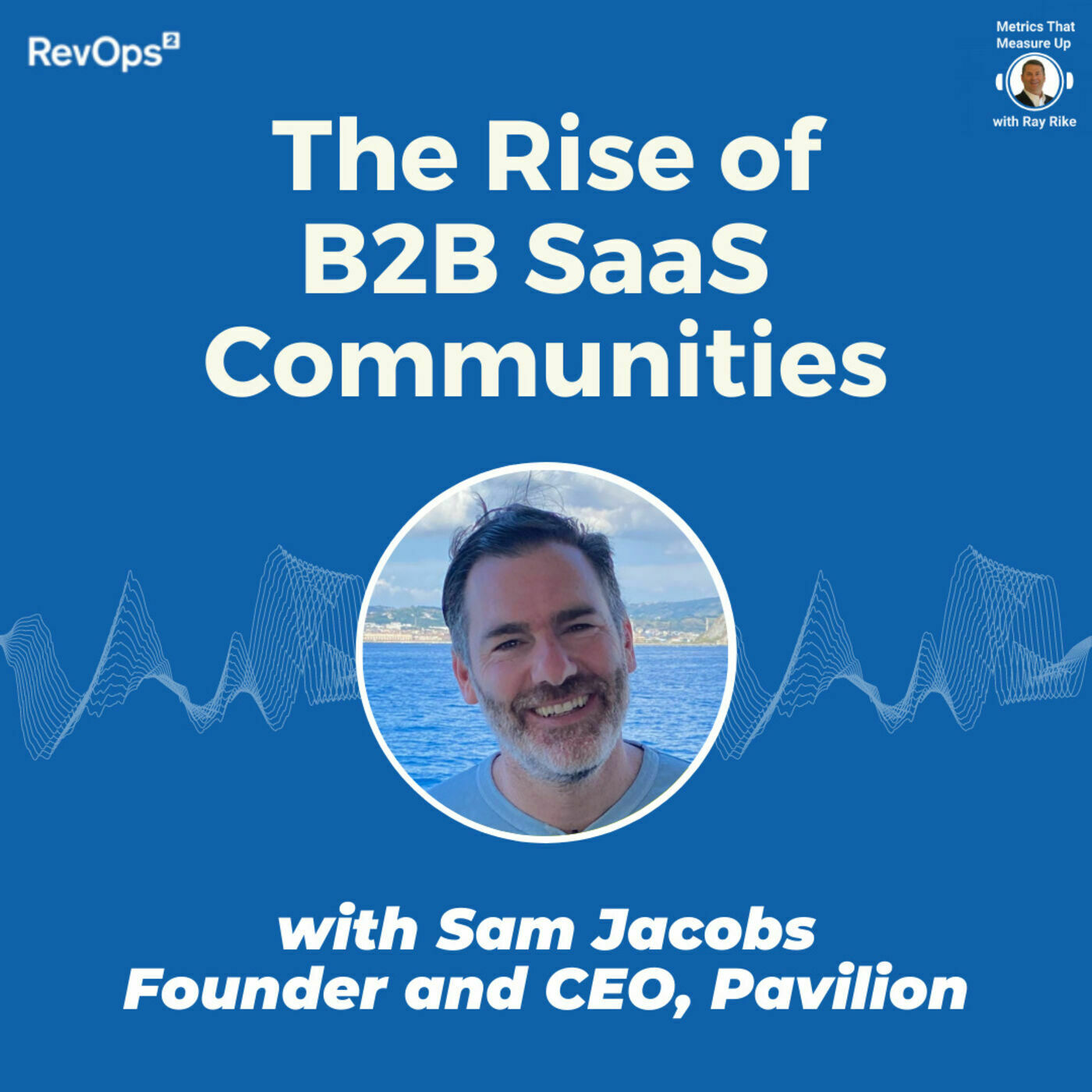
The Rise of B2B SaaS Communities with Sam Jacobs, Founder and CEO of Pavilion
Sam Jacobs first created the foundation for Pavilion - formerly the Revenue Collective in 2016. The vision was to address these two trends: 1) the average tenure of executives at B2B start-ups was shrinking - about 17 months for revenue leaders; 2) The job of being a B2B executive continues to grow in complexity and difficulty. Sam was experiencing this phenomenon in his career and wanted to create a platform and community to share best practices and assist members in realizing the potential that lies within themselves!Before Covid - Pavilion primarily used the format of in-person events. During Covid, the pressures on sales professionals did not decrease, while the ability to speak with fellow professionals became more difficult. Pavilion saw an increase from 800 members to over 3,700 members in 2020. In 2021, the number of members has increased to over 6,500 members by November 2021.The vision for Pavilion has evolved since 2016. When first launched, the Revenue Collective was more of an "us versus them" orientation and the community was only for B2B Sales professionals. That vision has evolved to help professionals reach their full potential across multiple functions. Today, the community supports Sales, Revenue Operations, Customer Success, Finance, and most recently, a CEO community was launched. The Pavilion vision does not end in the B2B tech industry but will continue to evolve across multiple industries. Pavilion is a "paid" membership community. Thus the customer is the member, and that creates a different set of expectations of the community and thus, the focus of Pavilion is to serve the member - not other stakeholders. As an example, Pavilion personally calls every new member to welcome them to highlight their focus on the members. Though there are many other B2B communities, Pavilion's reason to exist is not concepts such as "elevate the profession of sales" - the community is to achieve the goal to enable members to unlock their potential and have the career success they desire.A core value of Pavilion is "Get by Giving." This goal is to create a community ethos that is more about helping other people, which pays itself back many times over. Another value of Pavilion is to "Listen Closely and Act Quickly". Listening closely means understanding what the member really needs and not glossing over their words - but digging into the underlying meaning and goal of the words spoken. Another core Pavilion value is "We choose to come from Kindness" - which is a message to the world. This ethos is highly personal to Sam and begins with acting with compassion, human empathy, kindness, and even affection for those in your community - while still building a great business.What metrics does a community capture to measure its health? Retention rates are a critical measurement, and best-in-class consumer companies are experiencing 2% member churn per month. But that is not the whole story, the corporate client (Pavilion for teams) is a key to Pavilion's growth, and they have a Net Promoter Score of 56 - which translates to 71% of corporate customers love what they are receiving. Pavilion University is a key component to drive member value and thus retention. This offering is receiving positive member feedback with an NPS of 91!A top goal of Pavilion for CEOs is to reduce the loneliness of being a CEO. The three areas of focus include:Tactical skill knowledge - like finance, sales, HR, technology, etc.Personal leadership development.FUN - because everyone needs more fun in their lives - especially in such high pressure and stressful jobs.Sam's heartfelt goal to build a human first community provides a thought-provoking and highly informative discussion.See Privacy Policy at https://art19.com/privacy and California Privacy Notice at https://art19.com/privacy#do-not-sell-my-info.
Sales Development meets Demand Generation and Enablement- with Kyle Coleman, VP Revenue Growth and Enablement at Clari
Are you involved, responsible for, or dependant on Sales Development and pipeline growth for a B2B SaaS or Cloud company?If you answer yes to any of the above, this is an excellent conversation to gain new insights and hear innovative approaches to maximize pipeline development.Kyle Coleman is the Vice President, Revenue Growth and Enablement at Clari. This role includes sales development, sales enablement, and demand generation at Clari. This integrated approach to pipeline development is unique in the B2B SaaS industry.Kyle highlighted that having enablement as part of the same function ensures the messaging and campaigns that demand generation invests in developing make it to the target audience across every channel.Integrating sales development and demand generation as part of the same organization with common goals and measurements is unique. When asked, Kyle believes this is more due to transition and logic, and one of those legacy thoughts is that "quantity" of leads versus "quality" of outcomes such as pipeline dollar growth and new ARR.Though Kyle mentioned that it is still important to measure more traditional metrics like website visitor conversion rates, leads, paid media performance, etc. - the ultimate measurements for Sales Development and Demand Generation are PIPELINE and REVENUE.Where does the combined function of Sales Development and Demand Generation report? Kyle reports directly to the Chief Revenue Officer, while also having a dotted line reporting relationship to the Chief Marketing Officer. Kyle highlighted that his function is the core functional "connective tissue" to align marketing and sales.The Chief Revenue Officer (CRO) does not have responsibility for all marketing. However, in Clari, since demand generation is part of their responsibility, it frees marketing up to increase their focus on brand, content marketing, product marketing, and corporate communications. Account Management and Customer Success reports into the CRO, which provides a well-integrated approach to the entire customer lifecycle, including acquisition, retention, and expansion.Kyle is also blazing the trail by having dedicated Sales Development Reps focused on existing customer expansion in partnership with Account Managers. This is a new approach within Clari, and the process continues to evolve. Today, the Account Management team focuses more on existing customer renewals. The existing customer Sales Development Rep is responsible for sourcing, educating, and qualifying up-sell and cross-sell opportunities. The existing customer sales development resource is called an Account Development Manager. The Account Development Manager is compensated against qualified opportunity pipeline and has a management by objectives focused on expanding business within key target, strategic accounts.Kyle continued to refer to quality as a major topic, so we asked "how do you define quality" for sales development at Clari? Clari does NOT incent on booking meetings, it is more focused on outcomes, specifically qualified pipeline. SDRs create a Stage "0" opportunity, and then the Account Executive determines if the opportunity is qualified, and that is the first incentive component for SDRs. Clari does not use "BANT" but uses more nuanced criteria, including seniority, readiness, and next steps defined versus budget and timing. This approach is primarily due to the "Revenue Operations" Technology space still evolving and often not a budgeted line technology.If you are evaluating new and better ways to accelerate pipeline growth, Kyle is a great follow and listen!See Privacy Policy at https://art19.com/privacy and California Privacy Notice at https://art19.com/privacy#do-not-sell-my-info.
Crossing the Chasm with Geoffrey Moore, Author
Have you read Crossing the Chasm - the Go-to-Market bible for high tech leaders for over 30 years?Crossing the Chasm, written by Geoffrey Moore, was first published in 1991 introduced the Technology Lifecycle Adoption Framework.The basic concept of Crossing the Chasm is that there are five stages in the Technology Lifecycle Adoption curve, and each stage has a specific "buyer profile" at each stage of adoption:Stages of the Product Lifecycle Adoption Curve:Innovators - Get excited about the technology itselfEarly Adopters - Will bet early on the technology to gain competitive advantageTHE CHASM - The critical cross-over point from a niche market to a large addressable marketEarly Majority - Not genuine believers in technology - much more focused on a high priority problem Late Majority - Must be convinced the herd has already adopted and the ease of implementation and adoption outweighs the riskLaggards - The last phase of tech adoption - the goal is to neutralize, not convince them to changeBuyer type for each stage of the Technology Lifecycle Adoption Curve:Technology Enthusiasts - The first people to adopt any new technologyVisionaries - Have the insights to match up emerging tech to strategic opportunityPragmatists - Looking for incremental improvement versus innovation with higher riskConservatives - Believe more in tradition/status quo versus discontinuous innovationSkeptics - Believe new technology is synonymous with unintended consequencesBowling Alley - the strategy to increase the probability of success when crossing the Chasm to penetrate the early majority Knock over the first "use case" and then move to adjacenciesSame use case in a different industryDifferent use cases in the same industryThe first focal point of the bowling alley requiresWhole productWord of mouth community which requires 4-5 customers in the same industry as advocatesInside the Tornado - Result of increasing awareness of a technology segment + budget exists for this category. A great example - Conversational IntelligenceThe breadth of the vendors' ecosystem is critical to becoming the leader inside the Tornado.MainStreet - the stage where the majority of potential buyers knows they need to invest in this category The stage of Cloud and SaaS adoption todayConservatives have a lot of power in this stage - and ensuring customer success and business value received is critical to continued growth. How to manage a business at each stage of a company or products adoption curve?Zone Management - governs the management model at each stage of product adoption:Performance Zone - Main Street market with predictable growth measured by revenue growth, margins, and market shareProductivity Zone - process focused on improving the efficiency of every function to optimize profitability.Incubation Zone - Represents the start-up mindset and is about establishing Product Market Fit and "Power" in the marketplace by winning real customers and beating the competition.Transformation Zone - Basically conducting open-heart surgery on your existing business because the world has changed and your product is viewed as yesterday's news.Geoffrey Moore and his book Crossing the Chasm are legends in the technology industry marketing landscape. The principles from Crossing the Chasm are as effective in the Cloud in 2021 and beyond as they were when the book and framework were first published!See Privacy Policy at https://art19.com/privacy and California Privacy Notice at https://art19.com/privacy#do-not-sell-my-info.
Conversational Intelligence delivers Revenue Reality - with Amit Bendov, CEO and Co-Founder, GONG
Conversational Intelligence (CI) is a technology that materially enhances the effectiveness of every B2B Sales professional.CI has quickly become a "must-have" component in the B2B sales tech stack and has become a feature in most Sales Engagement Platforms...WHAT is the future of Conversational Intelligence?Our host, Ray Rike, recently spoke with Amit Bendov, Founder and CEO of Gong.io, to discuss the vision and future of Gong and the Revenue Reality.Amit's premise was "is there a better way to get market feedback" from every communication channel into the CRM without requiring manual data input.What was the initial catalyst for Gong and CI? Amit's previous company hit a wall and had revenue growth challenges for two consecutive quarters. After scouring every record he could in the CRM platform and speaking with the leaders across sales and marketing, he quickly realized there was no single version of the truth!Recently, Gong introduced the vision of "Revenue Reality" which is the mission to help companies understand the reality of their market and their market interactions. Unlocking the power of this insight is behind the next phase of Gong's evolution.Conversational Intelligence goes far beyond "recording conversations". The higher order of value is to gain additional insights into what the conversations are foreshadowing and then surfacing those insights without human intervention.Seventy percent of Gong customers have expanded the use beyond sales and into the post-sales organizations, including Customer Success and Product Management. These insights allow the product team to be "served up" the most relevant comments and insights from customer interactions with any other function. Leveraging conversational intelligence dramatically increases the product team's ability to benefit from direct feedback from the customer, without listening to a 30-60 minute conversation, and to identify common themes and trends across multiple customers and even buyers in the prospecting phase of the buyer's journey.One of the most intriguing parts of the Gong ecosystem is Gong Labs which surfaces insights from millions of interactions across thousands of companies. One example of a finding was that multi-threading the sales process across multiple individuals, including having a C-Level executive from your company in the process, DOUBLES the win rate. Additional information that Gong serves up that comes from their proprietary data is the number of questions that a salesperson asks during an introductory or discovery that predicts the highest probability to become a customer. Another interesting insight is that the more time spent on speaking while presenting a "PowerPoint" has an inverse correlation to win rates.One final insight is that during a discovery call, the close rate dramatically increases when NO slides were used, and the prospect engagement level rises. When using slides/presentations, the salesperson spends 25% more time speaking and asks 21% fewer questions!"Accept the Losses" is a comment Amit made in a recent LinkedIn post. The story behind this comment is that you can invest far too much time in understanding the primary reason you lose a deal and even identify false positives in the analysis. The primary goal behind this comment is to "simplify" the value proposition and reduce the number of variables that can lead to a loss. For example, Gong focuses on why their solution is BETTER, but it is not the low-cost solution - thus, knowing they will lose a few deals due to price is an acceptable revenue reality.Amit Bendov is a true leader in the B2B SaaS industry, and our conversation surfaces many great insights and ideas to accelerate revenue growth and gain revenue reality!See Privacy Policy at https://art19.com/privacy and California Privacy Notice at https://art19.com/privacy#do-not-sell-my-info.
Training the Modern B2B Sales Professional with Paul Fifield, Founder and CEO of Sales Impact Academy
B2B Cloud revenue is projected to grow from $300B+ in 2020 to over $800B by 2025. Some estimates highlight the industry will require 300,000 additional B2B Sales professionals to achieve this level of growth.If the above is even directionally correct, being able to train sales professionals is key to continued industry growth.Paul Fifield is the founder and CEO of the Sales Impact Academy. His vision to create the Sales Impact Academy is built upon his frustration in growing and leading revenue teams. Paul says that most B2B SaaS leaders are forced to "make it up" as they go because there is no great source of advice, education, and training for B2B Sales professionals.The first class Paul developed was a basic "how to build a predictable and scalable revenue function". This was the catalyst for Paul to identify the lack of repeatable models would negatively affect the industry's continued growth.Sales Impact Academy is a "universal best practice" approach to sales training. By identifying, packaging and training upon proven best practices, the industry will leverage the collective experience and knowledge of those who have gone before.Paul and the Sales Impact Academy approaches sales training with a fundamental belief that the basic process of selling, even in the Cloud, has not materially changed.Sales Management, Sales Leadership, Sales, Prospecting, Marketing, and Customer Success are the six primary curriculum categories across 15 core personas. Revenue Operations will be the next function to be added to the course curriculum.The courses are built primarily for people already "in the job" versus trying to prepare themselves to enter a new job/professional. The goal is to have an immediate impact on job performance Thus, the curriculum is primarily focused on helping people already in the job improve immediately. This requires an educational approach that is "easy for the individual" to take the class, which includes smaller, micro-learning segments that never exceed over 2 hours per week.Every class that Sales Impact Academy delivers is live with a subject matter expert versus self-directed videos. Being able to create a learning program at the scale requires reaching millions of people. This will require a significant improvement in existing digital learning approaches and supporting materials to empower leaders to embed the learning in their local organizations.When asked about "certification," Paul said this is a critical component of their vision to allow every company to be comfortable with the quality and impact of the Sales Impact Academy courses.When asked about ROI, Paul highlighted that the primary ingredient to ensuring a positive return on training is an integrated "feedback loop" embedded in every student's experience. One exciting aspect of the Sales Impact Academy is that there is no ONE WAY to achieve success. By having multiple subject matter experts deliver their approach from experiences leading to success, no ONE single approach will be trained. Each student will have an opportunity to choose the curriculum and approach that works best for them.Paul highlighted that he is now very focused on the "pedagogy" of their curriculum or their teaching approach. Learning design is key to delivering the optimal training program framework, coupled with subject matter experts to deliver the courses.If you are responsible for scaling your B2B SaaS Go-To-Market, revenue-producing teams and increasing productivity is key to achieving your goals next year and beyond, learning more from Paul and the Sales Impact Academy is a great place to learn a new, innovative approach that your employees will appreciate and your investors will love once they see the results! See Privacy Policy at https://art19.com/privacy and California Privacy Notice at https://art19.com/privacy#do-not-sell-my-info.

MOVE: A Go-To-Market Strategy with Sangram Vajre, Founder Terminus and Flip My Funnel Podcast
Sangram Vajre, Founder and Chief Evangelist at Terminus and host of the Flip my Funnel Forecast, joined our host Ray Rike to discuss his MOVE Go-To-Market framework.Sangram ran marketing at Pardot, an early marketing automation vendor for salespeople, which Salesforce ultimately acquired and co-founded Terminus seven years ago. Terminus is a true pioneer in providing a platform for Account-Based Marketing programs, which in today's B2B SaaS world represents about 44% of total marketing investment in customer acquisition programs.The first thing Sangram shared was that marketing and sales need to SHARE the same "REVENUE" number. Marketing's ultimate value must be measured by "Sales". If the two executives do not share the same number, Go-To-Market challenges are soon to follow.What exactly is a "Chief Evangelist"? Guy Kawasaki, Apple's early Chief Evangelist, said, "evangelism in a tech company is the purest form of sales"! A chief evangelist is the representative of the market on behalf of the practitioners. Sangram has been doing this for over seven years in the world of Account-Based Marketing.Next, we move to Sangram's Go-To-Market framework, which also happens to be the name of his latest book - "MOVE". MOVE focuses on four primary questions every company must ask as they "move" through each growth phase. Those four questions are:1 - Who should we market to?2 - What do we need to do to operate more effectively3 - When can we scale our business4 - Where can we grow the most These four questions relate directly to the MOVE acronym:M - MarketO - OperationsV - VelocityE - ExpansionMcKinsey says the primary reason companies fail as they begin to scale above $10M is the lack of evolving the Go-To-Market strategy and tactics.The four primary "Go-To-Market" strategy questions do not change at each growth stage, but the answers and resultant approach must change to maneuver through each stage of the growth journey successfully.Another framework MOVE includes the 3P framework:P - Problem Market FitP - Product Market FitP - Platform Market FitEach stage of the 3Ps does not directly correlate with company size (revenue). Sangram shared that some companies can hit $10M and even $20M before they move from Problem-Market Fit to Product-Market Fit. Similar to the concepts in "Crossing the Chasm" by Geoffrey Moore, the issue is when a company attempts to move the one phase of the #ps to the next phase - a classic chasm crossing challenge.Sangram is a wealth of information. More importantly, he has invested most of his career in learning, understanding, and now sharing his experiences and insights in an easy-to-understand yet robust Go-To-Market framework called MOVE.This conversation is a great listen for every B2B tech founder, CEO, and Go-To-Market executive regardless of which stage of growth your company is in to help cross the chasm to the next phase of the growth journey.See Privacy Policy at https://art19.com/privacy and California Privacy Notice at https://art19.com/privacy#do-not-sell-my-info.