
Age of Conquest: A Kings and Generals Podcast
346 episodes — Page 6 of 7
History of the Mongols SPECIAL: Islamization
The Mongols were known for unleashing a series of unrelenting horrors upon the Islamic world, from the catastrophic destruction of the Khwarezmian Empire under Chinggis Khan, to the sack of Baghdad under his grandson Hulegu, where the Caliph himself was killed on Mongol order. No shortage of Islamic authors over the thirteenth century remarked upon the Mongols as a deathblow to Islam, a punishment sent by God for their sins. Yet, many of the Mongols of the west end of the empire even before the end of the thirteenth century converted to Islam, and in time some of the heirs of Chinggis Khan held the sharia over the yassa. In today's episode, we explore why so many Mongols chose to convert to Islam. I'm your host David, and this is Kings and Generals: Ages of Conquest. The Mongolian interaction with Islam began in the twelfth century, as Muslim merchants came to Mongolia with expensive goods such as textiles or metal weapons and tools to exchange for furs and animals to sell in China or Central Asia. Some of these merchants took up valued roles among the up and coming Mongol chiefs; at least two Muslims, Hasan the Sartaq and Ja'far Khoja, were among the warlord Temujin's close allies during his fabled escape to lake Baljuna, where they swore long lasting loyalty to him. Hasan's arrival brought much need flocks of sheep to help feed Temujin's starving men, while Ja'far Khoja was supposedly a descendant of the Prophet Muhammad. Ja'far served Temujin in valued roles for the rest of his life, acting as an embassy to the Jin Emperor and as daruqachi, or overseer, over the Jin capital of Zhongdu and its environs once the Mongols took it in 1215. When Temujin took the title of Chinggis Khan and began to expand the Mongol Empire, initially Muslims found little reason to lament the expansion of the Great Khan. Muslim merchants continued to serve in prominent roles, acting as emissaries and spies on behalf of Chinggis Khan, who rewarded them handsomely: gladly did Chinggis give them gifts and overpay for their wares in order to encourage them to make the difficult journey to Mongolia, as well as bring him useful information of Central Asia. One such Central Asian, Mahmud, served as Chinggis' loyal envoy to the Khwarezm-Shah Muhammad. His actions earned him the title of Yalavach, becoming Mahmud the Messenger. In the Tarim Basin in 1218, the local Muslim population had suffered oppression under the Naiman prince Kuchlug, who had usurped power in the Qara-Khitai Empire. When Chinggis Khan's great general Jebe Noyan entered the region pursuing Kuchlug, he proclaimed that all those who willingly submitted would be free to worship as they chose. The region largely seems to have swiftly thrown out Kuchlug's garrisons and officers and happily accepted Mongol rule, not as conquerors but liberators. This, of course, was not the case for the next stage of Mongol expansion. The highly destructive campaign against the Kwarezmian Empire launched in 1219 resulted in the deaths of perhaps millions of people from what is now Uzbekistan and Kazakhstan through eastern Iran and Afghanistan, a predominatly Muslim region. There are no shortage of accounts of horrendous atrocities suffered throughout the former domains of the Khwarezm-shahs. Though most of what is now modern Iran submitted peacefully to the Mongol commander Chormaqun over the 1230s, with the arrival of Hulegu in the 1250s a new wave of massacres were unleashed, culminating in the infamous sack of Baghdad in 1258 and death of the 'Abbasid Caliph, an immense blow the psyche of the ummah. At the end of the 1250s it seemed reasonable to anticipate that soon the whole of the remaining Muslim world would become the subject of the Grand Khan. The initial period after the Mongol conquest was, for many Muslims, not easier. Statements by modern writers of Mongol religious toleration have been greatly over-exaggerated. While it is true that the Mongols in the early years of the Empire generally did not persecute on the basis of religion, the Mongols did persecute on the basis on specific beliefs that they felt ran contrary to steppe custom or the laws of Chinggis Khan, the great yassa. For example, for slaughtering animals the Mongols forbid the spilling of blood. This differed greatly from Muslim and Jewish halal and kosher slaughter, that mandated the draining of it. This in particular became a frequent source of conflict over the thirteenth century, with the Mongols feeling the spilling of blood on the earth would bring misfortune. We are told from the Persian writer Juvaini, a member of Hulegu's entourage in the 1250s, that Chinggis Khan' second son Chagatai so thoroughly enforced this prohibition that "for a time no man slaughtered sheep openly in Khorasan, and Muslims were forced to eat carrion." Essentially, the Mongol viewpoint was that as long as a given religion adherents remained loyal and did not perform the tenets the Mongols forbid, then the worshippers could practice fr
S2 Ep 532.53. History of the Mongols: Ilkhanate #3
After the death of the Ilkhan Arghun in 1291 at the end of our last episode, the Ilkhanid throne came to Arghun's brother, Geikhatu, the governor of Anatolia. Geikhatu's ascension set off one of the most unstable periods in the Ilkhanate's history so far, which would ultimately culminate in the rise of perhaps the most significant ruler of the Ilkhanate's later history, Ghazan, who would skillfully weld Chinggisid ideology with Islam. I'm your host David, and this is Kings and Generals: Ages of Conquest. On the death of Arghun Ilkhan due to excessive consumption of mercury and sulphur in at the start of 1291, there were three candidates for the throne: Arghun's brother Geikhatu, the governor of Anatolia; Arghun's cousin Baidu, based in Baghdad, and Arghun's son, Ghazan, who was stationed in the east of the Khanate battling the rebelling general Nawruz. While some members of the military elite, particularly the noyans Taghachar and Qunchuqbal, wished for Baidu to take the throne, a number backed Geikhatu. Among those who flocked to Geikhatu were the noyans Qurumshi, son of Alinaq, and Choban, better known as the Emir Choban.This is the first mention of Choban in the sources, though for today's episode he will play on a minor role. On the 23rd of July, 1291 Geikhatu was elected as Khan of the Ilkhanate. Neither Baidu nor Ghazan challenged him, though in accounts such as Marco Polo's, Ghazan was rather quietly furious at the matter. In his early thirties when he took the throne, like his late brother Arghun, Geikhatu was a Buddhist. Arghun had placed Geikhatu as the viceroy of Anatolia, bringing a region considered a distant frontier into closer connection with the rest of the Ilkhanate. Perhaps the greatest distinction from his brother though was his clemency. In part, it seems to have been a mixture of a personally more peaceful nature, and a belief that Arghun's reign was cut short by the many executions he had ordered in his final years. One of Geikhatu's first actions upon taking the throne was personally overseeing an investigation and trials into events surrendering the deaths of Arghun, his vizier Sa'd al-Dawla and other misdeeds undertaken by the noyans in Arghun's final days. The blame for these murders and abuses were, rightfully, laid onto the noyans Taghachar and Qunchuqbal, who had led the efforts. While Arghun would have met their disloyalty with the removal of heads, Geikhatu showed himself of a different ilk. Almost all of the conspirators received simple pardons, while others were subject to a temporary prison sentence. Taghachar, who was making a habit of being a traitorous sot, was given a pardon as well. Once the trials were completed, and Geikhatu hoped everyone could now start off fresh, the new Il-Khan immediately returned to his preferred Anatolia. His Noyan Shiktur was left to oversee almost the entirety of the Ilkhanate east of Anatolia as a supreme deputy. The Ilkhan's sudden removal back to Anatolia left a sort of vacuum behind. It's not clear to us today exactly what Geikhatu was doing in Anatolia, and it certainly wasn't clear to contemporaries as rumours spread that the Ilkhan had been killed in an uprising by local Turkic tribes. In Geikhatu's absence, his clemency paid dividends as the noyans he forgave almost immediately conspired against him. Taghachar Noyan, aided by his deputy Sadr' al-Din Zanjani, started to organize a coup to topple Geikhatu and enthrone one of Geikhatu's cousins, Anbarchi. The plot was discovered and foiled, but again, Geikhatu pardoned most of the conspirators. Taghachar himself was given an army to relieve an Ilkhanid fortress besieged by the Mamluks late in 1292 (something which he was unsuccessful at) and Sadr' al-Din Zanjani, after a brief imprisonment, was even made Geikhatu's vizier before the end of the year. Suffice to say, these men did not learn their lessons. While these plotters continued to plot, most of Geikhatu's reign was spent apparently enjoying the… uh, benefits of being king, if we should say politely. Effectively every medieval source which comments on Geikhatu presents him as a man of utter vice, enjoying constant parties, revelry, and the sons and daughters of the nobility. To quote the continuator of the Syriac churchman Bar Hebraeus, writing not long after Geikhatu's death: Now [Geikhatu] being ruler, [...] occupied himself with nothing except riotous living, and amusement and debauchery. He had no thought for anything else except the things which were necessary for kings, and which they were bound to have, and how he could get possession of the sons and daughters of the nobles and have carnal intercourse with them. And he would wanton with them without shame and without modesty. And very many chaste women among the wives of the nobles fled from him, and others removed their sons and their daughters, and sent them away to remote districts. But they were unable to save themselves from his hands, or to escape from the shameful ac
S2 Ep 522.52. History of the Mongols: Ilkhanate #2 (FIXED VERSION)
After the long reign of Abaqa Il-Khan, as covered in our previous episode, the Ilkhanate entered it's somewhat messy "middle period." These are the years between the death of Abaqa, in 1282, and the ascension of Ghazan in 1295. In these 13 years, four men came to the Ilkhanid throne: Teguder Ahmad, Arghun, Geikhatu and Baidu. Their reigns, if we believe the historians writing under Ghazan and his successors, constituted a period of disorder and anarchy before the stabilizing and centralizing rule of Ghazan. Usually glossed over in favour of Abaqa or Ghazan, today we take you through one of the lesser known periods of the Ilkhanate, beginning with the ilkhans Teguder and Arghun. I'm your host David, and this is Kings and Generals: Ages of Conquest. Our last episode ended with the death of Abaqa, son of Hulegu and a great-grandson of Chinggis Khan. A capable enough monarch, Abaqa had ruled the Ilkhanate stably from the mid 1260s until his death in April 1282. His death left three primary candidates: two of his brothers, Mongke-Temur and Teguder, and Abaqa's eldest son Arghun. The death of Mongke-Temur only a few weeks after Abaqa's death removed him from the running, and the more senior, powerful and well connected Teguder was able to claim the throne over the young Arghun. Prince Arghun was very bitter of the loss, and nursed his resentment though accepted Teguder's election. In June 1282 Teguder was installed as the third Ilkhan. In many ways he sought continuity with late brother. The beleaguered vizier Shams al-Din Juvaini and his brother 'Ala al-Din 'Ata-Malik Juvaini, the historian and governor of Baghdad, were retained in their posts, as were many other officials in the upper echelons of the bureaucracy. The new Ilkhan's reign differed from his late brother's in one significant respect though: Teguder was a Muslim, who on his enthronement took the name of Ahmad and the title of Sultan. For this reason he is often known, somewhat interchangeably, as Teguder Ahmad or Ahmad Teguder in modern writing, and usually just as Sultan Ahmad in the 13th and 14th century sources. As with so many Mongol converts to Islam, it is unclear when he converted; according to the contemporary Armenian writer Het'um Patmich', known also as Het'um of Corycus, Teguder had been a Christian in his youth with the baptismal name of Nicholas, but had converted sometime before taking the throne in 1282. It seems he was converted by sufis, as a number of dervishes were attached to his court and inner circle. One sufi in particular, Shaykh Kemal al-Din 'Abd al-Rahman held such great influence over Teguder that he continually consulted with him and referred to him as father. Teguder's Islam has been a tricky thing to define, as his commitment to islam varies depending on the source. In a letter Teguder sent to the Mamluk Sultan Qalawun, Teguder spoke of how he has established sharia law in the Ilkhanate, protected pilgrimage routes and built new religious buildings. Indeed, Teguder argued, based on their shared religion it should have been now easier for the Mamluk Sultanate to submit to him. Armenian writers from Cilicia like Het'um of Corycus generally portray Teguder as a great prosecutor of Christians who also destroyed churches, while his countryman Step'annos Orbelian believed Teguder wanted to exterminate Christianity. Yet at the exact same time, the Syriac churchman Bar Hebraeus wote of Teguder as a friend to Christians, an upholder of religious toleration who exempted churches and Christians from taxation and allowed Hebraeus to build a new church. 14th century writers from both the Mamluk Sultanate and the Ilkhanate write of Teguder's Islam in doubting terms. The Mamluks seem to have been largely skeptical of his conversion, while the great Ilkhanid vizier and historian Rashid al-Din, writing at the start of the 1300s under the aegis of the mighty Muslim monarch Ghazan and his brother Oljeitu, remarked Teguder only "claimed to be a Muslim." Teguder's conversion to Islam was not the start of Islamization of the Mongols; it instead reflects the gradual trend for conversion among some of the younger generation, but at the same time it does not seem to have been an issue for the acceptance of the new Ilkhan, with the exception of the opinion of the his nephew Arghun. Arghun, as Abaqa's oldest son, felt the throne was his by right. Teguder Ahmad's extended generosity on his enthronement, including many gifts for Arghun, did not ease Arghun's hard feelings. The always suspicious Teguder must have taken note of it, but Teguder had an empire to run and wanted to avoid civil strife so showed Arghun his due respect. In our last episode, we left of with the Juvaini brothers, the vizier Shams al-Din and the historian 'Ala al-Din, placed in a bind due to the efforts of their enemy, Shams al-Din's former protege Majd al-Mulk. Majd al-Mulk had found a willing ear in Prince Arghun, who in Abaqa's final years managed to imprison, fine, and gen
S2 Ep 512.51. History of the Mongols: Ilkhanate #1
Now that we have gone through the Yuan Dynasty, Ogedeid Khanate and Chagatai Khanate, our attention comes to the other Mongol Khanate ruled by the descendants of Tolui; the Ilkhanate. Ruling Iran, Iraq, the Caucasus and the Anatolian peninsula to the borders of the Byzantine Empire, the Ilkhanate was among the most powerful, and also perhaps the best understood of the Khanates, due to a wonderful surviving library of historical works, best exemplified by the mammoth universal history the Ilkhanate's vizier, Rashid al-Din. For our first episode on the Ilkhanate, we look at its establishment by Hulegu and his son Abaqa, the first twenty years of the Ilkhanate's history which did much to define the final fifty years. I'm your host David, and this is Kings and Generals: Ages of Conquest. As a brief aside, you can revisit a two part discussion between our series historian, Jack Wilson, with professor Michael Hope, a specialist on the Ilkhanate, which we have uploaded on all sites that host our podcast. We last left off with the Ilkhanate in episode 33 of our main series, on the Berke-Hulegu war, where Hulegu fought with his cousin Berke of the Golden Horde over the Caucasus in the early 1260s. Hulegu was the younger brother of Great Khan Mongke and of Khubilai. The third son of Tolui, they were grandsons of Chinggis Khan and thus of prestigious lineage. As we saw in episodes 28 and 29, Hulegu had been ordered by his brother Mongke in the 1250s to complete the conquest of southwestern Asia. Despite the claims of some Ilkhanid writers, or of modern historians who write of Khubilai and Hulegu being made viceroys of China and western Asia, respectively, it is highly unlikely Mongke had commissioned Hulegu to found a new Khanate. Rather, his role was almost certainly just a limited military one, assigned by his brother to complete the conquest so that the Middle East could be properly incorporated into the Central Governmental structure, or even territory that belonged directly to the Khan. Given Mongke's crackdown on the independence of the Ogedeids, Chagatayids and to a lesser extent, the Jochids, it seems unlikely he was setting up a vast area to become personal fief to another member of the family, even if it was his younger brother. Certainly, we can also ignore statements that this was land Chinggis Khan had granted specifically to the Toluids, or that the Ilkhanate emerged from a division of the empire following Chinggis' death in 1227. The conquest of Iran proper did not begin until after Chinggis' death, and it took until Hulegu in the 1250s for the Middle East to become territory of the house of Tolui. Infact, it seems much of this territory was considered, up until 1260 or so, as belonging to the house of Jochi. At least, the Jochids considered this to be the case. Whatever Mongke's intentions, as with so much, his plans were upset by his death on campaign in 1259. Hulegu was an important commander during Mongke's lifetime, but not necessarily one about to be appointed a long term governor. Though he had greatly expanded the Mongol Empire westwards and taken Baghdad, the territory that later became the Ilkhanate was divided between Jochids in the north, especially in the Caucasus and northern Iran but also scattered throughout the region; some Chagatayid territory in the east, namely in parts of Khurasan; and territory that belonged directly to the Great Khan, for whom it seemed Hulegu's conquests would all go to. Following Mongke's death, Hulegu essentially seized all these lands. Whether Hulegu had done this in order to declare his independence, or to take advantage of a primary lapse in imperial authority and then force Mongke's successor to recognize his gains, over 1260 Hulegu seized control of territory claimed by the Jochids and other branches of the family. The Jochid Khan, Berke, was particularly angered at the loss of the pastures and trade cities of the Caucasus, which Mongke had only shortly before re-confirmed for him. Hulegu did not return east to take part in the election of Mongke's successor or observe matters there, but thought of himself first, using the lull to enrich himself. It was this which precipitated war between the Jochids under Berke in 1262 over the Caucasus. As we addressed briefly in episode 30, it seems that following the sack of Baghdad in 1258, Hulegu began using the title of il-khan. While popularly translated as viceroy or subject khan, more recent scholarship has demonstrated that the title bore no such connotations of submission or subservience. Rather, it simply designated a sovereign in his own right. Most of the uses of the term il-khan reflect this usage in the historical sources, with rulers from Chinggis Khan himself to the Khans of the Golden Horde referred to as il-khan. By the start of the 1260s we can speak in earnest of Hulegu and his successors as the Ilkhans. We should expect that to contemporaries, Hulegu was understood as his own monarch in truth, whate
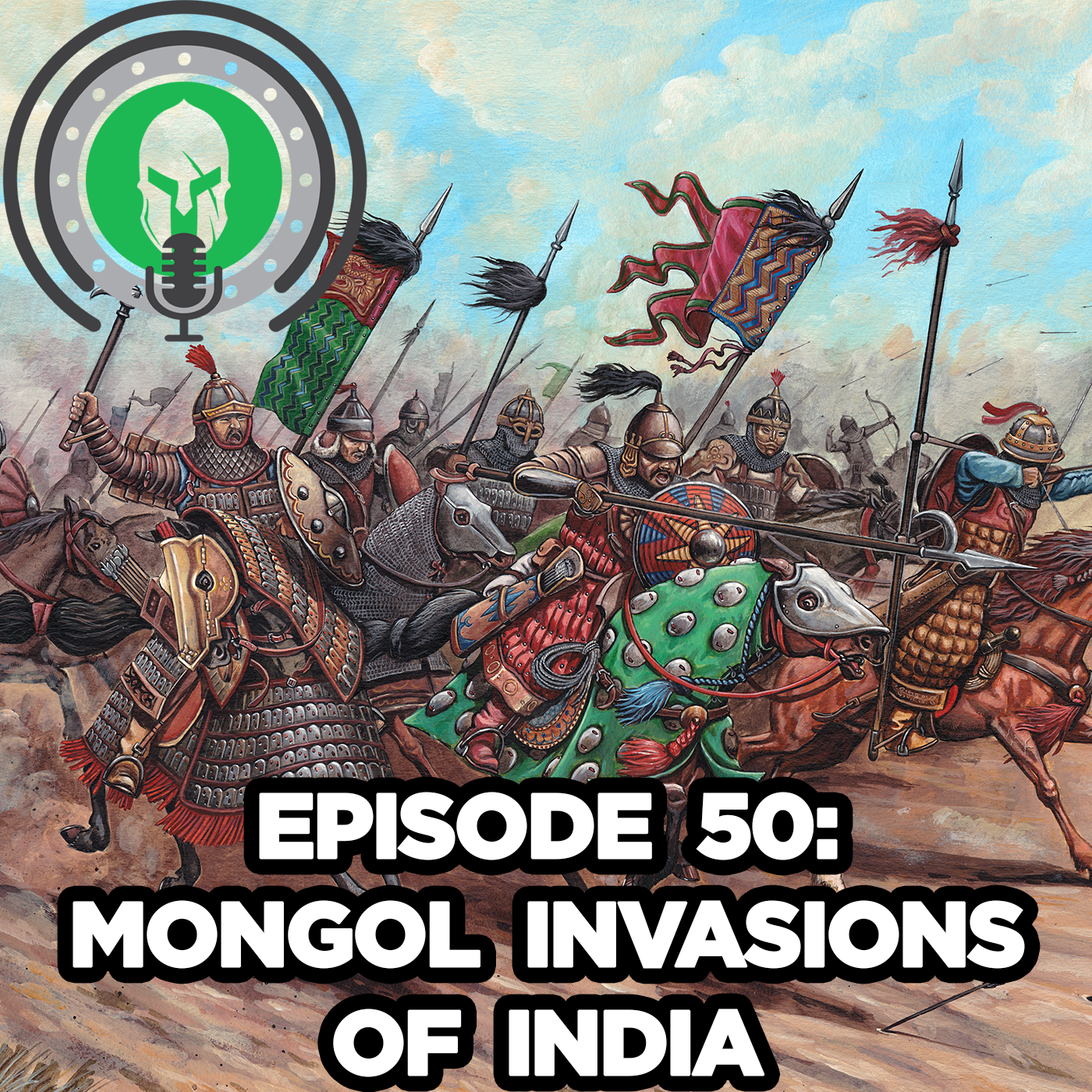
S2 Ep 502.50. History of the Mongols: Invasions of India
Back in our 15th episode of this series, we looked at Khwarezmian prince Jalal al-Din Mingburnu's exploits in India in the early 1220s. Having fled there after Chinggis Khan's devastating invasion of the Khwarezmian Empire, Jalal al-Din's flight brought India to the attention of the Mongols. While Chinggis Khan did not invade the subcontinent, this was not the last that India would see of the Mongols. In today's episode, we return to northern India, dominated by the Sultanate of Delhi, and look at its interactions with the Mongols who repeatedly raided its borders. Why the Delhi Sultans, from Iltutmish, Balban to Alauddin Khalji were able to largely successfully resist the Mongols will be examined, over nearly the century of Mongol-Delhi interactions. I'm your host David, and this is Kings and Generals: Ages of Conquest. The Delhi Sultanate arose from the ruins of the Ghurid Empire which had stretched from Afghanistan to Bengal. The Ghurids, or Shansabanids, had been a regional power in central Afghanistan emerging in the ninth century but were subdued by the Ghaznavids, also known as the Yamanids, a persianised Turkic dynasty which dominated much of the Iranian world up to the borders of India from the tenth to the twelfth centuries. The Ghaznavids under their great expander, the mighty Mahmud of Ghazna, reduced the Ghurids to a subject state early in the eleventh century, though in turn the Ghaznavids were pushed from Iran by the Seljuqs with the famous battle of Dandanaqan in 1040, and became tributary to the Seljuqs under their Sultan Sanjar at the start of the twelfth century. In this time, the Ghurid elite converted from Buddhism to Islam, and could be said to have bided their time. The Seljuqs weakened over the twelfth century with the arrival of the Qara-Khitai, the Ghuzz Turk invasions and independence of the Khwarezmian Empire in the north. In turn, the weakness of the Seljuqs advanced the weakness of the Ghaznavids, which provided an opportunity for the Ghurids to rise in the second half of the twelfth century. Under the brilliant leadership of Mu'izz al-Din Muhammad Ghuri, better known simply as Muhammad of Ghor, and his brother Ghiyath al-Din, the Ghurids conquered the remnants of the Ghaznavids. Repulsing invasions by the Ghuzz Turks and proving a staunch foe to the Qara-Khitai and Khwarezm-Shahs, Muhammad of Ghor received backing from the Caliph and expanded across the region. By the end of his life, he had forged an empire stretching from eastern Iran, Afghanistan, Pakistan across Northern India to Bengal. Muhammad of Ghor's military might rested in large part on his loyal ghulams, Turkic slave soldiers, though over the thirteenth century the term gave way to mamluk. A similar institution existed in the form of the Ottoman janissaries. While it was common for any good regional warlord to employ nomadic Turkic tribes due to their military prowess, they often proved unreliable and self-interested. For the conquest-minded Muhammad of Ghor, he could not put much stock on nomad chiefs who may value their own advancement over Muhammad's glory. Instead, Muhammad looked to the classic islamic institution of slave soldiers. Ghulams and Mamluks were young boys, generally sold by enemy Turkic tribes, that were brought into the Islamic world and raised from birth to be elite soldiers. Generally having already some horse and archery skills from their youth, these boys were converted to Islam and given the finest training in military matters, with top of the line equipment, weapons and horses, in addition to receiving education and even salaries. The result was a core of fierce warriors loyal not to any tribal or family ties, but to their fellow ghulams and their master, who sheltered and provided for them. No shortage of Islamic princes lamented on how their ghulams tended to be more loyal than their own sons; the sons awaited only the death of the father, while the ghulams wanted only his glory. Famously, the child-less Muhammad of Ghor is supposed to have remarked that, while other monarchs could have a few sons, he had thousands in the form of his ghulams. The source of many of Muhammad of Ghor's ghulams were various Qipchap Turkic tribes from the great steppe. As in late Ayyubid and early Mamluk Egypt, and indeed much of the islamic world, the Cuman-Qipchaqs were prized as warriors. His ghulams proved themselves in combat repeatedly. Though supported by local tribes, both Turkic and Pashtun, Muhammad of Ghor over his life increasingly relied on his ghulams, and in time they commanded his armies and acted as his governors. Attacking the Hindu kingdoms of northern India at the close of the twelfth century, Muhammad of Ghor had to return to Afghanistan to face the Khwarezm-Shah Tekish, and Tekish's son Muhammad. Muhammad bin Tekish, of course, we know best as the gentleman who antagonized Chinggis Khan some two decades later. In Muhammad of Ghor's absence fighting the Khwarezmians, his ghulams like Qutb
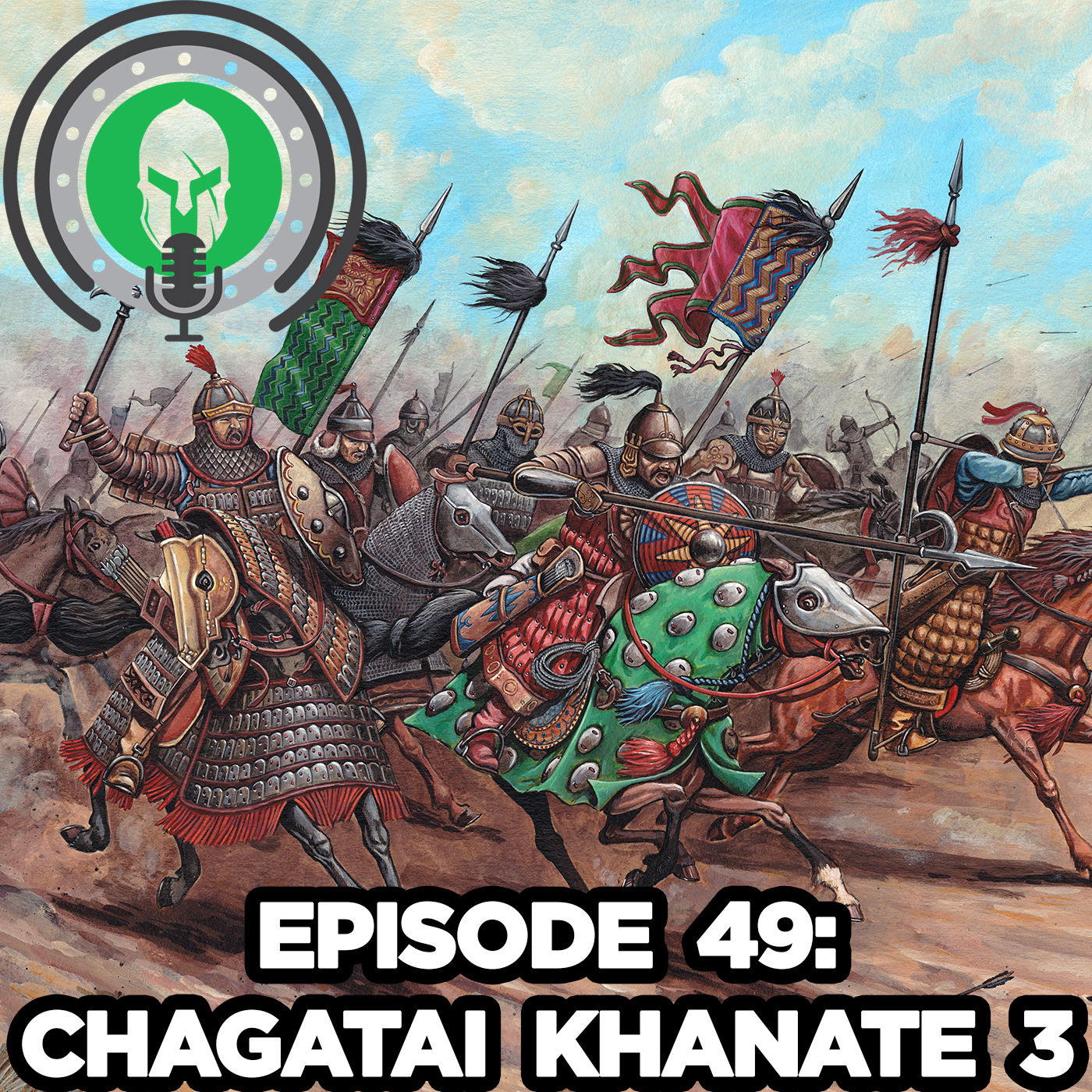
S2 Ep 492.49. History of the Mongols: Chagatai Khanate #3
Our previous two episodes have taken you through an overview of the history of the Chagatai Khanate, the middle ulus of the Mongol Empire. From its establishment following Chinggis Khan's western campaign in the 1220s, through rebuilding efforts by Mahmud Yalavach and Mas'ud Beg, to the turmoil of the 1260s and 70s with the Mongol civil wars and then consoldiation under Qaidu and Du'a, then the many successions of Du'a's sons to the throne in the first three decades of the fourteenth century. At the end of the last episode, the sixth and last of Du'a's sons to rule the Chagatais, Tarmashirin Khan, was murdered in the early 1330s, killed in a rebellion led by his nephew Buzan, supported by emirs from the eastern half of the Chagatayids. Over the period we saw the slow spread of Islam among the Mongols and their khans, as well as a widening gap between the western half of the Khanate, in Transoxania, and the Eastern half, Moghulistan. Today, both of trends continue as the Chagatai Khanate descends into anarchy following Tarmashirin's murder, finally culminating in Emir Temur seizing control of the western half of the ulus Chagatay in 1370, and forever changing the face of western Asia. I'm your host David, and this is Kings and Generals: Ages of Conquest. Tarmashirin Khan's murder in 1334 had a significant impact on the Chagatai Khanate. The last in the long lateral succession of Du'a Khan's sons, his death essentially opened up the throne to any willing claimant. His antagonizing of the Mongols of the eastern half of the khanate, particularly through his Islamic policies, supposedly abandoning of the laws of Chinggis Khan and leaving them out of government, ensured his reign ended bloodily. The Mongol chiefs of the eastern half of the Khanate rose up behind Buzan, Tarmashirin's nephew, who had allied with other grandsons of Du'a. They invaded Transoxania hunting down and killing Tarmashirin and causing a flight of pro-Tarmshirin, Islamic Mongol chiefs to the Ilkhanate and Delhi Sultanate in India. Buzan, according to most sources, was not a Muslim, though ibn Battuta wrote of him as a 'tainted Muslim.' Most sources accuse him of being anti-Muslim and strongly pro-Christian, though it seems more likely he was just religiously tolerant, simply allowing Jews and Christians to rebuild their religious structures. It seems he wanted to rule in a more traditional, steppe based fashion, a strong counter reaction to Tarmashirin's rule.. At least he would have, if Buzan wasn't murdered only a few months into his reign by a cousin, Changshi, another grandson of Du'a. If we believe ibn Battuta, Buzan was strangled by a bowstring. The thing about violently overthrowing your predecessor, is that it does not leave a lot of the legitimacy that is needed to prevent you being overthrown in turn by the next power-hungry individual. What we start to see in this period is princes refusing to recognize the legitimacy of these new Khans, and deciding to remedy this by replacing these new Khans with themselves. So begins an exceptionally chaotic period in the Chagatai realm. The new Khan of the Chagatais, Changshi, did not take the throne because he was a supporter of Tarmashirin. Like Buzan, Changshi sought to bring the center of power back to the steppe and Almaliq, the traditional capital of the Chagatais, rather than having it based in the more sedentarized, Islamic Transoxania as Tarmashirin had sought to do. He was apparently a devout Buddhist, ordering the construction of many Buddhist and temples and supposedly, ordering sculptures of the Buddha painted in mosques throughout the Khanate. Yet he also showed great favour to Christians, especially Catholic Franciscans. He was apparently cured of a cancer through the prayers of one Franciscan, and in response heaped rewards on them. Changshi had at least one of his sons baptized, taking the name of Johannes, and placed the Franciscan in charge of their education. A bishopric was established at Almaliq in the 1320s and flourished under Changshi. At Almaliq, Changshi also met with Nicholas, the newly appointed Archbishop of Khanbaliq, who was on his way to China. Changshi gave Archbishop Nicholas authorization to preach freely throughout the Chagatai lands, to repair and build churches and provided him lands on which to build a friary. News of Changshi's friendship to the Christians reached Pope Benedict XII, who sent a letter to Changshi in 1338. This was not the first letter between the popes and the Khans of Central Asia. In 1289 Pope Nicholas IV sent letters to Qaidu Khan; in 1329 Pope John XXII sent a letter to Eljigidei Khan in response to a message of friendship Eiljigidei had sent prior; and Benedict XII's letter in 1338 urged Khan Changshi to build stronger relations with Christianity and sponser the growth of the faith in his kingdom. Changshi never received the letter, for in 1337 he and his four sons were killed by his brother, Yesun-Temur. Many islamic sources portra
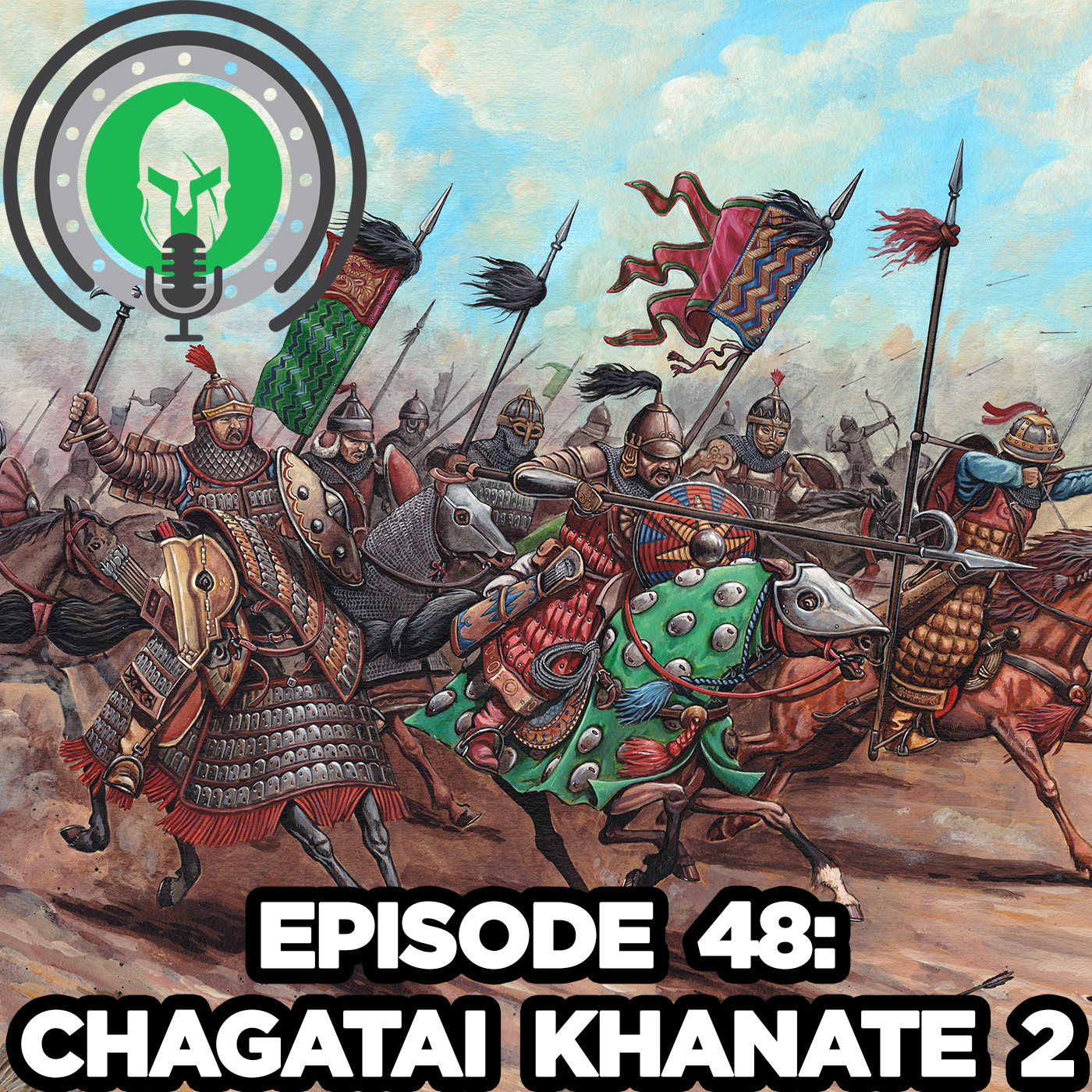
S2 Ep 482.48. History of the Mongols: Chagatai Khanate #2
While the Chagatai Khanate, the division of the Mongol Empire encompassing much of Central Asia and Northwestern China, has a reputation as the Mongol Khannate to fragment into infighting first, this would not have been the view for an observer on the ground in the early fourteenth century. Following the death of Qaidu, the Ogedeid master of Central Asia in the last decades of the thirteenth century, his former ally Du'a, Khan of the Chagatais, stood dominant, particularly with the Great Peace he achieved between the Khanates in 1304. Picking up from our previous episode, we take you through the history of the Chagatai Khanate in the early fourteenth century, from Du'a's singular rule in 1301 through the reigns of the six of his sons who became Khan, ending with Tarmashirin in 1334. I'm your host David, and this is Kings and Generals: Ages of Conquest. At the close of the previous episode, Qaidu Khan was dead. Qaidu was a descendant of Great Khan Ogedai, and as we covered thoroughly in episode 41, had from 1271 until 1300 been the most influential figure in Central Asia. Over the 1270s he came to dominate the Chagatai Khanate, finally consolidating his hold over them in 1282 when he appointed Du'a, a grandson of Chagatai, as their Khan. Du'a and Qaidu worked well together, ushering in a period of rebuilding for the Chagatai Khanate after the tumultuous 1260s and 70s. Qaidu was definitely the senior partner in the relationship, and led their wars against Khan Khubilai in northwestern China and western Mongolia. But with Qaidu's death in 1301, Du'a had had enough of the fighting. Du'a had been injured and forced to retreat before the Yuan armies. Only the year before, his eldest son Qutlugh Khwaja was killed fighting in India, and the Khan of the Blue Horde, the eastern wing of the Golden Horde, was attempting to rally the other Khanates into making a joint attack on the Ogedeids and Chagatayids. For the Central Asian Khanates, such a coalition would be absolutely disastrous. A combined Golden Horde, Ilkhanate and Yuan assault from all directions would be unstoppable. Du'a wanted to rest, recoup his strength and throw Mongol energies away from each other, and against unconquered lands like India. Interfering with the Ogedeid succession after Qaidu's death, Du'a ensured Qaidu's less compentent son Chapar was on the throne, then sent an embassy to the Great Khan Temur Oljeitu offering to recognize his authority. Temur Oljeitu was delighted, immediately accepted and over 1304 and 1305 messengers were sent across the Mongol Empire, inviting the Golden Horde and Ilkhanate to once more recognize the Great Khan. The Great Rapproachment saw the resumption of tribute and revenues back and forth across the empire, reconstruction and expansion of postal stations, the travelling of envoys and merchants, and the true start of a pax Mongolica. Against the Delhi Sultanate of India Du'a sent more armies, though no joint-Mongol campaign against India ever materialized. Du'a made good use of the partnership with the Yuan, for he was soon skirmishing, and then at war with, the Ogedeids. Many of the Ogedeid princes had not taken kindly to Du'a efforts to divide them, and had begun to oppose him. In 1306 Du'a, in conjunction with a Yuan army under the future Khaghan Qaishan, defeated a Ogedeid army under Qaidu's sons Chapar and Orus. Chapar surrendered, and the Ogedeis were left splintered. Chagatai horsemen were unleashed to hunt down those princes who still resisted; it is in these raids that Qaidu's famous daughter Qutulun was likely killed. Du'a would have wiped out the last of the Ogedeids, had he not died the next year in 1307. So ended the life of the longest reigning Chagatai Khan, who had overseen a recovery of the weakened ulus. Realigning their diplomatic position with their Mongol kinsmen, the Chagatais seemed poised to enter a new period of strength. Du'a was succeeded by his son Konchek, who continued his father's policies until his sudden death in 1308. Power was then seized by a distant cousin, Naliqo'a. Naliqo'a was the brother of a man who had briefly been Khan in the 1270s before Du'a took the throne, and was a great-grandson of Chagatai via his son Buri. Naliqo'a's reign as Khan was a shock to the Khanate. Firstly was the fact that he was not of the line of Du'a Khan. Du'a had been Khan for many years, and had many sons desiring the throne. Many within the Chagatai Khanate, especially those same sons, felt the throne belonged to the line of Du'a, and that Naliqo'a was thus a usurper despite his Chagatai heritage. Additionally, he was a Muslim, and sought to impose islamisizing policies upon the Chagatais. While the Chagatai Khanate is often dismissed as one of the Khanates which immediately converted to Islam, the conversion of the Chagatai realm was a slower and more difficult process than in either the Golden Horde or Ilkhanate. Mubarak Shah, during the few months he had been Khan in the previous episode, ma

S2 Ep 472.47. History of the Mongols: Chagatai Khanate #1
Having now taken you to the end of Mongol rule in China, we move westwards in our histories of the Mongol Khanates. Our next stop is the middle Khanate: the ulus of Chagatai. Encompassing much of Central Asia, the Khanate ruled by the descendants of Chinggis Khan's second son Chagatai is perhaps the most poorly known. In our first episode on the Chagatais, we'll take you through their history in the 13th century, touched on often in previous episodes but now recieving its own focus. From efforts at reconstruction by Mahmud Yalavach and his son Mas'ud Beg, to stability under the regeny of the widow Orghina Khatun, to disasters in battle at Herat to domination under Qaidu and the rise of Du'a Khan. I'm your host David, and this is Kings and Generals: Ages of Conquest. The territory which became the Ulus of Chagatai was conquered by the Mongols in two stages. The eastern half of the ulus, in what is now southeastern Kazakhstan and northwest Xinjiang, was taken largely peacefully when Jebe Noyan overran the empire of Qara-Khitai in 1218-1219. As covered back in episode 8, the fleeing Naiman prince Kuchlug had fled to Qara-Khitai and usurped power there. When Jebe invaded, Kuchlug ran for his life, leaving the cities of his new empire defenseless. The lack of defense was ironically beneficial, as they largely submitted peacefully, and the former Qara-Khitai troops joined their new Mongol overlords. The more densely populated western half of the empire was not so lucky. This region, including Transoxania and the Ferghana valley in modern southern Kazakhstan, Uzbekistan, Kyrgyzstan down to Turkmenistan, was controlled by the Khwarezmian Empire, and was violently crushed by Chinggis Khan in the first years of the 1220s, as we saw in episode 9. Each site that put up resistance fell victim to the Khan's wrath. The destruction not just of cities, but of agriculture and irrigation canals. The toll on the population was horrific. Perhaps millions were killed in the course of the conquest. Perhaps as many died from the ensuing starvation, spread of disease and banditry. Thousands upon thousands were displaced from their homes, or transported elsewhere on Mongol order. The initial governors set over the region and cities did little to help, simply bringing more taxation and material demands onto the population. Chinggis Khan's second son, Chagatai, stayed in the region after the conquest. Contrary to popular belief, Chinggis did not divide his empire among his sons in order for them to become distinct states. Rather, they were each allotted territory within the empire in order to support themselves. Chagatai was granted much of the former Khwarezmian and Qara-Khitai realms, becoming the basis of the ulus of Chagatai. Stern and demanding, Chagatai had little care for city life or the cultures of the people he ruled over. He was a man of the steppe, and his reign was spent in the steppe. Though he maintained a quasi-capital at Almaliq, near modern Kulja, northwestern Xinjiang on the Ili River, Chagatai resided in his summer and winter pastures. Almaliq served to collect tribute and house his treasures, his officials and received messengers from the court. Reconstruction of the conquered territories was not his concern. His engineers were used to build large pools for water fowl to flock to for Chagatai to hunt. This is not to say Chagatai had no interaction with his subjects. Chagatai was a strict upholder of the yassa and the yosun, the laws and customs of his father Chinggis Khan. We have mentioned in previous episodes that there was conflict on who these laws should apply to; that is, just nomads, or to the sedentarized populations of the empire as well. Well, Chagatai was of the opinion that everyone was subject to the laws, which were to be enforced as strictly as possible. Laws against theft were violently enforced. The Persian historian Juvaini, writing in the mid 1250s, who worked for the Mongols and spent quite some time in the Chagatai realm, wrote this famous passage you may have heard variations of: "For fear of his yasa and punishment his followers were so well disciplined that during his reign no traveller, so long as he was near his army, had need of guard or patrol on any stretch of road; and, as is said by way of hyperbole, a woman with a golden vessel on her head might walk alone without fear or dread." The presence of Chagatai was enough to discourage thievery, although the quote has often been taken out of context to suggest a woman could walk across all of Asia under Mongol rule and not face any danger. While a strict enforcer of the yassa's promulgations against theft, Chagatai was more infamous in the Muslim world for the anti-Islamic aspects of the yassa. Though the Mongols have a popular image as a beacon of religious liberty, this has been overstated. Though often tolerant in the most literal sense, as in they just tolerated certain religions seen as useful, the Mongols were less accommodating when

History of the Mongols SPECIAL: Gunpowder
The rapid expansion of the Mongol Empire in the thirteenth century cannot be attributed to a single new military invention providing technological supremacy over their enemies. The weaponry and equipment of the Mongols differed little from those of their enemies or from previous nomadic empires. Still, the Mongols were adept in employing the tools of their foes. As historian Timothy May wrote, "the Mongols rarely met a weapon they did not like." Therefore, many questions have been raised regarding the usage, or lack thereof, of gunpowder weapons in Mongolian expansion, particularly outside of China. Today, we give a brief introduction to gunpowder weapons, both their history of use, their use by the Mongols, and the possible role of the Mongol Empire in the dissemination of these weapons. I'm your host David, and this is Kings and Generals: Ages of Conquest. For some historians, like J.J. Saunders or Kate Raphael, the Mongols as both users of gunpowder and transmitters of its knowledge to the west is a total negative or extremely unlikely. They see no clear indication of it's usage in the western historical sources, seeing possible mentions as too equivocal to be relied upon. But the great British sinologist Joseph Needham and his associates, after a thorough study of well over a millennium of Chinese written sources and archaeology, has demonstrated thoroughly that not only were a number of a gunpowder weapons a common feature of Chinese warfare by the thirteenth century, but that the Mongols also used these during their wars in China. More recent historians such as Iqtidar Alam Khan, Thomas T. Allsen and Stephen G. Haw, have advanced Needham's arguments, arguing that the Mongols carried gunpowder weapons, such as bombs, fire-lances and rockets, west in their conquests over the rest of Eurasia. Stephen Haw in particular has suggested that the infamous smoke-screen employed by the Mongols in Poland at the battle of Liegnitz in 1241 was a gunpowder-based weapon. To demonstrate this, we must very briefly give an introduction to Chinese usage of gunpowder. Chinese alchemists and engineers had been mixing various chemicals for medicinal and experimental purposes for centuries, including some of those which constitute gunpowder. Gunpowder itself was not the result of any single individual's experiments, in the style of the old European fable of Berthold Schwarz, but rather a long series of trials combining materials -often, rather ironically, in search of elixirs to eternal life- which ultimately resulted in discovering a rather flammable substance. The first recipe for gunpowder finally appears during the Tang Dynasty in the 8th century CE, in a Taoist work urging alchemists not to mix saltpetre (potassium nitrate), sulphur and carbon-rich materials like coal, and to especially not add arsenic to the mixture, as the result would light aflame. The Chinese quickly found the energy produced by these materials quite mesmerizing when used in fireworks display, and found use for it in civil engineering and mining, but contrary to some popular sentiments that the Chinese only used it for peaceful purposes, it appears they rather quickly applied this new material for warfare. From the 10th century to the 13th, the Chinese created a great number of weapons to violently disseminate knowledge of gunpowder. By 1044, possibly in reaction to military defeats against the newly established Tangut ruled Xi Xia Dynasty, the Song Dynasty was presented a collection of nine kinds of gunpowder weapons and three distinct gunpowder recipes in the Wujing Zongyao. This technology advanced under the Song Dynasty, which faced a collection of ever-more fearsome foes on its northern borders. From the 10th century onwards, these weapons took a number of forms. Bombs thrown from catapults (huopao), enclosed in pottery or fragmenting metal shells. Arrows (huojian) with incendiary packages strapped to them, launched from bows or massive mounted crossbows, developing into early rockets over the twelfth century. Most infamous was the fire-lance (huojiang): a bamboo or metal tube capable of shooting a jet of flame three metres in length, sometimes with shrapnel and toxic materials packed into the tube to form a terrifying, flame-spouting shotgun. The proportions of consitutent chemicals were refined to increase power, with other additives such as lime to even human faeces to produce a number of horrific bombs; some to explode and throw armour piercing shrapnel, some to spread flame and destroy buildings, with others to have a choking, blinding gas dispersed by the explosion to envelop and confuse the enemy. The Song Dynasty government was so reliant on these weapons -and so terrified of their foes acquiring them- that it prohibited the sale of any of the materials composing gunpowder to the Khitan Liao Dynasty or Tangut Xi Xia in the 11th century. Both lacked access to natural reserves of saltpetre producing lands. But with the Jurchen conquest of
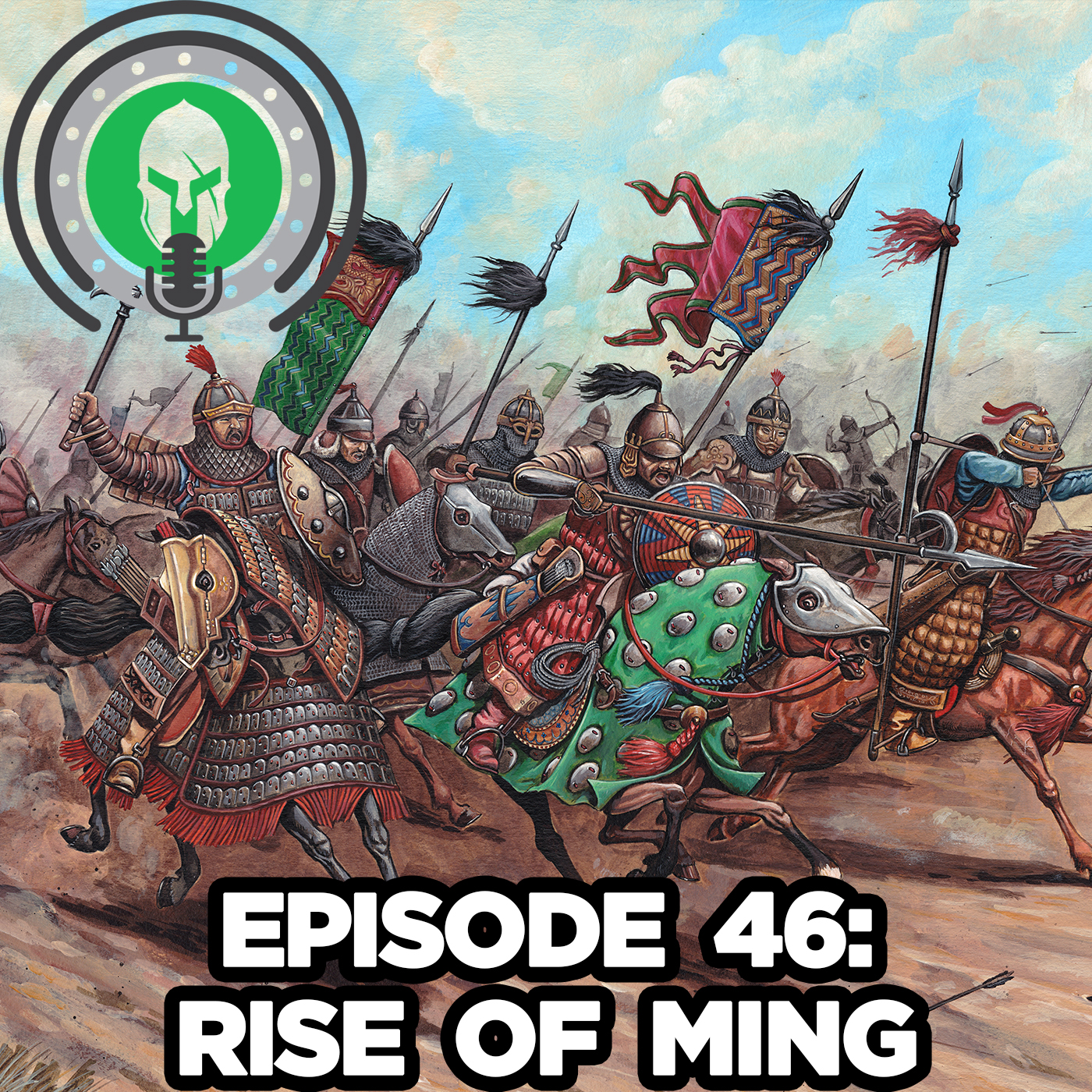
S2 Ep 462.46. History of the Mongols: Rise of Ming
With the Yuan Dynasty reduced to an ever shrinking area of land around Dadu in north China, to tell the story of the expulsion of the Mongol rulers in 1368 is to tell the story of Zhu Yuanzhang, a peasant turned monk turned warlord turned emperor. Today, we give you the rise to power of Ming Taizu, the Hongwu Emperor, his great victory at Lake Poyang and the Rise of the Ming Dynasty, and the final Yuan efforts to hold onto their dynasty. I'm you host David, and this is Kings and Generals: Ages of Conquest. Our last two episodes took us through the period of Mongol rule in China from Khubilai Khan's death in 1294, through his many successors until the reign of Toghon Temur Khan, who took the throne in 1333. Toghon Temur was largely a puppet to his chancellors; first Bayan of the Merkit, and most notably Bayan's nephew, Toghto. Though faced with a colossal economic and environmental crisis which spawned a series of uprisings in 1351, the Red Turbans, by the end of 1354 Toghto had nearly crushed the movement and restored order. But Toghon Temur Khan made the foolish decision to banish Toghto in January 1355, a decision which signalled the death blow to the Yuan Dynasty. Toghto was the last actor who could have arrested the fate of the Yuan or controled the dynasty's resources. Within months of Toghto's dismissal, the rebellion picked up with new energy, and the power of the Yuan court became restricted to the very north. The rest of the empire became subject to various warlords, some with nominal allegiance to the Yuan, and some seeking nothing but its utter destruction. A few points should be emphasized. The lack of interest Toghon Temur had in governing ensured that there was no individual in the Yuan court who could step into the role of Toghto. The strengthening of the regional rulers during the chancellorship of Berke Bukha, followed by mass mobilization in Toghto's last years left provincial, regional and local rulers newly empowered and at the heads of much stronger military forces. The famed Mongol army was one of conquest, not garrison duty: there were simply not enough Mongols to garrison all of China, leaving a light Mongol presence past even the Yellow River. Most actual Mongolian and Turkic cavalry were kept in a few strategic areas, largely centrered around the capital and the steppes. Southern China had been poorly integrated into the Yuan, where Song dynasty structures had often been hastily co-opted. With most of the Yuan government and armed forces in the north, in the south's countryside banditry became a real problem, as years of flood, famine, locust plagues and other environmental catastrophy annihilated farmland, the local economies and regular support networks. Unable to rely on the Yuan army for protection, regional and local leaders organized local defense forces for protection against bandits, the Red Turbans or even the undisciplined newly mobilized Yuan troops, which militarized and armed the population. It must have seemed apparent that the Yuan had lost the Mandate of Heaven, the right to rule China. In the years immediately after Toghto's dismissal, three warlords emerged within the Red Turban movement as the most powerful, all along the Yangzi River: Zhang Shicheng, the former salt-worker who became a warlord, declared himself emperor and was nearly crushed by Toghto during the chancellor's final campaign; Chen Youliang a former fisherman, then office clerk who became leader of the southern Red Turbans and declared his own Han Dynasty with himself as emperor; and a peasant, turned monk, turned warlord, Zhu Yuanzhang. Born into a destitute family of tenant-farmers in 1328, Zhu Yuanzhang grew up surrounded by famine and uncertainty in central Anhwei. His grandfather had fought against the Mongols for the Song Dynasty in its final years, and Zhu grew up listening to his exploits. In summer 1344, he lost most of his family to famine within three weeks. Unable to feed him, his surviving family gave him away to a Buddhist monastery for labour. With the monastery also unable to feed him, he spent a few years wandering before the twenty year old Zhu returned to the monastery, where he learned to read and write. There he may have happily stayed, until a local battle between Yuan forces and Red Turbans in 1352 resulted in some of the Chinese troops in the Yuan army sacking and looting Zhu's temple. Once again having lost everything, Zhu went to the only place he could: he joined a nearby Red Turban group. For a starving peasant turned monk, Zhu showed a surprising aptitude for war and gained the attention of the local Red Turban leader, Kuo Tzu-Hsing. Under Kuo's tutelage, Zhu rose in the ranks, and within a year was given his own command and married Kuo's adopted daughter, the future Empress Ma. By the start of 1355 Zhu was leading an army of about 30,000 men and building his own staff of educated men around him, most notably the scholar Li Shanchang, who encouraged Zhu's ambitions, urg
S2 Ep 452.45. History of the Mongols: Fall of the Yuan
In the almost 40 years from the death of Khubilai Khan in February 1294, to the ascension of Toghon Temur Khan in July 1333, nine Khans of the Yuan Dynasty had been enthroned, with only Temur Oljeitu Khan reigning over a decade. It was a period of treachery, political infighting, civil wars, fraticide, economic mismanagement and inflation and environmental crises upon environmental crises. It was for Toghon Temur, the final Yuan ruler in China, to have the longest reign, sitting for 35 years in the two capitals of Dadu and Shangdu. His long, passive reign saw the disintegration of Mongol rule in China and the expulsion of the Yuan court in 1368- despite some energetic efforts to save the dynasty. Today, we present to you the final years of the Yuan Dynasty, and the last, but doomed, efforts to save it from total ruin by a series of energetic chancellors, none more famous than Toghto of the Merkit. I'm your host David, and this is Kings and Generals: Ages of Conquest. Toghon Temur was only 13 years old when he became Khan of Khans in July of 1333. A great-great-grandson of Khubilai Khan, Toghon Temur was a son of Qoshila, who had briefly reigned as Khan in 1329 before being murdered by his brother, Tuq Temur. The young Toghon Temur had been exiled from the Yuan court by Tuq Temur Khan and his chancellor, El-Temur, first to Korea, then to Guangxi province in China's far south. It was unlikely he'd ever see the throne, and aside from some time with a Buddhist teacher in his exile, he received no training for governance. But when Tuq Temur Khan's designated heir died in 1331, the reigning Khan had a crisis of conscience, evidently from his guilt in the murder of his brother Qoshila. On his deathbed, Tuq Temur indicated he wanted the throne to go to the line of Qoshila; not to Toghon Temur, but his younger half brother, the six year old Irinjibal. There was a major obstacle to this, in the form of El-Temur, the real power in the Yuan Dynasty. It was El-Temur who had engineered the coup which placed Tuq Temur on the throne in 1328, and Tuq Temur Khan had been a puppet for El-Temur throughout his reign. Of Qipchaq descent, El-Temur was from the fourth generation of a celebrated family of Qipchap servants to the Khans. His great-grandfather and grandfather had both served Khubilai Khan in his campaign against the Dali Kingdom in the early 1250s, and since then the family had been among the most prominent in the Yuan realm, controlling one of the empire's key military units, the Qipchaq Guard. El-Temur and his father had loyally served Qaishan Khan, but after his death in 1311 had lost wealth and prestige. The coup El-Temur orchestrated in 1328 was not just to restore the line of Qaishan and place Tuq Temur on the throne, but restore his family's power. Alongside another non-Chinggisid powerbroker named Bayan of the Merkit, El-Temur controlled the Yuan court and married into the imperial family. Before his death, Tuq Temur Khan had entrusted his youngest son El-Tegus into Chancellor El-Temur's care, and El-Temur wanted the young boy to succeed his father. But Tuq Temur's widow Budashiri rallied the court into supporting her husband's final wish, and the aging and ill El-Temur reluctantly agreed to make Qoshila's six year old son Irinjibal Khan… until Irinjibal died of illness not even two months later. Once again El-Temur wanted El-Tegus to become Khan of Khans, but resistance from the court was too great; they wanted the throne to go to Qoshila's 13 year old son Toghon Temur. Even El-Temur's number 2, Bayan, was convinced of it by Empress Budashiri, and after several months of argument over early 1333, a declining El-Temur acquiesced, in part due to agreement to marry his daughter Danashirin, to Toghon Temur. With that, El-Temur died soon after. In July 1333, a little over a century since the death of Chinggis Khan, Toghon Temur was enthroned as the Khan of Khans. The boy was, as to be expected, a puppet. This time, for Bayan of the Merkit, who after serving as second fiddle to El-Temur, wanted to implement his own designs. Part of this was by securing power. In 1335 he unleashed a bloody coup which killed the members of El-Temur's family and loyalists still in government. Even the daughter married to Khan Toghon Temur was killed. That year, Bayan made himself the sole chancellor of the Yuan Dynasty, the maximum power and authority he could ever hope to attain. Bayan was not in the office simply for the sake of authority and killing his former coworkers. He actually had a dream. A rejuvenation of the Yuan Dynasty, desiring a restoration to the way things had been in Khubilai's time; the good old days, when Mongols and Chinese were separated, the racial hierarchy and ensuing privileges clearly enforced. Bayan changed Toghon Temur's reign title to Chih-yuan, which Khubilai had used from 1264 until his death, a clear symbolism, but there were much more overt and practical methods to Bayan's plan. Chinese were banned f
S2 Ep 442.44. History of the Mongols: Yuan - From Crisis to Crisis
After Khuiblai Khan's death in 1294, his successors ruled over the most powerful kingdom on earth, the Yuan Dynasty, controlling all of China and Mongolia. Yet not even one hundred years after the declaration of the Yuan in 1271, the Dynasty was pushed from China, their rulers a shadow of the men Chinggis Khan and Khubilai had been. In our first episode on the Yuan Dynasty, we take you through the first 40 years of their rule after Khubilai, and introduce you to ten Khans, from Temur Oljeitu to Toghon Temur, and the manner in which they lurched from crisis to crisis in the fourteenth century. It was an age of political chaos and bloodthirsty brothers, scheming bureacrats, overbearing mothers and misplaced Khans, and a century where every other person was seemingly named a variation of Temur. It was a period to have strangled even the greatest of rulers and most robust of dynasties; and these were not the greatest of rulers. I'm your host David, and this is Kings and Generals: Ages of Conquest. Our first of ten Khans for today is Temur Oljeitu, Khubilai's grandson and first successor. Khubilai, as we demonstrated rather thoroughly, had outlived his chosen heir, Jinggim, as well as a plethora of other sons and grandsons. After Jinggim's death, Khubilai had vacillated on who should succeed him. It was much more traditional Chinese custom for chosen heirs and the like, as opposed to the Mongolian method of 'to the strongest,' and declarations of quriltais. Seemingly reluctantly, only in the very twilight years of his life almost a decade after Jinggim's death, did Khubilai move to make Temur Oljeitu, one of the late Jinggim's younger sons, his heir. In 1293 Khubilai gave Temur Oljeitu the jade seal of the heir apparent, but had not provided him the full titles and honorifics that Jinggim had held. Thus, when the old Khubilai finally did die in February 1294, Temur Oljeitu was the favourite candidate, but not the only one. He was challenged by his older brother, another son of Jinggim named Kammala. It came to the quriltai in April 1294, where both made their speeches, each demonstrating their knowledge of the maxims of Chinggis Khan, aiming to convince the elite and each other of their fitness for the Grand Khanate. Of course, it wasn't really just a matter of speeches which determined the outcome. Being the selected heir of Great Khan Khubilai was obviously a powerful boost, but Temur Oljeitu had a number of powerful allies backing him. His mother, Kokejin, was well respected and beloved by Khubilai; military leaders, especially Bayan of the Baarin, the great conqueror of the Song Dynasty, backed Temur Oljeitu; and prominent members of the bureaucracy, such as the Chancellor of the Right, Oljei. This was to be a heralding of the future of the succession Yuan Khans, where the bureaucracy and military elite became the decision makers. Kammala was convinced to accept Temur Oljeitu, who on April 15th, 1295, was duly enthroned as Khan of Khans and Emperor of the Yuan Dynasty. Temur Oljeitu was a respectable choice. Conservative minded, both he and Chancellor Oljei, as well as Oljei's successor Harghasun, aimed to consoldiate and stabilize the Yuan Dynasty after the struggles of Khubilai's final years. Open minded regarding Chinese culture, respecting Confucianism but not enmeshed in it, while also having connections to the military elite in the Mongolian steppe, Temur Oljeitu was very much a Khan in the mold of his grandfather Khubilai, though lacking his physical and intellectual vigour, while also keeping one of Khubilai's worst vices, a penchant for alcoholism. In order to stabilize the government and economy, reconciliation of various branches of the family was favoured and great invasions abandoned. Lavish gifts to princes on his accession helped affirm their loyalty and quiet some of the Mongols in Manchuria who had been so problematic in Khubilai's last years. Plans to invade Annam and Japan were cancelled; the only foreign ventures were to be brief excursions into Burma and northern Thailand which, though largely failures, were not on the scales of any of Khubilai's efforts. Tax debts from Khubilai's reign were cancelled, and Temur Oljeitu sought to reduce the tax burden on the people, forbidding the collection of anything beyond established quotas. Diplomatically, Temur enjoyed a significant triumph over his father. In 1301 his armies under his nephew Qaishan finally defeated Qaidu Khan, the master of central Asia. When Qaidu died of his wounds in September 1301, Qaidu's puppet Chagatai Khan Du'a decided he had enough of fighting the Yuan. With Qaidu's son Chapar, Du'a contacted Temur Oljeitu indicating his willingness to recognize Temur Oljeitu's overlordship. Temur Oljeitu was delighted and immediately accepted. Their representatives were sent to the Khan of the Ilkhanate, also called Oljeitu, and the Khan of the Golden Horde, Toqta. By 1304, peace had reached between the Khanates. For the first time sin

History of the Mongols SPECIAL: Dr. John Latham-Sprinkle on the Alans
The history of the Mongol Empire is not just a history of the Mongols, but the people they interacted with. In today's interview, our series historian, Jack Wilson, talks with Dr. John Latham-Sprinkle on one of those peoples affected by the Mongol Conquests, the Alans of the North Caucasus. Dr. John Latham-Sprinkle is a historian based at Ghent University in Belgium, whose work focuses on the history of the North Caucasus region, which today is part of the Russian Federation. He researches the Medieval kingdom of Alania, the formation of political power in imperial borderlands, and the history of slavery
History of the Mongols SPECIAL: Rabban Bar Sauma
"There was a certain man who was a believer, and he was a nobleman and a fearer of God. He was rich in the things of this world, and he was well endowed with the qualities of nature; he belonged to a famous family and a well-known tribe. His name was SHIBAN the Sa'ora. He dwelt in the city which is called [...] KHAN BALIK , [...] the royal city in the country of the East. He married according to the law a woman whose name was KEYAMTA. And when they had lived together for a long time, and they had no heir, they prayed to God continually and besought Him with frequent supplications not to deprive them of a son who would continue [their] race. And He who giveth comfort in His gracious mercy received their petition, and He showed them compassion. For it is His wont to receive the entreaty of those who are broken of heart, and-to hearken unto the groaning of those who make supplications and petitions [to Him]. [....] Now God made the spirit of conception to breathe upon the woman Keyamta, and she brought forth a son, and they called his name " SAWMA." And they rejoiced [with] a great joy, neighbours of his family and his relations rejoiced at his birth.' So begins the history of Rabban bar Sauma, as translated by E. Wallis Budge. There were a number of travellers, missionaries, diplomats and merchants who made journey from Europe to China during the height of the Mongol Empire. While Marco Polo is the most famous of these, we have also covered a few other travellers in previous episodes. Yet, there were also those who made the harrowing journey from China to the west. Of these, none are more famous than Rabban bar Sauma, the first known individual born in China who made the journey to Europe. Rabban bar Sauma was a Turkic Christian monk who travelled from Khanbaliq, modern-day Beijing, across Central Asia, the Ilkhanate, the Byzantine Empire, Italy, all the way to the western edge of France, visiting Khans, Emperors, Kings and Popes. Our episode today will introduce you to Rabban Sauma and his incredible journey across late 13th century Mongol Eurasia. I'm your host David, and this is Kings and Generals: Ages of Conquest. Sauma was born around 1225 in the city of Yenching, on which Beijing now sits. Yenching of course, we have visited before, when it was known as Zhongdu, the capital of the Jurchen Jin Dynasty. The Mongols took the city after a bloody siege in 1215, which we covered back in episode 7 of this season. Sauma was born to Turkic parents, either Onggud or Uighur, two groups which had long since recognized the supremacy of Chinggis Khan. Sauma's parents were Christians of the Church of the East, often called, rather disparagingly, Nestorians. Nestorius was a 5th century archbishop of Constantinople who had argued, among other things, the distinction between Christ's humanity and his divinity, and that Mary was mother of Jesus the man, but not of Jesus the God. For if God had always existed, then he could not have had a mother. For this Nestorius was excommunicated at the Council of Ephesus in 431 and his followers scattered across the east. From the Sassanid Empire they spread across Central Asia, reaching China during the Tang Dynasty. By the 12th century, the adaptable Nestorian priests converted several of the tribes of Mongolia, from the Naiman, the Kereyit to the Onggud, to which Sauma likely belonged. These Eastern Christian priests stayed influential among the Mongols for the remainder of the 13th century, with a number of prominent Mongols adhering to their faith. Sorqaqtani Beki, the mother of Great Khans Mongke and Khubilai, was perhaps the best known of these. The young Sauma took his Christian faith seriously; so seriously, his parents sought to dissuade him, fretting the end of their family line if their son became a monk. Refusing fine meats and alcohol, Sauma instead hungered for ecclestical knowledge and purity. Accepted into the Nestorian clergy of Yenching in 1248, at age 25 he donned the tonsure and garb of the monk. Developing a reputation for asceticism beyond even his fellow monks, he largely secluded himself in his own cell for 7 years before leaving the monastery for the mountains. His devotion to Christ made him famous among the Nestorians of North China and Mongolia, attracting the attention of a young Onggud Turk named Markos. From the Onggud capital of Koshang in modern Inner Mongolia, Markos was mesmerized by the stories of the holiness of Sauma. The 15 year old Markos marched by himself to Sauma in 1260. Impressed by the youth's tenacity even as he attempted to dissuade him from joining the monastery, Sauma eventually took Markos under his wing. Markos proved himself an excellent student, and within three years was accepted into the Nestorian monastic life. Sauma and Markos became fast friends and pillars of the Nestorian community around Yenching, which by then was the capital of the new Great Khan, Khubilai, and renamed to Dadu, "Great City," or Khanbaliq, "The Khan's Ci
S2 Ep 432.43. History of the Mongols: Death of Khubilai
The weight of years will bear down on each of us heavily, from the humblest farmer to the most august monarch. And Khubilai Khan, mighty even among the mighty, over his nearly forty year reign found even his immense energies sapped by this burden. Age, grief, the rigours of government, and military defeats ground down the vision of Khubilai, and in reaction he directed his energies to drink and food. In the vacuum left behind, corruption grew like mold on the young Yuan Dynasty, sowing problems neither Khubilai nor his successors would be able to solve. Today, we look at the last years of Khubilai Khan, the end of an era in the Mongol Empire: I'm your host David, and this is Kings and Generals, Ages of Conquest. For the past few episodes, we have dealt with Khubilai's long reign. First, we dealt with his conflict with his brother Ariq-Boke for the Mongol imperial throne. Khubilai was victorious by 1264, but in his victory was left with hardly even a nominal mastery over the western Khanates of the empire: the Golden Horde, Chagatai Khanate, Ilkhanate and Ogedeid Khanate under Qaidu were all effectively independent powers by the time of Khubilai's victory. As a result, Khubilai focused his attention on China. Over three episodes we detailed Khubilai's renewed effort to end the long war with the Song Dynasty, a victory finalized by 1279 which marked the conquest of China, almost 60 years since Chinggis Khan had first attacked the Jin Dynasty. Then, we looked at Khubilai's efforts to build his administration from 1264-1279, the period of his greatest energy and vision. By all standards, Khubilai was an impressive monarch, merging Mongolian and Chinese imperial traditions into a carefully balanced new system which, in many areas, seems to have genuinely sought to reduce the burdens upon Khubilai's subject population. Our following episodes dealt with the beginning of the end of Khubilai's good fortune. In Japan, Vietnam, Myanmar and Java, Khubilai's military forces met with either inconclusive, or outright diastrous results. A stunning expenditure of resources and lives for little in the way of strategic gains, the efforts to meet these costs required imaginative efforts on the part of Khubilai's finance ministers- the topic of our previous episode, looking at the so-called Three Villianous ministers, Ahmad, Lu Shih-jung and Sangha, and the animosity they inspired from the top levels of Khubilai's government to the subject population. For Khubilai, the successive defeats were not just a shock in comparison to the overwhelming victories over the previous decades, but were more alarming in a personal manner. In both the Mongolian and Chinese imperial traditions, the right to rule rested on the support of Heaven. Heaven's support always manifested itself in bountiful harvests, good climates, good governance and military victories. For the Mongols, the many amazing conquests of the thirteenth century had demonstrated Eternal Blue Heaven's desire for the Mongols to rule the whole of the world. Khubilai had firmly believed that the ultimate destiny of the Mongols, and his destiny, was that his rule would include everything beneath the blue sky. There simply could not have been an alternative to this. So to be met with the alternative; that is, successive rounds of wasteful defeats in foreign countries from the late 1270s through the 1290s, must have come not just as an immense shock, but a blow to Khubilai's own psyche. Coupled with the knowledge of his loss of control over the Khanates in the west of the empire, and the rebellion he faced within and along his borders, Khubilai would have struggled with a sense of failure; his failure to complete the mission begun by his grandfather, great Chinggis Khan. Aside from defeats and failure in his foreign policy, the internal matters of Khubilai's realm also saw the failure of many of his efforts to actually run his empire, and failures in his personal life. After 1276, the seizure of the Song Dynasty's capital at Hangzhou, and especially after 1279, with the final defeat of the Song holdouts on the island of Yaishan, Khubilai Khan began to steadily reduce his role in the governance of his empire. By the end of the 1270s, Khubilai was already in his sixties. His efforts over the 1260s and 70s had been physically draining on him, having thrown himself in military campaigns, restructuring government and administration. By the end of the 1270s, a largely successful decade marred only by the failure of the first invasion of Japan, Khubilai was in essence high on his accomplishments, but burned out from the pressures of ruling. From the turn of 1280 onwards marked a significant change in Khubilai's method of rulership. The hands-on monarch in weekly and daily discussions with his advisers on the running of the empire making sweeping plans turned into a man steadily withdrawing and becoming disinterested with the actual running of the government. The causes of this were multi-fa
S2 Ep 422.42. History of the Mongols: Three Bad Ministers of Khubilai
"You must know that, as we shall tell you later on, the Great Kaan has entrusted to twelve men the task of attending, as seems best to them, to all territories, governments, and everything else. Among these twelve men, there was a Saracen, [Ahmad] by name, a shrewd and capable man, who above all others enjoyed great power and influence with the Great [Khan], who loved him so much that he gave him every liberty, for, as was found after his death, this [Ahmad] laid such a spell over the Kaan with his sorceries that the latter placed absolute faith in his words, paying them the closest attention. Thus he was able to do all that he wished. He it was who distributed all governments and offices, and punished all offenders. And every time he wished to encompass the death of someone he hated, whether justly or unjustly, he would go to the [Khan], and say, "Sire, such a man is worthy of death, for he has offended your Majesty in such a way." Then the [Khan] would say, "Do what thou thinkest most fitting." And straightway he would have the man put to death. Hence, seeing the complete liberty he enjoyed, and that the Lord placed absolute trust in his words, no one dared cross [Ahmad] in anything whatsoever." So the Venetian traveller Marco Polo, in the Benedetto translation, introduces Ahmad Fanakati, the famous "evil finance minister" of Khubilai Khan. Ahmad, the first of Khubilai's "Three Villianous Ministers," as they're termed in the Chinese sources, is often used to symbolize the decay and corruption of Khubilai Khan's final years. Where Khubilai had once been a vigourous monarch attending to every detail of state, by the 1280s his interest and energy for governing declined with every year. Having taken you through the inconclusive, expensive and disastrous foreign miltiary expeditions of Khubilai's last years, we shall now take you to the political and personal failings of Khubilai's twilight, beginning with the Three Villianous ministers- Ahmad Fanakati, Lu Shih-Jing and Sangha. I'm your host David, and this is Kings and Generals, Ages of Conquest. Ahmad, the first of the "Three Villianous Ministers," was a Muslim from Central Asia who had been a favourite of Khubilai's wife Chabi. Appointed to Khubilai's Central Secretariat in 1262, Ahmad's power and influence rapidly rose through his canny ability. For a refresher on the secretariats and government structure of Khubilai, you can check back to episode 37, "Kublai Khan's Reign." By 1264, Ahmad was Vice-Chancellor of the Central Secretariat, and in 1271 was even briefly appointed as head of the newly made Supreme Secretariat. His primary responsibility in Khubilai's service was as a finance minister, tasked with providing the Great Khan more and more revenues. In this position he promoted trade, particularly with Central Asia and sought to increase the number of taxable households in the empire- usually by tracking down those who had escaped prior registration. Ahmad also oversaw further progress on implemention of regular land taxation, one of those ever-present problems of the Mongol administration in China, as well as new taxes on merchants. One of his most noteworthy efforts was the expansion of government monopolies; iron producing regions would have to provide yearly quotas of iron to the government, which would be turned into tools and farm implements to be sold back to farmers. After 1276 Ahmad forbade the private production of copper tools, making it a privilege of the government to produce and sell these, usually in exchange for grain. The yearly revenue from the strictly enforced salt monopoly increased dramatically over the 1270s and early 1280s, and monopolies on tea, liquor, vinegar, gold, silver - all traditional monopolies of the Chinese state- were enforced under Ahmad's supervision. None of Ahmad's financial policies in and of themselves indicated an expectional cruelty on his part or hatred towards the Chinese. Rather, he was enacting the will of Khubilai, who was making ever increasing demands for income. Ahmad had to choose between more state revenues or looking to fail the Great Khan, and judged, rather wisely, it was better to come up with more revenue. Ahmad carried out his mandate thoroughly, and for this earned as much love as any thorough tax collector will- i.e, not very much. If we are to believe the sources, the Chinese at large hated and cursed him for his policies, and the fact that he was a foreignor. Khubilai, as Ahmad's backer, thus found his own standing harmed in their eyes. However, whatever "public opinion" was regarding Ahmad does not particularly matter: the Mongols never showed themselves really concerned with how the masses viewed their ministers. The fact that Ahmad was bringing in the revenue streams and trying to handle the tricky task of incorporating the former Song territories into the Yuan Empire mattered more to Khubilai than the cursings of merchants. The reason that Ahmad has become so infamous comes not from
S2 Ep 412.41. History of the Mongols: Wars of Qaidu
Qaidu was raised in Chinggis Khan's camp, and after Ogedai Khaan he served in Mongke Khaan's retinue. After him, he was with Ariq Boke, conspiring and amking efforts to elevate him to the khanate. When Ariq Boke went before Kublai Khaan and submitted to him, Qaidu was wary of Kublai Khaan because it was the law that no creature should change the Khaan's command or decree, and any who did would be branded as criminals. He had transgressed the law and rebelled, and from that time until present, ona account of his rebellion, many Mongols and Tajiks have been annhilated, and flourishing land has been devastated." So our oft-cited friend Rashid al-Din describes, rather negatively, his contemporary Qaidu, Khan of the house of Ogedai and master of Central Asia in the late thirteenth century. Qaidu is best known for his daughter Qutulun, the wrestler-princess, his long resistance against his cousin Kublai, Great Khan of the Yuan Dynasty, and enjoys a popular image as a spirited defender of traditional Mongolian culture- or, for writers like Rashid al-Din, an image of little more than a brigand harassing settled regions. To explore Kublai's failed attempts to exert power over the western half of the Mongol Empire, we will look at the long life of Qaidu, master of the uluses of Ogedai and Chagatai. I'm your host David, and this is Kings and Generals: Ages of Conquest. While Kublai Khan overcame his brother Ariq Boke to become Khan of Khans in 1264, that was not the end of his troubles from his Mongolian kinsmen. Many refused to recognize Kublai's authority, or actively took up arms against him, most famously Qaidu, a grandson of Ogedai Khan who led a 40 year campaign of resistance against Kublai Khan. While most famous for stories of his warrior daughter Qutulun and for his own personal sternness and military ability, Qaidu's reign has often been misportrayed as an effort to seize the title of the Great Khan. His main focus however, was securing the position of the descendants of Ogedai within a fragmenting Mongol Empire. Chinggis Khan had granted parts of eastern Kazakhstan, Xinjiang and western Mongolia as personal ulus, or territory, to his son Ogedai, serving as a base for Ogedai's family until the 1250s. The Toluid Revolution, which by now you should know very well, saw the seizure of the throne by the sons of Tolui, away from the line of Ogedai following the death of the final Ogedeid Great Khan, Guyuk, in 1248. After Tolui's eldest son Mongke became Khan in 1251, he discovered an alleged conspiracy against him by Ogedai's family. This served as pretext for a purge of the Ogedaids, killing many and confiscating their lands and armies, effectively dissolving the Ogedaid ulus, as explained back in episode 21 of this series. Those few who survived, such as the young Qaidu, were granted distant lands to appease them but which were too poor to serve as a base for resistance. Born only around 1235 or 6, Qaidu was only just entering manhood when Mongke carried out his purges, deemed too young to be a threat. In proper Ogedeid fashion Qaidu's father, Ogedai's fifth son Qashi, drank himself to an early death shortly before Qaidu's birth, leaving Qaidu's early years to quietly rule over what little people, herds, pastures and towns Mongke Khaan had allotted him around Qayaliq, in what is now southern Kazakhstan. We can only imagine Qaidu's frustration and anger, a sense that everything that was his by right had been taken from him, anger at the theft by the house of Tolui- not of the Great Khanate, which Qaidu was unlikely to have ever inherited, but of the ulus of Ogedai itself, the personal territory Chinggis Khan had granted that line of the family. One tradition from Qaidu's earliest youth that survives, recorded by Jamal al-Qarshi, is that Ogedai Khaan once held the young boy and was so impressed with the 5 year old, that he stated Qaidu would one day succeed him and ordered his every need to be provided for. Even if the story were true, it must be remembered that Ogedai indicated about half of his sons and grandsons should have succeeded him at various points, and anyways, Qaidu was no mroe than six years old at the time of Ogedai's death. No, the young Qaidu was not ever destined, nor likely ever considered himself to be, for the throne of the Great Khan. Qayaliq was too poor to offer a base of resistance on its own, but it did not stop Qaidu from pushing his boundaries. In 1256, Mongke Khaan sent a judge to Qaidu's territory as an official imperial representative- the exact mission unclear in the sources- and the 20 year old Qaidu promptly captured him, holding him captive for the next two decades. No reaction is recorded from Mongke, who may have been preoccupied with his forthcoming assault on the Song Dynasty to divert attention to an annoying Ogedeid boy. Perhaps Mongke had been planning to deal with him upon his return from campaign, but as we know, he never got the opprotunity: Mongke died on campaign in Au

History of the Mongols SPECIAL: Dr. Michal Holeščák on the archeology of Mongols and Cumans Pt2
The Mongols were far from the only nomadic peoples to interact with Europe, even in the thirteenth century. Of these, the Cumans are perhaps the most well-known and have left us a considerable legacy in the archaeological record. Today, our series researcher Jack Wilson talks with Dr. Michal Holeščák regarding the archaeological presence of the Cumans and Mongols in 12th and 13th century Eastern Europe. Michal Holeščák is an archaeologist dealing with the material culture of late nomadic peoples, namely the Mongols and Cumans, from Mongolia to the westernmost fringes of the Great Eurasian Steppe in Hungary.

History of the Mongols SPECIAL: Dr. Michal Holeščák on the archeology of Mongols and Cumans in Eastern Europe
The Mongols were far from the only nomadic peoples to interact with Europe, even in the thirteenth century. Of these, the Cumans are perhaps the most well-known and have left us a considerable legacy in the archaeological record. Today, our series researcher Jack Wilson talks with Dr. Michal Holeščák regarding the archaeological presence of the Cumans and Mongols in 12th and 13th century Eastern Europe. Michal Holeščák is an archaeologist dealing with the material culture of late nomadic peoples, namely the Mongols and Cumans, from Mongolia to the westernmost fringes of the Great Eurasian Steppe in Hungary.
S2 Ep 402.40. History of the Mongols: Invasion of Java
Around 40 episodes ago, we discussed Chinggis Khan fighting for control of the Mongolian steppe. Now, some 90 years later in our chronology, we will discuss his grandson sending Mongol armies across the sea to lands beyond Chinggis' imagination. While Japan, Vietnam and Burma were all subjects of invasions towards the end of Kublai Khan's life, all of these were regions relatively close to Yuan China, directly bordering its subject territories. Our discussion today focuses on a much less obvious target: the island of Java in modern Indonesia. The expedition against Java was one of the last military campaigns ordered by Kublai in his long life, and like many of these later invasions, cost the Yuan heavily in men and resources for little gain. I'm your host David, and this is Kings and Generals: Ages of Conquest. In the 13th century, Eastern Java and parts of the neighbouring islands of Sumatra and Borneo came under the influence of the Kingdom of Tumapel, named for the city of the same name on the island of Java- or atleast it was the same name until the reign of King Jaya Wisnuhardhana, who changed it to Singhasari. You'll find this state therefore referred either as the Kingdom of Tumapel, or Singahsari.The Tumapel kings were not absolute rulers, with much of their kingdom made up of loosely controlled vassal kings and chiefs. Rather, their significance for our purposes came from their place on a lucrative position along the maritime trade routes going through Indonesia and across the southern coastline of the Eurasian landmass. By the 12th century, the island of Java was one of China's chief suppliers of pepper and safflower dye, along with Bali. The island exported rice, and held trade contacts from China to India. In turn, they imported gold, silver, lacquerware, iron goods and ceramics from China. The southeast Asian sea trade was a valuable market which had been expanding considerably since the ninth century- and one which now attracted the attention of a man hungry for conquest and with less and less patience for, well, patience. By the 1280s, Kublai Khan had completed his conquest of China proper, but good, overwhelming victories were frustraingly eluding him in Central Asia, Japan, Vietnam and Myanmar, and as he advanced in years, the knowledge that he was failing to bring the world under Mongol authority must have weighed heavily on him. Now in his seventies, with his poor health, depression, deaths of his friends and family, increasing removal from affairs of state and awareness of his own impending mortality, Kublai must have been desperate for victories to console his aching spirit. In addition, the economic aspects must not be overlooked -though they were not separate, from Kublai's point of view, but merely a component of universal rule. Kublai's Yuan dynasty, while obviously influenced by China's Confucian norms and traditions, felt no need to bind themselves to it, and kept for instance, the Mongolian practicality regarding merchants. Rather than treat them as inherently lower class, they were invited and rewarded, and trade as a whole encouraged. This took a notable form on the recent completion of the conquest of the southern Chinese coastline. Soon after the imposition of Mongol rule at the end of the 1270s, a new Bureau of Maritime Trade was established as the major port of Quanzhou. The Bureau not only oversaw and taxed the trade in and out of Quanzhou, but sought to actively encourage it as well as the settlement of foreign traders there. Contacts were made across the region- the Southeast Asian coastline of course, but also the Phillipines, Indonesia including Java and Sumatra and to India and Iran's southern coastline. We, have for instance, south Indian style Hindu temples with Tamil transcriptions in Quanzhou from this period, and knowledge of a significant Muslim population and resettled Persian. To the Islamic world Quanzhou was known as Zayton, by which Marco Polo recorded the name. The Yuan Dynasty had a keen interest in trade, and sought to extend their control over it throughout the region- at the same time extending the Mongols' heavenly Mandate to rule the whole of the world. On these considerations, Kublai Khan increased diplomatic missions across the seas of southern Asia, from Malabar to Sri Lanka, ordering the monarchs and peoples across the sea to submit to the Great Khan, as per the wish of Eternal Blue Heaven- something it should be noted, many of these states did do. In fact, for the privilege of trading with China, most regional states already undertook a sort of yearly tribute to whichever Chinese dynasty ruled the requisite ports they wanted access to. The Chinese dynasties were generally content to accept the trade and maintain the image of themselves as the Sons of Heavens, the centre of the world in name even if it wasn't quite so in practice, and the Son of Heaven did not exercise actual authority in these states. The Mongols, as many a state in eastern Asia
S2 Ep 392.39. History of the Mongols: Invasion of Burma
On a thickly humid day, flanked by dense forest of a deep green, rows of archers astride skittish horses struggle to control their mounts. Their local allies, armed with bows and tightly clutched spears, have their eyes focusing on a mass of men surging forward towards them. Infront comes a vanguard of the beast terrifying the Mongol horses; elephants, adorned in gold, armour and broacde, their tusks spiked and decorated, tall towers on their backs housing archers and spear throwers. The Mongol commander is afraid but refuses to show it; it would do no good to show fear before the men and the vassal troops. As calm as he can, he orders the cavalry to retreat to the treeline and dismount; they would stand before the oncoming host of the King of Pagan, modern Myanmar onfoot, armed with nothing but their bows and the will of Eternal Blue Heaven. I'm your host David, and this is Kings and Generals: Ages of Conquest. Of all the foreign ventures ordered by Kublai Khan in his later years, it was the invasions of Burma, or rather,, Myanmar, which are among the most poorly known in the west. While not as overtly disastrous as the more famous campaigns against Japan or Vietnam, which we have previously covered, the fighting in Myanmar still showcased the limits of the Mongol military, where tactical victories could not always translate into strategic success. By the 13th Century, the Kingdom of Pagan [pronounced somewhere between Bagan, Pakam, Pokam] had dominated Myanmar since the mid 9th century. Considered a golden age, from its strategic position on the Irrawadday River, the city of Pagan was the capital of a multi-ethnic, multi-religious and multi-linguistic kingdom straddling both upper and lower Myanmar. Military conquests backed by expanding infrastructure, irrigation and administrative systems laid the groundwork for a stable and regionally dominating empire. Population growth and infrastructure led to the increased development of Lower Myanmar, coupled with the expansion of arable lands to support it. To legitimize themselves, the Kings of Pagans patronized Thereavdic Buddhism and built monumental architecture to celebrate themselves. Huge donations of arable land to the Buddhist monasteries gradually put more and more of the kingdom's wealth and resources in the hands of the monks; by the thirteenth century, the Pagan kings found themselves in a more and more desperate economic situation, struggling to reclaim lands from the entrenched powers but continually needing to build monuments to legitimize themselves and maintain Buddhist support for their power. Skillful kings like Kalancacsa, reigning 1084-1111 were able to balance all the elements of the Pagan kingdom, its various ethnic groups and traditions and the Buddhist clergy, but the kings of the thirteenth century lacked this ability- particularly Narathihapade, who took the throne in 1254. By then, long held tensions were bubbling beneath the surface, and the once un-developed Lower Myanmar was becoming a major population and political centre that the king in Pagan struggled to control. And with so many kingdoms of the thirteenth century, this crockpot of troubles was aggravated by the addition of an extremely potent ingredient; the Mongol Empire. Pagan, separated from China and the Song Dynasty by the Kingdom of Dali in Yunnan and Dai Viet in Northern Vietnam, had escaped the attention of the Mongols during their first forays into these kingdoms in the 1250s, as we have covered in previous episodes. With the initial submission of these regions in that decade, the Mongol Empire now shared a border uncomfortably close to Pagan's northeastern-most outposts. It was in 1271 that the Great Khan Kublai's first envoys reached the Kingdom of Pagan, requesting the submission of its monarch, King Narathihapade, as well as the necessary trade and tribute demanded upon all subjects of the Mongol Emperor. History has not been kind to Narathihpate, often presented as a vain and greedy ruler. Usually, you'll be pointed to this incrisiption he place on the Mingalar Zedi Pagoda in 1274, "King Narathiha Pati, supreme commander of 36 million soldiers and who is the consumer of 300 dishes of curry daily, enshrined fifty-one gold and silver figurines of kings, queens, nobles and maids of honour, and over these a solid silver image of Lord Buddha Gautama one cubic high, on Thursday the Full Moon of Kason of the year 636." Of course, Narathihapade did not command 36 million soldiers, though his ability to consume curry in prodigious amounts is outside the realm of our discussion today. This is however an example of the earlier mentioned needed for Narathihapade and the Burmese kings to legitimize themselves through large monuments and inscriptions. His kingdom facing an economic problem undermining the very power of its monarchy and his own ancestry and position on shaky ground, Narathihapade had to shore up his position with boasts and monuments, wasting valuable resources

S2 Ep 382.38. History of the Mongols: Invasions of Vietnam
"In the West there is a province called Kafje-Guh, in which there are forests and other places of difficult access. It adjoins Qara-Jang and parts of India and the coast. There are two towns there, Lochak and Hainam and it has its own ruler, who is in rebellion against [Kublai Khaan]. Toghan, the son of the [Khaan], who is stationed with an army in Lukin-fu in the [south of China], is defending [China] and also keeping an eye on those rebels. On one occasion, he penetrated with an army to those towns on the coast, captured them, and sat for a week upon the throne there. Then all at once their army sprang out from ambush in the sea[shore], the forest, and the mountains and attacked Toghan's army while they were busy plundering. Toghan got away safely and is still in the Lukin-fu area." So the Ilkhanid historian and vizier Rashid al-Din, writing in the first years of the 1300s, describes events less than twenty years prior but very far away. Rashid al-Din transcribed a very brief, but recognizable sketch, of the Mongol invasions of Vietnam in the 1280s. Having covered for you the first half of Kublai's reign up until the end of the 1270s and his conquest of China, we will now take you to the beginnings of his failures. Back in July we already presented the Mongol invasions of Japan in 1274 and 1281, so now we'll turn our gaze southwards, to the efforts to extend Mongol suzerainty over the kingdoms of what is now Vietnam. I'm your host David, and this is Kings and Generals: Ages of Conquest. Before we discuss the military operations, it's useful to set the scene and establish Vietnam's 13th century status. As has been so often over this series, for context we must go back to the fall of China's Tang Dynasty in 907. For roughly a thousand years, starting from the Han Dynasty in 111 BCE, the northern half of what is now Vietnam was under Chinese dominion, broken up by a few decades of revolts and brief independence here and there. Of course, the Chinese Dynasties were not dominating a 'Vietnam' in any modern sense. Rather, they were exerting control or tributary relationships with the Viet, or Kinh, peoples around the Red River, or Hong River, Delta. This delta is usually described as the cradle of Vietnamese civilization, the most densely populated and fertile part of the country even today. Vietnam's capital, Hanoi, sits in this region. The long period of Chinese rule and influence left an undeniable mark upon Vietnamese conceptions of state, and every succeeding Viet dynasty has born obvious echoes of it. With the collapse of the Tang in 907, the Chinese presence in the north of Vietnam weakened, and local groups began to exert independence. Some of the Tang's successors in Southern China invaded and briefly brought the Red River Delta back under Chinese rule. But by the middle of the tenth century, the first fully independent Vietnamese Dynasty in centuries, the Ngô Dynasty, was established… and collapsed into feuding warlords by 965. It was not until the Lý Dynasty, founded in 1009, was stability reached. Under the Lý Emperors- though only Kings, if you asked the Chinese- the recognizable aspects of medieval northern Vietnam were built. The capital was moved to Thăng Long, modern day Hanoi. Buddhism was adopted as the state religion, and in 1054 a new emperor declared a new name for their state; Đại Việt,, meaning 'great Viet,' by which we most commonly know the medieval and early modern state. Administrative and military reforms made it the most stable and powerful Vietnamese kingdom yet, and the state expanded both north and south. Agricultural expansion and land reclamation fueled population growth and a steady Viet colonization southwards. Good times for the Lý Kings did not last. By the start of the thirteenth century their rule had weakened, local warlords exerted their independence and the monarchs were generally inept with few heirs. In a series of political alliances and marriages, the Trần family gathered power and began to try to force the Lý Kings to be their puppets. Warfare broke out. The Lý Kings maintaned the throne, but with the Trầns the power behind it. The final ailing Lý King abdicated the throne in 1224 with only two daughters. His 7 year old daughter, Lý Chiêu Thánh, was enthroned as the only queen-regent in Vietnam's history. Throught the machinations of the Trần "mayor of the palace," Trần Thủ Độ married the young queen to his nephew, Trần Cảnh. The queen soon abdicated the throne, making Trần Cảnh the reigning monarch- the first ruler of Vietnam's prestigious Trần Dynasty, known by his temple name Thái Tông, the Vietnamese rendition of that classic Chinese temple name, Taizong. His father was posthumously made Taizu, and the scheming uncle Thủ Độ became the chancellor and the major powerbroker within Đại Việt until his death in 1264. The powerful new Trần Dynasty of Đại Việt centralized power and continued the expansion begun the Lý Dynasty. Further reclamation efforts and dykes to
S1 Ep 372.37. History of the Mongols: Kublai Khan's Reign
"Now I wish to tell you [...] all the very great doings and all the very great marvels of the very great lord of the Tartars, [...] who is called Kublai Khan, which [...] means to say in our language the great lord of lords, emperor, and [...]this great Khan is the most powerful man in people and in lands and in treasure that ever was in the world, or that now is from the time of Adam our first father till this moment; and under him all the peoples are set with such obedience as has never been done under any other former king. And this I shall show you quite clearly in the course of this our second book, that it is a true thing which I have told you so that each will be sure that he is, as we say without contradiction, the greatest lord that ever was born in the world or that now is." So Marco Polo introduces Kublai Khan in his Description of the World, as per the classic translation of Moule and Pelliot. Having now taken you through the successful Mongol conquest of China and fall of the Song Dynasty, we'll now look at Kublai's reign itself, and his efforts to build a new dynasty in China. Great Khan of the Mongol Empire and simultaneously Emperor of China, Kublai Khan was one of the single most powerful men in human history, rumours of his vast wealth and might spreading across the world. Kublai Khan's long reign will be dealt with in two halves; a first one today covering 1260 to 1279, followed by a look at Kublai's foreign ventures, then another episode detailing his last years. I'm your host David, and this is Kings and Generals: Ages of Conquest. Kublai's name has popped up in several episodes even before his war with Ariq Boke, but we've dealt little with the man directly. Born on the 23rd of September, 1215, Kublai was the second son of Tolui and Sorqaqtani Beki, and a grandson of Chinggis Khan. Indeed, Kublai was the last of the Great Khans to have ever personally met Chinggis, though Kublai was little more than 12 years old at the time of Chinggis' death. It was never likely that Kublai would have come to the throne: while all of Sorqaqtani's son received the same extensive education, learning to read and write the Mongolian script, take lessons in governance and even had Chinese advisers, Kublai was the only one of her four sons who really found himself attracted to Chinese culture. In time, Kublai even came to speak some Chinese, though never learned the characters. While Sorqaqtani's eldest son Mongke led armies on the Great Western Campaign across the steppe in the 1230s, Kublai was beginning to govern Chinese for the first time, having been given an appanage in North China by Ogedai Khaan in 1236. Like many Mongols granted territory in China, Kublai did not actually rule from China, staying in Mongolia proper. As with much of North China, Kublai's appanage was left to the whims of tax farmers and merciless officers demanding extraordinary levies. By the time Kublai learned of it, thousands of tenants had already fled their lands. Perhaps on the council of his Chinese tutors, Kublai sought assistance and local knowledge. The tax farmers in his lands were dismissed and replaced with dedicated officials. A regular taxation system enforced, burdens lessened and by the 1240s Kublai had succeeded in encouraging a number to return. The episode was an important one for Kublai. Leaving government to operate without oversight would allow all manner of corruption and abuse into the system, depreiving the lord of his tribute and putting increased pressure onto the peasanty and farmers at the bottom. Given the chance, they would flee, leaving those petty officials to now increase the pressure on remaining tenants and continue the cycle. By curbing abuses and encouraging growth, Kublai reasoned, the lord would reap even greater rewards over time. For most of the 1240s, Kublai was a minor figure. He was a grandson of Chinggis and thus a high ranking prince, to be sure, but one of little importance without a military record to his name- the only kind of record which mattered, as far as the Mongols were concerned. Just before 1240 Kublai married his second and most famous wife, Chabi of the Onggirat. A wise and outspoken woman, Chabi would, for most of Kublai's long life, be one of his most significant advisers and supporters, a calming and motivating voice when he needed it most. Chabi was also a devout Buddhist, and certainly must have encouraged Kublai's own interest in Buddhism. It's no coincidence their first son was given a rather classically Tibetan Buddhist name, Dorji. She may very well have been a driving force in bringing more Buddhist advisers into Kublai's fledgling court in the 1240s. In 1242, the Buddhist monk Hai-yun was summoned to Kublai, who further educated Kublai on Buddhism. In 1243, Hai-yun helped Kublai choose the Chinese Buddhist name of Zhenjin, "True Gold," for Kublai's second son, rendered in Mongol as Jingim. Hai-yun introduced Kublai to another Buddhist, Liu Ping-chung, who would

History of the Mongols SPECIAL: Dr. Stephen Pow discusses the terms Mongol and Tatar
Series researcher Jack Wilson and historian Stephen Pow discuss Pow's explanation for one of the most vexxing issues of Mongolian studies: what is the relation between the terms Mongol and Tatar, and why do so many people across Eurasia consistently use Tatar over Mongol?
S2 Ep 362.36. History of the Mongols: Mongol-Song War #3
"In the world there is the spirit of righteousness, taking many forms, bestowed on the ever-changing things. Below they are the rivers and mountains; above they are the sun and stars, With people it is called the spirit of honour and fearlessness, so vast it fills the universe. When the empire is tranquil one pours forth harmony in the splendid court. When times are extreme true fidelity is seen, and goes down in history case after case." So goes a poem written by one of the last defenders of the Song Dynasty, Wen Tienxiang, as translated by Feng Xin-ming. Held prisoner by Kublai Khan after the fall of the Song Dynasty, Wen Tienxiang wrote this poem as a part of his refusal to accept to Mongol rule before his ultimate execution. Such defiance was a surprising hallmark of the final years of the fugitive Song court, reduced to a collection of hardliners and loyalists unwilling to peacefully surrender the Mandate of Heaven to the house of Chinggis Khan. Today, we look at the flight of the fugitive Song court after the fall of their capital of Hangzhou in 1276. We will follow brave men like Wen Tienxiang, Zhang Shijie and Lu Xiufu in the final days of the Song Dynasty, a hopeless struggle culminating in the bloody waters of Yaishan in 1279. I'm your host David, and this is Kings and Generals: Ages of Conquest. Our previous episode brought us to the early months of 1276 with the surrender of the Song capital city of Linan, modern day Hangzhou. The child emperor, Gong of Song, and the elderly Empress Dowager, were brought into the hands of Mongol general Bayan, who escorted them north to bow before Kublai Khan. Organized Song resistance seemed broken, and while the Mongols would need to ensure the official submission of the southernmost regions of Song China, such actions were a mere formality compared to the effort needed to seize the Yangzi River cities. Most of the Mongolian army returned northwards soon after, intent on sparing Mongols and their horses from the worst of the south's summer heat and humidity. There was but one issue: two of the Song Emperor's young half-brothers had been smuggled out of Hangzhou under a small guard of soldiers. Bayan had sent riders to pursue them, but the fugitives escaped them in the mountains south of Hangzhou. Fleeing to southern Zhejiang province, they made it to Wenzhou, a city on the coast. From there, they took ships to Fuzhou, just across the straits from Taiwan, where they were joined by other loyalists who had abandoned Hangzhou in the days leading up to Bayan's arrival. These included the general Zhang Shijie, who had repeatedly fought with the Mongol fleet on the Yangzi in the last episode; Chen Yizhong, the former Song chancellor who had succeeded Jia Sidao; Wen Tienxiang, Yizhong's brief successor who was temporarily held captive by the Mongols before escaping; and other courtiers and generals, like Li Xiufu and Xia Gui. News of the gathering at Fuzhou spread across the south and brought other hiding loyalists to come out of the shadows in early summer 1276, encouraged by the Mongol withdrawal back over the Yangzi River. By June 1276, the older of the two half brothers, the five year old Zhao Shih, was declared the 17th emperor of the Song Dynasty, temple name Duanzong of Song. The enthronement prompted a wave of loyalist uprisings in the south and over the summer, growing into an actual offensive against the Mongols. Citizen armies retook cities in Guangdong and Jiangxi provinces. Most of the south and southwest of the Song realm were still outside of Mongol control, and in Sichuan those still resisting found new heart. At Fuzhou, the court built a new navy from those ships which had escaped destruction on the Yangzi, some provided by patriotic ship owners in the south, and some which were forcibly seized from private hands. For a few weeks, there was actual momentum against Mongol rule. By the fall of 1276, this momentum had largely burnt itself out. The infighting which had been endemic to the Song court reared its head in this fugitive court. Chen Yizhong, who had only come out of hiding after the royal boys had arrived in Fuzhou, had again been made Chancellor, despite the fact his performance as Chancellor in Hangzhou was generally ineffective. Once more the Song Chancellor, Yizhong immediately fought with the others for influence over the young emperor, a stupendously stupid act when all of their energies should have gone against the Mongols. His conflict with Wen Tienxiang forced the latter to abandon the court to fight on his own in his home region of Jiangxi, raising troops there to resist the Mongols. From his base in Jiangxi, Wen Tienxiang led hit and run attacks against the Mongols as far as Lake Poyang. With Tienxiang out of the way, Yizhong butted heads with the most important and capable military leaders left in the fugitive court, Zhang Shijie and Xia Gui. Xia Gui grew so frustrated that he defected to the Mongols, bringing with him a number of d
History of the Mongols SPECIAL: Subutai
To coincide with the release of the Kings and Generals Biography video of the Mongol general Subutai, for our podcast we'll present for your listening an extended version of that script, courtesy of our series historian writer. While Subutai is the most well known of all medieval Mongolian generals, the full extent of his career is rarely presented in a single document. With this episode, we'll hopefully do just that for you; providing an idea of the vast scope of Subutai's campaigns and his service to three generations of Chinggisids, providing along the way an idea of what made up this man's personality, and some historiography on him. This version of the script will be accessible to read with full footnotes and sources on the academia.edu page of our series writer, Jack Wilson. I'm your host David, and this is Kings and Generals: Ages of Conquest. Of all the generals of the Mongol Empire, none stand taller than Subutai, who led armies from China, across Iran, the Caucasus, Russia and into Eastern Europe. Yet, Subutai remains a murky figure, with difficult to access primary sources providing fertile ground for all manner of myths to grow instead. Utilizing the latest scholarship and medieval materials, we will paint for you a more accurate biography of one of history's fiercest generals. Perhaps the best place to start would be his name. Subutai, the most common form of his name on the internet, comes from the Chinese rendering of his name( 速不台 ). Numerous transliterations of his name exist, but perhaps the best approximation of the Mongolian is Sübe'etei. The common epithet attached to his name, Ba'atar, signifies bravery and is often translated as hero or knight. Sübe'etei was born in northwestern Mongolia in 1175-1176, to the Uriyangqat Mongols. There has been modern confusion of the Uriyngqat Mongols, nomadic pastoralists in the Mongolian steppe, with the Turkic Uriyangqai of the forests north of Mongolia, reindeer herders who did not raise the vast herds sheep, goat or horses. This confusion has resulted in the common misconception today that Sübe'etei was a Tuvan. However, the 13th and 14th century sources clearly identify Sübe'etei as a man of the steppe, whose father herded sheep and their family having been in close contact with that of Chinggis Khan's for five generations, a sublineage of the Mongol tribe to which Chinggis Khan belonged. Stephen Pow in his article with Jingjing Liao on Sübe'etei suggests part of the appeal to this belief of Sübe'etei as a 'reindeer herder,' is the irony in one of history's greatest cavalry commanders being a man who did not learn to ride a horse until well into his adulthood. Though specific details of Sübe'etei's early life are lost to us, we can assume it mirrored that of other Mongolian children. He would have learned to ride a horse, shoot a bow, hunt and herd animals from a young age, the basic skills necessary for warfare on the steppe. In the politically chaotic period of late 12th century Mongolia, Sübe'etei and his family likely suffered from raids and predatory marauders. As a young boy, he found a role model in the form of a fellow Mongol named Temujin. Since the time of Sübe'etei's great-great-grandfather Nerbi, their families had been close allies, and perhaps from Sübe'etei's earliest days Temujin had appeared as the centre of Sübe'etei's world. In the Secret History of the Mongols, around 1185 Temujin was elected as Khan of his Mongol lineage, the Borjigon. Per the Secret History's account, Sübe'etei, perhaps little more than 10 years old, attended, accompanied by his older brother Ca'urqan and their older cousin, Jelme. In Sübe'etei's most formative years, he attached himself to this rising warlord, whose family he would stay in loyal service to for the next six decades. Sübe'etei's role, if any, in the many trials of Temujin's rise to power are unmentioned. At 14 years old he would have been enrolled into military service as a lightly armoured horse archer. It is not until 1203, when Sübe'etei was about 27, that we have the first described event of his life. That year, Temujin suffered a devastating setback, betrayed by his ally Toghrul, the Ong Khan of the Kereyit. Defeated in battle by Toghrul and Jamukha, another ally turned enemy, Temujin's army was scattered and with a small force he fled to Lake Baljuna in eastern Mongolia. Slowly, his allies trickled in, one of whom was Sübe'etei's father Qaban, driving a flock of sheep to Baljuna to feed Temujin's hungry men. As described in the Yuan shi, Qaban was ambushed and captured by robbers. Sübe'etei and his brother Ca'urqan, not far beyond with the rest of the animals, followed the tracks of the robbers and ambushed them. Bringing down several robbers, the rest panicked and fled. Their father was rescued, and they brought the much-needed sheep to Temujin at Baljuna. Heartened by their loyalty and courage, he rewarded them; Ca'urqan was made a commander of 100, and Sübe'etei was enrolled into the

S2 Ep 352.35. History of the Mongols: Mongol-Song War #2
This episode details the Mongol-Song war from the fall of Xiangyang to the capture of Hangzhou in 1276, and the final stand of the infamous Song Chancellor Jia Sidao, and the failures of the Song court to avert disaster.

S2 Ep 342.34. History of the Mongols: Mongol-Song War #1
With the loss of control over the western half of the Mongol Empire, Kublai Khan was left to direct his considerable energies against the single strongest holdout to Mongol rule; the Southern Song Dynasty, dominating China south of the Huai River since the early 1100s. An immense economic and military power, the conquest of this dynasty would be no small feat- trying to do so claimed the life of no less that Kublai's predecessor the Grand Khan Mongke in 1259, as covered in episode 31. The completion of the conquest of China was to be Kublai's greatest accomplishment; but first Kublai needed to overcome the mighty walls of Xiangyang, the key to Song China. I'm your host David, and this is Kings and Generals: Ages of Conquest. As discussed in episode 31 and 32, at the end of 1259 Kublai was forced to withdraw from his campaign against the Song, returning to his residence in Inner Mongolia where he declared himself Khan in the first months of 1260. The led to war between Kublai and his brother Ariq Boke for the throne, culminating with Ariq's surrender in 1264 and Kublai securing his title as Khan of Khans. However, the upheaval of this conflict broke Mongol imperial unity, and by the mid 1260s the Mongol Empire was irrevocably broken into independent Khanates. Kublai had little authority over these western Khanates, his effective power only with difficulty reaching to the Altai Mountains and the Tarim Basin. Unlike the previous Khans whose power centres were in Mongolia proper, Kublai's very legitimacy was tethered to his Chinese territory. Aside from his own personal interests in Chinese culture, it had been the resources of northern China which had allowed him to overcome his brother Ariq. Abandoning Karakorum in Mongolia, which was exposed and difficult to support, Kublai moved his capitals south: first at Shangdu, in what is now Inner Mongolia on the very border of the steppe and China; and then at the site of the former Jin Dynasty capital of Zhongdu, where modern Beijing sits. This was Dadu, the "great city" in Chinese, or as it was known to Turks, Mongols and Marco Polo, Khanbaliq, the Khan's city. The indications were clear from the outset; Kublai was not just a Mongol Emperor, but Emperor of China- though the specifics of this political aspect we will explore in a future episode. As a part of this, Kublai needed to bring the Song Dynasty under his rule. Kublai, much like his brothers, was a firm believer in the eventuality of Mongol world domination. It was not a debate of if, but when. Kublai may have cultivated an image as a more humane conqueror than the likes of Chinggis or Mongke, but he was a conqueror nonetheless. The Song Dynasty had to accept Mongol overlordship or be destroyed. For a man also trying to overcome his 'barbarian' origins to show himself as rightful ruler of China, having a rival dynasty claiming to be the heirs of the illustrious Han and Tang Dynasties was a major hurdle to his legitimacy in the eyes of many Chinese. The flight of refugees from north China to the Song Dynasty was considerable throughout the thirteenth century, and any revolt within Kublai's domains could see Song aid, financial, moral or military. The subjugation of the Song to solidify his rule as both a Mongol Khan and a Chinese Emperor was, in Kublai's mind, absolutely necessary. The problem was actually doing that. Warfare with the Song broke out in 1234, months after the final defeat of the Jin Dynasty. Thirty years later, in 1264, the frontier had hardly shifted. The Mongols controlled the territory across the Song's northern and western frontiers, including Tibet and the Dali Kingdom in Yunnan. Even the northern Vietnamese Kingdom of Dai Viet, known to the Chinese as Annam, now paid tribute to the Khan. Advances against Song were difficult; western Sichuan was under a tenuous Mongol hold, unmoved since Mongke's death in that province. The Mongols had found they could often easily penetrate the Song border, but holding territory was another matter. Unlike northern China, marked by the relatively open North China Plain, the south was a myriad of thick forest, mountains, rivers and canals, the available space covered in rice paddies and other agriculture. This was not the open terrain so suited to Mongol cavalry warfare. The humidity and heat grew ever more oppressive the farther south one travelled, spreading diseases the Mongols and their horses struggled against. It was also home to the largest cities in the world. The Song capital of Linan, modern Hangzhou, held well over one million people- about the population of Mongolia when Chinggis Khan unified the tribes in 1206. The Song fielded a regular army of at least 700,000, supported by a large navy. The many huge cities built along the Yangzi River could be resupplied by naval support, an area in which the Mongols had little experience. The thoroughly planned campaign of Mongke in 1258-9 had wrought much devastation but little gain, and on the Mongol wi
History of the Mongols SPECIAL: Dr. Michael Hope on the Berke-Hulagu War part 2
History of the Mongols SPECIAL: Dr. Michael Hope on the Berke-Hulagu War
S2 Ep 332.33. History of the Mongols: Berke-Hulagu War
As Kublai Khan and Ariq Boke fought for the Grand Khanate in the east, in the western half of the Mongol Empire another dramatic war broke out. This was the Berke-Hulegu war, the concurrent civil war which permanently fragmented Mongol unity. Though influenced by the war for the throne, the battles between Berke and Hulegu emerged from long simmering tensions, brought violently to the surface with the absence of a central imperial authority, and set the stage for an antagonism which defined the Golden Horde and Ilkhanate for the next sixty years. I'm your host David, and this is Kings and Generals: Ages of Conquest. To understand the conflict which broke out in 1262, we must step back to the mid 1220s. Around 1225 or 1227, Jochi, the eldest son of Chinggis Khan and Borte, died. Though there had been tension between Jochi and his father, Chinggis did not extend this to Jochi's many, many children. In fact, they continued to hold suzerainty over the ever-growing Mongol dominated western Eurasian steppe, led by Jochi's two oldest sons, Orda and Batu. While Orda was the older, Batu was the more ambitious, maneuvering himself into leadership of the Jochid lineage. By the start of the great western campaign in 1235, Batu held not just a preeminent place on the campaign, but in the Chinggisid hierarchy. Only Ogedai Khan and Chagatai, Chinggis' two surviving sons with Borte, ranked higher. Batu led Mongol armies to seize the remainder of the western steppe, the Rus' principalities and into Hungary. When he departed from Hungary in 1242, Batu's influence grew with the deaths of Ogedai and Chagatai, leaving Batu as the aqa, the senior prince of the family. Insteading of returning to Mongolia or his Jochi's ordu along the Irtysh River, Batu set up on the rich grasslands of the lower Volga, where he built a capital, Sarai. As we have covered in previous episodes, Batu butted heads with Ogedai's successors, the regent Torogene and her son Guyuk, before finally taking a lead role in the election of Mongke Khan in the 1250s. Outside of political machinations, Batu strengthened the Jochid ulus. He oversaw the rebuilding of overland trade routes and cities, established administrative ties to the Rus' cities and sought to enforce Jochid hegemony over the Caucasus, Anatolia, Mazandaran, Khurasan and Khwarezm. In the initial dispensation of lands, Chinggis Khan had granted Jochi and his heirs everything as far west as the hooves of their horses would carry them, something Batu took very seriously. Mongke Khaan largely confirmed these holdings, and Batu was essentially the Grand Khan's viceroy of western Eurasia. Though immensely powerful, Batu still had to accept Mongke's tax collectors, census takers and provide troops when demanded, as he did when Hulegu set out on his campaign against the Ismaili Assassins and Baghdad. By the time of his death in early 1256, Batu created a fine foundation for his successors. So influential was his reign that the citizens of his realm remembered him as Sain Khan, the "good Khan." We should briefly touch on a somewhat confusing matter. You will recall we mentioned Batu's older brother Orda. See, Orda, as with the rest of Jochi's children, got his own territory, with Orda's number 2 only to Batu's. Orda and his descendants ruled over the steppe east of the Ural River, the left wing of the Jochid ulus bordering on the Chagatayid ulus and towards Mongolia. This was called the Blue Horde… or maybe the White Horde. See, Persian and Rus' sources give conflicting descriptions: that Orda ruled the Blue Horde and Batu the White, or Orda ruled the White Horde, and Batu the Blue. Further confusion comes from a tendency to refer to the section ruled by the Batu as the Golden Horde. For our purposes, we'll assume Orda ruled the Blue Horde, for that also corresponds with the Turko-Mongolian colour designations for the directions; Blue for east, White for west, and yellow or gold for the centre. Black by the way, is the colour for the north, and red for the south. The specific relationship of the Blue Horde to Batu's territory is unclear. Was it fully independent, as the Chagatayid ulus was? Was it subject to the line of Batu? Or was Batu and his descendants, the "Jochid Khans," merely first among equals within the lines of Jochi's children? The answer is unfortunately vague, and shifts depending on the specific period we're talking about. On Batu's death in 1256, it seems he had a clear successor in the form of his son, Sartaq. A Nestorian Christian and firm ally of the Grand Khan, Sartaq was duly confirmed by Mongke in Karakorum and returned to the Jochid ulus. Sartaq was a more pleasing choice to Mongke than Batu's brother Berke. Berke, the third son of Jochi, was ambitious, overbearing, and something of a black sheep, for he was an early convert to Islam. Precisely how and when Berke converted is contradicted in the sources. He was Muslim at least by 1250, and some sources state he had been since his yo
History of the Mongols SPECIAL: Dr. Martin Bauch and Dr. Stephen Pow

S2 Ep 322.32. History of the Mongols: Toluid Civil War
Mongke Khaan was dead. Over his 8 year reign, he had ruled the Mongol Empire firmly, strengthening government and renewing the conquests. Yet had not solved the tensions and problems which had been simmering below the surface since the death of Ogedai. Having not designated a successor, Mongke's brothers Kublai and Ariq Böke would stand in to fill the void, with disastrous results for the empire. In the aftermath of Mongke's death, the Mongol Empire was irrevocably torn apart, ending the dreams of Chinggis Khan for Mongolian unity. I'm your host David, and this is Kings and Generals: Ages of Conquest. Before we carry on with our narrative, we must note that following events are highly coloured by who won- quite literally a case of history being written by the victors seeking to justify their victory. Based on recent scholarship and recognition of these biases, we will try to offer a slight reinterpretation of the events, though the outcome remains the same. Mongke died in August 1259 while on campaign in China, fighting the Song Dynasty in Sichuan. His plan to overwhelm the Song came to a crashing halt, bogged down in sieges and mud, before his demise caused his army to fall back. Perhaps the sole safe guard left in place in event of his death was his youngest brother, Ariq Böke, left as regent in the imperial capital, Karakorum, while Mongke marched on China. Intended to keep the empire running smoothly in Mongke's absence, it's possible Mongke, as with so much of his reign, had tailored this as reaction to the regencies after the deaths of Ogedai and Guyuk. Rather than repeat the chaotic periods of control by Torogene and Oghul Qaimish, Mongke may have wanted Ariq to seamlessly step up and guide the empire to an organized quriltai, rather than rely on conniving mothers to do it themselves. Thus was Ariq brought to the forefront of the world stage. So who was Ariq Böke? The youngest son of Tolui and Sorhaktani Beki, he was born sometime in the early 1220s, putting him in his early forties at Mongke's death. Unlike his older brother Kublai, Ariq never showed any affinity to Chinese culture, despite being provided Confucian advisers. Instead, he is generally portrayed as a proud supporter of Mongolian culture, priding himself as a nomad uncorrupted by the sedentary world. The second part of his name, Böke, is an epithet, which means variously 'bull, strong/unbreakable, wrestler.' Evidently, he was a man of quite some physical prowess, perhaps a star in that favourite Mongol pastime of wrestling. He seems to have had an affinity to Christianity: the Franciscan Friar, William of Rubruck, during his visit to Mongke's court in 1254 interacted with Ariq and noted that he listened to Christian oratory several time, made the sign of the cross and stated that he knew the Messiah is God. Considering that Rubruck remarked on Mongke's own refusal to convert to Christianity or Islam and his personal failures to convert anyone, there's no reason to think he lied on Ariq's interest in the religion. Ariq's mother Sorhaktani and at least one of his sons, Mingliq-Temur, were Christians. His chief wife was an Oirat princess, Elchiqmish (el-chiq-mish), described as very tall and as a granddaughter of Chinggis Khan via his daughter Chechiyegen (Chech-ee-yeg-en), she was also Ariq's cousin. They had no children, but Ariq is said to have loved her very much. One of Mongke's sons who accompanied him on the campaign into China, Asutai, brought his father's body to Mongolia in autumn 1259. Immediately, Ariq Böke stepped into his duties as regent. Messages were sent across the empire to alert princes and notables of the Great Khan's demise: Kublai, Mongke's brother closest in age and also campaigning in China, learned of his death in September. Their third brother, Hulegu, learned of it in spring 1260. Representatives of the family were told to come to Mongolia in order for Ariq to arrange a quriltai and decide who would succeed Mongke. But trouble came from a perhaps expected direction: Kublai, their brother who had often butted heads with Mongke, now refused to return to Karakorum. Over Mongke's reign, Kublai had been a repeated problem for both the Khan and his chief officials. After his return from the Dali campaign in 1254, Kublai began administering a large swath of northern China. There he showed what some modern authors interpret as inclinations to independence; or at the very least, pretensions to greater autonomy. The first sign was Kublai butting heads with the head of the Secretariat for China, the long-time servant of the Central Government, Mahmud Yalavach. Yalavach was reappointed to the position in 1251, and nominally in charge of tax assessment and collection, but found his efforts challenged by Kublai and his Chinese advisers who desired a more 'Confucian,' and local method of taxation and governance. Yalavach was never on good terms with the Chinese, and found many enemies among Kublai's faction. Accused of malfeas
History of the Mongols SPECIAL: Interview with Dr. Timothy May

S2 Ep 312.31. History of the Mongols: Death of Mongke
Now that we've taken you through Hulegu's campaigns during Mongke's reign, it's time we cut back east to Mongke himself, and the Mongol invasion of the Song Dynasty, the great and immensely wealthy masters of southern China. Among the largest and most thoroughly planned of Mongol campaigns, it was one cut suddenly short with drastic consequences for the Mongol Empire. I'm your host David, and this is Kings and Generals: Ages of Conquest. Planning a war against the Song Dynasty was no easy task. All of Mongke's actions of his reign from 1251-1258 can be understood as him making preparations for it: cataloguing the resources and manpower of the empire, strengthening the central government and securing his various flanks. Mongke had valuable experience to use to determine his strategy; since 1234, the Mongols had fought rounds of inconclusive warfare with the Song; penetrating deep into the Dynasty's territory, routinely defeating armies and taking cities, yet never able to make substantial gains and frustrated by Song tenacity, all in an environment almost tailor made to hampher cavalry armies. To understand the war with the Song, it's necessary to introduce the Dynasty and its ruling house of Zhao- but what a task that is! In its 300 year history the Song were among the most complex and fascinating of all of China's imperial dynasties, a period when Chinese culture reached staggering new heights. To summarize it with any accuracy requires an entire podcast series to do so- the Cambridge History of China managed to get it down to two volumes totalling over 2,000 pages. The Song emperors oversaw a period of amazing economic, technological, agricultural and cultural achievements. Urbanization increased; the southern Song capital of Linan, modern Hangzhou, had a population in the 13th century conservatively estimated at 1.5 million. Paper money, a massive expansion and improvement of farming and rice cultivation, foreign and overseas trade, gunpowder, porcelain… the list goes on and on for either innovations or improvements the Song undertook. The wealth of the Song was immense, and it is rightly considered a Golden Age. The Song were a dominant force in China since the 960s, emerging in the decades after the fall of the powerful Tang Dynasty, a period of disunity called the 10 Kingdoms and 5 Dynasties. Through great effort the Song swallowed up the other kingdoms of southern China and marched up into the north China plain, where they butted heads with the Khitan ruled Liao Dynasty. Rounds of warfare followed for the remainder of the 10th century, but a pattern which became all too routine emerged. The northern, largely cavalry based armies could outmaneuver and often annihilate the Song armies, whose offensive performance was poor even at their height. Yet the Khitans were frustrated by the defensive ability of the Song, and were unable to hold gains made against them- particularly when a giant Song crossbow speared the Khitan leader in 1005. Weeks later, the Song and Liao came to terms for the infamous Chanyuan Treaty, marking their borders and requiring the Song deliver a massive annual tribute of silk and silver to the Liao. Part of the reason for the often criticized poor offensive military performance of the Song goes back to its founder, Zhao Kuangyin (kuang-yin), Taizu of Song. Zhao was a military man, as was his father and grandfather. Zhao owed much of his rise to the military- and also blamed it for the dissolution of the Tang Dynasty. Often, new Chinese dynasties structure themselves on what they perceived to be a key weakness of the preceding dynasty. To Zhao Kuangyin, the breakup of the Tang Dynasty came from military leaders and generals who grew too powerful, ignoring the imperial court to seek their own power, such as An Lushan in the 8th century. To Zhao, internal stability of the dynasty could only be secured with the military on a tight leash. Soon after consolidating power, the military leaders who had helped Zhao rise were eased into retirement and the army placed under permanent civilian command, the Bureau of Military Affairs. While often lambasted by later commentators, especially in the Youtube comments section, it wasn't a horrible idea. The Song Dynasty was never beset by warlords seeking independence and still succeeded in seizing most of China. The fact the dynasty went up against some of the fiercest military powers of the medieval world could not have been predicted. While an uneasy status quo was reached with the Khitans, in the early 12th century a major upheaval arose in the form of the Jurchen and the Jin Dynasty. In a few short years the Jin crushed the Liao; the Song allied with the Jin in an effort to seize Chinese territory and failed miserably. The alliance between Jin and Song hardly outlived the Liao Dynasty. In 1125 the Jurchens' fearsome heavy cavalry tore through the Song; by the end of the 1120s the Song capital of Kaifeng was taken, the Song Emperor Qinzong, whose
S2 Ep 302.30. History of the Mongols: Battle of Ain Jalut
"From the King of Kings of East and West, the supreme Khan: In your name, O God, who stretched out the earth and lifted up the heavens; Qutuz is of the race of those Mamluks, who fled to this region to escape our swords... Let Qutuz know, as well as all his emirs, and the peoples of his empire who inhabit Egypt and the neighboring countries, that we are the soldiers of God on earth; that he created us in his anger, and delivered into our hands all those who are the object of his wrath; what has happened in other lands should be a matter for you to think about, and distract you from making war on us. Learn from the example of others and commit your fate to us before the veil is torn, and, delivered to repentance, you see the penalty for your sins fall upon you: for we will not allow ourselves to be touched by crying and we will be insensitive to complaints. You have heard that we have conquered a vast expanse of land; that we have purified the earth of the disorders which defiled it; and that we have slaughtered most of the inhabitants. It's up to you to flee, and it's up to us to pursue you; and what land will offer you a refuge? Which road can save you?... You have no way of escaping our swords, of escaping the slaying of our weapons… Hurry to give us an answer, before the war ignites its fires and launches its sparks on you: then you will no longer find asylum, strength, protection, support. You would experience the most terrible catastrophes on our part, and you would soon leave your lands deserted. In sending you this message, we have acted nobly towards you; we have sought [...] to wake you from your slumber. Now you are the only enemies we must march against. May salvation be upon us, upon you, and upon all [...] who submit to the orders of the Supreme Khan. " So reads the ultimatum delivered to Cairo in early summer 1260, as recorded by al-Maqrizi. Qutuz, the newly declared ruler of the Mamluk Sultanate of Egypt, faced the awesome might of an army unsurpassed, invincibile and merciless. Qutuz, in a fragile alliance with his erstwhile enemy Baybars, made the frightful decision to kill Hulegu Khan's envoys, and roll the dice to challenge the Mongol hosts, ultimately facing them at the Battle of Ayn Jalut. I'm your host David, and this is Kings and Generals: Ages of Conquests. Our previous episode detailed Hulegu's sack of Baghdad in February 1258, and the death of the last 'Abbasid Caliph, al-Musta'sim. Hulegu soon moved north to Maragha to rest and prepare for the next leg of his journey; reducing the remaining independent powers along the Levantine Coast. For Hulegu and his massive army, it seemed nothing would stand in the way of the subjugation of the remainder of the Muslim world. Spending the summer of 1258 moving between Maragha and Tabriz, many throughout the region reaffirmed their submission. Sons and representatives came from the atabeg of Fars, various lords of the Caucasus and the Ayyubid Sultan of Aleppo and Damascus al-Nasir Yusuf. In person came the 90 year old Badr al-Din Lu'lu of Mosul and the two Seljuq Sultans of Rum, 'Izz al-Din Kaykaus II and his half-brother, Rukn al-Din Kilich Arslan IV. The fall of the Caliph sent shockwaves, and most were eager to reaffirm their vassalage lest they share his fate. 'Izz al-Din Kaykaus, knowing Hulegu was already displeased with him for his brief rebellion in 1256, made Hulegu a pair of fine boots with his portrait on the soles, and kneeling before Hulegu told him "your slave hopes the padishah will elevate this slave's head with his royal foot." Hulegu was pleased with himself; the conquests were coming easily and it seemed he would complete his older brother's will in good time. It's possible that at this time Hulegu adopted for himself a new title, il-khan, which he began to include on coinage he minted the following year. Generally il-khan is translated as 'viceroy,' or 'subject khan,' il in Mongolian having connotations of submission. However, there is argument that it's a Mongolian form of an older Turkic title, ileg khan, meaning 'sovereign.' Some sources from the Ilkhanate use it in this sense; one writer refers to Chinggis Khan as Il-khan,when such connotations of submission were quite inappropriate. Hulegu spent the remainder of 1258 in Azerbaijan, wintering in Arran and the Mughan plain, where the cool temperatures and fine pastures pleased the Mongols. Maragha emerged as Hulegu's de facto capital, and that region became the administrative centre and summer retreat of the Ilkhanate for the next 70 years. From here, Hulegu plotted. Intelligence came in of the fractured politics of the statelets from Syria to Egypt. The ruler of Mayyafariqin in the Jazira had previously submitted to the Mongols, but had revolted as the Mongol army surrounded Baghdad. Hulegu sent his son Yoshmut to deal with them. The Ayyubid sultan of Syria, al-Nasir Yusuf, had been a Mongol tributary since the early 1240s, but had failed to provide troops against Baghd
S2 Ep 292.29. History of the Mongols: Hulagu and the sack of Baghdad
In the dusty flood plain, 100,000 men and many times that in horses surround the walls of Baghdad. Catapults lob stones relentlessly into the city walls, hauled from great distance. Here, towers collapse under the barrage; there, ladders bring Mongol and subject peoples onto the fortifications, seizing them from the disorganized and panicking garrison. Arrows, some bearing messages, bring both confusion and injury where they land. The mighty Tigris River, the city's lifeblood, is now part of the trap; pontoon bridges, from them dangling nets embedded with iron hooks, rest both north and south of the city to catch those trying to flee. The final 'Abbasid Caliph sits frightened and overwhelmed in his palace, as the grasp of Hulegu Khan closes around him. Today, we discuss the fall of Baghdad, 1258. But first, we'd like to remind you that for those of you who enjoy the podcast, your support would be highly appreciated and would help us keep going. We have a patreon available for monthly or even one-time donations or, if you aren't able to support us financially, positive reviews on Apple Podcasts or other review sites really helps us out. And now, I'm your host David, and this is Kings and Generals: Ages of Conquest. We left our previous episode off with Hulegu destroying the Nizari Ismaili state, better known at the Order of Assassins, who had controlled a series of fortresses across eastern and northern Iran. By the end of 1256, Hulegu had reduced them to but a few holdouts, and he could begin to look to his next target. Considered heretics of the worst variety by most Sunni Muslims, the Persian writer Juvaini, a member of Hulegu's retinue, described his victory over the Nizaris in glowing terms, Hulegu as a sword of Islam carrying out God's will. Juvaini presents Hulegu's war as a more 'civilized' form of conquest compared to that of his grandfather, Chinggis Khan. Destruction was limited to Ismaili territories and the towns and fortresses that failed to submit, as opposed to the veritable tsunami of bloodshed Chinggis Khan wrought on the Khwarezmian empire over thirty years prior. What Hulegu was soon to do in Baghdad and to the titular head of Sunni Islam would not be so praised, and it is perhaps no coincidence that Juvaini's own chronicle ends with the fall of the Ismailis. As Hulegu left Ismaili territory in the final month of 1256, his eye was drawn to the 'Abbasid Caliph in Baghdad. In Islam, the spiritual leader of the religion was whoever was considered the successor to the Prophet Muhammad. For Shi'a Muslims, this was the imam- for Nizari Ismailis, the Imam was the ruler of Alamut, who had just been put to death on Mongol orders. For the majority of Muslims, known as Sunnis, the head of their faith was the Caliph, literally meaning 'successor.'The first four Caliphs to succeed the Prophet were the "Rightly Guided," the Rashidun, whose legitimacy is generally unquestioned by most Muslims. The Rashidun were succeeded by the Umayyads, who greatly extended Muslim rule east and west, across North Africa into Spain and across Eastern Iran into Central Asia. In 750, the Umayyad Caliphs were overthrown in the 'Abbasid revolution. Claiming descent from the Prophet's uncle 'Abbas, it was under the early 'Abbasids that the Caliphal capital was moved from Damascus to the newly established Baghdad along the Tigris River. Never comparable to the power of the Umayyads at their height, from the 9th century onwards the still vast 'Abbasid empire fragmented with threat from all directions: the Fatimids in Egypt, the Samanids, Buyids and Saffarids of Iran and finally from the steppes, the Great Seljuqs, all of which ground the 'Abbasids down until their state hardly stretched past the walls of Baghdad. The weakening of the Seljuqs after Sultan Malik-Shah's death in 1092 allowed the 'Abbasids to gradually reclaim independence and some authority, even repulsing a Seljuq army attacking Baghdad in 1157. The long reigns of Caliph al-Nasir and al-Mustansir, from 1180 until 1242, saw the 'Abbasids reclaim much of central and southern Iraq. A far cry from the sweeping power they had held in the 8th century, by the 13th century they still remained influential and held prestige. For 500 years they had been the heads of Islam, and had long cultivated an useful image as invioable and holy, above temporal affairs though they were more often than not mired in them. For instance, in the late 12th century Caliph al-Nasir was in conflict with the Seljuqs who continued to rule in Iran. He allied with the rising power northeast of the Iranian Seljuqs, the Khwarezmian Empire. Once vassals of the Great Seljuqs, the Khwarezm-shahs now butted heads with them as they expanded southwards, and the reigning Khwarezm-Shah, Tekesh bin Il-Arslan, was happy to ally himself with the Caliph. In 1194 at Rayy, modern Tehran, Tekesh defeated and killed the last Seljuq Sultan in Iran, Toghrul III, ending the dynasty and sending the Sultan's severed hea
S2 Ep 282.28. History of the Mongols: Hulagu and the Hashashins
Before we get into this week's episode, I want to give a shout out to another podcast that we've recently discovered here at Ages of Conquest! Pax Britannica is a narrative history podcast on the British Empire. Season 1 covered the start of English colonisation in North America and the Caribbean, the first decades of the East India Company, and the ruthless politics of the British Isles. Season 2 has just begun on the Wars of the Three Kingdoms. Civil war and revolution erupt in England, Ireland, and Scotland, pitting the forces of Charles I against his own subjects. By the end, the king will be dead, the monarchy abolished, and Lord Protector Oliver Cromwell will be at the head of a militarised and expansionist Commonwealth. If any of this sounds even remotely appealing, go give Pax Britannica a listen; available where all fine podcasts are downloaded. And now, on with OUR show! "You are to go with a large army and innumerable force from the borders of Turan to the country of Iran. Observe Chinggis Khan's customs and yosun and yasa in all matters large and small. From the River Oxus to the farthest reaches of the land of Egypt, treat kindly and affectionately and reward sufficiently whoever obeys and submits to your orders. Grind beneath the feet of your wrath those who resist, along with their wives, children, and kith and kin. Begin with Quhistan and Khurasan, and destroy the fortresses and castles. Rip up GirdKoh and [Lammasar] fortress and turn them upside down! Neither let any bastion remain in the world nor leave a pile of dust standing! When you are finished there, head for Persia and eliminate the Lurs and Kurds who constantly practice brigandage along the highways. If the Caliph of Baghdad comes out to pay homage, harass him in no way whatsoever. If he is prideful and his heart and tongue are not one, let him join the others. In all cases make your clear-sighted intelligence and golden mind your guide and leader, and be awake and sober in all situations. Let the subjects be free of excessive taxes and impositions. Return devastated lands to a flourishing state. Conquer the realm of the rebellious through the might of the great god so that your summer and winter pastures may be many. Consult Doquz Khatun on all matters." So were the orders Mongke Khaan, Great Khan of the Mongol Empire, gave to his brother Hulegu on the outset of his campaign in 1253, according to the Ilkhanid vizier Rashid al-Din. Among the most famous of the Mongol campaigns, Hulegu led Mongol armies to destroys the Ismaili Assassins in Iran, the 'Abbasid Caliph in Baghdad and into Syria, the prelude to the famous clash at Ayn Jalut. As this is perhaps the Mongol campaign with the greatest surviving detail, and one of the most well known, we're going to take you on a thorough look at Hulegu's western march, beginning with the destruction of the so-called "Order of Assassin." I'm your host David, and this is Kings and Generals: Ages of Conquest. Hulegu, the famed sacker of Baghdad, was the younger brother of Great Khan Mongke and Kublai, the third son of Tolui with Sorqaqtani. As mentioned back in episode 23, Mongke Khaan took the throne in 1251 with a renewed drive to complete the Mongol conquest of the world. He organized administrative reforms, censuses, and new taxes to levy the forces of the empire for this goal. In 1252, he held a meeting in Mongolia to put this next round of conquest in motion, placing his brothers at the head of two great armies. Kublai was sent against the Kingdom of Dali, in China's modern Yunnan province, as the opening move in the conquest of Song Dynasty. Hulegu meanwhile was to march west and subdue the few independent powers of the Islamic world: specifically, the Nizari Ismailis, popularly known as the Assassins; the Kurds and Lurs of western Iran, who annoyed the Great Khan through their brigandage, and the 'Abbasid Caliph of Baghdad. There is discrepancy in the sources as to what precisely Hulegu's mandate was. A number of later authors of the Ilkhanate- the state which emerged from Hulegu's conquests- assert that Mongke intended for the area from the Amu Darya River to the Meditteranean to be ruled by Hulegu as another ulus, or Khanate of the empire, a counterbalance to those of Jochi and Chagatai, a sort of Toluid axis across Asia sandwiching the Chagatayids. This is hardly agreed upon however. Other sources present Hulegu's command as a temporary military one. The Ilkhanid vizier and historian Rashid al-Din wrote that Mongke told Hulegu to return to Mongolia once he had achieved his tasks; Hulegu had to confer with his commanders on all strategic decisions, which included representatives from the houses of Jochi, Chagatai and even Ogedai, a first amongst equals rather than an almighty prince; and when Hulegu began to seize Jochid possessions in Iran, Khurasan and the Caucasus after Mongke's death, it seems to have taken them quite by surprise, for in the early 1250s Mongke confirmed grants of Ca
S2 Ep 272.27. History of the Mongols: Consequences of Invasion of Japan
Most popular discussions of the Mongol invasions of Japan simply end with the typhoon of 1281 wiping out the Yuan fleet off the coast of Kyushu. This was not the end of Kublai Khan's dreams to conquer Japan though, nor do such retellings present the long term consequences of the invasion. Today, we will do just that, describing what happened in the years after the events of the new video game, Ghost of Tsushima. Our previous two episodes have discussed the first invasion in 1274, the story of Takezaki Suenaga, a samurai who fought in both invasions, and went over in brief the invasion of 1281. If you're following Kings and Generals on Youtube, then you've also seen one of our newest videos, focusing on the battles on Tsushima and Iki islands. Now, we're going to tie together everything we've talked about, and how this huge expenditure of men and resources affected both Japan, and Kublai Khan's Yuan Empire. I'm your host David, but just before we get to today's content, we here at Ages of Conquest would like to say thank you to you, our listeners who download the podcast every week. Your support is greatly appreciated and the reason we do this. You could help us even more by donating through our patreon at www.patreon.com/kingsandgenerals or by leaving a five star review in your podcast app of choice! And now, this is,Ages of Conquest. We'll start off with the impact on Japan and then go into the consequences for Kublai later on in the episode. In Japan, the impact was significant but not immediate. In the days after the typhoon in August 1281, the Japanese killed the Mongol and Korean survivors they found. The Chinese were spared the sword, instead enslaved with few returning. Though a victory, the Japanese government, the shogunate ruling from Kamakura city, was wary. It was impossible for them to judge the full might of the Yuan, and Mongol envoys continued to arrive over the next few years demanding Japanese submission. In preparation for a third invasion, defences continued to be manned, the long sea wall built around Hakata Bay maintained, and garrisons stationed for the next 50 years. The Bakufu -the Japanese term for the shogunate- again considered launching an attack against Korea, the departing point for Mongol fleets in both invasions. Korean naval experience and ships were an important part of Mongol naval capabilities. It's difficult to gauge how far these talks actually went, but they never materialized into anything concrete. The shikken, Japan's de facto ruler, Hojo Tokimune, kept Japan on a war footing, a process which consolidated the power of the Bakufu, especially on Kyushu island where the fighting had happened. This was valuable, due to the rather… wonky nature of Japanese government. The shikken was officially regent for the shogun, who was ruling in the name of the emperor, who still had his own court, but the actual power in the court was the peculiar Japanese position of the retired emperor, or emperor emeritus. Sometimes called 'cloistered rule,' an emperor would retire after a short reign, and then allow a son to become emperor, who dealt with court protocol and ceremony while the retired emperor made the actual decisions. During this period, the shogun was also the grandson of the late emperor Go-Daigo. Of course, this isn't mentioning the layers of regional and local lords and vassals the government worked through. Officially the shikken could only boss around vassals of the shogun, and was in theory only in charge of military matters. The crisis brought on by the Mongol threat was a great opportunity to expand the power of the bakufu, placing allies and members of the Hojo clan into prominent military governor positions, bringing these into the direct hold of the bakufu. The only troops the bakufu could raise were the gokenin, or'housemen,' the vassals of the shogun. But in the danger of the oncoming second invasion, non-gokenin forces in western Japan were mobilized, making the precedent for increased military reach of the bakufu. In 1281 Hojo Tokimune was still young with foresight and great energy, and intended to further strengthen his family's hold on Japan. What more would he get away with using the justification of another Mongol attack! The position of the shogun and the emperor were totally compliant to Tokimune, and factions within his own clan were kept tightly in check. What might have been, had Tokimune not suddenly died in April 1284, only 34 years old. He was succeeded by his son, Hojo Sadatoki, too young to rule in earnest. The young Sadatoki was dominated by two advisors, Adachi Yasumori and Taira Yoristuna. The two had been at odds for years, but Tokimune had kept the peace. Without his presence, their cooperation could only be temporary. In late 1285, Taira Yoristuna and his faction suddenly attacked and killed Adachi Yasumori, leaving Yoristuna to control the young Sadatoki. From 1285 until 1293, Japan was ruled by the regent of the regent acting for the sho
S2 Ep 262.26. History of the Mongols: Samurai who fought the Mongols twice
For most who experienced the Mongol invasions first hand, it was a sight of untold horror, an unstoppable enemy bringing fire and ruin. For Takezaki Suenaga, a samurai who fought against the Mongols in both of their failed invasions of Japan, it was a chance for the highest glory, and none could restrain him from taking the field against them. For the second episode in our Ghost of Tsushima -themed week, we present the story of a historical samurai who fought the Mongols, one who provided us with a set of illustrated scrolls which described his exploits. Today, we're going to go through the account of Takezaki Suenaga, a rare opportunity to see how one man experienced the Mongol invasions first hand. Perhaps you'll be able to compare his experiences with those of the player character, Jin, in Ghost of Tsushima. I'm your host David, and this is Kings and Generals: Ages of Conquest. Very little is known of Takezaki Suenaga prior to the invasions. He was a gokenin, a 'houseman,' a minor samurai from Higo province of Kyushu island, the southernmost of the main five of the Japanese home islands. He was part of the Takezaki clan, owned lands, could provide himself a horse, armour and bring 5 retainers to battle- about average for warriors from Kyushu, but slightly more than what the common samurai of Honshu, the largest Japanese island, could muster. 29 years old on the eve of the first Mongol invasion in 1274, Suenaga was known to have been involved in a land dispute which had put his personal finances in great jeopardy. Beyond such broad strokes, his early life is lost to us. Higo Province, located in western Kyushu, was comparatively close to the strategic Hakata Bay, the large, natural harbour which any invasion fleet departing southern Korea would certainly strike for. Suenaga, living in Higo Province, was probably put on warning from 1268 onwards, when the Japanese government, the Kamakura Bakufu, began to prepare for a possible Mongol invasion. The details of this buildup of tension between Japan and Kublai Khan was explained in our previous episode, and we won't reiterate that here. The Mongol invasion fleet departed Korea early in November 1274, swiftly taking the islands of Tsushima and Iki. As the fleet neared Hakata Bay, the warriors of Kyushu were mobilized, Suenaga among them. In theory, the warrior would fight together with families of shared lineage, but were under no obligation to do so. Suenaga was part of the Takezaki clan, but operated nearly totally independently of them. By the time he and his men, all on horseback, arrived near the area of Hakata Bay, the Mongols had already broken through the defensive line. Suenaga had trained since childhood in archery, swordsmanship and riding; he had his own colourful set of yoroi armour, rows of iron lamellar and lacquered leather laced together. His principal weapon was the long, asymmetrical yumi, the Japanese warbow, a heavier bow than that utilized by the Mongols. In his small party was a bannerman to mark Suenaga's location on the battlefield. The sword- not yet the famous katana,which developed in the 14th century- was the dignified sidearm, though the longer, spear-like naginata was more commonly used once the enemy was too close for bow-work. When Suenaga arrived, the Mongols had already established a temporary camp at Akasaka, some kilometres inland. The commander in charge of the gathering samurai was Shoni Kagesuke. He ordered those samurai who were already approaching Akasaka, Suenaga among them, to fall back and await reinforcements. As it was poor terrain, they hoped to encourage the Mongols to come to them, lose their formation and then allow Japanese archery to tear at them. Suenaga followed the order, and once the various warriors were recalled and far from the enemy, Suenaga spurred his horse onwards, saying, "Waiting for the general will cause us to be late to battle. Of all the warriors of the clan, I Suenaga will be the first to fight from Higo!" In Japanese warfare of the period, men were rewarded for valour in combat, being the first to enter battle, taking enemy heads or losing men of their own. Rewards included fine garments, horses, even lands. For a relatively poor samurai like Suenaga who could quite possibly lose his expensive armour, weapons and horse in the battle, not to mention faced dispossession of his lands, such rewards made all the difference. The prestige itself from heroic acts in combat could not be dismissed, either. The problem was that these were powerful incentives against patiently waiting for orders. As Suenaga rode on, one of commander Kagesuke's retainers called on Suenaga to dismount and wait, to which he replied, "We five are going to fight before you. We won't limit ourselves to merely shooting down the enemy! I have no purpose in life but to advance and be known!" Kagesuke recognized that he'd be unable to hold Suenaga back, and told him that he would be witness to him. This was an important aspect
S2 Ep 252.25. History of the Mongols: Invasion of Japan and Battle of Tsushima
For the release of the new Sucker Punch video game, Ghost of Tsushima, which depicts a lone samurai defending a Japanese island from Mongol invaders, we're going to change up our presentation for a few episodes. This will be the first in a three part series looking at the Mongol invasions of Japan, a slight jump ahead in the timeline of our episodes so far, going from the reign of Great Khan Mongke to that of his younger brother, Kublai Khan. This first episode will provide greater context to the game, discussing the cause of the first Mongol invasion of Japan in 1274, the actual battle for Tsushima island and the fighting in Hakata Bay. Our following episode will detail the story of Takezaki Suenaga, a samurai who fought against both invasions and later produced a brilliant set of scrolls depicting his exploits. The final episode will cover the oft-overlooked consequences of the invasion on both Japan and Kublai Khan's empire, as well as its historical legacy: altogether, we hope to provide an accurate and well rounded view of the historical events surrounding the game utilizing both primary sources and scholarly literature. I'm your host David, and this is Kings and Generals: Ages of Conquest. Japan first came to Mongol attention through Japanese raids against the Korean peninsula. Called wakō, piracy against the Korean coastline had existed for centuries, but picked up again in the 1220s during Korean weakness caused by the Khitan and Mongol invasions, covered in our previous episodes. The island of Tsushima, situated between Korea and Japan, was a prominent base for these pirates making the short trip over the straits to strike undefended settlements. These attacks were not court sanctioned, a crime of individual opportunity rather an organized effort. By the time the Korean leadership finally submitted in 1259 the raids had largely ceased, but it meant the existence of Japan was known to the Mongols. The new King of Korea in 1260, King Wonjong, had a good relationship with the new Mongol Emperor, Kublai. We will return to Mongke's reign after these episodes, but for those of you who do not know, Mongke Khan died on campaign in China in August 1259. Two of his younger brothers, Kublai and Ariq Boke, both declared themselves Khaan in the months following. Known as the Toluid Civil War, Kublai based in China was able to overcome his brother based in Mongolia by 1264. Consequences were immense: Mongol imperial unity was shattered as the Mongol ruled Khanates across western Asia began their own conflicts, the Hulegu-Berke war between the Ilkhanate and Golden Horde. Kublai had defeated Ariq, but lost the empire. His authority beyond the western borders of China was only nominal, and the Khanates were effectively independent states from that point on, though contact remained between them. Kublai, by necessity, was forced to focus his continued conquests on China and the surrounding territories. Kublai's main target was the Song Dynasty, which ruled southern China. A huge economic power with a massive population, the Song war was a difficult task. The Mongols needed to resort to indirect strategies to help bypass the frontier: in the 1250s, Kublai had conquered the Kingdom of Dali, in China's modern Yunnan province, to open a front on the southwest of the Song. The Japanese, who had trade ties with the Song, were another direction Kublai could exert his influence. Forcing the Japanese to cut trade with the Song would help weaken the Song economy, and so aid Kublai's overall war with them. Further, like his brother Mongke, Kublai firmly believed in the eventuality that all of the world was to come under Mongol rule. Bringing in the submission of the Japanese was merely Kublai enacting heaven's will. He had one other concern that his predecessors did not. Despite controlling Mongolia, the core of Kublai's realm was China, and tied himself to Chinese imperial tradition for legitimacy there. In classic Chinese tradition he declared his own dynasty in 1271, the Yuan Dynasty, marking himself as heir to the Chinese empires of Han, Tang and successor to the dying Song Dynasty. In the days of the mighty Tang Dynasty, ruling from 618-907 CE, Japan had diplomatic, economic and religious ties with China, and the Tang Emperors considered the Japanese their vassals. These ties petered out before the end of the Tang, and only during the years of the southern Song was there even trade between them. For Kublai, to vassalize Japan would help to legitimize him to the Chinese, bringing Japan 'back into the fold,' so to speak. With these various interests in mind, in 1266 he ordered a first set of envoys to travel to Japan via Korea. Kublai addressed the letter to the King of Japan, and it's here we can discuss a rather unique feature of Japanese government of the time. Firstly, Japan's official ruler was not the 'King,' but the Emperor, at that time Emperor Kameyama, the 90th emperor of Japan. However, since the end of the Genpei
S2 Ep 242.24. History of the Mongols: Invasions of Korea
Had you to guess a kingdom to offer decades of resistance to the Mongols at the height of their power, Korea might not have been high on your list. Situated close to Mongol dominated North China and first coming to Mongol attention at the start of the 1220s, it took until the beginning of the 1260s for the peninsula to be firmly under Mongol rule. Today's episode will detail the long and devastating Mongol war in Korea and the final subjugation during the reign of Great Khan Mongke. I'm your host David, and this is Kings and Generals: Ages of Conquest. By the 13th century the Korean peninsula had been ruled by the house of Wang since 918. Their kingdom was called Koryo [also written Goryeo (Gor-yeo)], a shortened form of the name of the more ancient Korean Kingdom of Kokuryeo (kok-ur-yeo) [also written Goguryeo] which fell in 668 CE. Both terms are the origin of the modern name for the peninsula. Smaller in scale than the empire of Kokuryeo, the 13th century Koryo kingdom's territory did not extend much past the Yalu river. Staunch Buddhists, the Kingdom of Koryo was a major player in regional trade and commerce, and a centre of art and culture, and was a proud state. Successfully resisting invasions by the Khitan Liao and Jurchen Jin, Koryo entered into tributary relationships with both but maintained its internal autonomy, and unique worldview where the Korean King was essentially also son of Heaven, alongside the Chinese monarch who traditionally held the title. Similar to the contemporary Song Dynasty, military roles were subservient to the civilian classes and excluded from powerful civil positions. Despite the military being key to repulsing the Jurchen invasion of the 1120s, they gained no recognition, or promotions, for their efforts. Conditions worsened over the 12th century when revolts needed the military to be crushed. During the reign of King Uijong from 1146-1170, matters came to a head. More interested in visiting Buddhist temples than governing, under Uijong, corruption peaked. Government institutions were controlled by aristocratic families competing with the central government, the court was divided among factional lines and critics were exiled. These grievances fed into existing frustrations of the military leaders, ultimately culminating in a coup by the general Chong Chungbu in 1170. The King was dethroned in favour of a brother, and military leaders assumed most of the top offices. This was the beginning of a century of military dictatorship in Korea, its kings reduced to puppets. It was a system remarkably similar to the shogunate established at nearly the same time by Minamoto no Yoritomo in Japan, wherein the Japanese Emperor still head his title and conducted ceremonial roles, but real power was held by the shogun- though after Yoritomo's death in 1199, real power was held by regents, the shikken of the Hojo clan. Chungbu struggled to exercise his authority and could not fix the problems facing Koryo; revolts across the country continued and Chungbu was ousted by rivals in 1178, followed in turn by a succession of generals vying for power. It was not until 1196 when the general Ch'oe Ch'unghon assassinated the military dictator. A skilled and brave warrior, Ch'oe Ch'unghon was also a patriot, and saw the years of failed military rule as a disaster for his career, and for Koryo. Ch'oe was adept at political maneuvering. After assassinating the current dictator, he met the King and explained his actions. Gaining royal approval, his authority was established quickly. With support of the Korean King- whom Ch'oe Ch'unghon soon replaced- as well as key military figures, Ch'oe rooted out rivals, skillfully threw bones to military officers, civil leaders and literati, and revitalized the dynasty. Authority was extended through existing dynastic institutions, reformed to weed out corruption but ensured loyal men were in control of those institutions. Marriage ties cemented political alliances, and Ch'oe Ch'unghon essentially established his own dynasty alongside the royal dynasty. He was careful to ensure that alternate power bases to his own were undermined: government military forces weakened while he built up his own private army. Knowing how to champion Zen Buddhism and Confucianism, Ch'oe Ch'unghon masterfully manipulated his public image and public works. Allowing the King to focus on ceremonial and religious roles, Ch'oe's tight lease on government meant that, over the first decade of the thirteenth century, he felt his position on HIS peninsula to be quite secure. But like so many others, Ch'oe Ch'unghon's plans were upset by a little someone named Chinggis Khan. The Great Khan's invasion of the Jin Empire began in 1211, during which the Korean ambassador to the Jin was killed in the fighting. We have little information on what the Koreans and Ch'oe Ch'unghon thought of the rapid Mongol conquest of the Jin. During these centuries, the Korean kingdoms were always concerned with their
S2 Ep 232.23. History of the Mongols: Reign of Grand Khan Mongke
From Anatolia to Central China; from northern Korea to the eastern edge of Europe; from the forests of Siberia to the borders of India. This was the empire of Grand Khan Mongke, perhaps the single most powerful monarch in history. No other king, sultan or emperor could compare to the sheer swath of humanity that Mongke ruled over, a man who reformed, centralized and expanded the empire even further. Yet, he was to be the last as uncontested Khan of the Empire, and on his death, the dream of Mongol unity was to be shattered. Today's episode will present the reign of Mongke Khaan and his efforts to strengthen the Mongol Empire in the 1250s, while our following episodes will take us through the conquests launched and completed under his orders. I'm your host David, and this is Kings and Generals: Ages of Conquest. Mongke, as we covered in episode 21, came to the throne in what historians call "the Toluid Revolution." On Chinggis Khan's death back in 1227, it seemed the throne was to remain in the line of his third son, Ogedai. After the death of Ogedai's son, Guyuk Khaan in 1248, the next Khan was the son of Ogedai's brother Tolui, supported by the descendants of Jochi. Mongke, the oldest son of Tolui and his wife Sorqaqtani Beki, was enthroned in 1251 in Mongolia. A failed attempt to oust Mongke resulted in a great purge against the line of Ogedai, seizing most of their territory. Several figures of the Chagatai lineage were killed and the Chagatai Khan replaced, while top officials were forced into a very bloody retirement. The new line of the Great Khans held the throne with the permanent animosity of many of the surviving Ogedaids and Chagatayids. But with the full support of the Toluids and the Jochids under Batu Khan, Mongke had the strength to keep everyone in line. A Toluid Khan without that support would find it very difficult to extend his authority westwards, but that's getting ahead of ourselves… Enthroned as the fourth Great Khan in summer 1251, Mongke immediately set out reorganizing government. Mongke came to the throne with a view of 'getting things back on track,' since the death of Ogedai. The empowerment of the ortoq merchants as tax collectors, the strengthening of regional Mongol princes at the expense of the central government and infighting was a distraction to the Empire's true purpose: bringing everything under Heaven under Mongol rule. That this had not yet been accomplished was an embarrassment as far as Mongke was concerned. Everything Mongke did was for this goal, this destiny, and none would stand in his way. The house of Ogedai had shown resistance, and for this had been crushed. Though raised to the throne by the efforts of Batu and Sorqaqtani, Mongke was no puppet. Sorqaqtani died soon after her son became Khaan, and Batu and Mongke reached an agreement, wherein Batu was essentially viceroy of the west. Given great autonomy and little imperial interference in his affairs with the integrity of the Jochid realm confirmed, Batu, until his death in 1255, was a staunch supporter of the new Khaan. Mongke presented himself as the ideal Mongol ruler in the mould of Chinggis Khan. With his brother closest in age, Kublai, the two had a proudly shared experience with their famous grandfather. On a hunting trip with the old Chinggis, the young boys had fat from the kill spread on their fingers by the Great Khan himself. Considering how many grandchildren Chinggis had in his final years, to be singled out in any manner was a proud thing. Mongke's father Tolui was often on campaign, leaving Mongke to be raised under the auspices of Sorqaqtani. Alongside the necessary riding, hunting and warfare abilities ingrained into all Mongol children, Mongke and his brothers were also taught leadership skills, administration, how to read and write Mongolian and were introduced to foreign cultures. Mongke was groomed to be a ruler. Taking part in the great western campaign, Mongke made it as far as Kiev, and led in various theaters, battles and sieges, forging a reputation as a skilled general. By Guyuk's death in 1248, Mongke was a well respected and leading figure among the third generation of Chinggisids. Intelligent, brave, and ambitious, he stepped into the mantle of leadership easily. Vengeful, domineering and merciless to those he deemed as standing in his way, he was a dangerous foe. Mongke's reign from 1251 to the beginning of 1258 was largely focused on political and administrative needs in order to support large military campaigns across Asia. In contrast to the campaigns of his grandfather Chinggis, the conquests of the 1250s come across almost as an institutionalized form. For Chinggis Khan, government was somewhat of an accidental creation out of military-tribal structures and conquests: necessary, but minimal. For Mongke, the government served as a tool of organizing conquest, an arm of the Khan with which to pursue his will. Mongke's control was not totalitarian by any modern sense, but i
S2 Ep 222.22. History of the Mongols: Europeans in the Mongol Empire
Especially in modern textbooks and broad historical surveys, the Mongol withdrawal from Europe in 1242 is presented as the Mongols 'disappearing into the mists of the east,' as far as the Europeans were concerned. But in the immediate wake of the 1242 withdrawal, Europeans needed to know more about this new foe. Rather than a 'Mongol disappearance' from the European mind, European diplomats and representatives made the trip to the Mongol Empire on behalf of Kings and Popes- even to distant Mongolia. A number of these travellers wrote down accounts of their journeys, providing us yet another viewpoint to events within the Mongol Empire. In this episode, we will discuss three of these accounts from the 1240s and 1250s- that of John de Plano Carpini, Simon of St. Quentin and William of Rubruck. I'm your host David, and this is Kings and Generals: Ages of Conquest. Our first journey is that of John of Plano Carpini, or Giovanni da Pian del Carpine. Like today's other accounts, Plano Carpini was a member of a religious order, in this case the Franciscans, an influential group of Christian mendicants founded in the early 13th century by St. Francis of Assisi. Known for their rejections of wealth, simple brown habits, or robes, and often going about barefoot, since the lifetime of St. Francis they had worked closely with the Catholic Church in Rome. John of Plano Carpini was a leading figure among the Franciscans, having been at the forefront of their expansion into Germany. The impetus for Plano Carpini's journey could not have come from a higher authority, that of Pope Innocent IV. This Pope had in 1245 organized the First Council of Lyons, one of those great ecclesiatical gatherings held every few years in the High Middle Ages to determine church doctrine and how to react to temporal matters. At Lyons in 1245, the biggest topics on the menu were two great foes of the Pope: Frederick II Hohenstaufen, the Holy Roman Emperor and the Mongols. While Innocent's main concern was the Kaiser, there was great worry over the mysterious horsemen. On the initiative to learn more about them and establish diplomatic ties to avert a repeat of the horrors in Hungary, Pope Innocent sent the 65 year old John of Plano Carpini on the long road east in late 1245. Aided along the way by the King of Bohemia and the High Duke of Poland, Carpini soon reached the Prince of Volhynia, Vasilko. Vasilko and his brother, Daniel of Galicia, were the westernmost princes of Rus', and who escaped most of the destruction suffered by the other Rus' principalities. With Vasilko, Carpini was provided the most up-to-date information on the Mongols one could have in Europe. Passing the ruins of Kiev and an emptied countryside, only at Kaniv did Carpini reach territory under direct Mongol rule. As official envoys of the monarch the Mongols dubbed "the great Pope," Carpini and his small company were provided escorts and use of the yam system, the great continental messenger route. Once on the yam, Carpini's route picked up speed. They rode day and night over the steppe, changing horses three or four times a day as they reached yam stations. By April 4th 1246, they were in the camp of Batu. Batu did not return to Mongolia after the invasion of Europe, instead setting up his camp in the great swath of grassland along the Volga River which made up the middle of his territory, where he held immense power. Carpini saw that Batu used King Bela IV's linen tents as his own, taken as booty after the victory at Mohi. At Batu's camp their letters from the Pope were translated into Russian, Persian and Mongolian, and then they were sent on their way. This stage of the journey is one Carpini had little love for. They rode their horses day and night, sometimes eating nothing except millet with water and salt, or only drinking snow melted in kettles. They passed the ruins of the cities of the Khwarezmian Empire, the names of which Carpini had no chance to learn before they had moved on. By July 1246, they were in Mongolia. The hard ride had a purpose, for Carpini arrived in in time for the election of the new Great Khan, Guyuk. As messengers of the Pope they were treated well, provided their own tent and provisions. Carpini gives a fantastic description of Guyuk's enthronement and the accompanying ceremonies- one detail is a sudden hailstorm postponing Guyuk's official enthronement until August 24th. He noticed representatives of powers from across Asia: the Rus' Prince Yaroslav of Suzdal', Chinese and Korean representatives, princes from the Kingdom of Georgia and the ambassador of the Caliph of Baghdad, among many others. Carpini's embassy spent little time with the new Great Khan, offering only a brief description of him: quote, "The present Emperor may be forty or forty-five years old or more; he is of medium height, very intelligent and extremely shrewd, and most serious and grave in his manner. He is never seen to laugh for a slight cause nor to indulge in any fr
S2 Ep 212.21. History of the Mongols: Guyuk and the Toluid Revolution
You could be forgiven for not knowing the name of Guyuk Khan. Guyuk, as Great Khan of the Mongol Empire since 1246, makes a poor figure compared to the likes of his grandfather, Chinggis Khan, his father Ogedai, or cousins Mongke and Kublai. Few medieval writers had much good to say about him, and his successor, Mongke, ensured Guyuk's legacy was tarnished. Yet, the reign of Guyuk was a turning point in the history of the Mongol Empire, the transition of the Khanate from the line of Ogedai to the descendants of Tolui. I'm your host David, and this is Kings and Generals: Ages of Conquest. Guyuk was about 40 years old when he became Great Khan of the Mongol Empire in summer 1246. The oldest son of Ogedai Khaan and his wife, Torogene, not much is known of him prior to his ascension. He seems to have had little administrative experience, and only in the great western campaign does Guyuk come to notice. There, he performed well though friction developed between him and the senior prince of the campaign, Jochi's son Batu. Guyuk and his cousin Mongke left with their troops before the campaign reached Hungary, but did not reach Mongolia before Ogedai's death in December 1241. After Ogedai's death, his widow Torogene began orchestrating support for Guyuk's election to succeed his father. While Ogedai at various points -and various states of sobriety- had named several of his sons and a grandson as heirs, he never seems to have made such an explicit statement in regards to Guyuk. The Mongols did not practice primogeniture, so it was hardly a sure matter that, as the eldest, Guyuk had any right to succeed Ogedai. Neither did Guyuk seem to exert much effort for the nomination; the historical sources depict this as the efforts of Torogene, Guyuk almost a bystander to the matter. Despite this, Torogene succeeded, at quite some financial and personal cost, falling out with another son, Koten, and a grandson, Shiremun, who also wanted the throne. So what was the character of the new monarch? Raised under the close supervision of the atabeg Qadaq, the atabeg being a Turkic institution to train young men in the art of war, the fact that Qadaq was a Christian seems to have instilled an affinity for the religion in Guyuk though he never converted. As we will explain later, Guyuk's reputation was ripped apart by his successors. In the official accounts, he is generally depicted as suffering from some chronic, unidentified illness, engaging in daily drinking binges like his father, and generally shown as a poor monarch more interested in debauchery than ruling. Sources outside the empire, as stressed by historian Hodong Kim, provide a more balanced view. An important account is that of John de Plano Carpini, a European Friar sent as an envoy from the Pope to the Mongol Empire who attended Guyuk's coronation in 1246. His account, uncoloured by the intrigues which emerged between the later Chinggisids, shows a strict, stern man who did not engage in frivolity, interested more so in continuing his father's legacy, centralizing and expanding the empire. Guyuk, as we will see, probably was an alcoholic and suffering from illness, though neither was a trait unique to him among the Mongol princes. Yet, that he was also trying to restabilize the empire after Torogene's regency and reign in local princes used to less imperial oversight, better explains the actions of his reign. Keeping that in mind, let us see what our boy Guyuk got up to. Torogene had bitterly campaigned to place her son on the throne, in the process making several enemies, granting positions to favourites and in many respects, unintentionally weakening the central government of the empire. With her close confidant, the Shia Central Asian Fatima, she attempted to arrest Ogedai's chancellor, the Nestorian Christian Chinqai, the head of the secretariat for China Mahmud Yalavach, Yalavach's son and the head of the Central Asian secretariat Mas'ud Beg, and other appointees who stood against tax farming and exploitation. Chinqai and Mahmud Yalavach fled to Koten, Torogene's son who also desired the throne, while Mas'ud Beg fled to the court of Batu in the western steppe. Others less fortunate were caught and killed. To raise the necessary funds for the bribes and gifts to secure Guyuk's nomination, Torogene needed rapacious tax farmers, and thus appointed 'Abd al-Rahman to the head of the China secretariat. 'Abd al-Rahman, as we covered in the previous episode, had essentially put all of Mongol occupied north China in debt, and there is no reason to doubt that his efforts under Torogene were any less greedy. Other favours and positions were awarded to secure loyalties and remove figures who stood in Torogene's path. The picture is of a destabilization of the empire's bureaucracy, a general weakening of the central government over the corners of the empire. Batu, situated in what is now modern Russia and Kazakhstan, began to emerge in this period as an immensely powerful figu

S2 Ep 202.20. History of the Mongols: Death of Ogedei
Over our previous few episodes, we've taken you from the ascension of Ogedai as Great Khan in 1229 to a whirlwind journey of conquests across Asia. The final conquest of the Jurchen Jin Dynasty in North China, the subjugation of the rest of Central Asia, Iran, through the Caucasus into Anatolia, and the famous great western campaign, wherein Subutai and Batu led Mongol forces across the western steppe, conquering the independent Turkic Cuman-Qipchaps, Rus' principalities, and culminating in battles in Hungary and Poland. Now, let us step back to the latter half of the reign of Ogedai and his ultimate demise at the end of 1241, and the seeds this sowed for the future of the Mongol Empire. I'm your host David, and this is Kings and Generals: Ages of Conquest. We left off with Ogedai at the highpoint of his reign as Great Khan. Episode 13 detailed his establishment of the imperial administration, taxation systems, construction of the imperial capital of Karakorum and ordering of new conquests, while the following episode detail the fall of the Jurchen Jin Dynasty in 1234. The final conquest of the Jin, the longtime foes of the Mongols who had managed to survive the mighty onslaught of Chinggis Khan, must have been a moment of great pride for Ogedai. He oversaw the monumental expansion of the Mongol Empire, though he himself was not at the head of most of these armies. Nonetheless, in the first half of the 1230s Ogedai took a direct and energetic role in government. Under his watch, skilled figures like Yelu Chucai in north China, Mahmud Yalavach in Central Asia and Chinqai as Chancellor became overseers of reconstruction after the initial conquests. Ogedai truly wielded an authority and influence across Asia, not to mention an immense wealth, which few monarchs in history can compare to. Yet, the clouds formed over Ogedai quickly. The death of Tolui, his brother and close confidant in 1232, likely from excessive alcoholism, was a blow he struggled to recover from. The death of his son and heir Kochu in the early rounds of the Mongol-Song conflict in 1236, which began months after the destruction of the Jin, was another severe blow, marking his major withdrawal from government. Depressed, Ogedai increasingly absolved himself from the function of state to partake in excessive drinking and feasting, his health declining precipitously. As early as 1235, when the great western campaign was beginning, Ogedai may have already not been in physical shape to join them. His judgement clouded by alcohol and disinterest, the Khan was easily swayed by smooth talking officials and wife, Torogene, whose interests were more often personal enrichment than the rebuilding of conquered territories. Yelu Chucai, the Khitan minister who fought vigorously to impose a proper and fair government in China, felt these effects keenly. Chucai, you'll recall, had managed to persuade Ogedai against eradicating the northern Chinese and instead implement a regular taxation system, and reduce the extortion of the local people by rapacious officers. At the start of the 1230s, Yelu Chucai was met with success, and with Ogedai's support implemented further reforms. In 1231 he was made head of the Secretariat for North China, placing him in charge of the region's civilian government. With the fall of the Jin in 1234 and Mongol rule now established across all of northern China, Chucai was able to convince Ogedai to launch a census of the region, undertaken by Shigi Qutuqu, Ogedai's adopted brother, and help encourage the displaced population to return to their homes. Chucai even convinced the Mongols to implement a household tax, lessening the individual taxes the Mongols used in Central Asia. Further, the grain levies were now assessed based on the value and quantity of land, rather than a flat rate. These efforts alone greatly reduced the tax burdens on many, and in 1235 Chucai was at the height of his influence. In 1230, he had collected 10,000 ingots of silver in tax from North China; by 1234, the revenue quota was set to 22,000. Chucai was turning his attention to reintegrating Jin officials to serve in the Mongol administration, and must have had high hopes for what he would accomplish. Unfortunately 1236 marked a downhill turn for, well, everything. With the completion of the census, done on Chucai's urging to properly organize tax obligations, the Mongol government had a rough idea of the population distribution of their northern Chinese territory. The census showed a population of North China of 1,730,000 households over ten districts: about 8 and a half million people. For comparison, the final census the Jin Dynasty took in 1207 showed a figure of 8,400,000 households, approximately 53 and a half million individuals! While there certainly was a horrific loss of life in the former Jin territory, it's important to note much of this can be attested to population displacement, and a massive influx of refugees to the Song Dynasty in southern C
History of the Mongols SPECIAL: Interview with Dr. Stephen Pow
S2 Ep 192.19. History of the Mongols: Mongol Occupation of Europe
For two days' walk a trail of corpses lead from the bridge over the Sajo River. Arrows protruding from fallen Hungarians, limbs bent at unnatural angles, leading to a dense marsh where armoured bodies lay sunk in the bloodied water. Riders picked over the bodies, collecting unbroken arrows, still usable weapons and armours while finishing off survivors. Great piles of loot were made, to be divided among the troops, and Batu Khan, grandson of Chinggis, took the royal tents of the Hungarian King, Bela IV, for himself. Bela had escaped, but the Mongol riders would pursue. In the aftermath of the carnage at the battlefield at Mohi, the rest of the Hungarian Kingdom and Europe itself seemed open to Mongol horsemen. Batu and Subutai may have envisioned leading their men into the cities of Italy, Germany and France, but within a year they pulled their forces back from Europe. I'm your host David, and this is Kings and Generals: Ages of Conquest. The Mongols considered the battle of Mohi, over the 10th and 11th of April, 1241, among their greatest victories, a hard fought battle over a determined enemy. Though the battle over the bridge was close, Mongol losses running high and certain princes wishing to retreat, in the end Batu and Subutai outplayed the Hungarians and destroyed the royal army. Yet King Bela IV had escaped, as had his brother Prince Coloman, and a number of Hungarian nobles had not been present, never providing their troops to Bela in the first place. Nonetheless, the battle's outcome was a massive disaster for the Hungarians. Alongside the sheer volume in manpower lost, many of the Kingdom's highest ranking figures had been killed. From top bishops, archbishops, the Knights Templar within the Kingdom, to Bela's chancellor, were among the fallen. In one stroke, the head of the Hungarian administrative apparatus was nearly severed. Though Bela and his brother Coloman survived, they were on the run, desperate to get as far from the Mongols as possible. In the even terrain of the Great Hungarian Plain east of the Danube River, it was hard to get far enough. Prince Coloman reached Pest, where the Hungarian army had rode from so confidently a week prior. He urged the inhabitants to flee, but was rebuffed, the wall-less town choosing then to begin building ditches and defences. Coloman rode on to Zagreb in Croatia where he succumbed to his injuries in May. Bela rode to his territories west of the Danube River, near the Austrian border where his wife and young children were. There they were invited to seek refuge in Austria by its Duke, Frederick. Bela headed to the Austrian fortress of Hainburg, where he was promptly imprisoned, the Austrian Duke demanding an exorbitant ransom from the Hungarian King: at least 1,000 marks in coin, another 1,000 in gold, silver vessels, jewels, and five western counties of Hungary to be ceded to Frederick. Bela reluctantly paid, then rejoined his family in Hungary before fleeing south to Croatia. Duke Frederick sought to take these territories by force, but due to local resistance, was only able to hold three. Angered, he began extorting money from refugees seeking shelter in Austria! Bela reached Zagreb around May 18th, in time to bury his dear brother Coloman, in some accounts forced to give him an unmarked grave to avoid it being descretated by the Mongols. In his absence, Hungary was left to the Mongols. In the Hungarian Plain where fortifications sat on level ground and consisted of wood or earthworks, the Mongols were unstoppable. Historical sources and archaeology show horrific destruction, depopulation and indiscriminate slaughter. In some regions of the plain population loss reached as high as 70% , many villages permanently abandoned. Remains of people trapped within burning buildings abound. The few locations built in difficult to access sites, such as mountaintops or thick marshand protected with stone, fared better, but these were rare and of little consolation to the majority. Demographically, this caused a massive shift with refugees flooding out of the plain to western and northern Hungary, territory more rugged and easily fortifiable. We have evidence of desperate, impromptu defenses built around churches, often the only stone buildings accessible. Ditches and earthworks were dug in concentric layers around churches, incorporating the local cemeteries and features. Arrowheads and bodies are always found, indicating only hopeless last stands. At Pest, Batu and Subutai linked up with Qadan, Burundai and Bojek, the commanders who had campaigned through Transylvania. The hastily constructed defences of Pest were easily penetrated, the town burned down by the 30th of April. From Pest, the Mongols ravaged the cities on the east and north banks of the Danube River, unable to cross it. By July 1241 Mongols riding west along the north bank of the Danube reached the Duchy of Austria. Austria's Duke Frederick defeated some Mongol parties, in the process making a fas
S1 Ep 182.18. History of the Mongols: Legnica and Mohi
"I, Khan, the emissary of the heavenly king, to whom he gave power over the earth to lift up those who subject themselves to me and lay low those who resist, am amazed at you, king of Hungary – that when I will have sent you envoys thirty times, you do not send any of them back to me, and send me neither your messengers nor letters. I know that you are a wealthy and powerful king, that you have many soldiers under you, and alone you rule a great kingdom. And, therefore, it is difficult for you to submit yourself to me voluntarily. However, it would be better and more beneficial if you were to voluntarily submit to me! I have understood, in addition, that you are keeping the Cumans, my slaves, under your protection, for which reason I command you not to keep them with you any longer, and do not have me as your enemy because of them! It is easier for them to escape than you because they, lacking houses and migrating about with tents, might perhaps get away. But you, living in houses, having castles and cities – how will you escape my hands?" So reads the famous ultimatum sent by Batu, grandson of Chinggis Khan, to Bela IV, King of Hungary. Our previous two episodes have covered the rapid Mongol campaign across the western steppe from 1236-1240, conquering the Volga Bulghars, the Alans, the Cuman-Qipchaqs and the Rus' principalities. Having just taken Kiev in December 1240, Batu and mighty Subutai cast their eyes to Eastern Europe: Poland, the Hungarian Kingdom and beyond. I'm your host David, and this is Kings and Generals: Ages of Conquests. The man standing between Europe and the Mongols was Bela IV, King of Hungary, a great power of Europe. The Magyars, as the Hungarians call themselves, came to Europe as nomadic horse archers like the Mongols, conquering the Pannonian Basin -Hungary- in the 8th century and raiding western Europe. At Lechfeld in 955 they were defeated by the Holy Roman Emperor Otto I and some fifty odd years later these pagans officially adopted Christianity with the baptism of Stephen I, first King of Hungary, on Christmas Day 1,000. In the following centuries they abandoned the old ways, but with a still formidable military the Hungarian Kingdom emerged as the lead power between the Holy Roman Empire in Germany and the Rus' principalities to the east. Controlling not just modern Hungary but large swathes of Romania, Slovakia, Slovenia, Croatia and Bosnia, the Hungarian monarch controlled a diverse realm, the crossroads between Catholic and Orthodox Christendom. Bela IV made few friends after his coronation in 1235. Born in 1206, the same year Chinggis Khan declared his Empire in distant Mongolia, Bela had a rocky relationship with his father King Andrew, whose decentralization of the kingdom through rich land rewards to the nobility frustrated Bela. Their tension progressed, Bela essentially making himself an autonomous monarch in Hungary's Croatian territory. With Bela's marriage to a Byzantine princess, Andrew urged the Pope to annul the union and forced Bela from the Kingdom. Ultimately he let his son return, making him ruler of Transylvania in the 1220s, where Bela came into regular contact with the Cumans. Cuman presence increased with the eastern upheavals from Mongol expansion, Cuman Khans fleeing to Hungary for asylum and baptism. Bela was drawn to the Cumans as a pillar of support against his father, while also boosting his reputation as a good Christian ruler by encouraging missionary work among them, styling himself King of the Cumans. Bela's first years as King after 1235 saw the reclamation of crown lands and reduction in privileges of the nobility while expanding the Kingdom. Border territories were taken from Bulgaria and in 1238 Bela's brother Coloman extended their rule in Bosnia by force. Bela's efforts made him unpopular among the aristocracy of the kingdom, who felt their rights trampled upon.When a large body of Cumans under Khan Kotjen sought refuge in Hungary in 1239, Bela was only too happy to welcome them. 40,000 skilled mounted archers loyal directly to Bela provided him a massive bodyguard against a possible uprising from the barons of the kingdom, and Bela heaped rewards and rights to them. Bela was not unaware of the Mongols' western expansion. One contemporary author, Thomas of Spalato, records that the Hungarians had heard so many rumours of impending Mongol invasions that when news came of their arrival in the 1240s, it was treated as a joke. Bela certainly had up to date information from refugees like Kotjen Khan and Mikhail Vsevolodovich (Vsye-vo-lod-o-vich), Prince of Chernigov, and the Domincian Friar Julian returned with letters from Batu demanding Bela's submission, preceding a number of Mongol envoys. Contrary to popular depictions and contemporary accusations, Bela was not a monarch sitting idly on his hands; he had foreknowledge and some measures were enacted. Passes through the Carpathian mountains, the shield dividing the Hungarian plain from th
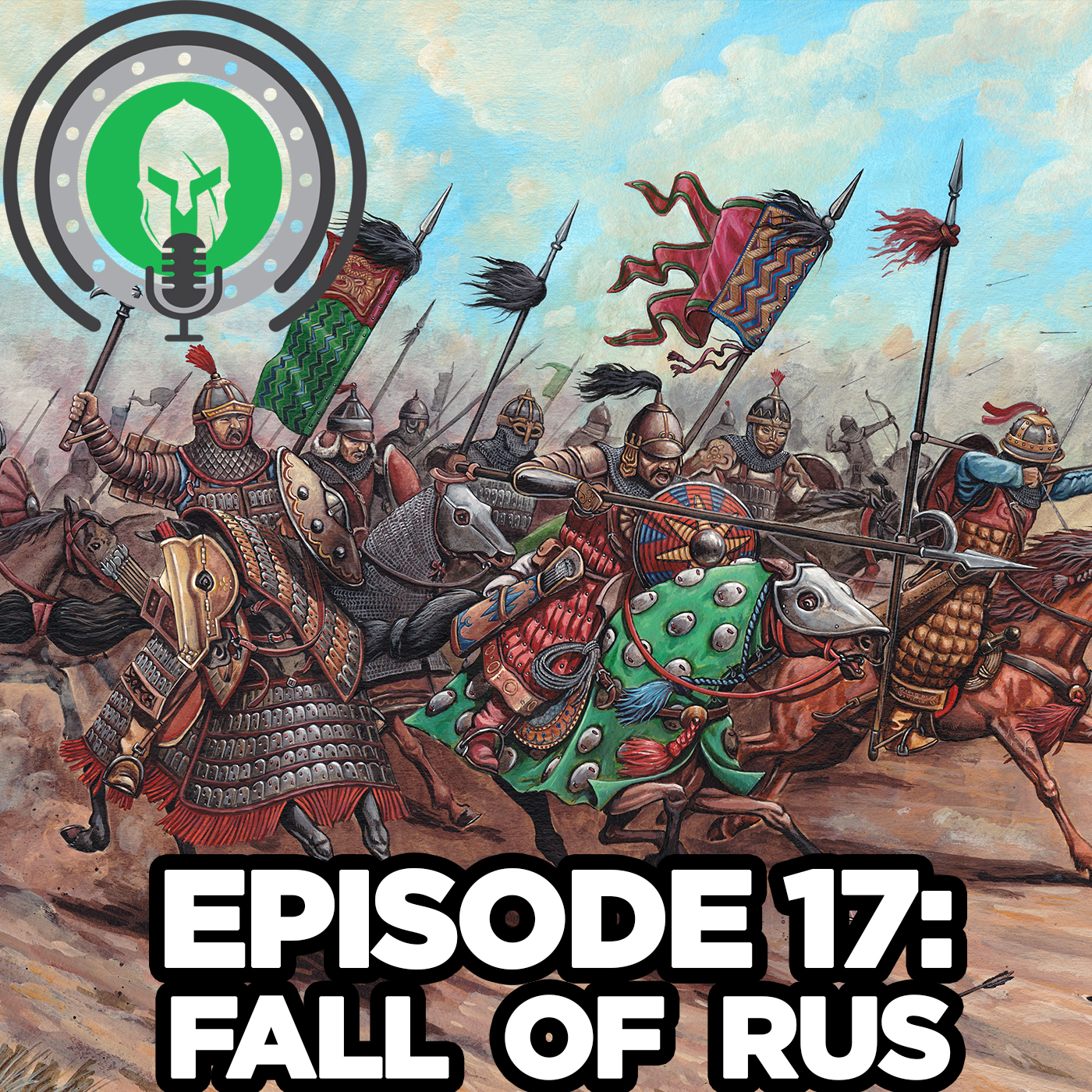
S2 Ep 172.17. History of the Mongols: Fall of Rus
"And from thence they proceeded to the land of the Rus and conquered that country as far as the city of Magas, in the inhabitants of which were as numerous as ants or locusts, while its environs were entangled with woods and forests, such that even a serpent could not penetrate them. The princes all halted on the outskirts of the town, and on every side they built roads wide enough for three or four wagons to pass abreast. And they set up catapults opposite the walls, and after a space of several days left nothing of the city but its name, and took great booty. And they gave orders to cut off the right ears of the people, and two thousand seven hundred ears were counted. And from thence the princes returned homewards." So the Persian writer Juvaini describes the siege of the Alanian capital of Magas in winter 1239, a lesser known corner of the famous Mongol western campaign. In our previous episode, we covered the years 1236-1238, the first years of the great campaign wherein Batu and Subutai wrecked havoc across the northern Rus' principalities and Volga Bulghars. When we left off, Batu and Subutai were withdrawing from the ashes of the northern Rus' in spring 1238 to spend the summer resting men and horses and preparing their next moves. In today's episode, we follow their continued movements, securing the remainder of the Volga and south Russian steppes, down to Crimea and the Northern Caucasus, to the resumption of hostilities against the southern Rus' and the fall of Kiev, mother of cities, at the end of 1240. I'm your host David, and this is…. As we've stated already, Batu and Subutai pulled their forces back from the northern Rus' to rest their men, fattening their horses on the grasslands of the steppe over summer 1238. The campaign had so far been a great success, marred by only a few difficult sieges and the loss of a son of Chinggis Khan, Kolgen. The northern Rus' principalities had been subjugated, leaving only a collection of Rus' states in the west still independent. For a time though, the Rus' would have a respite. The Mongols were loathe to advance too far without securing their rear, and Subutai knew well from his own experience how tough the steppe's inhabitants could be. Were you to place the conquests at that point onto a map of modern Russia, you would have seen a huge strip of land from the northernmost point of the Caspian Sea to where Moscow sits today as under Mongol rule. The steppes of southern Russia, Ukraine, Crimea and between the Black and Caspians seas north of the Caucasus were still unconquered, where several nomadic, semi-nomadic and other independent powers continued to reside. Many Cuman-Qipchaq tribes had fled deeper into that region, having avoided the initial Mongol advance. Leaving them unattended would allow them to move back into their original territory once the Mongols moved on, or even strike their rear while the Mongols focused on the Rus' settlements. So the decision was made, once man and horse was rested by the end of summer 1238, to subdue these peoples. You may recall our episode covering Chormaqun Noyan's conquest of the Caucasus and Georgian Kingdom. That was happening essentially at the same time as this. As the Qipchaqs and Georgians were known to have had contacts and alliances in the past, it may have been a conscious decision to coordinate these offenses, ensuring no help would come from the steppe to the Caucasus while ensuring the Caucasus could not be a haven for fleeing nomads. Securing the region also provided another lane of contact for Mongol forces, rather than all messages being forced to circumnavigate the vast Caspian Sea. An interesting thing to note in regards to the scale of the Mongol Conquests, which often happened simultaneously: it's easy to forget, since by necessity most discussions have to pick only a narrow window to discuss. In autumn 1238, several Mongol armies shot across the southern steppe, beginning at the Black Sea coastline and moving east. Batu's brother Shiban, Chagatai's grandson Buri and Tolui's son Bojek marched into the Crimean Peninsula, defeating the Cuman tribes who inhabited the peninsula's fertile steppe, and its Armenian, Greek and even Gothic population. On December 26th 1238, the famed Crimean trade port of Sudak, also called Soldaia, fell to the Mongols, leaving them the masters of this great trade entrepot. Another of Batu's brothers, Berke, later to be the famous Muslim ruler of the Golden Horde, at the same time campaigned against the Cuman-Qipchaqs north of the Black Sea. Those not subjugated by Berke were dislodged and likely among their number, or soon to be at least, was an important Cuman leader called Kuthen in Latin sources, though more commonly known as Kotjen or Kötöny. We've met him before, as he was present at the battle of the Kalka River back in 1223. With a marriage alliance to the Rus' prince Mstislav the Bold, it was on Kotjen's urging that the Rus' came to assist him against Jebe and S