
ADHD reWired
582 episodes — Page 4 of 12

427 | Maybe This Time: A Musical About Living with ADHD and Dyslexia with Jonathan Orenberg
EIn this episode, Eric is joined by Jonathan Orenberg from the San Francisco Bay area. As the founder of Care Life Services, Jonathan is no stranger to the healthcare field. After graduating from Baldwin Wallace University: Conservatory of Music, he decided to follow in the footsteps of his father - an emergency room physician and medical director - and his mother, a registered nurse. Jonathan went on to become a CNA and certified senior fitness specialist and is also an accomplished Bay-area bass performer who has been in the industry for over 25 years, proud member of Actors' Equity since 2008, and owner of a private acting studio. Johnny has shared the stage with such stars as Sutton Foster, Kathleen Marshall, Michael Rafter, and Kate McGarry, while performing at some of the most prestigious theaters in the United States, including the Barnstormers Theatre, Cleveland Play House, Great Lakes Theater Company, 42nd Street Moon Theatre Company, and The Walt Disney Company. Johnny has learned how to harness his ADHD and dyslexia-superpowers into fuel for his entrepreneurial spirit and mindfulness in the toll that hyperfocus can take on family life in the battle of business goals and personal values. Johnny is also an Alum of ADHD reWired's Coaching & Accountability Groups! Connect with Johnny: Instagram: @thejonathanlakin Website: https://www.thejonathanlakin.com Discover the ADHD reWired Podcast Family: adhdessentials.com with Brendan Mahan hackingyouradhd.com with Will Curb adhddiversified.ca with MJ Siemens
426 | Research, College, and Complementary & Alternative Approaches with Patrick LaCount
EIn this episode, Eric is joined by Patrick LaCount, the director of Practical Psychological Services in Fort Collins, Colorado, specializing in the assessment and treatment of ADHD. He completed his doctorate in clinical psychology at the University of Wyoming, pre-residency at Duke University Medical Center and post-doctoral fellowship at Seattle's Children's Hospital. In addition to providing psychological services, Dr. LaCount is passionate about disseminating the latest science to the ADHD community and is a research consultant for the How To ADHD YouTube Channel! [ more shownotes coming soon! ]

425 | The Neurodiverse Safe Work Initiative with Catherine Lee
EIn this episode, Eric is joined by Catherine Lee, the director of Lethbridge Piper & Associates, an Australian occupational health and safety management consultancy. For 30 years, Catherine has advised employers, CEOs, boards, executives, and leadership teams on strategic health and safety management. She holds post-graduate degrees in occupational health and safety management and is a certified occupational health and safety professional. Catherine created the Neurodiverse Safe Initiative for making work safe, healthy, and inclusive for neurodiverse workers. Get her ebook "ADHD Safe Work" for free here! Other Topics & Questions in this Episode: How did Catherine's work in occupational health and safety lead to her own diagnosis? Under what circumstances may an employee with ADHD feel like they need to stop taking their medication? What is the potential value of a person with ADHD, or any person who is neurodiverse, as an employee? How is Catherine getting the information she's gathered into places of employment for leaders and management to understand what safety and acceptance really means in the workplace? How can employers integrate neurodiverse persons in their companies? What's the "selling point" for people/employers who are not empathetic towards different kinds of brains? Resources & Honorable Mentions: Website: Neurodiverse Safe Work Initiative Podcast: A Cognitive Skill to Magnify Humanity | The On Being Project Discover the ADHD reWired Podcast Family: adhdessentials.com with Brendan Mahan hackingyouradhd.com with Will Curb adhddiversified.ca with MJ Siemens
424 | March Live Q&A with the ADHD reWired Podcast Family!
EJoin the ADHD reWired Team every second Tuesday of the month for the monthly Live Q&A, and be sure to listen all the way through to hear a very special guest join us on this episode! Questions & Topics in this Episode: How do I keep my time-blindness from derailing my teaching of a 90-minute class that has a very tightly-structured curriculum? What are some of the signs that a job is not the right fit and that it might be time to move on? Do you have any input or tips on how to make strategies that are not working anymore - because of the pandemic - work again? What are some strategies or tools I can use for accountability? How can I keep doing the routines that keep my ADHD under control when I am traveling or in a different environment? My kids want me to play Roblox with them. Do you have a favorite game we can play together? If you're a kid with ADHD, what if the parent also has ADHD? Any advice for a kid living with an ADHD parent? I am 41 and recently diagnosed and my spouse is neurotypical. What are some ways we can work on communication so that we don't end up in unnecessary conflict? Any tips for improving memory, particularly recall, when being put on the spot? Resources & Honorable Mentions: App: Task Player Book: Make It Stick: The Science of Successful Learning Book: Your Brain's Not Broken: Strategies for Navigating Your Emotions and Life with ADHD Book: Crucial Conversations: Tools for Talking When Stakes Are High by Kerry Patterson Tool: Clocky (the rolling alarm clock!) Tool: Time Timer Tool: Shelpful Article: Avoid the "Urgency Trap" with the Eisenhower Matrix Article: Why Task Switching is Difficult for ADHD Brains — and 7 Ways to Smooth Transitions (on ADDitude Magazine written by Brendan Mahan!) Episode: Seven ADHD Friendly Travel Hacks for an Awesome Vacation with Will Curb Check out the Other Podcasts on the ADHD reWired Podcast Network: adhdessentials.com with Brendan Mahan hackingyouradhd.com with Will Curb adhddiversified.ca with MJ Siemens Don't Forget These, Too: adhdrewired.com/patreon — Support the show by becoming a Patron! coachingrewired.com — Get your name on the waitlist to join the fall season of ADHD reWired's Coaching and Accountability Groups adultstudyhall.com — Join your ADHD-friendly co-working space! adhdrewired.com/events — Join ADHD reWired's Live Q&A with the reWired team every 2nd Tuesday of the month at 12:30pm Central (10:30am Pacific / 1:30pm Eastern)

423 | Is Work a Struggle? with Alex Gilbert
EIn this episode, Eric is joined by New York's Alex Gilbert who is a Mets fan, yogi, and brunch enthusiast. Alex also has dyslexia and ADHD, being diagnosed at 8 years old.. After spending a career working in leadership development, she decided to start a consulting and coaching business that helps adults with learning disabilities and ADHD (just like her!) who have been struggling in their careers. Her business is called "Cape-Able Consulting", creating it to help people navigate their day-to-day workloads so they feel supported so they can reach their highest potential! You'll hear how Alex's experiences in school led to her diagnoses, how she began advocating for herself and finding accommodations that worked for her, and the importance of knowing yourself and what you need before beginning to self-advocate. Then, you'll hear differences between best practices and best principles, ways to ask for what you need, and why knowing about her ADHD at a young age wasn't necessarily an advantage. You'll even hear Eric use one of his own accommodations in real time! Connect with Alex: Website: Cape-Able Consulting Facebook: Cape-Able Consulting LLC TikTok: iamcapeable Instagram: @iamcapeable Other Topics & Questions in this Episode: How did Alex create a program for students to advocate for themselves? How did the self-advocacy skills from school transfer to the workplace? Why is it important to know yourself and your needs before disclosing ADHD? Without disclosing their ADHD, are there any suggestions for an employee to test the water before fully disclosing? How can employers support their employees who are neurodivergent? How can employers draw out their strengths? What does the boss do when they are the ones with ADHD? What was the most valuable accommodation Eric utilized in college? If Alex had a magic wand to turn all workplaces into ADHD-friendly workplaces, what would change? Resources & Honorable Mentions: https://www.additudemag.com Hear Alex as a guest on ADHD Essentials with Brendan Mahan: ADHD and Employment with Alex Gilbert of Capeable Consulting Discover the ADHD reWired Podcast Family: adhdessentials.com with Brendan Mahan hackingyouradhd.com with Will Curb adhddiversified.ca with MJ Siemens adhdfriendlylifestyle.com with Moira Maybin

422 | Tik Tok's Coach with Ryan Mayer
EIn this episode, Eric is joined by Ryan Mayer who you might have seen on TikTok! Ryan is a performance and mindset coach on a mission to help others navigate through the storms caused by ADHD. He calls on first-hand experience to help his clients who, like him, are falling short at work and at home. He helps others to believe in themselves again through empathy, enthusiasm, and education. Ryan's coaching empowers others to live a happier life. You'll hear Ryan share his experience in corporate-America, his journey to becoming an ADHD coach, and the importance of finding a path that suits your strengths and personality. You will also learn the ways that Ryan and Eric use accountability, how crucial accountability is to getting things done, and how Ryan draws from his personal life to create his content on TikTok. Other Topics & Questions in this Episode: How do you not get stuck on TikTok? What are the nuances of accountability that makes it work? Is it a good idea for your spouse to be your accountability partner? What does Ryan mean by "Walking the razor's edge"? Follow & Connect with Ryan: Website: https://ryanmayercoaching.com Instagram: @adhd_coach_ryanmayer TikTok: @adhd_coach_ryan Resources & Honorable Mentions: Community: Adult Study Hall by ADHD reWired Tool: Focusmate Book: The Couple's Guide to Thriving with ADHD Book: The ADHD Effect on Marriage: Understand and Rebuild Your Relationship in Six Steps Book: Faster Than Normal Episode: 218 | Models for Coaching with David Giwerc Episode: 390 | How to Recover From Years of Failure with Aron Croft Episode: 399 | Workplace Accommodations: Do I Need to Disclose? with Kat Hoyer Episode: 413 | From HR to ArC with Kat Hoyer
421 | How We Learn & Coaching for Structured Routines with Aran Rees
EEric is joined by Aran Rees, joining the show from across the pond! Aran has worked in professional development for close to a decade, specializing in self-directed peer-supported experiential learning and believes that learning is a survival skill! You'll hear about the ways that the "why" behind the "what" we want to learn can affect the ways we learn, how our environments affect how we learn, and what is needed for genuine learning. Topics & Questions in this Episode: How is work changing? How does the move from office-work to at-home work change the way we work? (As of this recording), what is the average job tenure? Is the shift to learning online geared more towards compliance versus actual learning? Eric to Aran: "Whether we are trying to learn a new skill ourselves or a new job, from what you do professionally, what do we know about what is actually needed for genuine learning rather than regurgitation?" What does learning begin with? How does the interest in what we're learning affect the ways we learn? Are the goals you are pursuing actually important to you, or is this something someone else is encouraging you to do? Is it only important to you because that person is important to you? Then, is that enough of an 'interest' to keep you engaged? Once you've made a commitment and you care about something and you've carved out the time - what else is essential for learning a new skill or new ability? What is Aran's deep 'why' behind wanting more structure in his routines? How can your environment affect learning? How can our environments affect our routines? What is the importance of environmental cues? Resources & Honorable Mentions: "...I want to learn the piano, but actually I don't want to learn the piano, I want to have learned it." - Aran "People can't be made to learn something they don't care about." - Aran Book: Four Thousand Weeks: Time Management for Mortals by Oliver Burkeman Book: Atomic Habits: An Easy & Proven Way to Build Good Habits & Break Bad Ones by James Clear Book: The Lean Startup: How Today's Entrepreneurs Use Continuous Innovation to Create Radically Successful Businesses by Eric Ries

420 | Leading with ADHD - with Sherri Cannon
EIn this episode, Eric is joined by Sherri, a CEO/executive coach and facilitator who was diagnosed with ADHD at the age of 40. Her mission: Equip ADHD leaders to confidently lead by example making every workplace friendlier for all brains. She has led leadership teams, developed programs for diverse organizations around the world. Before turning entrepreneur, Sherri worked at Procter & Gamble where she climbed from a soap sales-rep (yes, bars of soap!) to Southern California district sales manager. Hear Eric and Sherri talk about self-acceptance, imposter syndrome, and her journey into leadership training. You'll hear about the executive-functioning drain of meetings, Sherri's suggestions on running better "meetings", and the importance of fun and communication. It's about identifying the needs and challenges are, then coming up with processes to fall to in order to do the things you're wanting to do. Connect with Sherri: Sherri Cannon Topics & Questions in this Episode: How did Sherri go from selling soap to coaching leaders? What is the importance of self-awareness? How did Sherri's ADHD diagnosis affect her work work? After the tech-boom, what drew Sherri back into coaching executives? What does it look like to be dialed in with self-awareness? When working with leaders with ADHD, what are some of the common challenges that leaders go to Sherri with? Which struggles are most common? How do we make sure that, when our teams are together, that everybody's going with, "Yes! That's what we agreed on!"? How can a leader be constantly increasing self-awareness? What is the importance of feedback? Can there really be 5-minute meetings or conversations? What is the importance of experimentation in leadership? Resources & Honorable Mentions: Book: Where the Action Is: The Meetings That Make or Break Your Organization Book: The Five Dysfunctions of a Team: A Leadership Fable Book: Feel the Fear and Do It Anyway by Susan Jeffers "You cannot overstate the importance of having someone believe in you." - Eric "...Communication is not what's said, it's about what's received." - Eric "There's so much gold laying around us all the time as neurodiverse folks!" - Sherri

419 | February Live Q&A with Brendan Mahan, Will Curb, MJ Siemens, ADHD reWired Coaches Moira Maybin & Kat Hoyer, and Lisa!
EJoin the ADHD reWired Podcast Family & more of the ADHD reWired Team every second Tuesday of the month for the monthly Live Q&A! In this Q&A episode, you'll hear Eric, Brendan, Will, MJ, Moira, and Kat answer your ADHD-related questions! Questions & Topics in this Episode:(The following questions have been paraphrased.) What are some ADHD-friendly organizing resources when preparing to relocate? Emotions can be really big and dysregulated with ADHD. Do you have advice on dealing with surprise disappointments that come up? My dad loses his temper a lot and it's very difficult to talk to him. If I didn't know better, I would have felt that some of the things he does could be borderline abusive. I don't blame him because a lot of this is involuntary because of the ADHD, but if this continues, it's not good for the family as a whole. I'm not sure how to deal with this. How can I improve my sleep hygiene with shift-work? I am currently caring for my mom who has early dementia. I'll be trying to work on my tasks, but I keep getting off track. How do I manage interruptions? How do you decide if "This is an ADHD thing" and "it should not be this much of a struggle so I should find a work-around" versus, "This is hard, but everybody struggles to do it, so I will struggle to do it!"? What suggestions do you have for finding an ADHD-friendly workplace? Resources & Honorable Mentions: Book: Burnout - The Secret to Unlocking the Stress Cycle Book: Nonviolent Communication: A Language of Life by Marshall B. Rosenberg, PhD Book: Adult Children of Emotionally Immature Parents by Lindsay C. Gibson Book: Recovering from Emotionally Immature Parents: How to Reclaim Your Emotional Autonomy and Find Personal Happiness by Lindsay C. Gibson Article: The Health Risks of Shift Work Article: Dim or Kill Your Devices' Bright LED Lights Once and for All - CNET Article: T.H.I.N.K Acronym for Kinder and More Effective Communications Mentioned: Transtheoretical Model - Wikipedia (The Cycle of Change) Mentioned: Al-Anon Mentioned: Adult Study Hall Mentioned: Glassdoor (US) Mentioned: Glassdoor (Canada) Mentioned: Episode 399 - Workplace Accommodation: Do I Need to Disclose? Check out the Other Podcasts on the ADHD reWired Podcast Network: adhdessentials.com with Brendan Mahan hackingyouradhd.com with Will Curb adhddiversified.ca with MJ Siemens adhdfriendlylifestyle.com with Moira Maybin Get More from ADHD reWired: adhdrewired.com/patreon — Support the show by becoming a Patron! coachingrewired.com — Get your name on the waitlist to join the fall season of ADHD reWired's Coaching and Accountability Groups adultstudyhall.com — Join your ADHD-friendly co-working space! adhdrewired.com/events — Join Eric, Brendan, Will, MJ, Moira, Kat, and Lisa for an hour of Live Q&A on Zoom, every 2nd Tuesday of the month at 12:30pm Central (10:30am Pacific / 1:30pm Eastern)

418 | Struggling to Structure the Day: A Coaching Conversation with Laura Kane
EIn this episode, Eric is joined by Alumni member Laura Kane. Laura is a transplant from Boston living with her rescue dog in Delray Beach, Florida. Just prior to the pandemic, Laura discovered a love of nature photography and is incredibly grateful for this gift. Most days, she can be found taking pictures of birds, alligators, and other assorted wildlife. Her top bucket-list item is to go on a safari. Creating structure and sticking with it is a constant struggle for her, but she refuses to give up! Listen in as Eric and Laura work together to build her daily structure, the why behind the desire to create the structure, and how uncomfortable it can be to accept praise when sharing our joy. You'll also hear about the significance and impact of accountability, how Laura's passion gives her purpose, the anxiety of implementation and commitment, and understanding how the all-or-nothing mindset can actually get in the way. Laura's Instagram: @joyfulphotographybylbk Where does the narrative of comparing oneself to others, not feeling good enough, stems from? How can you cue the "why" behind the routine? How easy is it to create back-up plans ahead of time versus in-the-moment? How is exercise helpful? What about online exercise classes? What barriers can get in the way of building habits/derailing our habits? How do you strengthen accountability? What's the story behind "having" to ask for help? What's the story behind believing we have to do things by ourselves? How do we get our goals met? How do we structure our day when we're the only ones depending on the structure? How has the pandemic affected building habits and routines? Resources & Honorable Mentions: Habit Stacking: How to Build New Habits by Taking Advantage of Old Ones AppBlock Freedom app Atomic Habits: Build Good Habits and Break Bad Ones
417 | Automation Tools with Brittany Smith
EIn this episode, Brittany Smith returns to the podcast! Eric and Brittany share some of the digital automation tools they use, such as battery delivery for Tile, automated messages, using smart-lights, setting reminders and routines, and more! You will also hear Eric and Brittany talk about some of the pain-points they attempted to solve using apps and automation. About Brittany: Brittany is a productivity, ADHD, and technology coach and recently published her first course, "From Aggravated to Navigated: Choosing a task-management system with ADHD". She has a Masters of Science degree in Cognitive Neuroscience lab at the University of Oregon. Brittany uses geeky pop-culture and cognitive science to help her clients and ADHD Guild members get more done with less stress. Connect with Brittany: Devise & Conquer Brittany Smith - Productivity and ADHD Coach - Devise & Conquer Productivity Coaching | LinkedIn Devise & Conquer (@Devise_Conquer) / Twitter Devise & Conquer: Productivity, Technology, ADHD - YouTube Questions Answered In this Episode: How does Brittany use automation? What is the importance of 'stability' when using apps for automation? What can you do with smart-bulbs? Can automation help routines? If someone has been thinking about getting into automation but they haven't purchased anything yet to start (smart switches, smart devices, smart bulbs, etc.), is it a good idea to stick with one platform? Why? What is Tile? What does the premium version of Tile do? What is the Shortcuts app? (for iOS users only) What are some good uses for an ADHD life? What is possible with automation? Can finances be automated? Before jumping into automation tools, here are some questions to consider before you start: How can I scaffold my executive functions through automation? What exactly do you want from automation? Where is your pain point where automation can help? What are the fiddly things that you would like to have happen for you? What's really going to make a dramatic difference in your life? Honorable Mentions & Resources: Zapier How to Automate Your Life with Apple's Shortcuts App (iOS only) Tile (Android™ and Apple® compatible) OmniFocus (iOS only) Keyboard Maestro IFTTT "If This Then That" (Android™ and Apple® compatible) For our listeners who are PC and Android™ users – What tools do you use, if any, to automate your executive functions in your daily life? Share it with us on our website at ADHD reWired!
416 | When I'm 64 with Lorri Hollingsworth
EIn this episode, Eric is joined by Lorri Hollingsworth who was officially diagnosed with combined-type ADHD about two-and-a-half years ago at the age of 64, having reached retirement without suspecting any neurodivergencies. Yet, she always felt herself to be the "misfit" given the expectations set by friends, family, coworkers, and society at large, and forever assumed the role of "Inadvertent Perpetrator" with all the guilt inherent therein. Lorri will share her journey shaped by the absence of an ADHD diagnosis in early childhood, which inevitably led to numerous comorbidities over the decades, as well as the never-expected hope that she now experiences for her future. You'll hear about the different comorbidities that were discovered before Lorri's ADHD diagnosis, how her husband of over 35 years aided in Lorri getting diagnosed, her journey of the ways her diagnosis changed the way she viewed her past, and the dynamics of her environment growing up undiagnosed. You'll also hear about Lorri's thrill of a challenge, and her journey through unhealthy eating behaviors, OCD, depression, anxiety, and more. Lastly, you'll hear about the importance of learning, self-awareness, and forgiveness to move forward. Questions Answered & Memorable Moments in this Episode: Lorri goes in depth about how important it is to get more stories of seniors getting diagnosed. What was it that led Lorri to get the diagnosis? "I think the persistent leaving of cabinets and drawers open should be part of the diagnostic criteria!" - Eric "...unless somebody does something drastic to get your attention, they don't have your attention." - Lorri Mentioned here: https://drgabormate.com/book/scattered-minds/ How we show up in relationships: Is that a product of our environment, or does ADHD sometimes get in the way? "I, .as far back as I can remember, have been a 'loner'." - Lorri At 64, you've been through a lot of stuff, so why does it matter now (to get diagnosed)? "If you love your life, it's worth the work." - Lorri "You have to forgive yourself, and you have to forgive the people that might have contributed inadvertently to you being in that place. Forgiveness is so important." - Lorri Check out the Other Podcasts on the ADHD reWired Podcast Network: adhdessentials.com with Brendan Mahan hackingyouradhd.com with Will Curb adhddiversified.ca with MJ Siemens adhdfriendlylifestyle.com with Moira Maybin Don't Forget These, Too: adhdrewired.com/patreon — Support the show by becoming a Patron! coachingrewired.com — Get your name on the waitlist to join the sping season of ADHD reWired's Coaching and Accountability Groups! adultstudyhall.com — Join your ADHD-friendly co-working space! adhdrewired.com/events — Join Eric, Brendan, Will, MJ, Moira, Kat, and Lisa for an hour of Live Q&A on Zoom, every 2nd Tuesday of the month at 12:30pm Central (10:30am Pacific / 1:30pm Eastern)
415 | January Live Q&A with Brendan Mahan, Will Curb, MJ Siemens, ADHD reWired Coaches Moira Maybin & Roxie Martin, and Barb!
EJoin the ADHD reWired Podcast Family every second Tuesday of the month for a Live Q&A! In this Q&A episode, you'll hear Eric, Barb, Brendan, Will, MJ, Moira, and Roxie answer your ADHD-related questions! Check out the Other Podcasts on the ADHD reWired Podcast Network: adhdessentials.com with Brendan Mahan hackingyouradhd.com with Will Curb adhddiversified.ca with MJ Siemens adhdfriendlylifestyle.com with Moira Maybin Don't Forget These, Too: adhdrewired.com/patreon — Support the show by becoming a Patron! coachingrewired.com — Get your name on the waitlist to join the spring season of ADHD reWired's Coaching and Accountability Groups adultstudyhall.com — Join your ADHD-friendly co-working space! adhdrewired.com/events — Join Eric, Brendan, Will, MJ, Moira, Kat, and Lisa for an hour of Live Q&A on Zoom, every 2nd Tuesday of the month at 12:30pm Central (10:30am Pacific / 1:30pm Eastern)
414 | Hitting the Brain-Brakes: A Coaching Conversation with Danielle!
EIn this episode, Eric is joined by Danielle, a fresh graduate as of spring 2021. She has a Masters in Mechanical Engineering and was very recently diagnosed with ADHD. She has learned a lot about herself after receiving her diagnosis, especially after listening to ADHD reWired's podcast. She felt some imposter syndrome after receiving her diagnosis, but has fully embraced it after learning about the symptoms and how it presents for her. In this coaching conversation, you'll hear about Danielle's biggest struggle with feelings of rejection while being a high-achiever, the thoughts that went through her head through the feelings of failure, and shares some of the ways she calms her mind in the midst of racing thoughts. Eric and Danielle also touch on topics of emotional regulation, uncertainty, feeling out of control, and you might even relate to some of the inner dialogue she shares throughout today's show! Then, hear Eric and Danielle come up with a few ideas that might potentially help with some of the feelings of rejection, distorted thought patterns, and ways to pause when the mind begins to spiral. In this Episode, you'll hear Danielle answer some of these questions: How did you make it through your Masters degree without knowing you had ADHD? Being diagnosed with ADHD: Was it a surprise or a relief? What were some of your common struggles going through higher education? Was some of the rejection you felt possibly driven by perfectionism? With your new ADHD diagnosis, have old stories started to change, or do they still have a bit of emotional sting to them? What's the internal dialogue that's guiding what you say and do? Do you internalize or experience any types of feedback that leans even a little bit on the negative side? Is there something you might be able to do that you think you might enjoy that you would definitely "not be good" at? What if you did something you felt wasn't your best work? If there were some patterned thoughts around the things that tend to send you in that spiral, if those patterned thoughts were like headlines, what would those headlines be? Is there anyone you know, whether work or personally, who can give you regular feedback about something where you could also - at the same time - communicate how you're rating yourself while you're getting the feedback? Is there anything else you think would help you in either handling uncertainty in certain situations, or being able to receive feedback that might be difficult to hear while being regulated?
413 | From HR to ArC with ADHD reWired Coach, Kat Hoyer
EReturning to the podcast is Kat Hoyer, a recovering HR Specialist who hosts our Career Accelerator Sessions (or CAASH+) in ADHD reWired's Adult Study Hall Community. Get to know Kat even more in this episode, amd invite you to join us in welcoming Kat Hoyer as ADHD reWired's newest coach to the coaching team! You'll hear even more about Kat's story about how she pivoted from her dream job in human resources to becoming a life and career coach, then the steps leading up to her officially joining the ADHD reWired Coaching Team. In this Episode: So, who is Kat Hoyer? How did Kat make the transition from HR to Career Coaching to Life-Coaching? Is Kat still involved with the HR Community? Is the perception of ADHD and Neurodiversity really shifting in the workplace? What compelled Kat to make the change to join the ADHD reWired Coaching Team? What is Kat most excited about when the spring-season of coaching groups arrives? What values does Kat bring to coaching? What does Kat feel will be her greatest opportunities for growth? This year, I have a word - it is "enough". I am really working on understanding that sometimes, it's okay to be where you are and not be pushing myself… and sometimes "enough" is where I need to live. Kat Hoyer

412 | Guided Meditation with Alejandro Santiago
EIf you enjoyed this episode, and want more from Alejandro, check out his website: alejandrosantiago.com/ Alejandro is a mindfulness life coach and yoga instructor who first experienced the benefits of mindfulness and breathwork when he was a student at Parsons School of Design in New York City. To cope with the stress of ADHD and university, he cultivated a practice of Pranayama, an ancient form of yogic breathwork. Today, he's teaching people how to get out of their heads and into the breath by merging the Western practices of mindfulness based in self-compassion, and yogic Pranayama meditations. He studied compassionate inquiry with Dr. Gabor Maté, a therapeutic approach to uncover and heal trauma in our bodies. When he's not teaching and coaching, he works as a portrait photographer in Toronto, Canada.
411 | Meditation & Breathwork with Alejandro Santiago
EMore Shownotes coming soon! In the meantime, get to know today's guest a little more by going to his website at alejandrosantiago.com/ In this episode, Eric is joined by ADHD reWired Coaching Group Alumni, Alejandro Santiago. Alejandro is a mindfulness life coach and yoga instructor who first experienced the benefits of mindfulness and breathwork when he was a student at Parsons School of Design in New York City. To cope with the stress of ADHD and university, he cultivated a practice of Pranayama, an ancient form of yogic breathwork. Today, he's teaching people how to get out of their heads and into the breath by merging the Western practices of mindfulness based in self-compassion, and yogic Pranayama meditations. He studied compassionate inquiry with Dr. Gabor Maté, a therapeutic approach to uncover and heal trauma in our bodies. When he's not teaching and coaching, he works as a portrait photographer in Toronto, Canada.
410 | December Live Q&A with Brendan Mahan, Will Curb, MJ Siemens, ADHD reWired Coaches Moira Maybin & Roxie Martin, and Barb!
EJoin the ADHD reWired Podcast Family every second Tuesday of the month for a Live Q&A! In this Q&A episode, you'll hear Eric, Barb, Brendan, Will, MJ, Moira, and Roxie answer your ADHD-related questions! The questions you'll here answered in this episode: (The following questions asked in the episode have been paraphrased below.) I can't be medicated, even for ADHD. I will have exciting things I'm involved in, then I have an episode that makes me feel rejected and I fall into a rumination dive and it takes me a while to get back up. I'm trying to find a way to catch myself sooner, get out of it sooner, so I can continue on the path towards my goal and keep my momentum going. I have started on meds and am having trouble unwinding and slowing my brain down at the end of the day. I wanted to know what your tips are for some of that. How do Time-Timers work? Bonus: Panelists also share some of the other time-tracking tools they use! I'm looking for tips on how to help my partner understand what ADHD is and what it isn't. My partner is neurotypical. My partner seems to not believe ADHD is a real thing, or that it's a crutch to misplace things. How can I get him to understand? I was just diagnosed about two months ago. I'm navigating this new identity and trying to find my community. I'm trying to figure out how to navigate who to tell and how to know who to tell. I've had some conversations go surprisingly well and others not go so well. How do you handle being true to yourself while also protecting yourself? Are there any personal assistants that understand ADHD and could help keep me accountable? Check out the Other Podcasts on the ADHD reWired Podcast Network: adhdessentials.com with Brendan Mahan hackingyouradhd.com with Will Curb adhddiversified.ca with MJ Siemens adhdfriendlylifestyle.com with Moira Maybin coming soon - Wait, What Was the Question? with Will Curb and Coach Roxie Martin! Reach out to Will and Roxie at [email protected] Don't Forget These, Too: adhdrewired.com/patreon — Support the show by becoming a Patron! coachingrewired.com — Get your name on the waitlist to join the fall season of ADHD reWired's Coaching and Accountability Groups adultstudyhall.com — Join your ADHD-friendly co-working space! adhdrewired.com/events — Join Eric, Brendan, Will, MJ, Moira, Roxie, and Barb for an hour of Live Q&A on Zoom, every 2nd Tuesday of the month at 12:30pm Central (10:30am Pacific / 1:30pm Eastern)
409 | How to Choose Your Productivity Apps with Brittany Smith
EHave you tried using all sorts of to-do and task-management apps but haven't found 'the one' yet? In this episode, Eric is joined by Brittany Smith, a productivity, ADHD, and technology coach and recently published her first course, "From Aggravated to Navigated: Choosing a task-management system with ADHD". She has a Masters of Science degree in Cognitive Neuroscience lab at the University of Oregon. Brittany uses geeky pop-culture and cognitive science to help her clients and ADHD Guild members get more done with less stress. Connect with Brittany: Devise & Conquer Brittany Smith - Productivity and ADHD Coach - Devise & Conquer Productivity Coaching | LinkedIn Devise & Conquer (@Devise_Conquer) / Twitter Devise & Conquer: Productivity, Technology, ADHD - YouTube In this Episode: How do you do things so that you will be successful no matter which tool you choose? With task-management apps, how do we make these things suck less? How do we choose what task-management app to use? How do we make task-management apps a "less bad" fit for our brains so we make sure we know what we need to do? Mentioned: Task Management Software Built For Pros - OmniFocus - The Omni Group (Mac/iOS only) What's your personal style? What should we be looking at if we are stuck in task-management-app "hopping"? What is a great app for automating? Mentioned: Todoist Mentioned: Google Keep Mentioned: TaskPaper (Mac/iOS only) Mentioned: Drafts (Mac/iOS only) Mentioned: Notion Mentioned: Trello Mentioned: Miro Mentioned: MindNode Honorable Mentions: Listen to Brittany as a guest on ADHD Essentials with Brendan Mahan! Asana What is GTD - Getting Things Done® Did you know: There are built in tasks if you use Google Assistant. (The same principle applies to the Echo!) Obsidian Evernote SimpleMind Discover the ADHD reWired Podcast Family: adhdessentials.com with Brendan Mahan hackingyouradhd.com with Will Curb adhddiversified.ca with MJ Siemens adhdfriendlylifestyle.com with Moira Maybin coming soon - Wait, What Was the Question? with Will Curb and Coach Roxie Martin! Reach out to Will and Roxie at [email protected]
408 | The Meaning of ADHD with Dr. Russell Barkley
EHere's another Blast-from-the-Past episode! From the archives, ADHD reWired rebroadcasts Episode 63, where Eric has his first interview with Dr. Russell Barkley. To find more in-depth shownotes, go to https://www.adhdrewired.com/63 About Dr. Russell Barkley: Renowned professor, educator, and author of numerous ADHD books and clinical manuals, Dr. Russell Barkley talks about the mechanics and ideas behind many core ADHD concepts. Ranging from executive functions, to neuroimaging, to public perception and more, Dr. Barkley shares knowledge from his extensive research and informed perspective on ADHD, breaking down its basic concepts in an understandable and approachable way.

407 | Motivation & the Brain: 13 Tips to Increase Motivation
EIt's a Blast-from-the-Past episode! From the archives, ADHD reWired rebroadcasts Episode 8 where Eric shares 13 tips to increase motivation! 1. Visualize what the reward is. Then put that picture in it place that you will see it frequently, and ideally in the place where you were likely to need that reminder 2. Use a star chart. Yes the show is primarily geared towards adults, and using a star chart is effective. We like infographics, we like to see the progress we are making on something. 3. Use small short-term rewards 4. Reward progress 5. Surround yourself with affirming people. 6. Exercise 7. Share it with someone 8. Create systems so you are less reliant on executive functioning. 9. Do what you love. 10. Do what you hate first 11. Talk to a doctor about medication. 12. Find a supportive accountability group 13. Learn more about ADHD.

406 | November Live Q&A with Brendan Mahan, Will Curb, MJ Siemens, ADHD reWired Coaches Moira Maybin & Roxie Martin, and Barb!
EJoin the ADHD reWired Podcast Family every second Tuesday of the month for a Live Q&A! In this Q&A episode, you'll hear Eric, Barb, Brendan, Will, MJ, Moira, and Roxie answer your ADHD-related questions! What you'll hear in this episode: What are some tips for managing ADHD and exercise post-surgery? Moira talks about her recovery process from falling off a cliff and brain injury. Find different ways to take care of yourself. Recovery takes time. As the weeks go by, new shiny habits fall off. Any advice for sticking to making progress on weight loss? What's your "Why"? Go slowly. It may be helpful to think more of what you want to add to your diet instead of what you want to take out. Start with the supermarket. Think about the health of the gut microbiome. Also mentioned here: Noom Make it fun and do things that make you feel good. My partner and I have ADHD and we have a young child with ADHD. While they're too young for a diagnosis, what resources can we use, where can we start exploring, and what are habits we can start building now so they don't have to struggle like I did? Be mindful of shame and be compassionate. "My child is not giving me a hard time, they are having a hard time." Try your best to stay out of wor-st-case scenario thinking. Mentioned here: ADHD Essentials: Brendan's Parent Coaching Groups Focus on connection, communication, and anxiety management. Look at the motivation of what your child is doing instead of the outcomes. Model repairing and model owning your mistakes. Do you have advice about disclosing ADHD in the workplace? Mentioned here: 399 | Workplace Accommodations: Do I Need to Disclose? with Kat Hoyer Don't disclose your ADHD, do disclose what you need to be successful. Mentioned here: Job Accommodation Network: JAN "Ask JAN" Mentioned here: Rough Cut! Reflections from Day 3 of the International Conference on ADHD 2021 What are your best home-hacks? Cleaning and decluttering are not the same thing. Take a picture of your workspace, then share it. Then, after you've finished cleaning, take a picture when you're done! Mentioned here: https://www.adultstudyhall.com Keep it simple, like one load of laundry, because that is easier to start and get to "done". Store cleaning supplies everywhere you need them. For example, if you have more than one bathroom, keep cleaning supplies in both bathrooms. If you can, consider a cleaning service. Baskets are a great way to keep clutter contained. Don't live alone? Split up your cleaning duties. Start small and start cleaning for five minutes - you may be surprised how much you can get done! Gamify the cleaning! If you start cleaning and it turns out to be a project, add it to your task list and find a way you can be reminded to finish. If I am not diagnosed yet, what do I need to prepare for my ADHD evaluation to make sure my symptoms get taken seriously, especially if I did fine in school and was a gifted kid? Have a bullet point of things you want to share with the evaluator. It's OK to share that you are concerned that your symptoms may not be taken seriously. A good evaluator will ask good questions and will help you tell your story to be able to come up with a diagnosis. Mentioned here: The One About Diagnosis – ADHD Friendly Lifestyle Why has it been observed that women are more commonly misdiagnosed than men? Is the practice of improv helpful for building skills to manage ADHD? What could this target be? Accepting "what is" and seeing what we can actually do about our situations. For example: When something unexpected happens, how do we accept that as it is, and identify what can we do and problem-solve around this?" Improv can open us to more growth-mindset thinking. Life is not a script. Life is improv! The more we can adapt to what's thrown at us, the better we're going to do. Might the practice of improv be helpful for folks with ADHD who are verbal processors? Mentioned here: 27: Improv to Improve Communication and Relationships Mentioned here: Improvement Through Improv with Rachel Hamilton I am a single parent. My child is accident prone and has a lot of energy. After being diagnosed at 5-years old, I was forced by my child's school to start medication. Nothing has happened. How else can I help my now 6-year old? If you are asking how you can help your kids, you are already on the right track. In the United States: schools are not allowed to force your kid to take medication. Find therapists who specialize in ADHD. Keep communication open with teachers and daycares. Mentioned here: CHADD You are the best advocate for your child. As we reflect on 2021, Eric asks: What can you do, what do you want to do come 2022 to help rewire your ADHD beyond learning about it? What are the actions you want to take that will make the biggest difference in the lives of yourselves, of your family, where you work, and your communities? Check out the Other Podcasts on the ADHD reWired Podcast Network: adhdessentials.com with Brendan Mahan hackin

405 | The Mess of Personal Growth with MJ from ADHD Diversified
EIn this episode, Eric and MJ have an unmedicated dialogue about the messiness of personal growth, the work it took to rewrite the stories she held about her self-worth, and how happy she was to have been proven wrong about the stories she's told herself since completing a season of ADHD reWired's Coaching & Accountability Groups in the summer of 2020. They continue the conversation about the work they've put in to achieve their goals, how heartwarming it is to witness others learn to love and accept themselves, and that no one with ADHD ever has to go on their growth journey alone. The final registration event for the 27th season of Coaching & Accountability Groups is on Thursday, December 9th! There are only a few spots left in Eric's groups (Sections 3 and 4). Moira and Roxie's groups are now full. Register for our final event by going to https://coachingrewired.com to add your name to our winter interest list! About MJ: MJ is a Canadian-born Asian who was diagnosed with ADHD in 2019, living in Canada with her ADHD partner. Since completing her own season in season of ADHD reWired's Coaching & Accountability Groups in Season 21, she created and hosts the ADHD Diversified Podcast and is a returning peer-mentor for the Coaching & Accountability Groups. What you'll hear about in this episode: "When you first started with being a member of the coaching groups, do you think you realized how hard you were on yourself?" - Eric What is the importance of better and more accurate language to describe our feelings and our emotions? "It's still hard to believe that the good stuff is true even though there's clear evidence that there's a difference being made ." - MJ Compassionate ass-kicking & meeting ourselves where we're at... "Real growth isn't about fast-tracking." - MJ Why is joining the Coaching & Accountability groups with an open mind so important? The stories we've told ourselves may have been true in the past, but they don't have to be true right now. "I think if I would've stayed stuck... thinking that my mentality was right, I would not be where I am right now." - MJ You don't have to be an entrepreneur to have an entrepreneurial mindset. "I do not know it all and I absolutely don't do it all perfectly." - Eric Honorable Mentions: Atlas of the Heart - Brené Brown Nonviolent Communication: A Language of Life by Marshall B. Rosenberg Check out the Other Podcasts on the ADHD reWired Podcast Network: adhdessentials.com with Brendan Mahan hackingyouradhd.com with Will Curb adhddiversified.ca with MJ Siemens adhdfriendlylifestyle.com with Moira Maybin coming soon - Wait, What Was the Question? with Will Curb and Coach Roxie Martin! Reach out to Will and Roxie at [email protected] Don't Forget These, Too: adhdrewired.com/patreon — Support the show by becoming a Patron! coachingrewired.com — Get your name on the waitlist to join the fall season of ADHD reWired's Coaching and Accountability Groups adultstudyhall.com — Join your ADHD-friendly co-working space! adhdrewired.com/events — Join Eric, Brendan, Will, MJ, Moira, Roxie, and Barb for an hour of Live Q&A on Zoom, every 2nd Tuesday of the month at 12:30pm Central (10:30am Pacific / 1:30pm Eastern)

404 | Let Pleasure be the Measure with Pasha Marlowe
EIn this episode, Eric is joined by Pasha Marlowe who was diagnosed with ADHD at 49. She is a family therapist, therapeutic comedy coach, ADHD coach, podcast host and author. She artfully blends her unique life experience with her life's work in healing through psychotherapy, embodied emotions, holistic wellness, life-coaching, ADHD coaching, CBT coaching, theatre, and comedy. Pasha's podcast, "Let Pleasure be the Measure" is a playground of conversations about the importance of incorporating pleasure, play, and humor into your personal work, home, and sex life. Pasha also published a book in 2021 called, "My Next Husband Will be a Lesbian." What you'll hear in this episode: What did it feel like to be in a place that felt so helpless and challenging to be able to bring humor into a dark space? What is therapeutic comedy? "...folks with ADHD have the ability to think creatively, potentially think outside the box, gain new perspectives, see things from a different angle - which, in this case is really a beautiful gift… I feel like... creativity is a way to manage our ADHD stress." - Pasha Marlowe Because there is so much value in using humor, where is the line between when you call someone out for acting like the clown and avoiding versus actually dealing with and recognizing that it is a healthy tool? "Let Pleasure be the Measure" - Where did this podcast idea come from? "Play is the opposite of perfection." - Pasha Marlowe What is, "My Next Husband Will be a Lesbian" all about? Follow & Connect with Pasha: https://pashamarlowe.com Instagram: pasha marlowe | roar! @pashamarlowe Youtube: pasha marlowe Facebook: Pasha Marlowe, CEO - Home Honorable Mentions: My Next Husband Will Be a Lesbian: A Collection of Stories From Womxn Finding Their Truth by Pasha Marlowe Where the Action Is: The Meetings That Make or Break Your Organization by J. Elise Keith Check out the Other Podcasts on the ADHD reWired Podcast Network: adhdessentials.com with Brendan Mahan hackingyouradhd.com with Will Curb adhddiversified.ca with MJ Siemens adhdfriendlylifestyle.com with Moira Maybin coming soon - Wait, What Was the Question? with Will Curb and Coach Roxie Martin! Reach out to Will and Roxie at [email protected] Don't Forget These, Too: adhdrewired.com/patreon — Support the show by becoming a Patron! coachingrewired.com — Get your name on the waitlist to join the fall season of ADHD reWired's Coaching and Accountability Groups adultstudyhall.com — Join your ADHD-friendly co-working space! adhdrewired.com/events — Join Eric, Brendan, Will, MJ, Moira, Roxie, and Barb for an hour of Live Q&A on Zoom, every 2nd Tuesday of the month at 12:30pm Central (10:30am Pacific / 1:30pm Eastern)

403 | Adult Study Hall Wins: Accelerating Your Job Search
EIf you're on a job-hunt but don't know where to start, Adult Study Hall by ADHD reWired is the place to be! Listen in as a few members in one of our popular Adult Study Hall Plus (ASH+) sessions share their wins while looking for their next job. You'll hear about feedback from mock-interview sessions, identifying your dream-job and your skills, why some members decided to join our ASH+ Career Accelerator facilitated session, and overcoming a job loss and moving forward to the career they could truly thrive in. Go to https://www.adultstudyhall.com to sign up and join our Career Accelerator Session every week! To access this session and all of our Adult Study Hall sessions, including our drop-in room that's open 24/7, visit adultstudyhall.com. It's free for the first week and only $19.99 a month after that! Check out the Other Podcasts on the ADHD reWired Podcast Network: adhdessentials.com with Brendan Mahan hackingyouradhd.com with Will Curb adhddiversified.ca with MJ Siemens adhdfriendlylifestyle.com with Moira Maybin coming soon - Wait, What Was the Question? with Will Curb and Coach Roxie Martin. Reach out to Will and Roxie at [email protected] Don't Forget These, Too: adhdrewired.com/patreon — Support the show by becoming a Patron! coachingrewired.com — Get your name on the waitlist to join the winter season of ADHD reWired's Coaching and Accountability Groups, starting in January 2022! adultstudyhall.com — Join your ADHD-friendly co-working space! adhdrewired.com/events — Join Eric, Brendan, Will, MJ, Moira, Roxie, and Barb for an hour of Live Q&A on Zoom, every 2nd Tuesday of the month at 12:30pm Central (10:30am Pacific / 1:30pm Eastern)

402 | October Live Q&A with Brendan Mahan, Will Curb, MJ Siemens, ADHD reWired Coaches Moira Maybin & Roxie Martin, and Barb!
EJoin the ADHD reWired Podcast Family every second Tuesday of the month for a Live Q&A! Listen in on today's episode as the ADHD reWired panelists answer your ADHD-related questions! In this episode, we cover topics like dealing with shame and guilt, feedback from employers, partnerships, pet-care, mind-wandering, and more! (Recorded on October 12th / 2021) [00:03:06] - How do you deal with feedback from bosses that you don't want to disclose your ADHD to? [00:17:15] - As the neurotypical partner in the relationship, what is it that I can do best to help my ADHD partner feel productive and useful being a stay-at-home dad? [00:31:22] - Being on antidepressants for over 10 years, and finally finding out about my anxiety and depression being a result of undiagnosed ADHD, being 51 and female, does anyone have the experience of getting off SSRI's and learning to feel out what "normal" is? [00:35:09] - Being fairly new to the ADHD journey, I feel that my biggest issue is with mind-wandering. Does the panel have any experience or advice regarding mind-wandering? [00:43:38] - Do you have any tips on how to care for pets, especially cats, with ADHD? I keep forgetting to do things that they really need me to do. [00:53:51] - Do you have suggestions for working through shame and disappointment? [01:01:00] - New to the diagnosis, the meds help with energy and focus, but when my ADHD kids meltdown, it sends my anxiety through the ceiling. Any suggestions? [01:02:19] - How do I get my wife to understand that ADHD is real, and that she must embrace this in order to support me? [01:03:29] - I am 70 and finally have gotten the ADHD diagnosis. The shame I am filled with is remembering how my parents treated me as a child. My family has now put me to the side [...] but… [01:04:37] - ADHD reWired's King of Dad-Jokes gives us a Moment of Dad... Check out the Other Podcasts on the ADHD reWired Podcast Network: adhdessentials.com with Brendan Mahan hackingyouradhd.com with Will Curb adhddiversified.ca with MJ Siemens adhdfriendlylifestyle.com with Moira Maybin coming soon - Wait, What Was the Question? with Will Curb and Coach Roxie Martin. Reach out to Will and Roxie at [email protected] Don't Forget These, Too: adhdrewired.com/patreon — Support the show by becoming a Patron! coachingrewired.com — Get your name on the waitlist to join the fall season of ADHD reWired's Coaching and Accountability Groups adultstudyhall.com — Join your ADHD-friendly co-working space! adhdrewired.com/events — Join Eric, Brendan, Will, MJ, Moira, Roxie, and Barb for an hour of Live Q&A on Zoom, every 2nd Tuesday of the month at 12:30pm Central (10:30am Pacific / 1:30pm Eastern)

401 | Eric Tivers in the Hot Seat: What Comes Next?
EThe 27th season of ADHD reWired's Coaching & Accountability Groups begins in January 2022! Our next registration event is on November 11th 2021. If you've been wondering what group coaching can do for you, head over to coachingrewired.com to find out how you can be a part of our award-winning, online and video-based coaching and accountability groups, so you can get your ADHD rewired and rewrite your ADHD story! In this episode, Eric gets in the Mastermind hot-seat while a few members of the ADHD reWired Coaching Community Alumni pick his brain and ask what could be next for The ADHD reWired Podcast. How does Eric celebrate? What has he learned about consistency? And what could the future hold for The ADHD reWired Podcast? Check out the Other Podcasts on the ADHD reWired Podcast Network: adhdessentials.com with Brendan Mahan hackingyouradhd.com with Will Curb adhddiversified.ca with MJ Siemens adhdfriendlylifestyle.com with Moira Maybin coming soon - Wait, What Was the Question? with Will Curb and Coach Roxie Martin. Reach out to Will and Roxie at [email protected] Don't Forget These, Too: adhdrewired.com/patreon — Support the show by becoming a Patron! coachingrewired.com — Get your name on the waitlist to join the fall season of ADHD reWired's Coaching and Accountability Groups adultstudyhall.com — Join your ADHD-friendly co-working space! adhdrewired.com/events — Join Eric, Brendan, Will, MJ, Moira, Roxie, and Barb for an hour of Live Q&A on Zoom, every 2nd Tuesday of the month at 12:30pm Central (10:30am Pacific / 1:30pm Eastern)

400 | ADHD reWired Celebrates 400 Episodes!
EThe 27th season of ADHD reWired's Coaching & Accountability Groups begins in January 2022! Our next registration event is on November 11th 2021. If you've been wondering what group coaching can do for you, head over to coachingrewired.com to find out how you can be a part of our award-winning, online and video-based coaching and accountability groups, so you can get your ADHD rewired and rewrite your ADHD story! What happens after 400 episodes? What have the Alumni members of the ADHD reWired Coaching & Accountability Groups learned? What really happens when connections are made? Listen to today's episode where some of our members share their experiences within the ADHD reWired community and how it's made an impact on their lives with ADHD. Mentioned on the Show: Episode 39 - Don't Doubt the Dream Everything Dr. Russell Barkley: Episode 63 Episode 152 Episode 271 Episode 272 More episodes mentioned coming soon! Check out the Other Podcasts on the ADHD reWired Podcast Network: adhdessentials.com with Brendan Mahan hackingyouradhd.com with Will Curb adhddiversified.ca with MJ Siemens adhdfriendlylifestyle.com with Moira Maybin coming soon - Wait, What Was the Question? with Will Curb and Coach Roxie Martin. Reach out to Will and Roxie at [email protected] Don't Forget These, Too: adhdrewired.com/patreon — Support the show by becoming a Patron! coachingrewired.com — Get your name on the waitlist to join the fall season of ADHD reWired's Coaching and Accountability Groups adultstudyhall.com — Join your ADHD-friendly co-working space! adhdrewired.com/events — Join Eric, Brendan, Will, MJ, Moira, Roxie, and Barb for an hour of Live Q&A on Zoom, every 2nd Tuesday of the month at 12:30pm Central (10:30am Pacific / 1:30pm Eastern)

399 | Workplace Accommodations: Do I Need to Disclose? with Kat Hoyer
EAbout Kat Hoyer: Kat is a "recovering HR (Human Resources) manager" and started as a member of ADHD reWired's Coaching and Accountability Groups back in 2015. She is the creator of the Steer Your Life Coaching Program and has q9 Steer-Certified coaching across the country. Her business, SYLC Consulting brings holistic workplace development to organizations where she helps organizations talk about stress management, emotional intelligence, and cognitive agility. [00:02:45] - How do we, as people with ADHD, advocate for ourselves in the workplace for what we need without saying we have ADHD? [00:06:54] - What types of accommodations can we ask for? [00:08:23] - What does an accommodation look like, or how can we work through it? [00:09:06] - How can accommodations that we feel we need be beneficial to whatever the mission or the goals of the company are? What happens if we are denied accommodations? [00:12:16] - If we are searching for a job, what are some of the questions we can ask during the interview process without disclosing our ADHD? [00:20:09] - Eric talks about what he's learned & about getting accommodations and what he asked for. [00:22:28] - What exactly are reasonable accommodations? [00:25:01] - Eric & Kat talk about working extra hours, communication, requesting feedback, and advocating for yourself in a way that is solutions-oriented. [00:30:03] - Self-acceptance & self-awareness can make it easier to advocate for ourselves. [00:37:27] - Neurodiversity in the workplace: Where does it stand? [00:39:32] - Has the workplace evolved? What about hybrid models? What if we're struggling with this hybrid model? [00:42:49] - What can managers and bosses do to be more supportive of neurodivergent brains? [00:44:51] - What's the perfect job for someone with ADHD? [00:46:39] - Is it a toxic work environment? [00:47:39] - Kat speaks to her experiences in ADHD reWired's Coaching & Accountability groups, the tools that has helped others, and the positive things she has seen from people who have gone through the coaching groups. Connect with Kat: Website: SYLC Consulting | Akron, OH | Life Coaching Twitter for SYLC Consulting: @SYLC_Consulting Facebook: STEER Your Life Coaching - Home Listen to her on episode 175: We're Like-Brained, Not Just Like-Minded, with Kat Hoyer Honorable & Noteworthy Mentions: Americans with Disabilities Act Check out the Other Podcasts on the ADHD reWired Podcast Network: adhdessentials.com with Brendan Mahan hackingyouradhd.com with Will Curb adhddiversified.ca with MJ Siemens adhdfriendlylifestyle.com with Moira Maybin coming soon - Wait, What Was the Question? with Will Curb and Coach Roxie Martin. Reach out to Will and Roxie at [email protected] Don't Forget These, Too: adhdrewired.com/patreon — Support the show by becoming a Patron! coachingrewired.com — Get your name on the waitlist to join the fall season of ADHD reWired's Coaching and Accountability Groups adultstudyhall.com — Join your ADHD-friendly co-working space! adhdrewired.com/events — Join Eric, Brendan, Will, MJ, Moira, Roxie, and Barb for an hour of Live Q&A on Zoom, every 2nd Tuesday of the month at 12:30pm Central (10:30am Pacific / 1:30pm Eastern)

398 | Can We, Though? with Greg Hopewell
EThe 27th season of ADHD reWired's Coaching & Accountability Groups begins in January 2022! Our first registration event is on Saturday, October 30th! If you've been wondering what group coaching can do for you, head over to coachingrewired.com to find out how you can be a part of our award-winning, online and video-based coaching and accountability groups, so you can get your ADHD rewired and rewrite your ADHD story! About Greg: Greg was first diagnosed with ADHD at 10 and went untreated until he was re-diagnosed at 33, after procrastination on a big project made him leave the hospital shortly after the birth of his little girl. Greg has a degree in computer engineering and law, and works as a patent attorney in Silicon Valley. During COVID, Greg found his way to ADHD reWired and is a graduate of season 23 of ADHD reWired's Coaching & Accountability Groups, and joined season 25 and 26 as a peer-mentor (or "ADDmin") supporting other members of the award-winning coaching program. If you want to hear a story about some mind-blowing growth from one of the most cynical skeptics we've ever encountered in the coaching groups, then this is the podcast you need to listen to. Check out the Other Podcasts on the ADHD reWired Podcast Network: adhdessentials.com with Brendan Mehan hackingyouradhd.com with Will Curb adhddiversified.ca with MJ Siemens adhdfriendlylifestyle.com with Moira Maybin coming soon - Wait, What Was the Question? with Will Curb and Coach Roxie Martin. Reach out to Will and Roxie at [email protected] Don't Forget These, Too: adhdrewired.com/patreon — Support the show by becoming a Patron! coachingrewired.com — Get your name on the waitlist to join the fall season of ADHD reWired's Coaching and Accountability Groups adultstudyhall.com — Join your ADHD-friendly co-working space! adhdrewired.com/events — Join Eric, Brendan, Will, MJ, Moira, Roxie, and Barb for an hour of Live Q&A on Zoom, every 2nd Tuesday of the month at 12:30pm Central (10:30am Pacific / 1:30pm Eastern)

397 | September Live Q&A with Brendan Mahan, Will Curb, MJ Siemens, coaches Moira Maybin & Roxie Martin, & Barb McDonagh
EWant to join the ADHD reWired Coaching & Accountability Groups? Go now to coachingrewired.com and get your name added to our winter interest list so you can join our kickoff registration event this month in October! Shownotes & timestamps coming soon... Check out the Other Podcasts on the ADHD reWired Podcast Network: adhdessentials.com with Brendan Mahan hackingyouradhd.com with Will Curb adhddiversified.ca with MJ Siemens adhdfriendlylifestyle.com with Moira Maybin coming soon - Wait, What Was the Question? with Will Curb and Coach Roxie Martin. Reach out to Will and Roxie at [email protected] Don't Forget These, Too: adhdrewired.com/patreon — Support the show by becoming a Patron! coachingrewired.com — Get your name on the waitlist to join the winter season of ADHD reWired's Coaching and Accountability Groups! adultstudyhall.com — Join your ADHD-friendly co-working space! adhdrewired.com/events — Join Eric, Brendan, Will, MJ, Moira, Roxie, and Barb for an hour of Live Q&A on Zoom, every 2nd Tuesday of the month at 12:30pm Central (10:30am Pacific / 1:30pm Eastern)

396 | Finding the Fun and Flow in Fitness with Karen Broda
EDo you struggle with staying active? Does the word "fitness" make you shy away from starting? Then this is the episode you need to listen to because getting your body moving and adding physical activity to your daily routine doesn't have to be boring! About Karen: Karen is a body and mind transformation coach & personal trainer for ADHD women. From Canada, she teaches you how to thrive in your fitness, nutrition and health - not just manage it. She believes you are worthy of your dream body that you feel incredibly confident in, with a mindset to match - even if you have ADHD. Fun fact about Karen: While she spends her spare time camping, she also spends time training in the circus, and also lives in a tiny home! Mentioned on the show: Find Karen on Instagram: https://www.instagram.com/karen.broda/ Grab Karen's 15-minute Morning & Night Routines and find her Fitness Identity course here: https://linktr.ee/strong.and.smart Check out Karen's YouTube channel: Fitness, Nutrition, & Mindset for ADHD Check out the Other Podcasts on the ADHD reWired Podcast Network: adhdessentials.com with Brendan Mehan hackingyouradhd.com with Will Curb adhddiversified.ca with MJ Siemens adhdfriendlylifestyle.com with Moira Maybin coming soon - Wait, What Was the Question? with Will Curb and Coach Roxie Martin. Reach out to Will and Roxie at [email protected] Don't Forget These, Too: adhdrewired.com/patreon — Support the show by becoming a Patron! coachingrewired.com — Get your name on the waitlist to join the fall season of ADHD reWired's Coaching and Accountability Groups adultstudyhall.com — Join your ADHD-friendly co-working space! adhdrewired.com/events — Join Eric, Brendan, Will, MJ, Moira, Roxie, and Barb for an hour of Live Q&A on Zoom, every 2nd Tuesday of the month at 12:30pm Central (10:30am Pacific / 1:30pm Eastern)

395 | Race Car Brain with Nicolas Hunziker
EAbout Nicolas: Nicolas was first originally from Switzerland. He's a long-time motoring enthusiast, licensed racer, and fourth-generation painter. He now lives and works in the U.S. as a professional automotive fine artist. He trained at Pasadena ArtCenter College of Design and incorporates many elements of Art Deco advertising posters in his paintings - a style he called, "Period Correct." He's worked with the likes of Porsche, 24h Le Mans, McLaren, and Ford, to create one-of-a-kind art pieces and automotive-themed design prints for apparel and products. [00:03:26] - Nicolas talks about a 20-foot painting he was commissioned to do in 2015 for Porsche and says more about his artwork and his business. [00:04:30] - Mentioned here: Hunziker Design – HUNZIKER [00:05:29] - Hear more about Nicolas' family history of artists, Art Deco, photography, and postmodernism. [00:07:01] - Nicolas gives an honest answer when people ask him how they can become a painter, his thoughts on corporate culture, the types of clients he's worked with, and what he did before becoming a full-time painter. [00:10:07] - A relatable moment of time-blindness is mentioned here. (Implied; the phrase, "time-blindness" is not actually mentioned here.) Then, Eric and Nicolas dive more into ADHD and how it's "the worst-named disorder in the world", the difference between hyperfocus and flow, and how Nicolas experiences hyperfocus. [00:14:19] - Eric talks about the COVID hobby he picked up - painting - and asks Nicolas about changing brushes. A question for the listener: Is it just Eric? Or do you think painters with ADHD have to buy more brushes because "we" don't clean them off fast enough? [00:21:47] - Nicolas answers Eric's question: "From what you're learning so far, how do you see ADHD showing up in your work, in a way that challenges your work?" Here, Nicolas opens up about mindfulness and other tools he uses, and how he organizes his environment. He also opens up about impulse control and not being able to say "no", being an instigator, and how his ADHD affects his business and relationship. [00:24:05] - Eric and Nicolas talk about starting "22 things at the same time", deadlines, and perfectionism. Later, they talk about how long it can take Nicolas to finish a painting. [00:27:52] - Hear a helpful reframe on how hyperfocus can potentially be more draining, rather than a superpower. Then, Nicolas talks about the energy differences when he paints versus sketching, how long it takes him to figure out details for historical accuracy, and how perfectionism plays a role. [00:34:03] - Mentioned here: VIRTUAL FREEDOM – More Time More Productivity More Freedom [00:43:26] - Nicolas shares how his ADHD has affected his relationship, the challenges they've had to face together, and how a fantastic referral led him to his ADHD diagnosis. [00:46:26] - Eric and Nicolas share a moment when it comes to filling out forms and how they change their handwriting. [00:48:07] - Nicolas talks about the research phase of ADHD, how he's still learning, how the scope of his ADHD has affected his life and the people around him, losing things, and getting derailed. Unintentional tip from Nicolas: Walk around with paper in your hand, it looks like you're going somewhere. Or, you can hold a phone to your ear! [00:51:18] - Eric and Nicolas talk about auditory processing and dyscalculia, recalling conversations, emotional scarring, and the messiness of sequencing events. Then, they talk about taking notes and how Leonardo da Vinci would handwrite. [00:53:59] - Nicolas opens up about communication challenges, his triggers, his tendencies, and his awareness of his reactions. [00:56:49] - Nicolas shares an analogy about an intention versus the effect of the intention. [00:58:39] - Eric and Nicolas talk more about being emotionally laden, emotional defense mechanisms, and forgetfulness. [01:01:56] - Nicolas gives his thanks. He hopes this episode can help someone listening to his story, too. Mentioned on the show: Hunziker Design – HUNZIKER VIRTUAL FREEDOM – More Time More Productivity More Freedom Check out the Other Podcasts on the ADHD reWired Podcast Network: adhdessentials.com with Brendan Mehan hackingyouradhd.com with Will Curb adhddiversified.ca with MJ Siemens adhdfriendlylifestyle.com with Moira Maybin coming soon - Wait, What Was the Question? with Will Curb and Coach Roxie Martin. Reach out to Will and Roxie at [email protected] Don't Forget These, Too: adhdrewired.com/patreon — Support the show by becoming a Patron! coachingrewired.com — Get your name on the waitlist to join the fall season of ADHD reWired's Coaching and Accountability Groups adultstudyhall.com — Join your ADHD-friendly co-working space! adhdrewired.com/events — Join Eric, Brendan, Will, MJ, Moira, Roxie, and Barb for an hour of Live Q&A on Zoom, every 2nd Tuesday of the month at 12:30pm Central (10:30am Pacific / 1:30pm Eastern)

394 | What Music Helps YOU Focus at Will? with Will Henshall
EAbout Will: Will is a Los Angeles-based tech entrepreneur, inventor, and music producer, who is the CEO and founder of Focus@Will. He is the founding member of the 90's hit UK pop-soul band LONDONBEAT, founded a tech company called Rocket Network based in San Francisco, and sold the company in 2003. Will also founded the company called "DigiDelivery", which morphed into Avid Cloud Collaboration (part of ProTools) and is used everyday in pro audio production all over the world. Sources: Linkedin Check it out: Focus@Will: Music to help you focus. Optimized by science. [00:03:47] - Will talks about being diagnosed and shares some of his thoughts about ADHD. [00:07:27] - Eric and Will talk about using music as a tool, what's helpful for them, and the science of music on the brain. [00:11:17] - Hear a sample from Focus@Will, "The Deep", and more. [00:12:36] - Will explains a musician's brain. [00:15:37] - Will shares a story from a friend about music and Alzheimers. [00:22:09] - Eric asks Will about the creation process, the data, and what the data says. [00:24:28] - Will tells us who gave him his ADHD diagnosis, and the types of jobs where ADHD brains need a lot of stimulation to focus. [00:26:22] - Hear more samples from Focus@Will, as Will walks us through the purpose of each sample. [00:29:04] - Will explains how Focus@Will started and what was involved with starting up. [00:32:08] - Hear more about the science, the cognitive testing, and the distinct link between brain types and the kinds of music that helps that type of brain. Did you know: Statistically, one in three people cannot listen to any sound at all while they're working! [00:33:43] - Will talks about the bell curve of the studies, the correlation of ADHD, a link to autism, and how the data came out with how having music on while working helps two thirds of people. [00:36:36] - Hear about a statistic of Focus@Will in a work environment, and how the people using it compare to the organization. [00:42:51] - Eric wants to know about the musical and creative side of Focus@Will - and then we get serenaded! Will explains making music for the non-conscious mind. [00:44:35] - Will talks about "Nature Beat", a channel that is also his own personal artistic endeavor. Then, hear a sample of Nature Beat itself, as Will walks us through how it works and the intentionality behind its creation. (All Nature Beat tracks are 25 minutes long - the same as a Pomodoro!) [00:48:43] - Will explains what "entrainment" is with a demonstration using his guitar. Did you know: Strings sympathetically resonate with sounds that make the strings happen. You can do this with a piano by singing into a piano and holding the sustain pedal! [00:50:07] - Hear "the skinny" about binaural beats, and the brainwaves we need to focus and concentrate. (It's alpha waves.) [00:52:56] - Go to focusatwill.com, take the quiz on the website, and discover what kind of music might best help you get focused! Hint: It often recommends music you don't like. Will explains why. [00:55:36] - Will shares three tips he's received: "Every time I do an email during the day, I 'click' a [pitch] counter." (It just might have been our own Brendan Mahan!) A tip from a Podiatrist (foot doctor): Make sure your feet are grounded at 90 degrees to your ankles when you're working. It has a profound impact on your typing accuracy! An eye-doctor talked about eye-strain and working in front of a computer. The tip: Close one eye, look at your screen, and then look away (or outside) at the brightest source (but not the sun!), and then look back at your computer screen. If it is exactly the same [brightness], you're good to go. But if it's not, then adjust the brightness of your screen so it matches the ambient light. Get in touch with Will Henshall & follow Focus@Will: On Twitter @WillHenshall Like Focus@Will on Facebook Focus@Will on Instagram Other honorable mentions: Musicophilia: Tales of Music and the Brain by Oliver Sacks Learn more about Entrainment here (Wikipedia link) Check out the Other Podcasts on the ADHD reWired Podcast Network: adhdessentials.com with Brendan Mehan hackingyouradhd.com with Will Curb adhddiversified.ca with MJ Siemens adhdfriendlylifestyle.com with Moira Maybin coming soon - Wait, What Was the Question? with Will Curb and Coach Roxie Martin. Reach out to Will and Roxie at [email protected] Don't Forget These, Too: adhdrewired.com/patreon — Support the show by becoming a Patron! coachingrewired.com — Get your name on the waitlist to join the fall season of ADHD reWired's Coaching and Accountability Groups adultstudyhall.com — Join your ADHD-friendly co-working space! adhdrewired.com/events — Join Eric, Brendan, Will, MJ, Moira, Roxie, and Barb for an hour of Live Q&A on Zoom, every 2nd Tuesday of the month at 12:30pm Central (10:30am Pacific / 1:30pm Eastern)
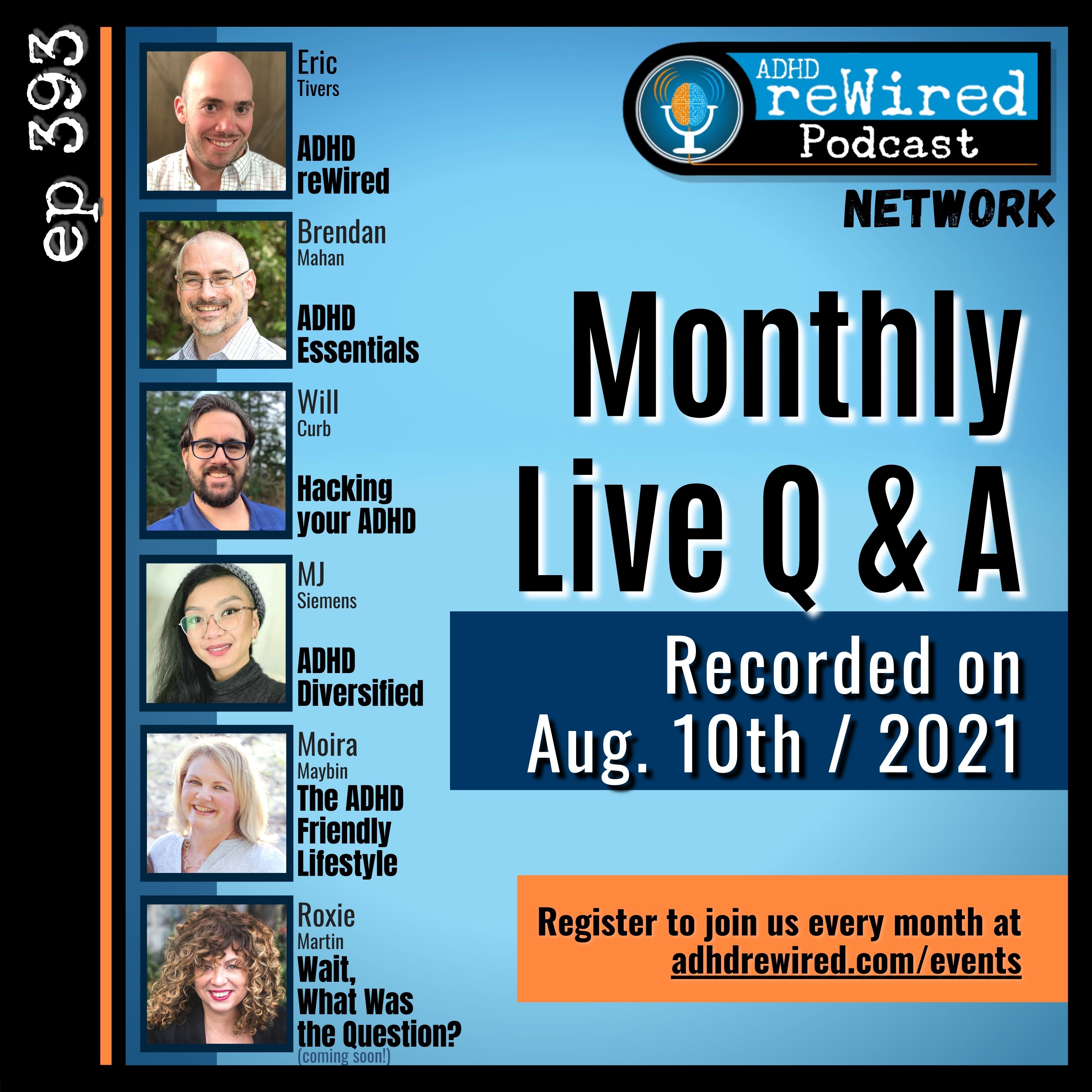
393 | August Live Q&A with Brendan Mahan, Will Curb, MJ Siemens, coaches Moira Maybin & Roxie Martin, & Barb McDonagh
E** There's still room for YOU to join the 26th season of the award-winning ADHD reWired Coaching and Accountability Groups, starting in October! Head over to coachingrewired.com to find out how you can be a part of these intensive, online and video-based coaching and accountability groups, so you can get your ADHD rewired and rewrite your ADHD story! [00:02:20] - Eric has the first ADHD moment of the show [00:04:38] - Question: A listener who was recently diagnosed with ADHD asks about hyperfocus, prioritizing, and how to tell the difference between something that is a "new" passion versus a hyperfocus, versus a new commitment that may lose interest in. Learn as much as you can about ADHD. It's a disorder where information makes a difference. If you can anticipate the things in your environment that you're more susceptible to falling into hyperfocus and plan for them. Our tendencies can be double-edged swords. Ask ourselves: Is it a passion or calling, or something we're just doing a deep dive on? Have a place to store your ideas, because it doesn't mean you have to act on them and continue to scroll. It's okay to be curious about it, and observe if the curiosity will fade tomorrow before acting on it. The more we are engaged in thinking about it (our ADHD), the more we are going to take our lives off auto pilot. Is it a time-suck or a time-investment? Learning about ADHD is really learning more about ourselves. [00:14:33] - Question: What is the most frustrating thing about your ADHD? This listener's most frustrating thing is having to wait for stuff. But first, Barb and Eric have a moment! Roxie: working memory in almost every aspect of her life, and shares a working-memory moment. Moira: day-to-day is waiting, but the big-impact ADHD frustration is impulsivity with blurting out. Will: An extreme lack of executive function while recovering from COVID (at the time of this recording) and activating on the task at hand. MJ: Impulsivity to never (or rarely) say "no". Then optimism kicks in, then they realize they can't do all the things, even though their ADHD wants to do all the things. Brendan: The "waiting-brain" and having trouble initiating prior to something bigger in the future. Eric: Transitioning or moving on to the next thing, and multi-tracking and maintenance in multiple domains of life at once. [00:19:37] - Question: A listener is one month away from having a baby and is in serious need of working on their recently diagnosed ADHD, and wonders how to balance these. Suggestions: Don't join a coaching group (yet). Focus on your baby and get to know your baby because the years will fly by. Learn more about ADHD by listening to podcasts, because you can listen to a podcast and feed a baby at the same time. The more passive the learning, the easier it's going to be to fit in [the learning] around your baby. When you're pregnant, your body has a lot of estrogen which helps your ADHD. When you deliver, those hormones decrease. Women with ADHD have a much higher rate of postpartum depression largely due to this drop. Figure out what works for you even when others want to give advice, ask for help, don't be afraid to ask for help, and take care of yourself. [00:30:55] - Question: A listener, who is a startup cofounder, asks about navigating and managing rejection in a practical way, and avoiding participation with the anxiety of facing rejection. It's not just about competing with someone else, it's about competing and challenging ourselves. Is there risk? Yes. The only guarantee if a "no" is to not do the thing that scares us. Ask ourselves: Can you do everything that you think you can do and at the same time, understand that it might not go your way, or seal your own fate by not doing anything? Ask ourselves: What's our mindset when we go into these things? Ask ourselves: Do we love what we're doing? One of the things that makes rejection so hard is the story we tell ourselves about why we were rejected. If we change the story and make it one that serves us rather than one that undermines us, it's easier to take that risk the next time because we're not ruined by the story we told ourselves. [00:35:16] - A listener gets burnt out from doing productive things, but when they feel burnt out, they know exactly what they need to do to recharge. But when they feel like they need to do more things, they don't feel like they have the right to recharge. (The panelists can relate!) "I need to do all my work first before I can recharge" may be an old story we tell ourselves. We can't only do the work because that's what leads to burnout. Nobody gets everything done on their to-do lists, including neurotypical people. Ask ourselves: What's the story we tell ourselves? What are the remnants of our old belief patterns? Are we making up for our ADHD? Plan the time off first, and protect that time after it's been planned. We're never going to escape the mental trap that says, "Oh, I could do more." Sure, we could do mor

392 | Bi Polar, ADHD, and the Road to Recovery with Jim Long
E** There's still room for YOU to join the 26th season of the award-winning ADHD reWired Coaching and Accountability Groups, starting in October! Head over to coachingrewired.com to find out how you can be a part of these intensive, online and video-based coaching and accountability groups, so you can get your ADHD rewired and rewrite your ADHD story! About Jim: Jim has been battling ADHD since his diagnosis at the age of 10 in the early 1980's, adding bipolar type 2 (Bipolar II), substance abuse, and an anxiety disorder to the mix has made life interesting, to say the least! Having a robust recovery plan and a team in place is helping Jim overcome these obstacles and stay on the path to recovery. Jim is a father of four, married to his wife for 30 years, an army Veteran, and a fire EMS captain. (Check back for updated timestamps of this episode!) Check out the Other Podcasts on the ADHD reWired Podcast Network: adhdessentials.com with Brendan Mehan hackingyouradhd.com with Will Curb adhddiversified.ca with MJ Siemens adhdfriendlylifestyle.com with Moira Maybin coming soon - Wait, What Was the Question? with Will Curb and Coach Roxie Martin. Reach out to Will and Roxie at [email protected] Don't Forget These, Too! adhdrewired.com/patreon — Support the show by becoming a Patron! coachingrewired.com — Get your name on the waitlist to join the fall season of ADHD reWired's Coaching and Accountability Groups adultstudyhall.com — Join your ADHD-friendly co-working space! adhdrewired.com/events — Join Eric, Brendan, Will, MJ, Moira, Roxie, and Barb for an hour of Live Q&A on Zoom, every 2nd Tuesday of the month at 12:30pm Central (10:30am Pacific / 1:30pm Eastern)

391 | Can a Passion For Videogames Help? with Henry Holman
EThis week, Eric talks with his guest, Henry Holman, about how some of the lessons he's learned through gaming can also apply to real life, the impact of discovering when you're not alone with your ADHD, and dive into a quick coaching session for tips and strategies to managing your to-do's. About Henry: Henry is going to be a senior at DePaul University, studying computer science and is working towards a career in game programming. Although he was diagnosed at 9 years old, he didn't start learning about ADHD until he was 19, and remains fascinated with the "why" behind his ADHD-ness. He has loved video games for as long as he can remember, and in recent years, he has learned a lot about himself as he strives to improve at competitive Super Smash Brothers™. His long term career goal is to create a game that makes players feel like they have ADHD, to increase awareness and understanding surrounding the disorder. This is one of the first episodes in a while where Eric gets to have a guest in-studio! [00:02:48] - Eric asks how Henry got into video games. It all started with a Game Boy Color™ and a McDonalds toy. Henry and his siblings also split a game console.Then Eric and Henry hash out their virtual tennis accomplishments, and why a lamp-timer is helpful. [00:04:39] - Henry talks about a video game he wants to create that will make people feel like they have ADHD. His brother recommends a game to play, where the underlying theme of the game is a metaphor for overcoming the character's anxiety, and why it resonated with Henry. He also talks about a game he's played where the character in the game suffers from psychosis, which also gave him inspiration. Fun fact: The game Henry mentions in the timestamp above was, indeed, made in collaboration with neuroscientists and mental health professionals. Henry says, "They didn't want to do [the game] a disservice" and wanted to break a misrepresentation of mental health in games. Read more: Hellblade studio launches a new venture to explore mental health through games How Hellblade: Senua's Sacrifice changed lives with its thoughtful portrayal of mental illness [00:08:31] - Eric asks where Henry is at [with his game]. Henry has already made some prototype levels, designed after Dr. Russell Barkley's theory of executive deficits, and how the levels represent these deficits. [00:11:00] - Eric and Henry talk about enthusiasm vs. pursuing a passion professionally. Henry reflects on an episode of ADHD reWired he's listened to. "We don't have the luxury [with ADHD] of doing things we don't like to do for a living" is a phrase that resonates with how he felt about school. [00:12:44] - Henry really wanted to do game design as a career, but got a "C" in a game-design class, but didn't quite know what it was he truly wanted to do. Later on, Henry discovers a love for programming, problem-solving, and playing with Lego and K'nex. [00:15:31] - A moment of ADHD happens right before the break. [00:22:26] - Henry started educating himself after getting stuck on breaking his skill-ceiling, and talks about the game he dove into to learn how to play competitively. Eric and Henry nerd out about their "mains" in Super Smash Brothers™. Henry explains how picking up a new character in the game was a perfect metaphor for living life with ADHD. [00:27:13] - "Autopilot" isn't effective. Henry talks about how his skill-ceiling led to frustration, and coming up with new strategies after losing another set. When he realizes his ADHD may have something to do with his struggles, he talks about diving into ADDitude magazine articles, watching HowToADHD videos on YouTube, and going down the ADHD Reddit rabbit-hole. [00:30:48] - Henry learns about tournament-nerves, staying calm under pressure, and being able to control impulses, and how in Super Smash Brothers™ was helpful to apply the principles he learned to the real world. [00:33:20] - Henry recommends taking a drink of water to knock your body out of fight-flight-freeze mode, and how it became his pause-mechanism. [00:34:33] - Henry's passion about games "speaks to if we're going to problem-solve around any area of life, if we can figure out a way to put it through the lens of what we are passionate about, it gives our brain a fighting chance." - Eric [00:40:55] - Eric and Henry go through some coaching about a consistent system to keep track of his to-do's. From a digital-assignment notebook and a whiteboard. [00:44:46] - Eric and Henry talk about the assignment books they received in school, and dive into some of the tools Henry used to use, and how what has worked before never lasted for him, aside from Google Calendar. Then, Eric asks, "What if we can… shift to the mindset from 'I want to find a consistent tool' to being quick to pivot when we realize we are no longer paying attention to this tool?" [00:47.01] - Eric talks about the different places his to-do's live, and what Eric found helpful for him. Eric also recommends setting a reminde

390 | How to Recover from Years of Failure with Aron Croft
EThis is an episode you won't want to miss. Listen in as Eric - and his guest, Aron Croft - talk about the coping mechanisms Aron went through before he was diagnosed, the lessons he learned from his failures, and how he rose like the pheonix from Procrastinator in Chief to developing an ADHD-friendly productivity system you can't not hear about! About Aron: Aron appeared to have it all together when he got into Harvard. But that was the beginning of his demise. He struggled non-stop for 15 years until he was broke, divorced, and earning minimum wage, failing out of his first seven jobs and businesses. But after getting a masters degree in coaching psychology and a diagnosis of inattentive ADHD, his life changed. He built a successful fortune 500 career, got married, and discovered how to get shit done with a neurodivergent brain. RIght before Eric and Aron hit record, Aron also adds another skill in pillow fort building for reducing slap-back audio in a not-perfectly-acoustic room! [00:02:26] - Eric and Aron start at the "bottom" of Aron's story. Aron gets into Harvard and explains how he dropped out twice before graduating, hating school, being outmatched and outclassed. He lost the structure he had around him, moving from south Florida to Boston, and was sick of the pain to get things done by waiting until the last minute until fear motivated him to get things done, studying computer science. Eric affirms that activation energy can be amazing, but comes at a price. [00:05:10] - Aron talks about the ways he got through high school, building relationships with teachers that felt inauthentic, feeling like he needed to be studying subjects that had "right" answers, such as math and science. He goes into how it was easier to bounce back from dropping out of school the first time. [00:07:11] - Aron shares how he moved his life to an island off the coast of New Zealand, his plan to retire early, and what came out of these decisions he made in his early 20's, navigating with some minor inconvenient factors he'd overlooked. Even though Aron and his then-fiance quickly discovered boredom, he doesn't regret his decisions. [00:10:00] - Eric and Aron agree on the idea of boredom and "retirement". Then, they discuss the "drug" of self-improvement. Then, Eric asks Aron how they got off the island. [00:11:55] - Aron teaches Eric and the listeners about "The Harvard Curse" and being heavily influenced by his environment. [00:13:32] - "It's applying it that's challenging for me." - Aron [00:22:16] - Eric asks Aron about the next 15 years. Aron talks about his first job out of school and a decision he wasn't proud of in that chapter of his life. He then talks about the other jobs he had, but repeated a pattern of letting things pile up until the last minute to get things done. Aron explains how this affected his relationship - navigating without yet being diagnosed with ADHD. After a year and some at his second job, he takes his ambitious 25-year-old-self to start a business in real-estate. Then, queue a slight tangent about their handyman skills! [00:25:41] - Aron shares a realization about being his own boss, moving to Australia, and going into sales. He then discovers a world-renowned program at the University of Sydney in Executive Coaching, seeing a Master's Program in Coaching Psychology, changing the trajectory of his life for the better. His passion shines here, and tells the story about how a gag-gift from a friend sparked his relationship with personal development. [00:30:50] - Eric and Aron fast forward to when he moved back from Australia to Chicago and landing a new job. Receiving some feedback and realizing his position is now at risk, Aron shares his story about the measures he took to keep himself employed. Mentioned here: If you are struggling with addiction, here are some resources available in the United States & Canada: In the United States: Substance Abuse and Mental Health Services Administration American Addiction Centers Crisis Text Line National Drug Helpline Partnership to End Addiction National Suicide Prevention Lifeline National Institute of Mental Health In Canada: Get help with substance use - Canada.ca - The Government of Canada website lists the resources available for each province. [00:38:14] - Eric has Aron dive into his "holy shit" moment of only having two weeks to redo his work while under probation. Aron talks about his "swiss-cheese" resume and the drastic measure (which is NOT endorsed by ADHD reWired and its team or Aron Croft). He [Aron] then realized what it meant when people told him to "just focus." Eric also affirms the Oh-moment, while Aron explains how these actions led to scheduling an appointment to getting an ADHD diagnosis. Then, Eric and Aron share the experience when they were asked how they managed to "survive" and "get this far" before getting diagnosed. [00:42:55] - Aron not only finishes his work after getting thrown under the bus, his environment changes and start
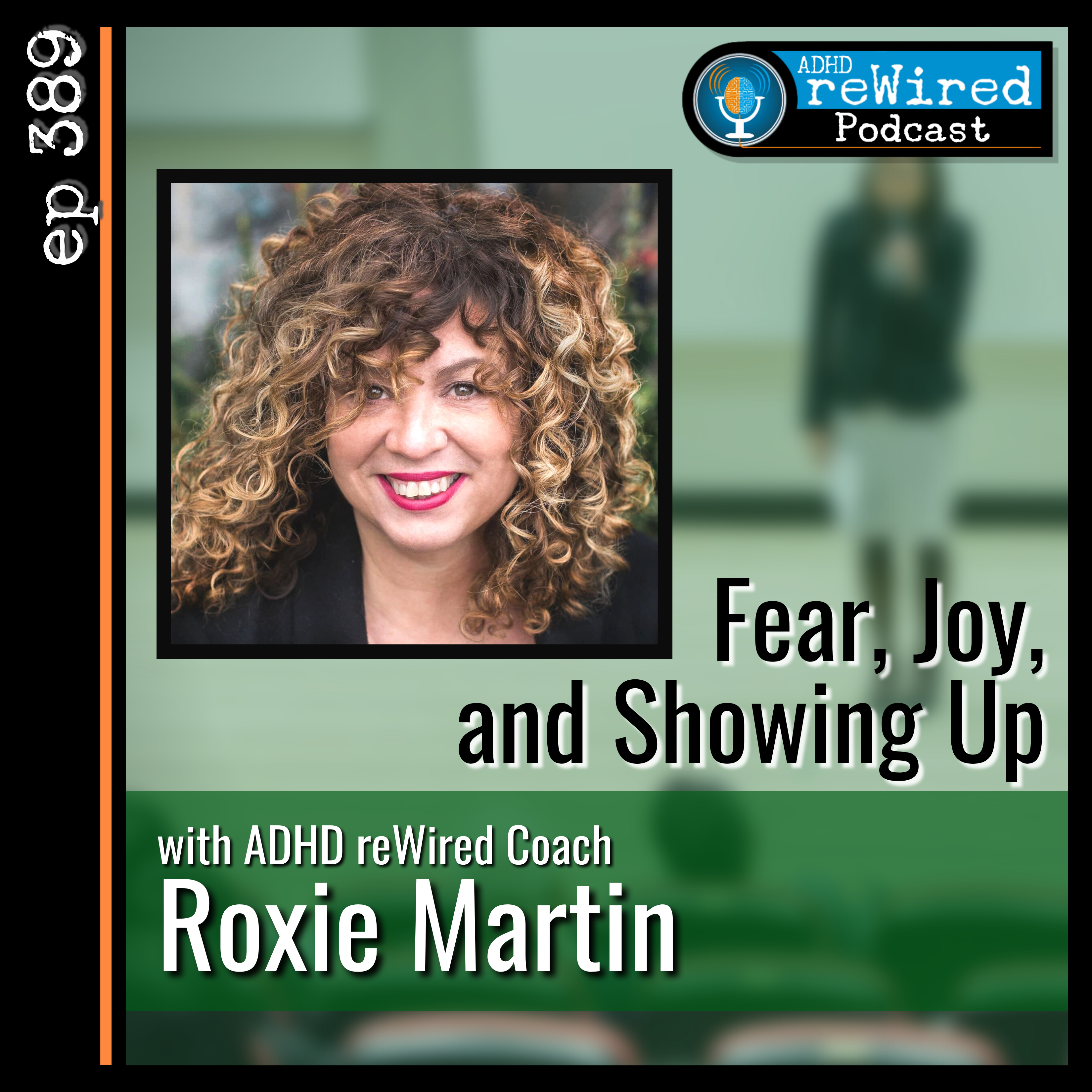
389 | Fear, Joy, and Showing up with ADHD reWired Coach - Roxie Martin
EIf you've wanted to hear more about ADHD reWired Coach, Roxie Martin, then this is the show you need to listen to. In this episode, Eric and Roxie get vulnerable and dive into tackling fear, facing joy, and what it means for them to show up. About Roxie: Roxie Martin is a certified life-coach, currently coaching her second season of ADHD reWired's Coaching and Accountability Groups. She has 35 years of research experience in what it's like to be an adult with ADHD, and a lifetime of hard-won wisdom to share. She has a colorful and diverse background that allows her to deeply relate and connect with almost anyone. She has been a ministry leader, a wife, a mom, a hair stylist, and a mentor. She is compassionate, encouraging, and has a finely-tuned bullshit-meter that helps cut quickly through the fluff and get right to the good stuff. [00:02:17] - Eric and Roxie go into the timeline of how she became one of the ADHD reWired Coaches. From ArC member to peer mentor, Eric wanted Roxie to become a coach for the groups. [00:03:57] - Eric asks Roxie if she's always innately had [her bullshit-meter] - her answer feels like an honest yes and explains why it feels weird to say it. They talk about intuition, as Eric feels like grad school beat the intuition out of [them] and learned not to trust the intuition, but has learned to listen to and amplify his intuition through coaching. [00:05:31] - Eric talks about the vision of how things were "supposed" to go, have a laugh about how things went out-of-order, and how Roxie is coaching her second season and starting up a podcast with Will Curb called, "Wait, What was the Question?" [00:06:40] - Eric and Roxie dive into who Roxie is, and the vulnerabilities Roxie has been exploring in her own life. Roxie goes more into "counterfeit" vulnerability through her own exploration and self-awareness. She talks about things that hadn't changed over the years, and what she did when she was put into situations she had to be vulnerable in. Roxie goes more into what her actions used to be and verbalizes the feelings that came up for her when faced with a choice to take the easy or vulnerable way through. [00:09:16] - Roxie answers Eric's question about what it is she was numbing from. She talks about where she noticed it [the feelings] came up the most, such as events or parties or being in settings where she's not comfortable - particularly social things, and where she knew she would have to have a hard conversation. [00:10:27] - Roxie talks about what got her more curious, with Eric's impression that she looks through a lens of curiosity. Roxie says she wishes she had a bullshit meter for herself but can feel it when she's justifying, compromising, or playing small. She then talks about why she's played small. She acknowledges she's not able to change it, but is not able to ignore it. Hear more here about her beginning when she first joined ArC and talks about being dumb on purpose. She also talks about creating a safe space for the members of her groups. [00:13:22] - Eric asks what her training has taught her about showing up in group. She says she's learned a lot more about coaching from being part of the ArC seasons, with her classes still being valuable. She then dives into compassion being great, but you need compassion and strength in order to feel safe and secure. Roxie dives into why the strength-piece is important, talks about the ways we communicate information, and trusting the intuition and gut with the knowledge and strength. [00:22:41] - Roxie and Eric shine a light on what Roxie has seen in her coaching sessions, what stands out for her, and what she's learned from the members. She talks about impulse control, the excitement of witnessing growth and self-realized epiphanies, and reframing self-talk, reiterating that it's a hard place to make progress without curiosity and compassion. Roxie also reveals some of the tips and tricks she's learned from members. [00:27:04] - Roxie explains more about picking up tools and how it's helped her teach what she's learned. Eric also talks about feeling clueless, being on time for class in grad-school, and explains why it's important to dig into this stuff [as coaches.] He also talks about giving space as such an important skill, recognizing that Roxie does that really well. [00:29:35] - Eric dives more into what Roxie mentioned earlier about "impulse control" and allowing members to make their own discoveries. Roxie dives into what she feels when she notices when she's only giving advice, and how the impulse of giving advice comes from being in some kind of fear. Eric talks about the foggy mirror, as Roxie explains setting up her environment to show up mentally, emotionally, physically. [00:32:33] - Roxie revisits Eric's earlier question about her favorite types of people to work with. Roxie loves the diversity of folks she gets to work with, and instead shares the types of people she is most intimidated by. Then, they dive deep i
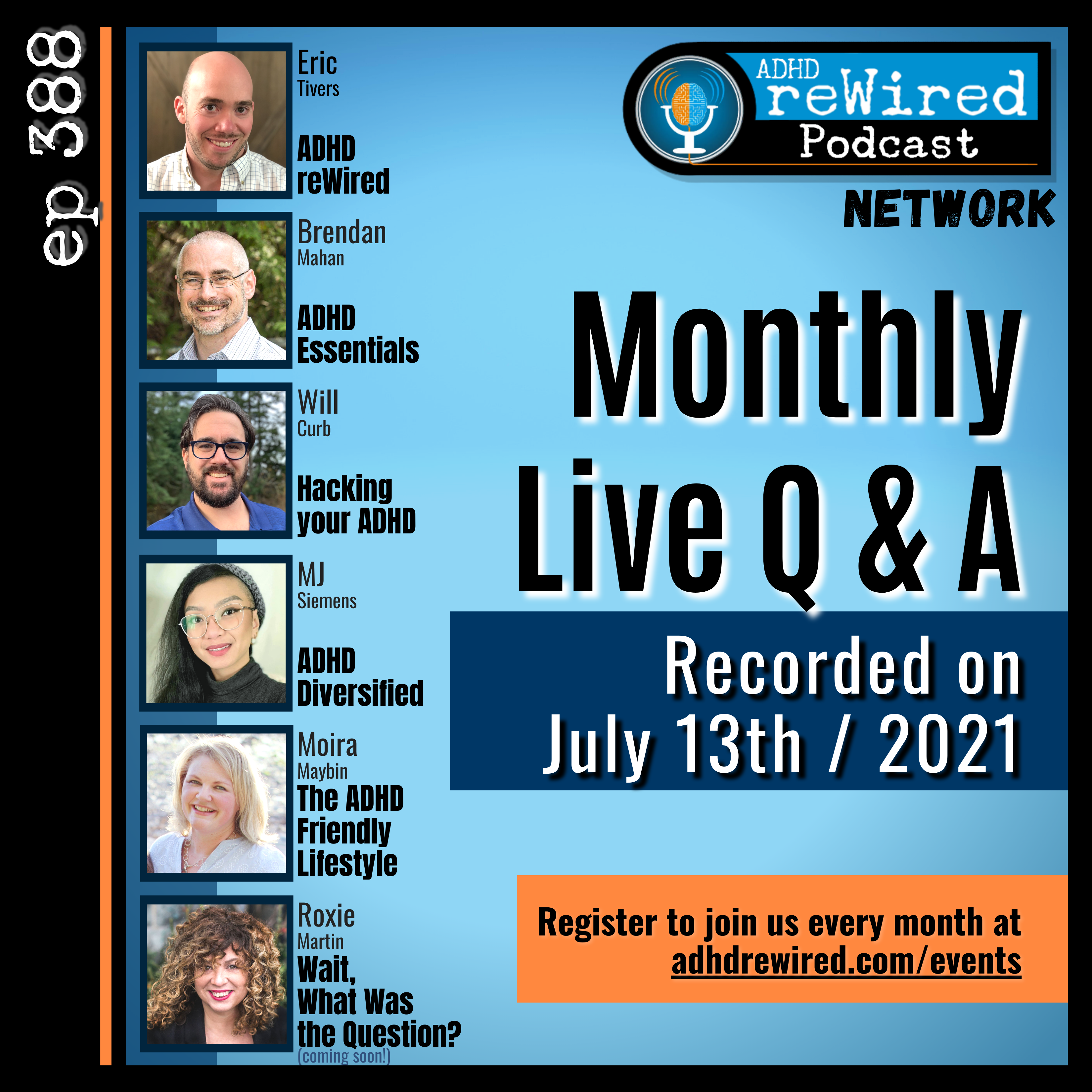
Ep 388388 | July Q&A with Brendan Mehan, Will Curb, MJ Siemens, Coach Moira Maybin, Coach Roxie Martin, & Barb
This week, we have the full panel of the ADHD reWired Podcast Family joining in for this month's Q&A Session, recorded on July 13th 2021. Find all the good stuff below! [00:03:56] Maria, a mom and former teacher, asks about subtypes of ADHD. She also asks about structure and looks for tools to strategize while jump-starting a teaching career online and plan better. Eric explains how ADHD "subtypes" shifted to "presentations" because over time, the presentation of ADHD can change. He also goes in depth about the diagnostic criteria, and the differences between children and adults. Most adults are the "combined" type of ADHD, along with Eric himself. When looking for strategies, he goes on to explain how it's important to look at the functional impairments. Any kind of diagnosis is a starting point, but isn't prescriptive. Moira explains how as people age, the more we internalize symptoms, so the hyperactivity may be more in thought rather than physically hyperactive. Women are also more likely to be inattentive, in the inattentive type. As Maria put it: "Meta inattentiveness!" [00:09:24] Malika asks about menopause and how she's observed that her symptoms have become much worse since it came on full time. Moira talks about estrogen, and once someone goes through menopause, the body doesn't make any more. Estrogen reduces ADHD symptoms, which is why when women are pregnant, they present with fewer ADHD symptoms. And, while women are in perimenopause, the estrogen levels are more erratic than in puberty. She talks about how hormone replacement therapy can be used to replace estrogen, and it also depends on someone's own health profile and family history, and hormone replacement therapy may not be for everyone. Another suggestion was increasing medication during that time, and a lot of things around lifestyle become important. Resource mentioned here: The Menopause Manifesto by Dr. Jen Gunter [0:14:31] Sandra asks, "How can I help my 14-year-old son become more organized for high school, and writing notes for his classes to study from for tests?" Brendan asks parents of ADHD kids: What's going on with the IEP and the 504? What are the supports happening at school to help him get to where he needs to be? Brendan says the best option is to have someone take notes or provide them for him so that he has good notes to study from, whether it's a teacher or a peer, so he can study notes that are useful. He explains that someone giving a model can help Sandra's son understand how he should be taking notes so he can do a better job with moving forward. Brendan also explains to be patient as he practices his new [note-taking] skill, and to leverage IEPs, 504s, and talking to teachers, guidance counsellors, special education teachers, etc. Roxie talks about how she's had to work really hard to take better notes and that models are helpful. She acknowledges that it's about incremental changes, because the template or the model doesn't automatically mean we become amazing at it right away. Resource mentioned here: About Marydee Sklar Eric mentions a course on how to draw your notes. He also explains that sometimes we don't know what's important, so we might take notes on everything, then we try to distill what's important and what's not. Brendan also suggests taking notes in two different colors, and to switch colors when a concept changes. Will reiterates the sketchnote idea and is great to help create that organization. Will also mentions the Cornell-style of taking notes, then Brendan goes in depth with how they work and how he makes that style work for him. It can be good for [taking notes during] business meetings, too! Moira found how-to books, and suggests that note taking is a life-long skill. As a teacher, she actively tried to teach these tips to her students, not realizing it was because of her own struggle with it. She also recommends having conversations with educators who are going to be more helpful with things like this, so that it can be looked at as building a lifelong skill. It's also okay for students to rely on their peer groups for good notes, share each other's strengths, and can make studying easier, too. MJ looks at note-taking from the student-perspective and how she would have liked to have been a part of the conversation to explain what works [for her], what doesn't, and why. She explains that allowing kids to have the voice to explain what does work versus being told how it's "supposed" to be done could be really helpful. Roxie brings up how it can be difficult to prioritize what's important. She finds it helpful if she is really specific and succinct about what is going into the note-taking experience and writes a little road map. Eric emphasizes that, with all things ADHD, they require experimentation until we find out what works. [00:30:30] Ryan, who is in her mid-20's, talks about struggling in the workplace with event planning and asks about a good system and starting place for planning, lo

387 | Healthy Curiosity and Self Discovery with Barb from ADHD reWired
Give a warm welcome to the human extraordinaire who helps Eric behind-the-scenes as the executive assistant of ADHD reWired - Barb McDonagh! Not only is Barb the biggest fan of her 13-year-old son (who also has ADHD), she also got her B.A. from Columbia College in Chicago majoring in poetry, and a Masters degree in teaching from National Louis University. As of this episode, Barb has been with ADHD reWired for two years. Listen to Eric and Barb as they talk about her journey to discovering her ADHD, how curiosity led to setting healthier boundaries, and how trying something different led to a community of people who you too, just might relate to! What will you find in this episode? [00:01:23] - Eric introduces the one and only Barb McDonagh and talks about how the last two eye-opening years working for ADHD reWired helped her discover her own ADHD and how it's changed the way she looks at her past. [00:03:17] - Barb talks about the reasons why she was interested in ADHD, and how being encouraged to try something different led to where she is now with ADHD reWired. She realizes that all the stories she's read in the spheres of ADHD reWired sounded far too relatable. [00:05:21] - Eric talks about self-examination and growth, while Barb talks about the books she's read and the process of what some of the growth and being curious meant to her. Barb also talks about what kicked her journey off, the process of gaining self-awareness, and how she was diagnosed with inattentive ADHD. [00:08:14] - Barb answers Eric's question, wondering how some of the personal work she's done has affected her family life, and how it's had a positive impact to reduce overwhelm, frustration, and setting healthier boundaries. Barb also mentions how she began asking for help. [00:09:48] - Eric and Barb talk more about boundaries, self-advocating, and what more healthy boundary setting can look like when you feel like you're always on the go. [00:11:07] - If anyone knows what an old transistor radio sounds like when you're trying to find the channel (…) That's how I feel and I can't tune in." [00:12:05] - Mentioned here: Crucial Conversations ; Barb talks about how didn't know how to talk about what she needed, and discovers how she can ask for what she needed. [00:12:53] - Barb and Eric talk about how, in the past, Barb had not really felt seen and how that has evolved. Barb speaks about looking "normal" and getting through a day, and what it was like to be able to talk and share her story and gain new friendships. [00:21:56] - Eric isn't used to doing ad-copy in real-time, but get back on track talking about being seen and what kind of impact that's had on Barb. [00:22:21] - Eric and Barb talk about the things that helped her recognize the things that were going on for her. Barb also went through the coaching groups and talks about how she wasn't yet at the point to be open to sharing and open. She discovers the power of sharing our stories and sharing the wins. She jokes about how the boss knows how hard she is on herself. [00:24:26] - Eric and Barb talk about productivity and prioritization when feeling overwhelmed and getting defensive. They also talk about how their working discussions have evolved, and how it can be hard to pull away from a task. They also discuss ways to make their roles more efficient as the business grows, and how those efficiencies and changes also need to be ADHD friendly since both Barb and Eric have ADHD, too! [00:29:03] - A discussion about executive function (EF) burnout is something that cannot be easily ignored, and how both Eric and Barb can still get distracted with "one more thing". Barb makes a point that you "can't set [self-care] aside." [00:30.01] - Barb and Eric talk about Pickleball - Eric's favorite sport! [00:37:00] - After the Time Timer falls again, Eric and Barb jump into a quick round of coaching around having "all this stuff to do", and different ways to curb distraction and get into deep focus. Quick mentions of dedicated time and setting boundaries come up again, and to remember to write down the things that do work! Check out the Other Podcasts on the ADHD reWired Podcast Network: adhdessentials.com with Brendan Mehan hackingyouradhd.com with Will Curb adhddiversified.ca with MJ Siemens adhdfriendlylifestyle.com with Moira Maybin coming soon - Wait, What Was the Question? with Will Curb and Coach Roxie Martin Don't Forget These, Too! coachingrewired.com — Get your name on the waitlist to join the fall season of ADHD reWired's Coaching and Accountability Groups adultstudyhall.com — Join your ADHD-friendly co-working space! adhdrewired.com/patreon — Support the show by becoming a Patron! adhdrewired.com/events — Join Eric, Brendan, Will, MJ, Moira, Roxie, and Barb for an hour of Live Q&A on Zoom, every 2nd Tuesday of the month at 12:30pm Central (10:30am Pacific / 1:30pm Eastern)

386 | Why is it so Hard to Plan a Vacation? with ADHD reWired Coach Moira Maybin
Planning a vacation is hard. It's even harder when you have ADHD! Listen in as your host, Eric Tivers, and his guest - fellow podcaster and ADHD reWired Coach - Moira Maybin of The ADHD Friendly Lifestyle brainstorm some of the ways you can plan an ADHD-Friendly vacation in an ADHD-Friendly way. About Moira: Moira Maybin has spent 25 years as an educator, working in classrooms, in special education and, as a learning assistance teacher with an educational psychology background. She lived through years of overwhelm and failed attempts at trying harder that compromised her self-care, physical, and mental health until finally receiving her ADHD Diagnosis. After experiencing a terrifying fall off a 50-foot cliff in 2018 that left her with serious injuries, she knew she had to commit to creating an ADHD Friendly Lifestyle and give up on trying harder if she really wanted to thrive. She's since re-shaped her life completely for a better fit, based on current research. Moira has dedicated the last 5 years of her life to diving in deep to learn as much as she can about ADHD and its impact on women. Now she's opening up about what it's like being a woman with late-diagnosed ADHD and a mom of two children, sharing the knowledge she's gained on her own personal journey, and as an educator and advocate for people with ADHD. What will you find in this episode? [00:02:05] - Eric & Moira talk about why this was a second attempt at recording an episode together [00:02:35] - Eric & Moira recognize when it's time to take the "exit ramp" [00:03:00] - Eric talks about struggling planning a vacation; Moira talks about her own experiences of not being able to relax at home, and how going away was the only way to decompress. [00:03:45] - One of the challenges for Eric is figuring out when to take a vacation. He talks about being stuck on a 7-year merry-go-round wondering when the right time will be. [00:04:19] - Moira shares her own experience when she got into teaching but didn't end up actually going anywhere during the summers. [00:04:35] - Moira asks Eric if he's spent some time wondering and dreaming as he talks about a Phish concert he's been waitlisted for. [00:06:05] - Moira acknowledges how Eric describes most of the things she does in advance of a trip, and how having a narrow focus is not so overwhelming. [00:06:30] - Moira says he might need another vacation after Eric's big trip, and why. [00:07:35] - Moira talks about "training" to figure out what to take and what not to take during trips and shows. [00:08:00] - Moira mentions making packing lists for herself and her family and doesn't try to think up anything on her own; using lists as a frame of reference and other resources to help save executive functions are extremely helpful. [00:08:40] - Eric jumps in and mentions travelfashiongirl.com and ricksteves.com [00:10:00] - Eric has a big question: What happens if a spot (for the Phish concert) doesn't open up? Moira shares her thoughts, what to watch for with airlines and tickets, how travelling on points is easier to change, and having a back-up plan. [00:12:00] - Moira asks Eric what else he likes to do and if going for an event or going for something completely different is part of a vacation for him. [00:12:47] - Eric thinks an all-inclusive resort sounds amazing because you don't have to plan much and likes the idea of going somewhere warm and sunny. [00:13:33] - Eric and Moira talk about how you can find others who have done some of the research and work already because they've already been there. [00:14:10] - One of the things that has helped Moira the most is going somewhere more than once. [00:14:26] - Mentioned here → https://www.additudemag.com/great-escapes/ [00:15:00] - Moira talk about time shares and points to limit the systems she has to navigate when planning a vacation, while Eric asks her about "glamp"-ing [00:16:33] - Eric says he needs to make vacations a part of his life as Moira talks about why she needs to make vacations a part of her life, and how it's evolved with growing kids. [00:18:33] - Eric and Moira say there just isn't really a good time (to vacation), so we need to make time to do it. [00:23:37] - Eric asks about other ways to have a more ADHD-friendly vacation [00:24:38] - Eric and Moira talk about guided tours, cupcakes, bike rentals, and routines [00:25:38] - Moira and Eric share some thoughts about Disney World [00:26:16] - Moira recommends to piggy-back off of folks who have the experiences and get the information from them to help narrow the scope of your research [00:26:52] - Eric and Moira talk about dietary and food sensitivities and ways to work with and around them [00:28:14] - Moira recommends travelling where you can have a kitchen, find places that do breakfast, and to hit-up a Costco! [00:30:20] - Eric asks Moira how far she plans in advance [00:30:34] - Eric and Moira talk about how time-shares actually work [00:31:59] - Eric calls out all the listeners who have pla

385 | The Self-Taught Lifestyle with Roland Tanner
EListen as your host Eric Tivers and his guest Roland Tanner talk about how he procrastinated his way to success on ADHD reWired. Roland Tanner has procrastinated his way through careers as a book seller, Medieval historian, author, publisher, software developer, podcaster, and would-be politician. He has sometimes been accused of being an entrepreneur! After a decade of battling depression, he scored top marks on an online ADHD test and was formally diagnosed with ADHD at the age of 50. What will you find in this episode? [00:01:29] - Eric introduces Roland as he procrastinated his way through careers as a book seller, Medieval historian, author, publisher, software developer, podcaster, and would-be politician & has been accused of being an entrepreneur. [00:02:00] - Hear Roland's voice! [00:02:13] - Eric brings to light how Roland feels that what he has to share doesn't have much value [00:02:33] - Roland talks about having an unplanned career. He explains his life with ADHD is an "interesting" example and that his career paths have certain been varied. [00:03:00] - Eric and Roland talk about how Roland wanted to be a politician, motivated by wanting an assistant to take care of his calendar & email, before he had any inkling of ADHD [00:03:40] - Roland talks about the executive functions of running his own business [00:04:03] - Roland really enjoys talking about politics & talks about his involvement and saw how others had their "executive function" minds externalized and handed to other people so they could concentrate on the conversations and people in front of them [00:05:10] - Roland says it didn't work out, but it was a fun process [00:05:13] - Eric asks how close the political race was [00:05:30] - Roland talks about the way the local politics work in Canada [00:05:41] - Roland explains the jobs and roles he played in running for local office [00:05:44] - He also talks about being a fairly shy guy and being described as introverted [00:06:01] - Roland observed that people liked talking politics [00:06:15] - Roland talks about being unsure if the job would have been very good for him because of the stress, but the "retail sales" part of it was a blast for him. [00:06:30] - The Dam Busters Story comes up [00:07:16] - Eric asks Roland about "Procrastinating the way to success" [00:07:40] - Eric asks what Roland was behind on when he scheduled this podcast interview [00:07:43] - Roland talks about debugging client websites & talks about his publishing company [00:08:00 - He talks about how he was supposed to be translating Medieval Latin documents but learned how to write code instead, which turned into an added job [00:08:32] - Roland talks about the challenges and being in a constant state of distraction [00:08:50] - Roland touches briefly about being a musician, what he thought about fidget spinners before he knew about his ADHD, and how learning guitar was his own way of fidgeting [00:09:45] - Roland uses playing instruments as his own equivalent of meditation [00:10:10] - Roland talks a bit about his experiences in the UK and taking A-Levels and how he'd play guitar instead of revise his notes [00:10:50] - Roland talks about his podcast for the "905" Telephone Code [00:11:20] - Roland brings up how the area is growing exponentially, how his area was portrayed, and how it's now one of the most ethnically diverse areas in Canada [00:12:08] - Roland brings up some of the issues in Canada surrounding the First Nations and Indigenous community with the discoveries of the graves and bodies being uncovered around residential schools [00:12:30] - Roland talks about working with First Nations involved with the Sixties Scoop [00:12:44] - He feels, even in a limited way, happy to be contributing to more knowledge of where (he) lives sharing the knowledge of First Nations & Indigenous issues in Canada [00:13:07] - He's relieved that there's something of an awakening of what's actually happened and what is still happening [in Canada] [00:13:33 - Eric asks Roland about going in deep into what he becomes interested in, and how that's gotten Roland into a bit of trouble at times [00:13:45] - Roland talks about being an "Accidental" entrepreneur and talks about not being very business-minded or driven like other people [00:13:58] - He also talks about how running your own business is tough [00:14:38] - Roland talks about the "boredom threshold" not being enough [00:20:50] - Before the break, Eric asks Roland about being a part of writing parts of speeches for the Queen (of England) [00:21:28] - Roland talks about his first career after the bookselling was a PhD in in Medieval history and talks about studying the Parliament of Scotland [00:22:44] - Roland brings up the speechwriting and how these experiences look good in a resume [00:23:15] - Eric asks what he's learned from all of these experiences [00:23:25] - Roland talks about the most frustrating part of the rules involved with these particular speechwriting o

S1 Ep 384384 | June Q&A with Will Curb, MJ Siemens, Coach Moira Maybin, Coach Roxie Martin, & Barb
EIn this episode, Eric Tivers is joined by Will Curb, MJ Siemens, and ADHD reWired coaches Moira Maybin & Roxie Martin. Barb also joins the panel as the ADHD reWired podcast family takes in and answers the questions from the listeners of the ADHD reWired Podcast. Brendan Mehan, we missed you this month! Every second Tuesday of the month, the ADHD reWired panel takes questions from our listeners live about their ADHD-related topics. Whether it's personal or professional, the panelists are here every single month to ask questions and offer their knowledge and unique perspectives to help ADHD folks find the solutions they need. Thank you for listening to the Q & A session this month. We cover a wide variety of topics and provide creative takeaways, no matter what stage you're in with your diagnosis. Listen in as we discuss your questions and the struggle we all continue working through as we navigate with ADHD. Find the other podcasts on the ADHD reWired Podcast Network: ADHD Essentials Podcast with Brendan Mahan Hacking Your ADHD with William Curb ADHD Friendly Lifestyle with Moira Maybin ADHD Diversified with MJ Siemens What will you find in this episode? [00:01:43] - Welcomin the ADHD reWired Podcast Family! [00:02:10] - Roxie and Will confirm rumors about their new podcast [00:03:21] - Jane asks, "What can you do when you just cannot get your brain to engage, even if you want to? [00:03:34] - Eric explains how trying to force it doesn't work; he shifts to prioritizing sleep, and his brain doesn't (typically) work with lack of sleep. [00:04:27] - Will says going for a walk and getting movement in is helpful. [00:05:05] - Eric talks about how even though taking breaks is difficult, he always feels better after doing so. [00:05:38] - Moira talks about hormones and how expectations can be managed around hormonal cycles, while Eric mentions her podcast [the ADHD Friendly Lifestyle!] [00:06:37] - Roxie talks about riding on someone's coattails, listens to ADHD-related podcasts & content, and enjoys singing karaoke for a break. [00:07:22] - Eric mentions Adult Study Hall and how a pomodoro dance break was really useful and fun! [00:07:52] - When MJ feels stuck, they talk about reaching out and telling someone, talking with their partner for a break, doing jumping jacks, and taking a pet-parent break. [00:08:53] - Will encourages ADHD folks to write down things that don't work and mentions how scrolling social media doesn't typically work. [00:09:18] - Eric likes video games but doesn't usually stop at just 5 minutes of playing. [00:10:03] - Scott asks about being on Adderall and wonders if his experiences are because of taking medication. [00:10:27] - Eric encourages folks to talk to their doctors and the documented side-effects of stimulant medication. [00:15:50] - Terry wants the panelists to talk about medications, particularly when kids are reluctant and contrary to medical advice. [00: 16:15] - Eric talks about how the research shows that when parents push medication during adolescence, the likelihood of the teens going back to medication as adults is drastically decreased. Eric encourages to allow the teen to make the call, which makes it more likely for them to go back to the medication as adults. [00:17:04] - Eric also encourages parents to read about motivational interviewing. [00:17:56] - Moira encourages parents to include the kids as part of the conversation. [00:20:10] - Eric encourages a healthy-fat high-protein breakfast before giving them their medication and let kids eat when they're hungry. [00:21:07] - Andrew wants to improve his communication skills and wonders if CBT or other methods could be helpful. [00:21:36] - Eric says CBT or DBT could be helpful. [00:22:06] - Mentioned: How to Win Friends and Influence People by Dale Carnegie, and Crucial Conversations by Joseph Grenny and Kerry Patterson [00:23:15] - Will talks about trying different communication models, such as a phone call or text to give the brain time to catch up. [00:24:13] - Eric says to take a break but 23] commit to coming back. [00:25:00] - Roxie realizes trying to get into problem solving before we're ready that we have such a huge breakdown. [00:25:10] - Mentioned: Change Your Questions, Change Your Life by Marilee Adams [00:25:25] - Kristen asks, "How do I lessen my interrupting in group discussions?" [00:25:36] - Moira talks about hyperarousal and treatments that helped her [00:26:03] - Eric and Moira encourage writing stuff down; Eric talks about some coping mechanisms and sitting in the discomfort of silence. [00:27:00] - Will talks about cultural conversational styles across the U.S. [00:27:37] - Suzanne asks about how to respond or having a set of pre-fabricated responses when people make comments about over-planning and other ADHD-related topics, while keeping composed. [00:28:20] - Eric thinks it's cute when someone says, "You'll remember that." [00:28:42] - MJ admits to being a chronic over-planner and talks about c

S1 Ep 383383 | Neurodivergence Runs in the Family
If this is the first time you've ever listened to this podcast, today's episode features a different type of interview than Eric usually has on the show. If you have kids, this is a great one to get them to listen to (or listen to with them) as well. For long-time listeners, you've heard Eric mention his son on the podcast before. Well, guess what? His son is here today as dad's very special guest! Listen as your host Eric Tivers and his son discuss his perspective on having ADHD (among other things) and its effect on him during this endearing and humor-filled episode of ADHD reWired. Eric's son is not just his favorite child interviewee on the podcast; he's also the first child to be interviewed on the show. Eric asks his 9-year-old questions like: What does it feel like afterward when you do something, and you're not sure why you did it? When is he likely to get distracted? As someone with both autism and ADHD, is he a big picture or small details kind of kid? Have other kids called him names at school? How does he view his giftedness, and how does it feel when something doesn't come easily to him? What does he want to say to kids like him listening to the show? In this episode, you'll also hear them talk about a tendency towards impulsiveness, a love for reading and math (including the Fibonacci sequence even at a mere six years old), and the different ADHD traits his son possesses. The 9-year-old even gets to take over the position of podcast host, interview his dad, and humorously offer his own tips towards the end of the show. Get ready for spontaneous special effects, singing, sidetracking, and then some. ADHD adults and their ADHD kids will get a kick out of sharing this listening experience together! You'll learn: [01:52] Eric's son says hello! [02:59] Listen to an explanation of neurodiversity from the perspective of a 9-year-old boy. [04:15] How does ADHD affect Eric's son? [05:48] Eric's son reveals his favorite thing to do to dad. [08:11] Eric shares an interesting tidbit about his son that's always fascinated him. [09:35] Eric's son loves to read! What book series is he reading right now? [11:40] When Eric read fiction as a kid, he had a hard time with this regarding characters. [13:32] Eric's son shares a "time flies" joke before the break. [21:54] Before resuming the interview, Eric's son gives a humorous plug for the podcast. [23:55] Eric's son has been working on improving this social skill at school. How's it going? [24:43] Despite not having autism himself, Eric still has trouble with this. [25:40] How does Eric's son think other kids perceive him? He's been waiting to hear someone call him this. [27:07] Listen as Eric's son reveals what he thinks about his own giftedness. [29:37] Eric and his son discuss handling things that don't come easily. [30:44] After a near-slip up transitioning to a new subject, Eric asks his son to define and opine on the word "transgender." [31:02] The tables turn and Eric is now the one getting asked questions. [32:14] In answer to his son's question, Eric discusses why he started this podcast. [34:52] We interrupt Eric's answer for a spooky sound effect request complete with spooky laughter. [36:47] Eric cringes a little when he listens to his first 20 or so episodes. Here's what that tells him, though. [42:13] Eric's son tries his hand at saying "ADHD reWired" like dad. [43:52] In this special part of the episode, Eric's son playfully offers his tips for those with ADHD. [45:48] When getting distracted while readying for school, here's what Eric and his son say to get back on track. [48:31] Eric's son signs off with a quick song about coronavirus. [50:10] If you are a regular listener, consider becoming a patron by clicking on our Patreon tab at www.ADHDreWired.com.

S1 Ep 382382 | Strategies for College Success with Judy S. Bass
"I know ADHD people who the minute the business is successful they sell it and start another business, because they're bored; it's running itself [and] it doesn't meet any challenge anymore." Listen as your host Eric Tivers and his guest Judy Bass discuss overcoming challenges and finding success in the college classroom for ADHD students on this episode of ADHD reWired. Judy is an internationally recognized expert in the field of college planning for students with ADHD and other learning challenges. Over the past 20 years, she has helped many ADHD adults in their late 20s and 30s realize their dream of earning a college degree. By focusing on their strengths and instead of their challenges, she helps ADHD adults develop a positive self-image, giving them the confidence to achieve success in life. Her website, Bass Education Services, offers comprehensive college planning where students and their families are guided through the selection and admission process. BES assists with everything from high school course and extracurricular activity suggestions, visiting colleges, conducting interviews, filling out applications, and writing essays to reviewing testing and college accommodations and fostering independence and self-advocacy skill development. Listen as Judy shares some of her surprising revelations of and experiences with neurodiverse students. She talks about the types of college learning environments and workloads that can be better for those with ADHD to find success. She even discusses perfectionists vs. procrastinators, how to request and receive ADHD accommodations from your college, and preparations you should make before the start of the school year to help keep you organized and on track. You'll also hear about alternative routes to traditional colleges, college graduation myths, changing majors, finding the best field of study for you, advice on talking to parents with certain career aspirations that you don't want to pursue, and more. Along the way, Eric shares some of his experiences as an ADHD adult college and grad student and offers his own recommendations. Your Resources: Rate My Professors Sonocent Audio Notetaker Momentum You'll learn: [02:18] Welcome to the show, Judy! [03:31] ADHD college students experienced these pleasant surprises during the pandemic. [04:15] How did Judy get into this line of work? [06:15] Judy shares her self-advocacy recommendations for neurodiverse students. [08:05] Not every professor accepts that some students have ADHD. [10:18] When he was in college, Eric did this to minimize distractions in the classroom. [12:06] Finding the right professor that matches your learning style can make all the difference. [13:42] What surprising characteristics does Judy find in people with ADHD when it comes to the pursuit of higher education? [15:45] Two colleges in the country, to Judy's knowledge, have six-week classes. But it can be both a blessing and a curse. [22:05] Judy discusses some alternatives to the traditional college environment available. [24:33] Judy reveals why it's a challenge to shake perfectionists out of their perfectionism. [24:58] How did Eric handle his own perfectionist tendencies in college? [27:23] If you decide to go back to college and need accommodations for your ADHD, Judy lays out what you should do step-by-step. [29:35] Meet with someone during the summer before you start college to get your syllabi streamlined into your calendar. [30:33] Several technological aids exist to help ADHD students stay on track, take notes, and get organized. [32:35] What if a college student has been told to get a psych evaluation (despite research saying it's unnecessary) to receive ADHD accommodations? [39:27] Eric divulges the key to getting the best accommodations for himself in college. [41:53] Smaller classes afford better opportunities to get to know your professors. [42:33] Here's what Judy tells students who are thinking about attending a large university. [44:15] Sometimes, Judy has recommended that students not go the traditional college route. [45:45] Judy and Eric expose these myths about college graduation in the U.S. [47:12] When a student wants to change majors, how does Judy help them evaluate their decision? [48:14] Students with ADHD really need to go after degrees due to genuine interest in the field, not for the money. [50:19] Judy talks about how she guides students to converse with parents who have set career expectations for them. [52:32] How do you find the best field of study for you if you have ADHD? [53:12] Judy doesn't recommend fields with these characteristics for those with ADHD. [56:10] If you are a regular listener, consider becoming a patron by clicking on our Patreon tab at www.ADHDreWired.com. Find Judy Bass: Bass Education Resources

S1 Ep 381381 | Resilience and Loss with Christian Morrow
"When you look at entrepreneurs, some of the most successful people in this world come from broken homes and troubled childhoods and poverty, and it's because they've been able to navigate adversity and they're so good at it." Listen as your host Eric Tivers and his guest Christian Morrow discuss growing up with ADHD, facing disease and addiction and depression in parents, and how Christian has and continues to work through the events of his life on this episode of ADHD reWired. Diagnosed with ADHD as a child, Christian has learned to navigate both a personal and professional life, as well as cope with tragedy in his personal life. More recently, he was also diagnosed with Obsessive-Compulsive Disorder (OCD), and his father passed away at age 64. He couldn't enjoy his early 20s like most other young adults and found himself having to get organized and grow up really quickly just as he was about to finish college. His plans for grad school and his life were even put on hold for a while. From dealing with a parent with an addiction to the loss of a parent to suicide while he was in college, Christian has developed a new perspective about life, resiliency, and self-discovery. Now, he currently works in higher education where he recruits for Miami University and deals directly with respective college students, counselors, and faculty every semester. He's also just graduated from grad school and has a home and a 4-year-old girl with his fiancée. Listen as Christian shares his experiences as a child with ADHD and the effect of his dad's leukemia and addiction and his mother's depression in his life from elementary school through college. He also reveals the difficulty he faced in trying to complete his education during some traumatic events involving his parents, discusses handling the aftermath of his mother's death, and talks about how he continues to process what has happened in his life. You'll learn: [02:47] Welcome to the show, Christian! [04:50] How did Adderall and Strattera affect Christian? [06:54] A leukemia diagnosis for his dad in 1995 triggered the start of Christian's hectic life. [09:02] Christian's dad traded in his family for his addiction. [10:24] Christian discusses the beginning point of his mother's depression. [12:24] After a period of rehabilitation, Christian's dad moved back in with his son and ex-wife. [14:40] Why has Christian always preferred writing in cursive over print? [16:07] Miami U delivered a letter to Christian that kicked things into high gear. [24:31] For a few years, Christian was living two lives as a college student and a caretaker. [25:47] Christian discusses his OCD as a trauma response. [27:01] What was it about teaching middle schoolers that turned Christian off? [28:47] On the morning of April 10, 2015, Christian got some bad news from his dad. [31:17] Christian became the executor of his mom's estate at age 22. [33:05] What kind of strategies helped Christian get organized? [38:23] ADHD is never just on an island by itself. It's part of the greater picture of life. [39:55] Christian's already done so much at age 29, and he's often told he has an old soul. [42:01] How does Christian continue to process the events of his life? [44:32] Christian has felt obligated to take care of others, but how does he take care of himself? [46:05] If you've recently found out you have ADHD or are struggling with it, Christian offers this advice. [48:38] Christian has this thing about not starting anything unless he knows he'll win or be successful beforehand. [50:27] How did his own upbringing shape Christian as a dad now? [53:16] To wrap up the show, Christian shares what he thinks listeners should take away from this conversation. [55:10] If you are a regular listener, consider becoming a patron by clicking on our Patreon tab at www.ADHDreWired.com.

380 | Resiliency, Self-Talk & the Power of Acceptance with Jennifer G.
"When I was in a high-stress situation, I don't know if it's the adrenaline acting like Adderall, but everything slows down for me and it's by the numbers." Today, listen as your host Eric Tivers and his guest Jennifer G. discuss how her diagnosis affected her law enforcement training and career as well as some of the traumatic events from her childhood involving her family on this episode of ADHD reWired. There are some officers out there who shouldn't be and others who are meant to be in their position. The latter really want to help people; it's what they do, and it's a very strong feeling. Jennifer was born and raised on Martha's Vineyard in the 1960s and was recently diagnosed with ADHD. Nancy Drew and The Happy Hollisters mystery book series heavily influenced her as a child. She started her career in law enforcement as a meter maid in her town. Then she became an emergency dispatcher and finally a police officer like her father. The story of arrest is one of struggle and triumph and then struggle again, both with and against ADHD. With her ADHD, Jennifer always came to work hyper prepared for any incident on a call. Her trunk had everything she could need for any possible scenario, something that her co-workers both teased her for and took advantage of when they needed her help. Listen to her stories of struggle with anxiety and depression and embarrassing incidents while training and working as a police officer with ADHD. You'll also hear about how Jennifer almost got hooked on alcohol and some hair-raising events during her childhood involving her older sister who suffers from drug and alcohol addiction. You'll even discover her unusual rock collection where prized pieces keep...exposing themselves to her on the beach for her to discover. You'll learn: [02:27] Welcome to the show, Jennifer! [03:39] How did Eric's podcast save Jennifer's life? [05:16] Jennifer discusses how she first got into law enforcement. [06:21] Jennifer humorously reveals her biggest claim to fame. [07:09] A mishap during police academy training almost halted Jennifer's career. [08:32] A squawking radio almost gave Jennifer away during an undercover drug call. [10:42] Hesitating to tell this story, Jennifer reveals a time she gave the wrong directions to her backup. [12:12] Was Jennifer more willing to take risks and enter dangerous situations? [14:30] Jennifer wonders if adrenaline acts like Adderall and slows you down. [29:15] Jennifer experienced a lot of trauma in her family growing up. [31:42] Has Jennifer explored the role PTSD might have played in her life thanks to her traumatic childhood? [32:25] At a young age, Jennifer discovered alcohol and could've gotten addicted. [34:52] If Jennifer hadn't stopped drinking at age 23, she doesn't think she'd be here right now. [37:00] Jennifer describes what her blue-collar dad and busy mom were like as she grew up. [39:42] The kindest thing Jennifer's younger sister ever said to her. [41:14] Self-compassion is the way forward, no matter what struggle you're working on. [49:27] Say what?! Jennifer has an erotic collection of rocks (which is growing every day). [51:31] Jennifer started rock hunting after her mother fell sick. She gets a bit emotional describing how her mom supported her. [53:21] For so many of us, the inner critic we hear comes in the voice of a parent. [55:09] Once you get diagnosed and start working with yourself, some people resist the changes in you. [55:36] Jennifer might be on the verge of a new invention. She's an idea machine! [59:21] If you are a regular listener, consider becoming a patron by clicking on our Patreon tab at www.ADHDreWired.com.

379 | May Q & A with Moira Maybin and MJ Siemens, Brendan Mahan and Will Curb, and Barb
In this episode, Eric Tivers and his guests, Brendan Mahan, Moira Maybin, MJ Siemens, Will Curb, and Barb answer listener questions in our May Q & A session of ADHD reWired. We're taking questions from you about situations you want to discuss. It doesn't matter if it's personal or professional. We're here to offer our knowledge and perspectives to help you find the answers you seek. Susan starts off the show with a question about her two ADHD children. She wants to know what the panel thinks about using functional psychiatry and nutrition to address ADHD symptoms. Winston asks about how to deal with his struggle with text messaging--sending them and responding to them in a timely manner, especially if they're group texts. Jane is curious to know if any link exists between ADHD and body temperature control. What are school systems doing regarding social-emotional learning for the fall when kids and staff will be in the same building for the first time in a while? Questioner Rich wants to ensure the best possibility for the upcoming school season to go as smoothly as possible for everyone. Les wants advice about anxiety, decision paralysis, and making the most efficient use of free time. Then the panel answers a question about the importance of healthy habits with sleep, movement, and nutrition. Marks wants to know how to loosely follow a GTD methodology while dealing with overwhelm by closing as many loops as possible. Diana has an action-oriented question for those who feel frantic about their list of priorities. Another listener wants advice for her ADHD-inattentive daughter on going to school for a future career in psychiatry. And the last somewhat related question from Sandra inquires about any professions where ADHD people tend to find success. Thank you for listening to the Q & A session this month. We cover a wide variety of topics and provide some creative takeaways no matter what stage you're in with your diagnosis. Listen in as we discuss your questions and the struggle we all still have dealing with ADHD. Your Resources: ADHD Essentials Podcast with Brendan Mahan Hacking Your ADHD with William Curb ADHD Friendly Lifestyle with Moira Maybin ADHD Diversified with MJ Siemens You'll learn: [02:08] Susan asks the first question. [02:57] Eric gives a caveat about natural approaches to health and treatment. [04:32] People respond differently to food, but crappy food leads to crappy feelings while good food makes you feel better. [05:30] Exercise is the best non-medicated tool for ADHD. [06:00] Moira addresses functional health and how it differs from holistic health. [07:50] Susan's daughter hasn't responded well to stimulant medications. [09:13] Winston has a question about texting which he struggles with. [12:00] Brendan realizes he forgot to respond to a text recently and shares how he prioritizes his messages. [13:09] If you're worried about your tone while texting, Brendan shares a funny tip to alleviate your concern. [13:50] On the iPhone, you can pin text messages that you haven't responded to. Eric shares how and offers another great way to respond. [16:48] MJ quickly talks about how she handles questions asked of her via text. [17:23] Eric realizes he hasn't yet introduced the panel so does so now. [18:52] Barb reads a question from Jane about any link between ADHD and controlling body temperature. [19:44] MJ can't seem to get her body into a comfortable temperature zone. [20:48] Moira has struggled with body temperature due to her thyroid disease and perimenopausal hormone changes. [22:17] Body temperature is a huge issue for many people during sleep. [32:14] After a long hiatus thanks to COVID, Rich wants to know what the landscape will look like for the students and staff returning to school. [33:29] Brendan answers part of Rich's question by sharing what he's seen and heard. [35:50] Teacher burnout is real. Their pay scale needs to be adjusted upward; otherwise, many will walk. [37:31] Getting on his soapbox for a minute, Eric expresses appreciation for what teachers have had to endure over the last year. [38:51] Barb reads a question from Les about advice on structuring free time. [39:37] Why is scheduling your free time activities not as restrictive as it sounds? [40:10] More than doing fun things,the anticipation of fun things will increase your enjoyment of them. [42:29] Even if you enjoy the work you do, your brain still needs to take breaks from it. [45:29] How important is it to establish healthy habits like cutting down on sugar, developing a good sleep routine, and physical activity? [52:29] Mark has a question about loosely following the GTD method. [53:13] Not all open loops need to be completed but some need to be dismissed. [54:37] When you know what you must do next and have a good list of priorities but feel frantic and overloaded, how do you get yourself to take action? [57:13] Eric believes that once you've had your top 3 priorities for the day, you have to earn the right to

378 | The Labyrinth of Growth Work with Justin Classen
"It's very easy to get lost in what other people say and think it's your own thoughts." Your host, Eric Tivers, welcomes back returning guest Justin Classen who was previously on the show in episodes 195 and 260. They discuss Justin's journey after his last appearance on the podcast, navigating issues of trust, attachment theory, and codependency, and his growth work today on ADHD reWired. Since Justin's ADHD diagnosis, he's made a multitude of critical changes to gain better insight and control over his seemingly chaotic existence that helped transform his life. A series of traumatic psychological events proved to be a catalyst that transformed a desire for truth into diligent hyperfocus and dedication to reprogramming his entire understanding of reality through the labyrinth of human psychology. The last time he appeared on the show, Justin had made significant progress on his journey to acceptance, positive change, and self-awareness development and discussed his strategies and results from transitioning between his home and work life. In this episode, he expands on what's happened during the last year and talks about seeking help through a psychologist, spending time alone with himself for greater self-awareness, and his experiences with co-dependency and dealing with manipulative people. He also shares how he handles moments of wanting to quit his growth work, accountability for himself, and speaking truth from trauma. From Edmonton, Alberta, Canada, Justin is a hyper-active whirlwind with many interests and passions. Those who know him call him a "jack of all trades." While he was diagnosed with ADHD in 2017, his diagnosis was prolonged for two years due to memory lapses that prevented him from attending his evaluation. But even with a profound number of failures, he's found success too and is currently investing his intense energy into various chosen hobbies and careers. You'll learn: [03:20] Welcome back to the show, Justin! [05:50] Justin reveals his latest hobbies. [07:07] In the last year, Justin has started seeing a psychologist. [09:18] Self-awareness is an important core value that can uncover blind spots and accelerate your growth. [11:44] How has Justin learned to trust himself and deal with others' feedback? [12:45] Often people with ADHD can be susceptible to narcissistic people. [14:21] Justin talks about why he often didn't enjoy receiving recognition from others. [15:50] What does Justin go through when he realizes he's in a manipulative relationship? [23:14] Eric and Justin discuss attachment theory. [24:51] Eric shares one of the most helpful pieces of information he found while reading up on attachment. [27:31] Justin has hit moments of wanting to get off the growth train for a while. [30:28] Organization is a big area Justin has been working on lately, but time management is still his biggest issue. [32:54] To remain accountable to himself, has Justin requested help from anyone to keep him disciplined? [33:45] Justin somehow manages to function on very few hours of sleep. [35:19] Eric finds it difficult to wind down when he's out of town on business. [36:35] Justin has managed to find ways to integrate his leisurely time into his busy daily life. [42:19] What does the phrase "from trauma speaks truth" mean to Justin? [44:14] Despite his traumatic past, Justin doesn't give off a feeling of resentment. [45:30] Friends that Justin thought he had a year ago are no longer friends. [47:07] Justin reveals the best thing he's learned over the past year. [48:58] What would Justin say to anyone who thinks that beating themselves up is the only way to change? [50:14] For some people, negative attention is better than no attention at all. [52:21] Laughter can be some good medicine. Find the funny in the situation. [54:35] Justin is in a vastly different place from when he first appeared on the podcast. [57:33] If you are a regular listener, consider becoming a patron by clicking on our Patreon tab at www.ADHDreWired.com. Find Justin Classen: Ju!cebox