Addiction Audio
149 episodes — Page 2 of 3
S3 Ep 12Caregiver alcohol use and child maltreatment with June Leung
In this episode, Dr Zoe Swithenbank speaks to Dr June Leung, a senior researcher at the SHORE and Whariki Research Centre at Massey University in New Zealand. The interview covers June’s systematic review and meta-analysis on the association of parental or caregiver alcohol use with child maltreatment.· An overview of the review and the definition and forms of child maltreatment [01:00]· Why it is important to look at all forms of child maltreatment [03:48]· Quantifying the harms of alcohol and identifying preventable risk factors [05:00]· The take home messages of the study [06:23]· What June’s findings do and do not suggest for the wider alcohol literature [07:28]· What the implications of the findings are for policy and practice [08:29]· The challenges in conducting the review [11:02]· The limitations of the study [13:08]· The surprising aspects of conducting this review [15:12]About June Leung: Dr Leung is Senior Research Officer at SHORE & Whariki Research Centre, Massey University, based in Auckland, New Zealand. Her research focuses on global alcohol policy, alcohol industry influence, and the epidemiology of chronic diseases. She is also a public health physician by training and a fellow of the New Zealand College of Public Health Medicine and the Hong Kong College of Community Medicine. She completed her undergraduate medical degree (MBBS), Master of Public Health (MPH) and Doctor of Medicine (MD) at The University of Hong Kong. Dr Leung has no conflicts of interest to declare.About Zoe Swithenbank: Dr Zoe Swithenbank is a senior research associate at Lancaster University, currently working on a National Institute for Health and Care Research (NIHR) funded research project exploring treatment pathways for co-occurring alcohol and mental health problems. She recently completed her SSA funded PhD at Liverpool John Moores University on behavioural interventions for smoking cessation in substance use treatment services. Prior to starting her academic career, Zoe worked in health services including substance use, mental health, and homeless services, and these experiences shaped her research interests, as well as her commitment to the inclusion of people with lived experience in research.Original review: The association of parental or caregiver alcohol use with child maltreatment: A systematic review and meta-analysis of longitudinal studies https://doi.org/10.1111/add.70055The opinions expressed in this podcast reflect the views of the host and interviewees and do not necessarily represent the opinions or official positions of the SSA or Addiction journal.The SSA does not endorse or guarantee the accuracy of the information in external sources or links and accepts no responsibility or liability for any consequences arising from the use of such information. Hosted on Acast. See acast.com/privacy for more information.
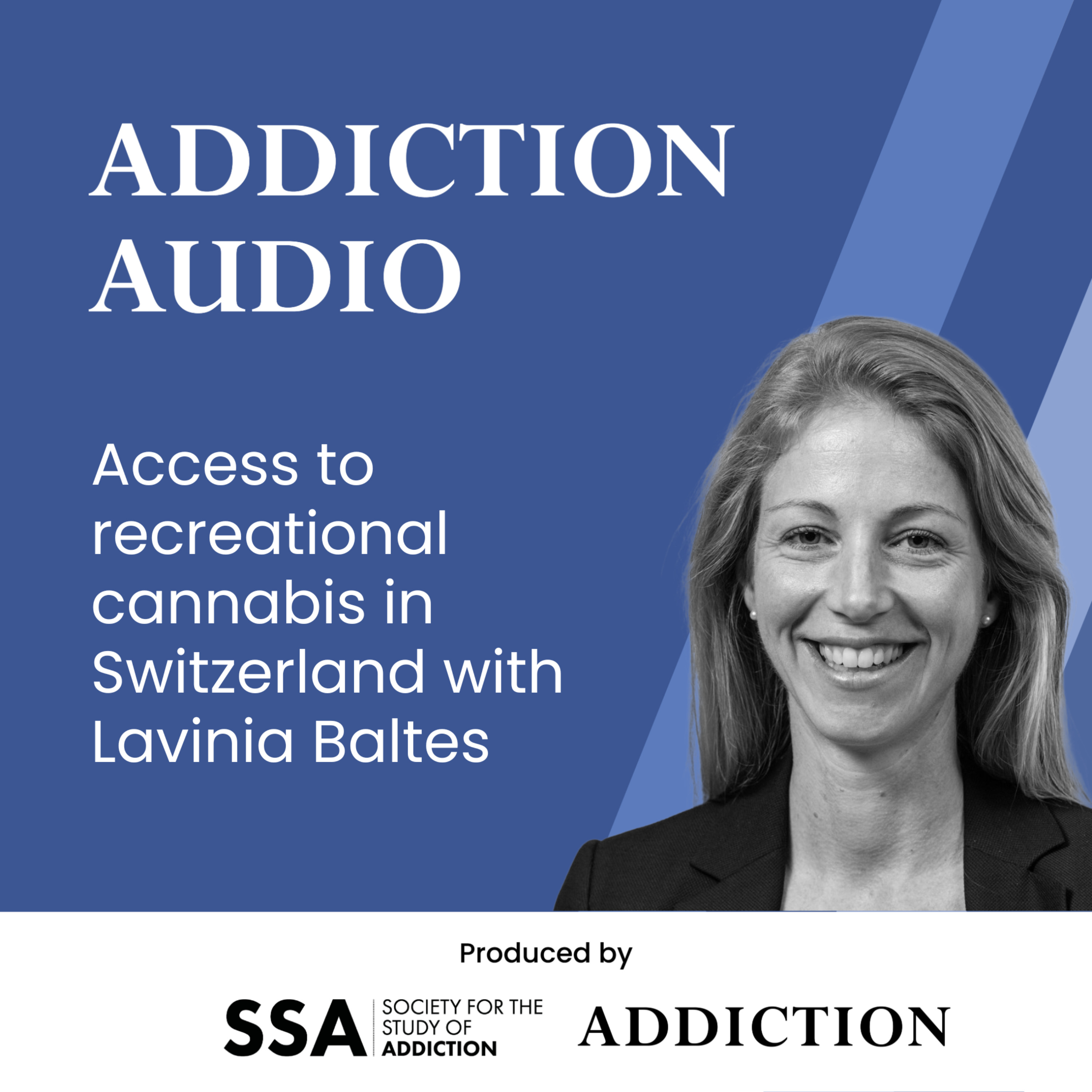
S3 Ep 11Access to recreational cannabis in Switzerland with Lavinia Baltes
In this episode, Dr Tsen Vei Lim talks to Dr Lavinia Baltes, Head of Research at the Clinic for Psychiatry and Psychotherapy, Psychiatric Services Aargau, Switzerland. The interview covers her research report on a randomised control trial of public health-oriented recreational cannabis access compared to illegal market access in Basel-Stadt, Switzerland. · The current legal landscape in Switzerland with respect to cannabis [01:12]· The difference between cannabis obtained legally and illegally [02:30]· The potential benefits of legal cannabis compared to illegal cannabis [03:25]· The key findings of the study [04:20]· Speculations about why the people who used drugs other than cannabis were more likely to reduce their cannabis use [05:31]· The findings that surprised the author [06:52]· How the findings contribute to policy or practice [07:37]· Could access to legal cannabis increase initiation among those who have never used cannabis? [08:32]· The importance of harm reduction strategies for cannabis [10:50]· The difficulties in conducting a randomised control trial [11:35]About Tsen Vei Lim: Tsen Vei is an academic fellow supported by the Society for the Study of Addiction, currently based at the Department of Psychiatry at the University of Cambridge. His research integrates computational modelling, experimental psychology, and neuroimaging to understand the neuropsychological basis of addictive behaviours. He holds a PhD in Psychiatry from the University of Cambridge (UK) and a BSc in Psychology from the University of Bath (UK). About Lavinia Baltes: Dr Baltes studied psychology at the University of Basel, Switzerland, and completed her PhD in health psychology at the University of Basel and at the Max Planck Institute in Berlin in 2015. She then worked at the University of Mannheim and later as deputy head of the Addiction Department of the Canton Basel-Stadt, contributing significantly to the ‘Weed Care’ study on regulated cannabis sales in Basel. Since 2022, she has been Head of Research at the Clinic for Psychiatry and Psychotherapy, Psychiatric Services Aargau, and continues as deputy study head of ‘Weed Care’.The authors have no conflicts of interest to disclose. Original article: Effects of legal access versus illegal market cannabis on use and mental health: A randomized controlled trial - https://doi.org/10.1111/add.70080The opinions expressed in this podcast reflect the views of the host and interviewees and do not necessarily represent the opinions or official positions of the SSA or Addiction journal.The SSA does not endorse or guarantee the accuracy of the information in external sources or links and accepts no responsibility or liability for any consequences arising from the use of such information. Hosted on Acast. See acast.com/privacy for more information.

S3 Ep 10Questionable generalisability of the AUDIT-C with Danilo Romero
In this episode, Dr Tsen Vei Lim talks to Dr Danilo Romero, a licensed clinical psychologist at the Stockholm Centre for Dependency Disorders in Sweden. The interview covers his research report on the questionable generalisability of the Alcohol Use Disorders Identification Test – Consumption (AUDIT-C) when used as an outcome measure in clinical trials than as a primary care screening tool, highlighting the need for researchers and clinicians to reconsider their application of the AUDIT-C. · What is the AUDIT-C and why it is widely used in primary care and research? [01:13]· What made the authors question the generalisability of the AUDIT-C in clinical trials? [02:02]· The risks of using the AUDIT-C in clinical settings [03:03]· The reason for the ‘ceiling effect’ of the AUDIT-C [04:21]· How the authors tested whether the AUDIT-C is useful in measuring treatment progress [05:15]· The key findings of the study [06:06]· What ‘collider bias’ is and how it could manifest in studies that use the AUDIT-C [06:59]· What the findings mean for studies that have used AUDIT-C in the past [09:23]· How the findings contribute to policy or practice [10:30]· Whether the authors, as clinical psychologists, personally use the AUDIT-C [11:28]· Birds eye view of psychiatric screening measures [12:40]About Tsen Vei Lim: Tsen Vei is an academic fellow supported by the Society for the Study of Addiction, currently based at the Department of Psychiatry at the University of Cambridge. His research integrates computational modelling, experimental psychology, and neuroimaging to understand the neuropsychological basis of addictive behaviours. He holds a PhD in Psychiatry from the University of Cambridge (UK) and a BSc in Psychology from the University of Bath (UK). About Danilo Romero: Dr Romero, PhD, is a licensed clinical psychologist at the Stockholm Centre for Dependency Disorders in Sweden. He recently completed his doctorate at Karolinska Institutet, conducting a multimethod project to improve treatment engagement for substance use disorders after acute-care episodes. More broadly, his research covers digital psychiatry, mental health informatics, psychometrics, and novel psychological interventions for substance use disorders.The authors have no conflicts of interest to disclose. Original article: Questionable generalizability of Alcohol Use Disorders Identification Test-Consumption scoring warrants caution when used for outcome monitoring: Evidence from simulated and real-world trial data - https://doi.org/10.1111/add.70074The opinions expressed in this podcast reflect the views of the host and interviewees and do not necessarily represent the opinions or official positions of the SSA or Addiction journal.The SSA does not endorse or guarantee the accuracy of the information in external sources or links and accepts no responsibility or liability for any consequences arising from the use of such information. Hosted on Acast. See acast.com/privacy for more information.
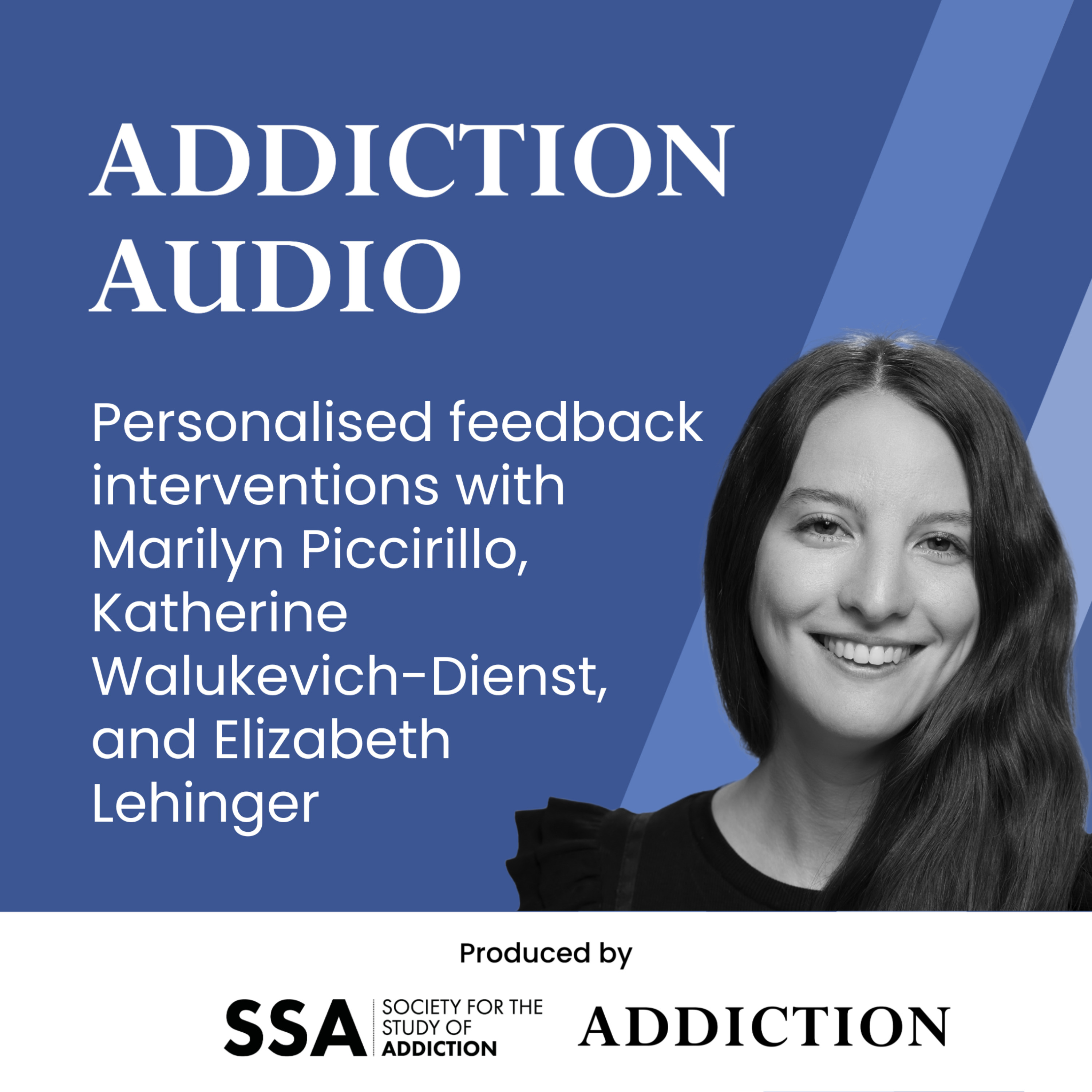
S3 Ep 9Personalised feedback interventions with Marilyn Piccirillo, Katherine Walukevich-Dienst, and Elizabeth Lehinger
In this episode, Dr Tsen Vei Lim talks to: Dr Marilyn Piccirillo from the Department of Psychiatry at Rutgers University-New Brunswick and Drs Katherine Walukevich-Dienst and Elizabeth Lehinger from the Department of Psychiatry and Behavioral Sciences at the University of Washington School of Medicine. The interview covers their research report on the longer-term efficacy of brief, alcohol-focused personalised feedback interventions among young adults in two universities on the West coast of the US. Note for listeners: The acronym PFI is used throughout this episode, which stands for ‘personalised feedback intervention’.· What is an alcohol-focused personalised feedback intervention? [01:48]· An example of how one of these interventions would work in practice [03:03]· The importance of considering distress [03:46]· The key findings of the study [07:24]· Why ‘less is more’ when it comes to alcohol interventions [12:19]· How the findings contribute to policy or practice [14:46]· The pioneers of personalised feedback interventions [17:41]About Marilyn Piccirillo: Dr Piccirillo is a licensed psychologist and an Assistant Professor in the Department of Psychiatry at Rutgers University-New Brunswick. She is also a Core Faculty member of the Rutgers Brain Health Institute and a member of the Rutgers Addiction Research Center. Dr Piccirillo uses person-centered frameworks to study motivating and maintenance factors for substance use problems, particularly for those experiencing co-occurring anxiety, trauma, and stress. She also examines how digital tools can be used to support treatment and recovery and optimise the design and delivery of treatments for substance use problems and addiction. About Katherine Walukevich-Dienst: Dr Walukevich-Dienst is a clinical psychologist and Assistant Professor in the Department of Psychiatry and Behavioral Sciences at the University of Washington. Her research focuses on developing and testing digital interventions to reduce substance use and improve mental health among young adults. She uses methods such as ecological momentary assessment to examine real-time behavior and intervention engagement. Dr Walukevich-Dienst has authored over 50 peer-reviewed publications and leads National Institutes of Health (NIH)-funded projects aimed at improving outcomes for cannabis and alcohol use through scalable, evidence-based approaches. About Elizabeth Lehinger: Dr Lehinger is an Acting Assistant Professor in the Department of Psychiatry and Behavioral Sciences at the University of Washington School of Medicine. She has two primary areas of research: 1) college student alcohol prevention, and 2) trauma recovery for individuals with co-occurring substance use disorders. Her research focuses on reward processes underlying these research areas. The authors have no conflicts of interest to disclose. Original article: Examining the longer-term efficacy of brief, alcohol-focused personalized feedback interventions for individuals with internalizing distress: Secondary analysis of a randomized controlled trial. https://doi.org/10.1111/add.70044 The opinions expressed in this podcast reflect the views of the host and interviewees and do not necessarily represent the opinions or official positions of the SSA or Addiction journal. The SSA does not endorse or guarantee the accuracy of the information in external sources or links and accepts no responsibility or liability for any consequences arising from the use of such information. Hosted on Acast. See acast.com/privacy for more information.
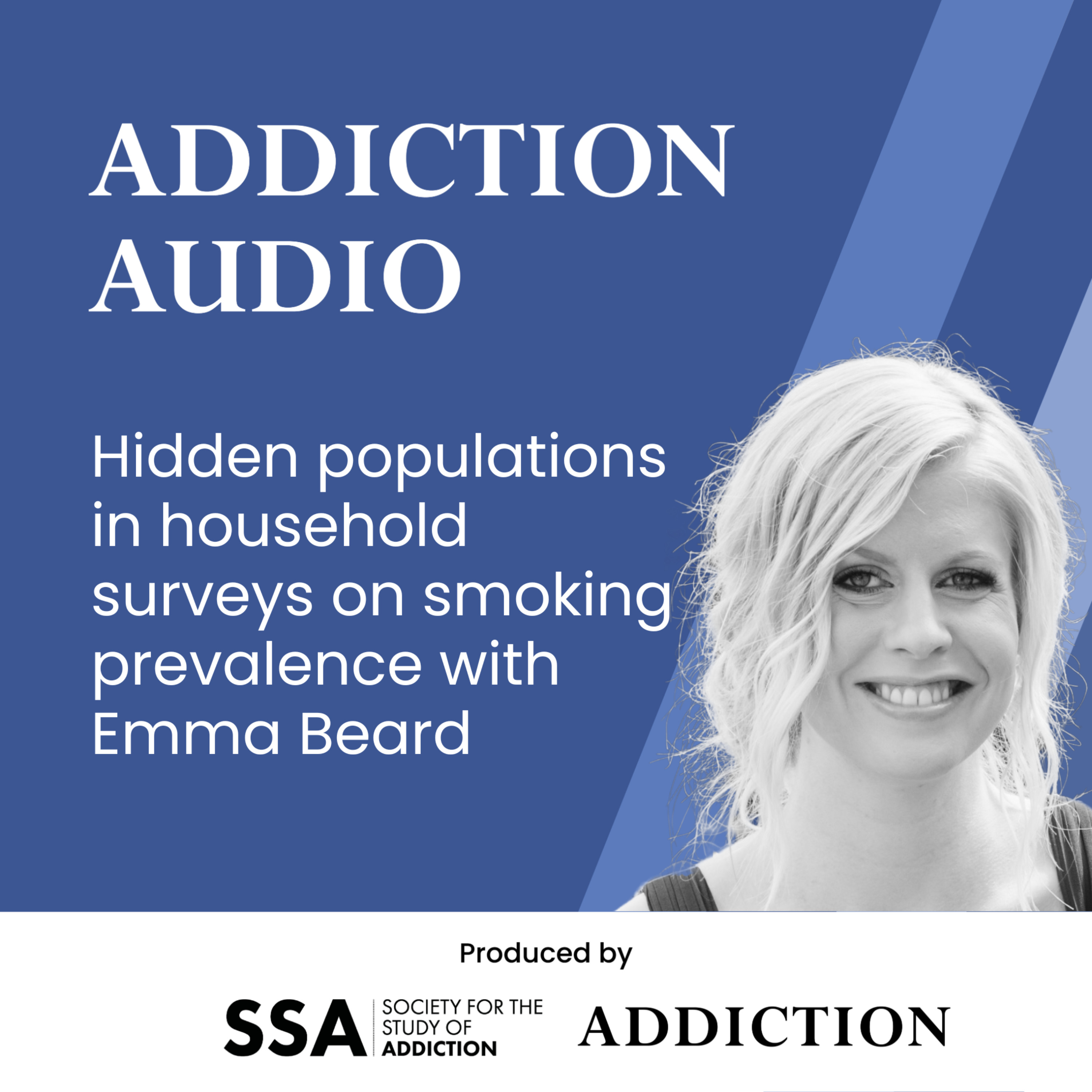
S3 Ep 8Hidden populations in household surveys on smoking prevalence with Emma Beard
In this episode, Dr Tsen Vei Lim speaks to Dr Emma Beard, a lecturer in statistics and quantitative methods at University College London. The interview covers Emma’s research report titled, ‘How much does the absence of the ‘hidden population’ from United Kingdom household surveys underestimate smoking prevalence?’· How we normally estimate the smoking prevalence reported in official statistics [01:28]· Why it is important to consider the hidden population [01:55]· The consequences of not taking into account the hidden population when estimating smoking prevalence [02:35]· The ‘workbook method’: how we estimate the hidden population [02:55]· The key findings and implications of these findings [03:30]· The size of the hidden population in the UK [04:42]· The huge undertaking of this research project to find these data [05:25]· The consideration of adolescent populations within smoking prevalence statistics [06:44]· What can be done within research to be more inclusive of hidden populations [07:52]· How Emma’s research can contribute to policy and practice [08:44]· The argument for more and better data to include hidden populations [10:00]In Emma’s paper, the hidden population for household surveys was defined as people from or living in communal establishments (e.g. care homes, student residence, prison), immigration detention centres, Gypsy, Roma and Travelling Communities, short-term accommodation, and those experiencing homelessness, including sofa surfing. About Emma Beard: Dr Beard is a Lecturer in Statistics and Quantitative Methods at University College London. She has over 130 publications on a variety of topics, with a key focus on tobacco harm reduction, high-risk alcohol consumption, and statistical methodology. Her research focuses on evaluating smoking cessation interventions and policies. She is a Deputy Methodological and Statistical Editor for the journal Addiction.About Tsen Vei Lim: Dr Tsen Vei Lim is an academic fellow supported by the Society for the Study of Addiction, currently based at the Department of Psychiatry at the University of Cambridge. His research integrates computational modelling, experimental psychology, and neuroimaging to understand the neuropsychological basis of addictive behaviours. He holds a PhD in Psychiatry from the University of Cambridge (UK) and a BSc in Psychology from the University of Bath (UK).Original editorial: How much does the absence of the ‘hidden population’ from United Kingdom household surveys underestimate smoking prevalence? https://doi.org/10.1111/add.70071 The opinions expressed in this podcast reflect the views of the host and interviewees and do not necessarily represent the opinions or official positions of the SSA or Addiction journal.The SSA does not endorse or guarantee the accuracy of the information in external sources or links and accepts no responsibility or liability for any consequences arising from the use of such information. Hosted on Acast. See acast.com/privacy for more information.
S3 Ep 7Publishing qualitative research in addiction with Jo Neale and Brian Kelly
In this episode, Dr Elle Wadsworth speaks to Professor Joanne Neale from the Addictions Department at King’s College London and Professor Brian Kelly from the Department of Sociology at Indiana University. The interview covers their editorial titled, ‘Over a decade later and Addiction journal is still committed to publishing qualitative research’. · The origins of the editorial and why it is needed [01:01]· The goal of the changes Addiction is implementing for qualitative submissions [01:44]· The importance of increasing the word limit to 6,000 words [02:49]· Whether similar journals in the addiction field struggle with low numbers of qualitative submissions [04:19]· The increase in qualitative editors at the Addiction journal since 2013 [05:52]· Finding consensus among a diversity of disciplines on the editorial board [07:21]· Semi-quantification over quantification in qualitative research [08:30]· What the authors hope to achieve with this editorial [09:36]· The take-home messages for qualitative researchers [11:04]About Professor Joanne Neale: Jo is Professor of Addictions Qualitative Research based within the National Addiction Centre at the Institute of Psychiatry, Psychology and Neuroscience, King’s College London, UK. She is also Conjoint Professor in the Centre for Social Research in Health at UNSW Sydney, Australia. Joanne trained in social work and is the Patient and Public Involvement and Engagement Lead for the UK NIHR Addictions Policy Research Unit. Her current research focuses largely on patient perceptions of treatments and interventions for alcohol and other drug use. In the last three years, Joanne Neale has received, through her university, research funding from Mundipharma Research Ltd and Camurus AB and honoraria from Camurus AB and Indivior for presentations.About Professor Brian Kelly: Brian is a Professor of Sociology at Indiana University and also Senior Research Program Leader at the Irsay Institute. His research examines social contextual influences on health, mainly focusing on substance use. His current research projects include the influence of policy contexts on youth substance use trajectories, sibling socialisation processes of adolescent substance use, and the impact of disasters on community drug-related outcomes.Original editorial: Over a decade later and Addiction journal is still committed to publishing qualitative research https://doi.org/10.1111/add.70047 Qualitative guidelines for Addiction: (1) https://doi.org/10.1111/add.12408 and (2) https://doi.org/10.1111/add.12857The opinions expressed in this podcast reflect the views of the host and interviewees and do not necessarily represent the opinions or official positions of the SSA or Addiction journal.The SSA does not endorse or guarantee the accuracy of the information in external sources or links and accepts no responsibility or liability for any consequences arising from the use of such information. Hosted on Acast. See acast.com/privacy for more information.
S3 Ep 6Identifying alcohol use disorder with James MacKillop
In this episode, Dr Tsen Vei Lim talks to Dr James MacKillop, a clinical psychologist and professor at McMaster University in Canada, and director for both the Peter Boris Centre for Addictions Research and the Michael G DeGroote Centre for Medicinal Cannabis Research. The interview covers his research report on the diagnostic validity of drinking behaviour for identifying alcohol use disorder (AUD) with findings from a representative sample of community adults and an inpatient clinical sample. · What alcohol use disorder is and how it is currently diagnosed [01:41]· The surprising exclusion of drinking behaviour in AUD diagnosis [03:03]· Unpacking ‘receiver operating characteristic curves’ [04:42]· The key findings of the study [05:45]· Whether James’ findings will change how we think about diagnosing AUD [07:35]· Why clinicians would benefit collecting how much people are drinking in one session [09:32]· Whether an indicator of heavy drinking would be helpful in treatment settings [10:35]· Bringing objective data into clinical application [12:09]· Whether we can use a similar metric to other drugs, such as cannabis [13:09]· What we can learn for policy and further research [15:56]· The barrier of the lack of biomarkers in alcohol use disorder [18:00]· The take-home message of the paper [19:40]About Tsen Vei Lim: Tsen Vei is an academic fellow supported by the SSA, currently based at the Department of Psychiatry at the University of Cambridge. His research integrates computational modelling, experimental psychology, and neuroimaging to understand the neuropsychological basis of addictive behaviours. He holds a PhD in Psychiatry from the University of Cambridge (UK) and a BSc in Psychology from the University of Bath (UK). About James MacKillop PhD, CPsych, FCAHS: Dr. MacKillop holds the Peter Boris Chair in Addictions Research and a Canada Research Chair in Translational Addiction Research at McMaster University and St. Joseph’s Healthcare Hamilton. There, Dr. MacKillop directs both the Peter Boris Centre for Addictions Research and the DeGroote Centre for Medicinal Cannabis Research. Dr. MacKillop trained as a clinical psychologist at Binghamton University and Brown University and studies addiction using a multidisciplinary approach, integrating psychology, economics, neuroscience, and genetics. James receives unrestricted research funding from Canadian Institutes on Health Research, the National Institutes of Health, and Correctional Services of Canada and am a senior scientist and principal in Beam Diagnostics, Inc., a technology transfer start-up company. The latter had no relationship to the publication in Addiction.Original article: Diagnostic validity of drinking behaviour for identifying alcohol use disorder: Findings from a representative sample of community adults and an inpatient clinical sample. https://doi.org/10.1111/add.70037The opinions expressed in this podcast reflect the views of the host and interviewees and do not necessarily represent the opinions or official positions of the SSA or Addiction journal. The SSA does not endorse or guarantee the accuracy of the information in external sources or links and accepts no responsibility or liability for any consequences arising from the use of such information. Hosted on Acast. See acast.com/privacy for more information.
S3 Ep 5Adolescent substance use in Africa with Sandra Jumbe and Chris Newby
In this episode, Dr Elle Wadsworth speaks to Dr Sandra Jumbe from the School of Social and Health Sciences at Millenium University in Malawi and the Wolfson Institute of Public Health Queen Mary, and Dr Chris Newby from the Medical School at the University of Nottingham. Sandra and Chris discuss their findings from a systematic review and meta-analysis on factors associated with adolescent substance use in Africa between 2000 and 2020. · What do we already know about adolescent use in Africa and why this review was needed [01:40]· The headline findings of the review [03:50]· What the consolidation of findings in this topic area will achieve [05:58]· The themes that came out of the ‘non-familial’ category of factors associated with adolescent substance use [09:00]· The main themes that came out of the ‘socioeconomic or environmental’ category of factors associated with adolescent substance use [10:05]· The regional differences in the drugs consumed across Africa [12:10]· What drugs are captured in standardised surveys [14:29]· The experience of doing systematic reviews and meta-analyses [15:20]About Sandra Jumbe: Dr Jumbe is a health psychologist currently working as a senior lecturer in research at Millennium University in Blantyre Malawi and a health researcher at the Wolfson Institute of Population Health at Queen Mary University of London. She is also an African Research Initiative for Scientific Excellence (ARISE) fellow with the African Academy of Sciences. She is an expert in behavioural science, enabling her to set the foundations for evidence-based work that informs development of effective interventions and policy decisions to improve human health. She has worked in both clinical and academic settings in primary care and mental health. Dr Jumbe’s long term aspiration is to expand understanding of global mental health and substance use, by advancing research niched on youth mental health in Africa, while training fellow young African scientists. She is also a mental health advocate, passionate about improving mental health literacy at grassroots level using community engagement and culturally sensitive approaches.About Chris Newby: Dr Newby is a senior medical statistician at the Research Knowledge Exchange, at the Medical School at the University of Nottingham. He has worked in NIHR Biomedical Research Units, Clinical Trial Units and is currently a senior quantitative advisor at the Research Support Service Leicester Hub and Partners. His interests are Respiratory, Mental Health and Equality Diversity and Inclusion in Health Research. Sandra, Chris nor Elle have any conflicts of interest to declare.Original article: A systematic review and meta-analysis of factors associated with adolescent substance use in Africa, 2000 to 2020: https://doi.org/10.1111/add.70023The opinions expressed in this podcast reflect the views of the host and interviewees and do not necessarily represent the opinions or official positions of the SSA or Addiction journal.The SSA does not endorse or guarantee the accuracy of the information in external sources or links and accepts no responsibility or liability for any consequences arising from the use of such information. Hosted on Acast. See acast.com/privacy for more information.
S3 Ep 4Nitazenes in wastewater with Richard Bade
In this episode, Dr Elle Wadsworth talks to Dr Richard Bade from Queensland Alliance for Environmental Health Sciences at the University of Queensland about his and his co-authors research report on the identification of nitazenes through wastewater analysis, using two-years of data from 22 countries. Richard discusses why a study detecting nitazenes in wastewater was needed and what the future for detecting nitazenes in wastewater looks like, including implications for policy and practice. · What is wastewater analysis and how we use it in the field of drugs [01:21]· What are nitazenes and why they are a problem [02:28]· Why a study detecting nitazenes in wastewater was needed [03:31]· Whether there is a demand for nitazenes [04:08]· How Richard and his team chose the eight nitazenes to study [05:05]· The headline findings of the paper [05:55]· Whether a lack of nitazenes in wastewater means that they aren’t there or they are in too low concentration to be found [08:16]· The benefits of wastewater analysis to detect nitazenes [09:37]· The surprisingly high level of nitazenes in Australia [10:37]· What we can learn for policy and practice [11:47]· The joy and difficulties working with many co-authors! [14:11]About Elle Wadsworth: Elle is an academic fellow with the Society for the Study of Addiction. She is based at the University of Bath with the Addiction and Mental Health Group and her research interests include drug policy, cannabis legalisation, and public health. Elle is also a senior analyst at RAND Europe, working on projects focusing on national and international drug policies. About Richard Bade: Dr Richard Bade is a Senior Research Fellow at the Queensland Alliance for Environmental Health Sciences (QAEHS) within The University of Queensland. He completed his PhD at the University Jaume I, Castellon, Spain in 2016 before moving to the University of South Australia in 2017 and QAEHS in 2021. He is interested in understanding links between environmental and community health using wastewater analysis. His particular research interests are associated with the surveillance, detection and identification of new psychoactive substances (NPS) in wastewater and other matrices as well as exploring the impact of chemical and pathogen exposure during mass gatherings. Dr Bade currently leads an expanding international consortium exploring the prevalence of NPS worldwide. These data can help provide insights into the emergence of new, potent NPS, and ensure that public harm from their exposure is minimized. Original article: Early identification of the use of potent benzylbenzimidazoles (nitazenes) through wastewater analysis: two-years of data from 22 countries. https://doi.org/10.1111/add.70027The opinions expressed in this podcast reflect the views of the host and interviewees and do not necessarily represent the opinions or official positions of the SSA or Addiction journal.The SSA does not endorse or guarantee the accuracy of the information in external sources or links and accepts no responsibility or liability for any consequences arising from the use of such information. Hosted on Acast. See acast.com/privacy for more information.
S3 Ep 3Communicating public health research with Sarah Jackson, Martin Jarvis and Robert West
In this episode, Dr Elle Wadsworth talks to three generations of tobacco/nicotine researchers: Dr Sarah Jackson and Emeritus Professors Martin Jarvis and Robert West, all from the Department of Behavioural Science and Health at University College London. They discuss a recent editorial, ‘The price of a cigarette: 20 minutes of life?’ – why the message resonated, what was and is difficult to convey in tobacco research, and how the media coverage has changed for tobacco research over the years. · What the editorial is about [00:56]· Why the editorial resonated with the public and the media [01:40]· What messages were difficult to convey to the public [03:05]· Why the number of ‘20 minutes of life’ has increased since the last estimate and why it is longer for women [07:43]· Choosing persuasive pieces and soundbites to communicate to the public [12:13]· The misinterpretation of research in the media and the difficulty in delivering nuance [14:08]· How the media coverage on tobacco and smoking has changed over the years [16:23]Dr Sarah Jackson is a Principal Research Fellow within UCL’s Tobacco and Alcohol Research Group. She has authored >100 peer-reviewed articles on nicotine and tobacco. Her research activity focuses primarily on modelling population trends in smoking, evaluating smoking cessation interventions and policies, and advancing the evidence base on vaping. She is President of SRNT Europe, Senior Editor for Addiction, and Social Media Editor for Nicotine & Tobacco Research. Martin Jarvis is Professor Emeritus of Health Psychology at the Department of Behavioural Science and Health, UCL, having for many years worked with Michael Russell’s smoking research group at the Institute of Psychiatry and then Cancer Research UK’s Health Behaviour Unit. He has researched and published widely on tobacco smoking, with special interests in the role of nicotine, social and family influences on smoking, smoking cessation methods and passive smoking. He was awarded an OBE in 2002.Robert West is Professor Emeritus of Health Psychology at UCL. He specialises in behaviour change and addiction. He is former Editor-in-Chief of Addiction, and has acted as an advisor to the English Department of Health on tobacco control and currently advises the Public Health Wales Behavioural Science Unit. He helped write the blueprint for the UK’s national network of stop-smoking clinics and is co-founder of the Capability-Opportunity-Motivation, Behaviour (COM-B) model of behaviour, the Behaviour Change Wheel framework for intervention development, and the PRIME Theory of motivation. Original article: The price of a cigarette: 20 minutes of life? https://doi.org/10.1111/add.16757 Authors praised the seminal work of the late Professor Michael Anthony Hamilton Russell (1932–2009). For further reading on the legacy of his landmark research, see here: https://doi.org/10.1111/add.14043The opinions expressed in this podcast reflect the views of the host and interviewees and do not necessarily represent the opinions or official positions of the SSA or Addiction journal. The SSA does not endorse or guarantee the accuracy of the information in external sources or links and accepts no responsibility or liability for any consequences arising from the use of such information. Hosted on Acast. See acast.com/privacy for more information.
S3 Ep 2Psychedelics to manage opioid use with Noa Krawczyk
In this episode, Dr Elle Wadsworth talks to Dr Noa Krawczyk from the Department of Population Health at NYU Grossman School of Medicine about her and her co-authors research report on self-reported experiences and perspectives on using psychedelics to manage opioid use among participants of two Reddit communities. Noa discusses the current treatments available for opioid use disorder and why psychedelics are having their moment as an alternative medicine, and what people who use opioids found when taking psychedelics with the intention of reducing or stopping their opioid use. · What is Reddit and why is Noa using it to answer her research questions [01:24]· The headline findings of the study [02:17]· The comparison of demographics of Reddit and the wider population of people who use opioids [03:46]· What the current treatments are for opioid use disorder in the US and why people are seeking alternatives [05:22]· Why Ibogaine stands out as a prominent psychedelic in the discussion [08:12]· The mechanisms of action found in the analysis [09:45]· The benefits and drawbacks of using psychedelics [13:26]· What we can take from the paper for policy and practice [15:28]About Elle Wadsworth: Elle is an academic fellow with the Society for the Study of Addiction. She is based at the University of Bath and her research interests include drug policy, cannabis legalisation, and public health. Elle is also a senior analyst at RAND Europe, working on projects focusing on national and international drug policies. About Noa Krawczyk: Noa Krawczyk, PhD, is an assistant professor in the Department of Population Health at NYU Grossman School of Medicine and Associate Director of the NYU Langone Center for Opioid Epidemiology and Policy. Her research focuses on studying ways to address barriers to evidence-based treatment for opioid use disorder at the individual, program, and policy levels. Her work centers on bridging research and practice by collaborating with drug user organizations, health system leaders, public health and government agencies, and advancing science that can help inform evidence-based policies and practices that reduce harm and promote well being.About co-author Megan Miller: Megan Miller, MPH, is a Research Coordinator in the Center for Opioid Epidemiology and Policy at NYU Grossman School of Medicine and served as the primary data analyst for the Reddit study. She holds an MPH from the University of North Carolina at Chapel Hill. NK receives fees as an expert witness in ongoing opioid litigation. MM has no conflicts of interest to declare.Original article: Self-reported experiences and perspectives on using psychedelics to manage opioid use among participants of two Reddit communities https://doi.org/10.1111/add.16767 The opinions expressed in this podcast reflect the views of the host and interviewees and do not necessarily represent the opinions or official positions of the SSA or Addiction journal. The SSA does not endorse or guarantee the accuracy of the information in external sources or links and accepts no responsibility or liability for any consequences arising from the use of such information. Hosted on Acast. See acast.com/privacy for more information.
S3 Ep 1Alcohol and the pleasure of intoxication with James Nicholls
In this episode, Dr Elle Wadsworth talks to Dr James Nicholls from the University of Stirling about an opinion paper he co-authored with Professor Geoffrey Hunt on whether pleasure should receive more attention in public health-oriented alcohol research. They discuss what alcohol researchers and public health professionals can learn about ‘intoxication and pleasure’ from drug research, the different ways that the pleasure of drinking is made more socially acceptable, and what more research on pleasure could do for policy and practice. · Why public health research has historically not explored the pleasure of alcohol intoxication [01:04]· Why this is an important topic to raise with the public health research community now [02:58]· Clarifying what type of pleasure is most neglected [04:55]· Measuring intoxication as pleasure and recognising the limitations of our methodologies [06:50]· Three broad reasons why additional attention should be paid to intoxication as pleasure [08:46]· What learning more about the pleasure of intoxication means for policy and practice [12:06]· The anticipation of publishing an opinion piece for debate [14:28]About Elle Wadsworth: Elle is an academic fellow with the Society for the Study of Addiction. She is based at the University of Bath with the Addiction and Mental Health Group and her research interests include drug policy, cannabis legalisation, and public health. Elle is also a senior analyst at RAND Europe, working on projects focusing on national and international drug policies. She holds a PhD in public health and health systems from the University of Waterloo (Canada), an MSc in addiction studies from King's College London (UK), and a BSc in chemistry from the University of Bristol (UK).About James Nicholls: James is a Senior Lecturer in Public Health at the University of Stirling, specialising in alcohol and drug policy research. Recent projects include leading a needs assessment for a safer drug consumption facility in Edinburgh, and a statutory review of the alcohol licensing system in Northern Ireland. He has also published recently on moral philosophy and drug policy advocacy. James was previously Director of Research and Policy at Alcohol Change UK, and Chief Executive Officer of Transform Drug Policy Foundation. James has no conflicts of interest to declare.Original article: Taking pleasure seriously: Should alcohol research say more about fun? https://doi.org/10.1111/add.16747 The opinions expressed in this podcast reflect the views of the host and interviewees and do not necessarily represent the opinions or official positions of the SSA or Addiction journal. The SSA does not endorse or guarantee the accuracy of the information in external sources or links and accepts no responsibility or liability for any consequences arising from the use of such information. Hosted on Acast. See acast.com/privacy for more information.
S2 Ep 38Young people and disposable e-cigarettes with David Hammond
In this episode Dr Elle Wadsworth talks to Professor David Hammond about vaping. They discuss policy differences between the Canada, the UK and the US as well as changes relating to disposable vapes and the use of nicotine salts. They cover the environmental impact of some of these products before talking about the different choices available to policymakers when developing regulations. “What the change has meant in England is that there’s probably more room for regulating some of these [vaping] products without undermining their use as a cessation aid”Original article: Use of disposable e-cigarettes among youth who vape in Canada, England, and the United States: repeat cross-sectional surveys, 2017-2023 by David Hammond and colleagues. Published in Addiction (2024). The opinions expressed in this podcast reflect the views of the host and interviewees and do not necessarily represent the opinions or official positions of the SSA or Addiction journal.The SSA does not endorse or guarantee the accuracy of the information in external sources or links and accepts no responsibility or liability for any consequences arising from the use of such information. Hosted on Acast. See acast.com/privacy for more information.
S2 Ep 37Opioids, cancer and mortality with Aleksi Hamina
In this episode Ben Scher talks to Dr Aleksi Hamina from the Norwegian centre for addiction research at the University of Oslo and the Niuvanniemi Hospital in Finland. They discuss a recent paper co-authored by Dr Hamina in which the team matched large national datasets to identify excess mortality among people who use drugs that can be attributed to cancers. They found increases in incidences and mortality according to liver, lung, larynx and pancreas cancers.They highlight the impact of smoking, alcohol use and hepatitis, and discuss the policy implications of knowing the impact that these issues have on the mortality of people who use drugs. These include ensuring good access to healthcare and reviewing the thresholds for onwards referral when symptoms of cancer are identified. “There is a more than twofold relative increase in cancer mortality in this population”Original article: Increased cancer incidence and mortality among people with opioid use-related disorders: A nation-wide cohort study by Emil Kostovski and colleagues. Published in Addiction (2024). The opinions expressed in this podcast reflect the views of the host and interviewees and do not necessarily represent the opinions or official positions of the SSA or Addiction journal.The SSA does not endorse or guarantee the accuracy of the information in external sources or links and accepts no responsibility or liability for any consequences arising from the use of such information. Hosted on Acast. See acast.com/privacy for more information.
S2 Ep 36Cannabis potency and psychotic experiences with Lindsey Hines
In this episode, Dr Rob Calder talks to Dr Lindsey Hines about her study using longitudinal data to examine links between cannabis use, cannabis potency and psychotic experiences. Dr Hines talks about using Avon Longitudinal Study of Parents and Children (ALSPAC) data - also known as 'Children of the Nineties' and discusses why psychosis and cannabis potency are important to measure and some of the challenges of doing so with both."In unregulated markets like the UK where it's illegal to use cannabis....better health messaging and better awareness among those using cannabis of those potential outcomes is the way that we can go".Original article: Incident psychotic experiences following self-reported use of high-potency cannabis: Results from a longitudinal cohort study by Lindsey A. Hines and colleagues. Published in Addiction (2024)Also in this podcast: Testing the validity of national drug surveys: comparison between a general population cohort and household surveys by Hannah Charles and colleagues. Published in Addiction (2021)The opinions expressed in this podcast reflect the views of the host and interviewees and do not necessarily represent the opinions or official positions of the SSA or Addiction journal.The SSA does not endorse or guarantee the accuracy of the information in external sources or links and accepts no responsibility or liability for any consequences arising from the use of such information. Hosted on Acast. See acast.com/privacy for more information.
S2 Ep 35Cannabis use in the US with Jonathan Caulkins
In this episode Dr Elle Wadsworth talks to Professor Jonathan Caulkins about self-reported cannabis use in the US between 1979 and 2022 and how those trends compare with alcohol use over the same period. The research focused on four specific time points, measuring cannabis prevalence against US policy changes. Dr Wadsworth and Professor Caulkins then talk about differences between cannabis and alcohol as intoxicants and the impact that cannabis regulations have on cannabis use and the intensity of cannabis use.Professor Caulkins also discusses the limitations of self-report when it comes to substance use, and how this is amplified when asking people about the impact that substance use is having on them and their families. He suggests instead asking people how other people’s substance use is affecting them in order to estimate harms from cannabis use.“Back in 1992 it [cannabis] was essentially a recreational or party drug, sort of a weekend activity and now it has morphed into something that is part of the daily routine for about 40% of its current users.” Original article: Changes in self-reported cannabis use in the United States from 1979 to 2022 by Jonathan Caulkins and colleagues. Published in Addiction (2024)The opinions expressed in this podcast reflect the views of the host and interviewees and do not necessarily represent the opinions or official positions of the SSA or Addiction journal.The SSA does not endorse or guarantee the accuracy of the information in external sources or links and accepts no responsibility or liability for any consequences arising from the use of such information. Hosted on Acast. See acast.com/privacy for more information.
S2 Ep 34Integrated care vans with Kathleen Page
In this episode, Ben Scher talks to Dr Kathleen Page about her evaluation of an integrated care van that ran in Baltimore offering healthcare interventions and buprenorphine prescribing. Dr Page discusses using a cluster randomised trial to compare outcomes in different neighbourhoods (those where the van did and didn't go) and to explore whether the van was effective at improving health outcomes for people who inject drugs.Dr Page also talks about the impact of COVID-19 on the research as well as the specific needs of people who accessed the van."When you go out on the van you really are serving a different group, a much more under-served group of people who generally mistrust or don't access the health system unless it's an emergency."Original article: Integrated care van delivery of evidence-based services for people who inject drugs: A cluster-randomized trial by Kathleen Page and colleagues. Published in Addiction (2024)The opinions expressed in this podcast reflect the views of the host and interviewees and do not necessarily represent the opinions or official positions of the SSA or Addiction journal.The SSA does not endorse or guarantee the accuracy of the information in external sources or links and accepts no responsibility or liability for any consequences arising from the use of such information. Hosted on Acast. See acast.com/privacy for more information.
S2 Ep 33Smoking and abdominal obesity with Germán Carrasquilla
In this episode Rob Calder talks to Dr Germán Carrasquilla about his study assessing whether smoking cased increases in abdominal obesity or belly fat. They discuss the implications of this kind of fat and note the importance of the findings for people who struggle to quit smoking. Germán talks about using Mendelian randomisation to identify a causal association between smoking and abdominal obesity. The findings, that 'smoking initiation and higher lifetime smoking may lead to increased abdominal fat', add evidence and important detail to the known health benefits of quitting smoking."People who might be afraid of quitting smoking due to putting on weight find these findings motivating to quit smoking because smoking increases this problematic internal fat which is a risk factor for many other diseases like diabetes, cardiovascular disease."Original article: Estimating causality between smoking and abdominal obesity by Mendelian randomization by Germán Carrasquilla and colleagues. Published in Addiction (2024)The opinions expressed in this podcast reflect the views of the host and interviewees and do not necessarily represent the opinions or official positions of the SSA or Addiction journal.The SSA does not endorse or guarantee the accuracy of the information in external sources or links and accepts no responsibility or liability for any consequences arising from the use of such information. Hosted on Acast. See acast.com/privacy for more information.
S2 Ep 31Benzodiazepines and treatment with Adam Bakker, Michael Liebrenz and Alexander Smith
In this episode Ben Scher talks to Dr Adam Bakker, Professor Michael Liebrenz and Dr Alexander Smith about their commentary in response to a previous paper by Domzaridou and colleages (2023). They discuss the complexities of providing treatment for people who use, and are prescribed, opiates, opiate agonist medications and benzodiazepines. They talk about using a combination of medical and non-medical treatments when working with people who use benzodiazepines as well as the research needed to bring clarity to this pressing clinical issue."This population is notoriously difficult to engage, but we should go the extra mile to retain them in treatment because of this high mortality."Original Article: Comment on Domzaridou et al.: Recognising the complexities of co-prescriptions and lifestyle factors in opioid agonist treatment by Adam Bakker and colleagues. Published in Addiction (2024).The opinions expressed in this podcast reflect the views of the host and interviewees and do not necessarily represent the opinions or official positions of the SSA or Addiction journal.The SSA does not endorse or guarantee the accuracy of the information in external sources or links and accepts no responsibility or liability for any consequences arising from the use of such information. Hosted on Acast. See acast.com/privacy for more information.
S2 Ep 32Contingency management with Gabriela Khazanov, James, McKay and Richard Rawson
In this episode, Ben Scher talks to Dr Gabriela Khazanov, Professor James McKay and Professor Richard Rawson. They discuss what contingency management is and how effective it can be in treatment settings. They also talk about how contingency management can be used for stimulant use disorders; an area where there are relatively few evidence-based treatments.the team goes on to discuss implementation of contingency management in the US and the barriers faced by practitioners such as predominant ethical concerns. They also cover how attitudes towards contingency management have changed over the past decade. The paper that was published in Addiction looked at ways to improve dissemination and implementation of contingency management.Often patients are not able to re-engage in contingency management if they drop out or they’re not allowed to repeat contingency management. And all of that was done to prevent fraud and waste and those kinds of concerns. But we don’t limit other kinds of treatment. We don’t limit behavioural therapy, typically we don’t limit the ability to take medications that could potentially be effective. Original article: Should contingency management protocols and dissemination practices be modified to accommodate rising stimulant use and harm reduction frameworks? by Gabriele Khazanov and colleagues. Published in Addiction (2024). The opinions expressed in this podcast reflect the views of the host and interviewees and do not necessarily represent the opinions or official positions of the SSA or Addiction journal.The SSA does not endorse or guarantee the accuracy of the information in external sources or links and accepts no responsibility or liability for any consequences arising from the use of such information. Hosted on Acast. See acast.com/privacy for more information.
S2 Ep 30Xylazine, heroin and drug markets with Caroline Copeland
In this episode Ben Scher talks to Dr Caroline Copeland about her work analysing drug death data to identify drug use trends, harms and to inform policy. Caroline talks about how xylazine first entered the US drug market but has been increasingly identified in Europe and the UK, even being identified in vapes sold as containing tetrahydrocannabinol (THC). Caroline covers the harms from xylazine and the implications for public health practitioners before relating the UK issues to wider global drug markets."The other really nasty thing that xylazine does is that it can cause blood vessels to contract, and our tissues need blood.....to survive, and if we're closing off those blood vessels, that tissue is going to die and it's going to turn into sores on your skin. And if they get infected it can lead to amputation"Dr Caroline Copeland is a senior lecturer in pharmacology and toxicology at King’s College London and the director of the National Programme on Substance Use Mortality.Original article: Broad evidence of xylazine in the UK illicit drug market beyond heroin supplies, triangulating from toxicology, drug testing and law enforcement by Caroline Copeland and colleagues. Published in Addiction (2024)The opinions expressed in this podcast reflect the views of the host and interviewees and do not necessarily represent the opinions or official positions of the SSA or Addiction journal.The SSA does not endorse or guarantee the accuracy of the information in external sources or links and accepts no responsibility or liability for any consequences arising from the use of such information. Hosted on Acast. See acast.com/privacy for more information.
S2 Ep 29Synthetic opioid production in Europe with Paul Griffiths
In this episode, Dr Elle Wadsworth talks to Paul Griffiths about synthetic drug production in Europe including the differences between lab-made substances and diverted medical drugs. They discuss organised crime and its impact on cocaine production, drug availability and the potential for drug contamination. They also cover fentanyl and the potential for a heroin drought resulting from changes in opium production in Afghanistan.Paul talks about the complexities of European drug markets explaining how they commonly respond to changes in both supply and demand. Elle and Paul then discuss how researchers can monitor drug trends through wastewater analysis and other methods.“These are often very small labs, but because of the potency of these drugs, it means very small production runs can have quite a big impact on local drug consumption patterns and mortality and morbidity. So we saw a few years ago, ten or fifteen years, one lab in central Europe we had a very brief outbreak of deaths in about three countries all related to a very very small, a kitchen lab it was actually in someone’s kitchen but it had an impact.”Paul Griffiths is the scientific director for the EMCDDA – the European Monitoring Centre for Drugs and Drug AddictionOriginal article: Opioid problems are changing in Europe with worrying signals that synthetic opioids may play a more significant role in the future by Paul Griffiths and colleagues. Published in Addiction (2024)The opinions expressed in this post reflect the views of the host and interviewees and do not necessarily represent the opinions or official positions of the SSA or Addiction journal.The SSA does not endorse or guarantee the accuracy of the information in external sources or links and accepts no responsibility or liability for any consequences arising from the use of such information. Hosted on Acast. See acast.com/privacy for more information.
S2 Ep 28Alcohol-free drinks in the US with Molly Bowdring
In this episode Dr Merve Mollaahmetoglu talks to Dr Molly Bowdring about her recent article on the impact of alcohol-free drinks such as zero-percent beers, wines and mocktails. Molly talks about using survey data to explore different patterns, such as using non-alcoholic drinks to slow alcohol consumption, to alternate days or as part of someones recovery. Merve and Molly discuss the occasional differences between how people think non-alcoholic drinks change their alcohol consumption and what actually happens to their overall use.If you're somebody who already uses them, be reflective about how is this impacting your desire for alcohol and your consumption in that same night or across the week and just be curious about the relation between your non-alcoholic beverage use and your alcohol use.Original article: Non-alcoholic beverage consumption among US adults who consume alcohol by Molly Bowdring and colleagues. Published in Addiction (2024)The opinions expressed in this post reflect the views of the host and interviewees and do not necessarily represent the opinions or official positions of the SSA or Addiction journal.The SSA does not endorse or guarantee the accuracy of the information in external sources or links and accepts no responsibility or liability for any consequences arising from the use of such information. Hosted on Acast. See acast.com/privacy for more information.
S2 Ep 27Gambling advertising with Philip Newall
In this episode, Rob Calder talks to Dr Philip Newall about how the gambling industry frames the evidence on gambling advertising. Philip talks about researching the kinds of bets that are commonly advertised, explaining how they are often projected to be 'good' bets when the chances of winning are very small. "It's really got the two sides of the coin there in that it appears really attractive, but actually it's the bookmaker that's really winning the most. And that's the underlying psychology in how they're able to offer things that seem good but are actually really profitable for them."Philip also talks about how difficult it can be corralling 50 people into co-writing a short letter.Dr Philip Newall is a lecturer in psychological science at the University of Bristol, a member of the Advisory Board for Safer Gambling (although speaking on this podcast in an independent capacity) and the joint winner of the Society for the Study of Addiction’s Impact Prize in 2023.Original article: No evidence of harm’ implies no evidence of safety: Framing the lack of causal evidence in gambling advertising research by Philip Newall and colleagues. Published in Addiction (2023)The opinions expressed in this post reflect the views of the host and interviewees and do not necessarily represent the opinions or official positions of the SSA or Addiction journal.The SSA does not endorse or guarantee the accuracy of the information in external sources or links and accepts no responsibility or liability for any consequences arising from the use of such information. Hosted on Acast. See acast.com/privacy for more information.
S2 Ep 26Addiction and definitions with Robert West
In this episode Zoe Swithenbank talks to Professor Robert West about his work on ontologies within addictions. Robert begins by summarising the definitions and constructions that relate to addiction, as well as their meanings and the implications for treatment. He also explains how different definitions can frustrate progress in addiction-related research.Zoe and Robert then discuss how the addictions sector can learn from other sciences - particularly the biological sciences - about how to use those definitions, labels and ontologies to aid research. Robert covers the work on AddictO Vocab (https://addictovocab.org/) and explains the goal to develop a well-defined construct for anything that anyone might want to refer to in a research paper."Ontologies are very specific ways of representing the world that have been developed primarily for use in computer science and data science.... They are very formal systems for representing things called entities. Entities are literally anything you can imagine whether it's real or not real. So 'unicorn' for example, can be an entity for example, as can 'addiction' - as can 'horse'."Original article: Achieving consensus, coherence, clarity and consistency when talking about addiction by Robert West and colleagues. Published in Addiction (2023)The opinions expressed in this post reflect the views of the host and interviewees and do not necessarily represent the opinions or official positions of the SSA or Addiction journal.The SSA does not endorse or guarantee the accuracy of the information in external sources or links and accepts no responsibility or liability for any consequences arising from the use of such information. Hosted on Acast. See acast.com/privacy for more information.
S2 Ep 25Nitrous oxide, addiction and substance use disorder with Sammie Back and Emese Kroon
In this episode Dr Elle Wadsworth talks to Sammie Back and Emese Kroon about nitrous oxide. The discussion happened on 8 November 2023, on the day that possession of nitrous oxide became a Class C substance in the UK. The group discuss the existing evidence for harms, addiction and other disorders, exploring this relatively under-researched area. They cover the lack of research and how researchers can begin to understand what's happening when a drug's popularity rapidly increases. They also talk about how people use nitrous oxide and in which circumstances use might be more likely. Finally, they relate nitrous oxide against criteria for substance use disorders taken from DSM-5 and discuss the implications from their findings. "We just need more data.... For a drug used this regularly, it's honestly quite astounding that we have so little scientific evidence to inform the public also healthcare professionals and policy makers." Emese KroonOriginal article: Does nitrous oxide addiction exist? An evaluation of the evidence for the presence and prevalence of substance use disorder symptoms in recreational nitrous oxide users by Sammie Back and colleagues. Published in Addiction (2023) The opinions expressed in this podcast reflect the views of the host and presenters and do not necessarily represent the opinions or official positions of the SSA or Addiction journal.The SSA does not endorse or guarantee the accuracy of the information in external sources or links and accepts no responsibility or liability for any consequences arising from the use of such information. Hosted on Acast. See acast.com/privacy for more information.
S2 Ep 24Pregnancy and opioids with Jerry Cochran
In this episode Ben Scher talks to Professor Gerald (Jerry) Cochran about his article based on a randomized multisite pilot trial investigating the impact of Patient Navigation. Jerry begins by describing Patient Navigation, explaining how it works and how it can help people stay engaged in care. The research team explored whether this approach helps pregnant people to stay in contact with treatment services.Jerry then go on to discus the next steps for his research and explains how his research findings might be scaled up to influence policy. Jerry describes how Patient Navigation could be implemented within US Medicaid programmes summarising the data that would be needed to scale up the intervention. They then reflect on the economic implications for Medicade or state insurers."That's really exiting and it's really satisfying when you're able to identify a partner like a Medicaid programme or a large pharmacy chain.... and help them integrate into their workflow into their systems something that might help patients and think 'oh wow'. You know, not only could we help patients in a single clinic but we could help people in a state or across the country"Original article: Patient Navigation for Pregnant Persons with Opioid Use Disorder: Results of a Randomized Multisite Pilot Trial by Gerald Cochran and colleagues. Published in Addiction (2023)The opinions expressed in this podcast reflect the views of the hosts and authors and do not necessarily represent the opinions or official positions of the SSA or Addiction journal.The SSA does not endorse or guarantee the accuracy of the information in external sources or links and accepts no responsibility or liability for any consequences arising from the use of such information. Hosted on Acast. See acast.com/privacy for more information.
S2 Ep 23Minimum unit pricing and road traffic accidents with Francesco Manca
In this episode Rob Calder talks to Francesco Manca about his research on Scotland's Minimum Unit Pricing (MUP) policy for alcohol, and specifically about the impact that MUP has had on road traffic accidents. Francesco discusses how the research team selected appropriate comparitors to assess whether changes to road traffic accidents could be attributed to MUP. He also talks about how this study compares with previous studies that used similar datasets yet drew different conclusions. He describes how understanding the subtle differences between time frames and outcomes can aid researchers to gain an in-depth understanding of alcohol regulation. "The original 50 pence as a floor price .... maybe too low over the years as it can be eroded by external factors such as inflation - so maybe indexing with inflation may create a more consistent effect of the policy over time"Original article: Evaluating the impact of minimum unit pricing for alcohol on road traffic accidents in Scotland after 20 months: an interrupted time series study by Francesco Manca and colleagues. Published in Addiction (2023)The opinions expressed in this podcast reflect the views of the presenter and interviewee and do not necessarily represent the opinions or official positions of the SSA.The SSA does not endorse or guarantee the accuracy of the information in external sources or links and accepts no responsibility or liability for any consequences arising from the use of such information. Hosted on Acast. See acast.com/privacy for more information.
S2 Ep 22Mental health and social care with Amy O'Donnell and Kat Jackson
In this episode, Zoe Swithenbank talks to Drs Amy O'Donnell and Kat Jackson about their recent study on how to improve care for people with coexisting heavy drinking and depression. The discuss the theoretical concept of Relational Autonomy and how it influenced their research. Amy and Kat describe how they set up the research, and in particular the challenges of recruiting participants from groups where your research is not their priority. They also talk about how much work it takes to conduct effective PPI (Patient and Public Involvement) and how important it is to do it well. They then go through their findings, discussing how they can inform theory and clinical practice: "A lot of people who we spoke to literally didn't have anybody. They'd been turned away from every formal health and social care service that they needed to access and they also didn't have any family relationships or friendships for various reasons. How are you supposed to get better if you don't have those?" Original article: Understanding people's experiences of the formal health and social care system for co-occurring heavy alcohol use and depression through the lens of relational autonomy: A qualitative study by Katherine Jackson and colleagues. Published in Addiction (2023)The opinions expressed in this podcast reflect the views of the interviewer and interviewees and do not necessarily represent the opinions or official positions of the SSA.The SSA does not endorse or guarantee the accuracy of the information in external sources or links and accepts no responsibility or liability for any consequences arising from the use of such information. Hosted on Acast. See acast.com/privacy for more information.
S2 Ep 21Smoking cessation trials with Zoe Swithenbank
In this episode, Rob Calder talks to Zoe Swithenbank about her recent article looking at how to improve research reports on smoking cessation trials. Zoe talks about the challenges of organising an international meeting of experts before the COVID-19 pandemic (before people were used to online working). She talks about some common errors and omissions that researchers make when reporting smoking cessation trials and how these can place limits on scientific progress. She talks about developing the CONSORT-SPI tool to help improve the ability of researchers to draw conclusions across studies."It was important to get that balance and try and get a good range, and we did have quite a variety of people...different backgrounds, different expertise which made for some interesting debates."Original article: Tailoring CONSORT-SPI to improve the reporting of smoking cessation intervention trials: An expert consensus study by Zoe Swithenbank and colleagues. Published in Addiction (2023) Hosted on Acast. See acast.com/privacy for more information.
S2 Ep 20Drug Consumption rooms with Laurence Lalanne
In this episode Ben Scher talks to Professor Laurence Lalanne about drug consumption rooms and the recent publication based on the COSINUS cohort study. They cover the range of interventions available in drug consumption rooms and how they can increase people's access to psychiatric support alongside barriers to accessing drug consumption rooms. Laurence talks about the epidemiological point of view in relation to the more biomedical aspects of drug consumption rooms, their objectives in reducing overdose and their impact on hospitals and the wider health-care system. "You need a very long follow-up....we need to follow for two years and three years to show important results about mental health and to see how they improve their well-being and access to other care."This is the second of a two-part podcast. The first, featuring Dr Marie Jauffret-Roustide, can be found here.Original article: Drug consumption rooms are effective to reduce at-risk practices associated with HIV/HCV infections among people who inject drugs: Results from the COSINUS cohort study by Laurence Lalanne and colleagues. Published in Addiction (2023). Hosted on Acast. See acast.com/privacy for more information.
S2 Ep 19Drug consumption rooms with Marie Jauffret-Roustide
In this episode Ben Scher talks to Dr Marie Jauffret-Roustide about drug consumption rooms and the recent publication based on the COSINUS cohort study. They cover a range of issues including the history of drug consumption rooms, the evidence on effectiveness and the challenges of studying this particular intervention.They also reflect on the social determinants of health and how drug consumption rooms can have a positive impact"We have 1% of people who attend drug consumption rooms who declared having ever shared injecting equipment in the last month before the interviews compared to 11% for people who were not exposed to drug consumption rooms"This is the first of a two-part podcast. The second, featuring Professor Laurence Lalanne can be found here.Original article: Drug consumption rooms are effective to reduce at-risk practices associated with HIV/HCV infections among people who inject drugs: Results from the COSINUS cohort study by Laurence Lalanne and colleagues. Published in Addiction (2023). Hosted on Acast. See acast.com/privacy for more information.
S2 Ep 18Drones delivering Naloxone with Caroline Copeland, Patrick Courtney and Paul Royall
In this episode, Rob Calder talks to Drs Caroline Copeland, Patrick Courtney and Paul Royall about their recent article assessing the time it would take for drones to deliver naloxone to people who are overdosing on opioids. The study team used NPSAD (National Programme on Substance Abuse Deaths) data to map out overdoses in Teeside over recent years and then to predict how long it would have taken a drone to make the journey and deliver naloxone to a bystander who would then be able to administer it. They then compared this time with the time it takes ambulances to attend the scene. Along the way they discuss take off stations, weather, traffic congestion, no-fly zones and the importance of considering whether a drone will be destroyed along the way."The initial design we came up with was a sort of cargo transport box on top of the drone, whereby the drone lands and then the bystander can remove the naloxone home kit or naloxone nasal spray from the top of that transport holder. At that point we then follow the guidance and recommendations of the at home naloxone or nasal spray." - Paul RoyallOriginal article: An evaluation of naloxone transit for opioid overdose using drones: A case study using real-world coroner data. By Caroline Copeland and colleagues. Published in Addiction (2023) Hosted on Acast. See acast.com/privacy for more information.
S2 Ep 17Canadian low-risk drinking guidelines
In this episode Dr Merve Mollaametoglu talks to Dr Catherine Paradis director of health promotion and scientific alcohol lead at the Canadian Centre of Substance Use and Addiction, Dr Kevin Shield from the Centre for Addiction and Mental Health in Toronto and Dr Peter Butt clinical associate professor Department of Family Medicine at the University of Saskatchewan.They discuss their recent article looking at ways of making of low-risk alcohol drinking guidelines. They talk about how difficult it is to reach consensus on low-risk alcohol thresholds and how scientific evidence and public opinion meet. And the development of their ‘risk-zone’ approach. And how this can be interpreted by people who had differing perceptions of risk.They talk about why people in alcohol focused cultures appear to be willing to accept a higher rate of risk from alcohol than they do from other risk-based activities."I would liken the development of the risk-zones the risk curves allowing people to situate themselves to other scientific discoveries….A lot of other public health agencies and a lot of people who have been involved in the development of these guidelines really are taken to the utility of those risk zones and hopefully we’ll see that picked up in a lot more guidelines as well” - Dr Kevin ShieldOriginal article: New perspectives on how to formulate alcohol drinking guidelines by Kevin Shield and colleagues. Published in Addiction (2023). Hosted on Acast. See acast.com/privacy for more information.
S2 Ep 16Social media and alcohol with Brandon Cheng
Dr Elle Wadsworth talks here to Brandon Cheng about his research on social media posting and drinking behaviour. Brandon talks about the influence that media and social media have on young people and how they can influence their drinking behaviour.“A young person watching a short video of people enjoying drinks [is] likely to develop a much more vivid imagery of what drinking can be like … compared to a viewer just to see an image or text relating to someone having a good time drinking.”Original article: A systematic review and meta-analysis of the relationship between youth drinking, self-posting of alcohol use and other social media engagement (2012 – 2021) by Brandon Cheng and colleagues. Published in Addiction (2023). Hosted on Acast. See acast.com/privacy for more information.
S2 Ep 15Cannabis, sport and anti-doping regulations with Tom Hudzik
In this episode Dr Rob Calder talks to Dr Thomas Hudzik about his work with the World Anti Doping Agency (WADA). Tom talks about the three principles by which a substance is assessed and how they use the latest research and policy changes to make decisions about whether a substance is banned and how it is detected. They specifically cover the decision to implement and in-competition ban cannabis and the basis on which that decision was made."The substance use can represent a risk to the athlete's health them-self or the health of those around them.... somebody who is allowed to perform in a group type of situation, their judgement will be impaired most likely. And that may affect the score that you have, but it could also mean that you do something silly physically that you might not have done otherwise because your reaction time is slow, your temporal estimation capabilities are slow." Original article: Cannabis and sport: A World Anti-Doping perspective by Thomas Hudzik and colleagues. Published in Addiction (2023) Hosted on Acast. See acast.com/privacy for more information.
S2 Ep 14Fentanyl, poly-substance use and the US opioid epidemic with Joseph Friedman
Ben Scher talks to Dr Joseph Friedman about his research on fentanyl overdoses. Joseph explains the four waves of opioid overdoses in the US and how opiate and opioid overdoses have changed.They discuss how patterns of poly-substance use are different across the US and how the combination of fentanyl and methamphetamines is become more prevalent across states. Along with the challenges of standardising results when coroners’ reports vary across the US.One of the main takeaways here is just understanding that poly-substance drug overdose is really becoming the norm….The percent of US overdose deaths involving both fentanyl and stimulants in 2010 was 0.6% so one in every 200 overdose deaths and by 2021 it rose to one-third of all [overdose] deaths.Original article: Charting the Fourth Wave: Geographic, Temporal, Race/Ethnicity, and Demographic Trends in Polysubstance Fentanyl Overdose Deaths in the United States, 2010-2021 by Joseph Friedman and colleagues. Published in Addiction (2023) Hosted on Acast. See acast.com/privacy for more information.
S2 Ep 13Vaping and smoking cessation with Vassilis Sideropoulos
Rob Calder talks to Vassilis Sideropoulos about a recent paper on the role of vaping products in smoking cessation. The first author for this paper was Dr Catherine Kimber.Vassilis talks about the array of components that can contribute to quitting smoking when using vaping products. He summarises the research team’s work on identifying which combinations of support types are most effective. He talks about their research into advice on vaping products, nicotine strength and e-liquid flavours, as well as providing information on the relative harms of vaping and smoking and text message support.There's so many different flavours right now you can pick up almost anything now..... it's a massive raise and I think that's why flavour is a component that we need to understand better.Vassilis also talks about the challenges of recruiting participants from social media and how to exclude bots from your research participant group.Original article: E-cigarette support for smoking cessation: Identifying the effectiveness of intervention components in an on-line randomized optimization experiment by Catherine Kimber and colleagues. Published in Addiction (2023) Hosted on Acast. See acast.com/privacy for more information.
S2 Ep 12Overdose risk, opioid agonists and other medications with Eleni Domzaridou
Rob Calder talks to Dr Eleni Domzaridou about her recent article on the risk of overdose among people prescribe medication for opioid use at the same time as being prescribed other medication - such as for mental health disorders.People who use opioid drugs are often prescribed drugs for physical or mental health problems or for pain management. Eleni and the research team studied non-fatal overdoses among this group of people. In this podcast, Eleni outlines why the marker of non-fatal overdose is important when seeking to prevent fatal overdoses. Eleni also talks about the challenges and practicalities of using a large data-set with data from GP surgeries to draw conclusions about associations between prescribed drug use and overdoses.There is an elevated non-fatal overdose risk for patients prescribed opioid agonists concurrently with benzodiazepines, gabapentinoids, z-drugs or antipsychotics.Original article: Non-fatal overdose risk associated with prescribing opioid agonists concurrently with other medication: cohort study conducted using linked primary care, secondary care, and mortality records by Eleni Domzaridou and colleagues. Published in Addiction (2023) Hosted on Acast. See acast.com/privacy for more information.
S2 Ep 11Methamphetamine, psychosis and family history with Rebecca McKetin
In this episode Ben Scher talks to Dr Rebecca McKetin about her recent article looking the relationship between psychosis, psychotic symptoms and methamphetamine use. They discuss the implications and talk about who exactly is at risk of methamphetamine-related psychosis. Along the way, they cover the background of methamphetamine use in Australia and how this varies from country to country.They then discuss the relative risk for psychotic symptoms among people with and without a family history of psychosis. The risk also changes when people are (or are not) actively using methamphetamine. Rebecca also talks about the potential for people to progress to schizophrenia and how treatment services should respond. Rebecca talks about the range of interventions that could be used to address methamphetamine related risks use and drug-related mental health problems.We need to target methamphetamine use as a risk factor for psychosis, regardless of whether people have a history of psychosis on their family.... the other one is that we need to be looking at people who do have a family history of psychosis at being at very high risk of having psychotic symptoms.Original article: How does a family history of psychosis influence the risk of methamphetamine-related psychotic symptoms: Evidence from longitudinal panel data by Rebecca McKetin and colleagues. Published in Addiction (2023) Hosted on Acast. See acast.com/privacy for more information.
S2 Ep 9Hallucinogen use, young adults and monitoring the future with Katherine Keyes
In this episode, Dr Elle Wadsworth talks to Dr Katherine Keyes about her study examining changes to hallucinogen use among young adults in the US. Katherine also talks about using the Monitoring The Future survey to identify patterns of substance use among young adults."...going from 2020 to 2021 we really saw substantial increases in the prevalence of young adults who are reporting that they use hallucinogens other than LSD. And we didn't see the same trend of use of LSD."Original article: Hallucinogen use among young adults ages 19–30 in the United States: Changes from 2018 to 2021 by Katherine M. Keyes and colleagues. Published in Addiction (2023) Hosted on Acast. See acast.com/privacy for more information.
S2 Ep 10Perspectives on gambling from 1561 with Louise Nadeau
In this episode Ben Scher talks to Professor Louise Nadeau about her recent article anaysing the content of a Latin-language treatise on gambling addiction written nearly 500 years ago. Ben and Louise discuss the medical model of gambling and issues of historic identification. They unpick how the original authors wrote about the medical model of addiction long before it was called that. Parts of the treatise refer to non-problematic gambling - noting that there was a small population who had problems. There are also references to gambling harms and models of treatment that go back to the 6th century AD. This podcast offers a fascinating historical insight in a way that illuminates our current understanding of addiction and co-occurring disorders."So here was this person in 1561 who was thinking of erroneous cognitions who thought of genetic vulnerability - all that at the end of the Renaissance."Original article: A re-discovered treatise from 1561 by Louise Nadeau and Marc Valleur. Published in Addiction (2023) Hosted on Acast. See acast.com/privacy for more information.
S2 Ep 8Risk of bias in tobacco cessation trials with Jamie Hartmann-Boyce
In this episode, Chloe Burke talks to Dr Jamie Hartmann-Boyce about new guidance from the Cochrane Tobacco Addiction Group (TAG) on assessing and minimising risk of bias in tobacco cessation trials. Jamie explains some of the key challenges in this area and explains some of the primary sources of bias that authors need to be aware of when analysing tobacco cessation trials. This article was published as part of Addiction's Methods and Techniques series."We wanted to do this to make sure people were assessing it [risk of bias] well, but also to put in some sort of consistency across our reviews so that the different author teams working on them were broadly using the same criteria"Original article: Assessing and minimizing risk of bias in randomized controlled trials of tobacco cessation interventions: Guidance from the Cochrane Tobacco Addiction Group by Jamie Hartmann-Boyce and Nicola Lindson. Published in Addiction (2023) Hosted on Acast. See acast.com/privacy for more information.
S2 Ep 7Cannabis legalisation in Canada with Janni Leung
In this episode, Dr Elle Wadsworth talks to Dr Janni Leung about her work on a systematic review of the evidence on cannabis arrests, cannabis products and prices since Canada legalised cannabis. Janni talks discusses how arrest figures have changed, along with trends in legal and illicit purchase of cannabis. She covers issues relating to cannabis packaging and the potential for this to have an impact on people who do not purchase cannabis. They also discuss cannabis legalisation in the context of driving and traffic-related injuries."We found that after cannabis legalisation there have been significant reductions in cannabis arrests. This means that less police time and efforts have been spent arresting people for cannabis use"Original article: The implementation and public health impacts of cannabis legalization in Canada: a systematic review by Wayne Hall and colleagues. Published in Addiction (2023) Hosted on Acast. See acast.com/privacy for more information.
S2 Ep 6Bacterial infections and social determinants of health with Thomas Brothers
In this episode Ben Scher talks to Dr Thomas Brothers about his qualitative systematic review looking at infections from injecting drug use. Tommy and Ben talk about bacterial and fungal infections and how social and structural factors can have a detrimental impact on access to treatment and health outcomes for people who use drugs. Tommy discusses the differences between countries, highlighting that the prevalence of injecting drug use is not always matched by increases in infections from injecting drug use. They talk about the influence of fentanyl, changes in drug use, drug supply and drug policy, whilst noting that the study found increases in bacterial infections that could not always be explained by these factors.In many of these countries there's been worsening economic and equality, worsening homelessness and our findings suggest that those sorts of economic policy factors are playing a big role in making people vulnerable to infections.Tommy also talks to Ben about conducting a qualitative systematic review, discussing the three steps of using thematic synthesis methods.Original article: Social and structural determinants of injection drug use-associated bacterial and fungal infections: A qualitative systematic review and thematic synthesis by Thomas D. Brothers and colleagues. Published in Addiction (2023) Hosted on Acast. See acast.com/privacy for more information.
S2 Ep 5Cannabis and apps with Marleen Olthof and Matthijs Blankers
In this episode, Rob Calder talks to Marleen Olthof and Dr Matthijs Blankers about their research into ICan - a digital health app designed to reduce cannabis use. They initially talk about the potential of using apps to improve health and support people who use drugs before also discussing how apps can improve access to support. “It’s a much smaller step to sign up for a digital intervention than to enter treatment”- Marleen Olthof They discuss how complicated it can be to 'blind' people to a particular condition when researching digital apps and the techniques they used to run a single-blind randomised controlled trial. They then discuss the implications of their findings. Matthijs discusses pre-registration and how this helped the team to prepare; and, how open science principles benefit researchers throughout the research cycle.Original article: A guided digital intervention to reduce cannabis use: The ICan randomized controlled trial by Marleen Olthof and colleagues. Published in Addiction (2023) Hosted on Acast. See acast.com/privacy for more information.
S2 Ep 4Long-acting buprenorphine with Jo Neale
Professor Joanne Neale talks to Addiction Audio about her latest research into how people feel during the first 72 hours of having long-acting buprenorphine (Buvidal). Jo talks about the recent history of this medication and how it predated the COVID-19 pandemic and was then brought to attention because it meant that people did not have to attend a pharmacy on a daily basis. Jo also talks about how this can be positive for some people but isn't appropriate for everyone.Jo discusses the gap in the literature around how people respond to long-acting buprenorphine when it is first administered. Jo presents data from the first wave of a longitudinal study examining people's experiences throughout the medication. The findings from this first set of data will be used to help people prepare for the effects and to know what to expect.Jo discusses using an embodiment and embodied cognition approach when analysing the data. This was chosen because the researchers saw how the data quickly became complex."People had these positive and negative experiences at the same time simultaneously; sometimes they were positive physical effects, sometimes they were positive psychological effects, sometimes they were negative physical effects, sometimes they were negative psychological effects. And when we started to map this out, we could see that it was quite complicated and that everything was interacting. And that brought us round to thinking that the concept of embodiment and embodied cognition are quite helpful here because they help us understand how the mind and body interact."Original article: How do patients feel during the first 72 h after initiating long-acting injectable buprenorphine? An embodied qualitative analysis by Joanne Neale and colleagues. Published in Addiction (2023) Hosted on Acast. See acast.com/privacy for more information.
S2 Ep 3Smoking and Ecological Momentary Assessment with Olga Perski
Dr Perski explains the evolution of Ecological Momentry Assessment (EMA) studies and how they have been used to collect granular data relating to everyday experiences. Olga's latest review focuses on EMA studies and smoking, looking at lapse and relapse. She talks about how EMA can be used to test and develop models and theories of addiction in ways that cross-sectional studies cannot. She also covers how you can use EMA to capture fluctuating and dynamic changes among people who use drugs."If we go back to thinking about more traditional survey based studies which would measure these constructs weeks apart - knowing that lapses can happen very rapidly in response to very rapidly increased cravings or a cue in the environment. For example, in a bar or restaurant where someone would pick up a cigarette that can very rapidly lead to a lapse. I think that helps emphasis the point that Ecological Momentary Assessment and maybe also sensor data is required in order to pick up these very very rapid fluctuations."Olga then talks about developing an appraisal tool for assessing the quality of EMA studies, which involves looking at reporting guidelines. She then talks about how and why open science principles can be applied to EMA studies.Original article: Within-person associations between psychological and contextual factors and lapse incidence in smokers attempting to quit: A systematic review and meta-analysis of Ecological Momentary Assessment studies by Olga Perski and Colleagues. Published in Addiction (2023) Hosted on Acast. See acast.com/privacy for more information.
S2 Ep 2The acute effects of cannabis with Will Lawn
Rob talks to Dr Will Lawn about his research into the acute effects of cannabis on young people and adults. Will talks about setting up a study looking at young people and adults’ experiences of using cannabis with different levels of cannabidiol. He talks about the challenges of blinding participants to different types of cannabis; about how to manage the placebo effect when participants can become quickly aware of whether they have or have not had cannabis and the challenges of running a trial involving a controlled drug.He discusses the study’s findings that suggest that teenagers respond similarly to adults in the acute stages of cannabis use and experience the same short-term harms as adults.He also talks about the importance of selecting the best episode of The Simpsons for an academic study.“In the last four to five years there’s been a swing towards thinking CBD doesn’t really moderate the impact of THC at these kind of 1 to 30mg dose levels”Dr Will Lawn is a Lecturer at King’s College London Psychology DepartmentOriginal article: ‘The acute effects of cannabis with and without cannabidiol in adults and adolescents: a randomised, double-blind, placebo-controlled, crossover experiment by Will Lawn and colleagues. Published in Addiction (2023) Hosted on Acast. See acast.com/privacy for more information.
S2 Ep 1Heated tobacco products and nomenclature with Katie East
In this episode, Dr Katherine East talks about her recent article on heated tobacco product use. When conducting this research, Katie talked to former and current smokers who use IQOS to understand the words they use to describe themselves and what they do in relation to heated tobacco products. Katie and Rob then talk about how the language can reflect identity and how this can influence the risk of people relapsing to smoking or other forms of nicotine use. They discuss the importance of social norms and how language can play a substantial role in shaping those norms. Katie explains why some potential words that might have been used have since been discarded, including “heaters” and “IQOSers”. They also talk about different social circumstances and how heated tobacco use, vaping and smoking identities interact. Link to Katie’s previous podcast“Lots of people refer to it as smoking still…. It also means less having to explain what it is because very few people have heard of IQOS”“The way that people refer to things and they way they think about themselves as product users can influence their behaviour.”“Whilst people referred to IQOS use as smoking they were very resistant to being identified as a smoker”. Original article: ‘It's not what you'd term normal smoking’: a qualitative exploration of language used to describe heated tobacco product use and associated user identity by Katherine East and colleagues. Published in Addiction (2022). Hosted on Acast. See acast.com/privacy for more information.