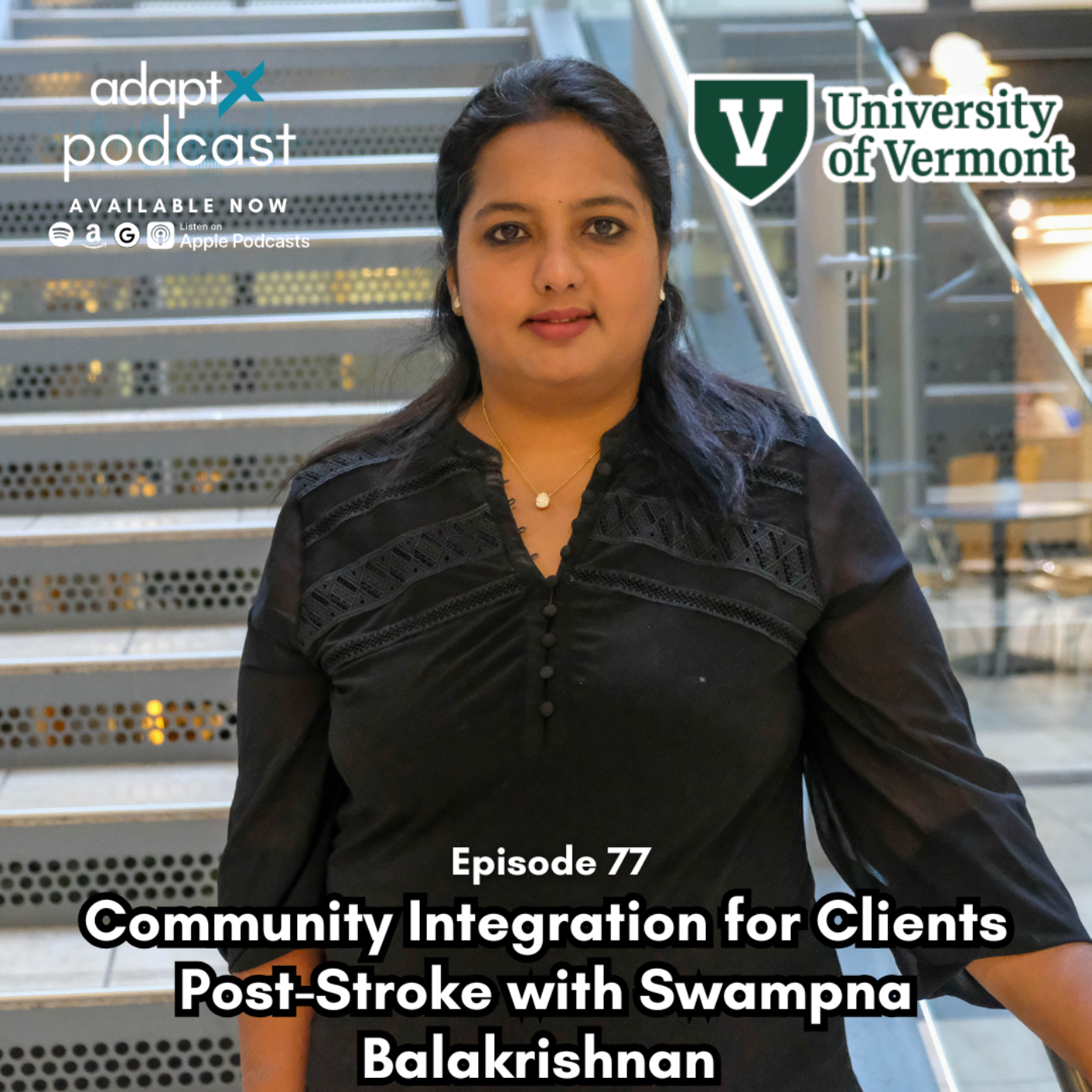
#077 - Community Integration for Clients Post-Stroke with Swampna Balakrishnan
AdaptX Podcast · AdaptX
Audio is streamed directly from the publisher (content.rss.com) as published in their RSS feed. Play Podcasts does not host this file. Rights-holders can request removal through the copyright & takedown page.
Show Notes
In this episode of the AdaptX podcast, Dr. Swapna Balakrishnan discusses her journey into the field of neurodegenerative diseases and the importance of bridging the gap between research and clinical practice. Dr. Swapna Balakrishnan is a Doctor of physical therapy and currently a PhD Candidate in the Mobility and Investigative Neuroimaging (MAIN) Lab at the University of Vermont. She has extensive experiences of providing evidenced based care to patients with advanced dementia, stroke, spinal cord injury, and other neurodegenerative disorders. Her current research focuses on the use of wearable sensors to better understand how people with stroke move in the community and stay physically active.
To learn more about Swapna and the MAIN Lab, check the links below,
- Main Labs Website: https://mainlab.wixsite.com/mainlab
- Wearable Lab Study: https://www.youtube.com/watch?v=NhSqUN9dsSQ
- Swapna’s Email: [email protected]'
Takeaways
- The transition from inpatient to community care is crucial for stroke recovery.
- Community fitness centers can play a significant role in post-stroke recovery.
- Wearable sensors can help monitor activity levels in stroke patients.
- There is a disconnect between research and clinical practice that needs to be addressed.
- Insurance coverage often limits ongoing support for stroke survivors.
- Motivation is key to encouraging physical activity post-stroke.
- Collaboration between clinicians and fitness professionals is vital for patient success.
Keywords: accessible healthcare, neurodegenerative diseases, stroke recovery, wearable sensors, community fitness, rehabilitation, personal trainers, patient motivation, healthcare collaboration, research in physical therapy
Chapters
00:00 Introduction to Accessible Healthcare
06:51 Community-Based Recovery Post-Stroke
13:41 The Importance of Ongoing Support
20:22 Data Collection and Community Mobility
27:12 Excitement for Research and Proactive C