
ABA Inside Track
614 episodes — Page 10 of 13

Ep 78Episode 78 - Should Behavior Analysts Use Social Thinking? w/ Dr. Justin Leaf
While many of you may have heard of Michelle Garcia Winner's Social Thinking curriculum, have you ever wondered if it's appropriate for behavior analysts to use it? Well, Dr. Justin Leaf certainly has and he joins us on the podcast to share all of his thoughts on the subject including whether Social Thinking is empirically supported, whether it should be categorized as scientific or pseudoscientific, and whether behavior analysts may be at risk of violating our ethical code for using it. Articles discussed this episode: Leaf, J.B., Townley-Cochran, D., Taubman, M., Cihon, J.H., Oppenheim-Leaf, M.L., Kassardjian, A., Leaf, R., McEachin, J., & Pentz, T.G. (2015). The teaching interaction procedure and behavioral skills training for individuals diagnosed with autism spectrum disorder: a Review and commentary. Review Journal of Autism and Developmental Disorders, 2, 402-413. doi: 10.1007/s40489-015-0060-y Leaf, J.B., Kassardjian, A., Oppenheim-Leaf, M.L, Cihon, J.H., Taubman, M., Leaf, R., & McEachin, J. (2016). Social Thinking: Science, pseudoscience, or antiscience? Behavior Analysis in Practice, 9, 152-157. doi: 10.1007/s40617-016-0108-1 Leaf, J.B., Kassardjian, A., Oppenheim-Leaf, M.L., Cihon, J.H., Taubman, M., Leaf, R., & McEachin, J. (2016). Erratum to: Social Thinking: Science, pseudoscience, or antiscience? Behavior Analysis in Practice, 9, 158-159. doi: 10.1007/s40617-016-0119-y Crooke, P.J. & Winner, M.G. (2016). Social Thinking methodology: Evidence-based or empirically supported? A response to Leaf et al. (2016). Behavior Analysis in Practice, 9, 403-408. doi: 10.1007/s40617-016-0151-y Crooke, P.J., Hendrix, R.E., & Rachman, J.Y. (2008). Brief report: Measuring the effectiveness of teaching Social Thinking to children with Asperger syndrom (AS) and high functioning autism (HFA). Journal of Autism and Developmental Disorders, 38, 581-591. doi: 10.1007/s10803-007-0466-1 If you're interested in ordering CEs for listening to this episode, click here to go to the store page. You'll need to enter your name, BCBA #, and the two episode secret code words to complete the purchase. Email us at [email protected] for further assistance.

March 2019 Preview
It's another exciting month here at ABA Inside Track. Not only do we have two amazing guests lined up to review their research, but we also have a recording from one of our recent live shows. But, before all of that, we review some follow-up from last month's episodes in errata and take a few moments to celebrate our THIRD YEAR of podcasting! Interested in applying for a job in an area in desperate need for ABA services? Autism Compassion Africa is looking to expand their team. Check out the posting here for more information. And feel free to listen to our interview with co-founder Whitney Hammel to learn more about ACA Articles for February 2019 Should Behavior Analysis Use Social Thinking? w/ Dr. Justin Leaf Leaf, J.B., Townley-Cochran, D., Taubman, M., Cihon, J.H., Oppenheim-Leaf, M.L., Kassardjian, A., Leaf, R., McEachin, J., & Pentz, T.G. (2015). The teaching interaction procedure and behavioral skills training for individuals diagnosed with autism spectrum disorder: a Review and commentary. Review Journal of Autism and Developmental Disorders, 2, 402-413. doi: 10.1007/s40489-015-0060-y Leaf, J.B., Kassardjian, A., Oppenheim-Leaf, M.L, Cihon, J.H., Taubman, M., Leaf, R., & McEachin, J. (2016). Social Thinking: Science, pseudoscience, or antiscience? Behavior Analysis in Practice, 9, 152-157. doi: 10.1007/s40617-016-0108-1 Leaf, J.B., Kassardjian, A., Oppenheim-Leaf, M.L., Cihon, J.H., Taubman, M., Leaf, R., & McEachin, J. (2016). Erratum to: Social Thinking: Science, pseudoscience, or antiscience? Behavior Analysis in Practice, 9, 158-159. doi: 10.1007/s40617-016-0119-y Crooke, P.J. & Winner, M.G. (2016). Social Thinking methodology: Evidence-based or empirically supported? A response to Leaf et al. (2016). Behavior Analysis in Practice, 9, 403-408. doi: 10.1007/s40617-016-0151-y Crooke, P.J., Hendrix, R.E., & Rachman, J.Y. (2008). Brief report: Measuring the effectiveness of teaching Social Thinking to children with Asperger syndrom (AS) and high functioning autism (HFA). Journal of Autism and Developmental Disorders, 38, 581-591. doi: 10.1007/s10803-007-0466-1 Teaching Tacts at TACT (LIVE) Carroll, R.J., & Hesse, B.E. (1987). The effects of alternating mand and tact training on the acquisition of tacts. The Analysis of Verbal Behavior, 5, 55-65. PMCID: PMC2748455 Kodak, T. & Clements, A. (2009). Acquisition of mands and tacts with concurrent echoic training. Journal of Applied Behavior Analysis, 42, 839-843. doi: 10.1901/jaba.2009.42-839 Arntzen, E. & Almas, I.K. (2002). Effects of mand-tact versus tact-only training on the acquisition of tacts. Journal of Applied Behavior Analysis, 35, 419-422. doi: 10.1901/jaba.2002.35-419 Instructive Feedback w/ Dr. Jason Vladescu Vladescu, J.C. & Kodak, T.M. (2013). Increasing instructional efficiency by presenting additional stimuli in learning trials for children with autism spectrum disorders. Journal of Applied Behavior Analysis, 46, 805-816. doi: 10.1002/jaba.70 Haq, S.S., Zemantic, P.K., Kodak, T., LeBlanc,B., & Ruppert, T.E. (2017). Examination of variables that affect the efficacy of instructive feedback. Behavioral Interventions, 32, 206-216. doi: 10.1002/bin.1470 Dass, T.K., Kisamore, A.N., Vladescu, J.C., Reeve, K.F., Reeve, S.A., & Taylor-Santa, C. (2018). Teaching children with autism spectrum disorder to tact olfactory stimuli. Journal of Applied Behavior Analysis, 51, 538-552. doi: 10.1002/jaba.470

Ep 77Episode 77 - Public Speaking
May I have your attention, please? Webster's dictionary defines public speaking as the act of speaking in front of an audience. And it's sort of terrifying…and I'm sweating just standing here talking to you. Now my PowerPoint slides have malfunctioned and I've dropped my notes. And I'm picturing the audience naked which is making me feel very uncomfortable. If only I'd listened to that amazing podcast about public speaking and how to improve my own abilities before agreeing to speak in front of all the best behavior analysts. Save me, ABA Inside Track! Articles discussed this episode: Friman, P.C. (2014). Behavior analysts to the front! A 15-step tutorial on public speaking. The Behavior Analyst, 37, 109-118. doi: 10.1007/s40614-014-0009-y Fawcett, S.B. & Miller, L.K. (1975). Training public-speaking behavior: An experimental analysis and social validation. Journal of Applied Behavior Analysis, 8, 125-135. doi: 10.1901/jaba.1975.8-125 Black, E.L. & Martin. G.L. (1980). A component analysis of public-speaking behaviors across individuals and behavioral categories. Communication Education, 29, 273-282. doi: 10.1080/03634528009378425 If you're interested in ordering CEs for listening to this episode, click here to go to the store page. You'll need to enter your name, BCBA #, and the two episode secret code words to complete the purchase. Email us at [email protected] for further assistance.
Ep 76Episode 76 - Gamification
What began as Rob's excuse to talk about his favorite Mario games turned into a long discussion of research about gamification and its role (if any) in improving human behavior. We review the literature, the theory, and the anecdotes around this hot hot trend in every field from education to environmentalism. Is gamification the Fortnite of productivity? Or should it be tossed in a landfill like E.T. for Atari 2600. Articles discussed this episode: Morford, Z.H., Witts, B.N., Killingsworth, K.J., & Alavosius, M.P. (2014). Gamification: The intersection between behavior analysis and game design technologies. The Behavior Analyst, 37, 25-40. doi: 10.1007/s40614-014-0006-1 Sailer, M., Hense, J.U., Mayr, S.K., & Mandi, H. (2017). How gamification motivates: An experimental study of the effects of specific game design elements on psychological need satisfaction. Computers in Human Behavior, 69, 371-380. doi: 10.1016/j.chb.2016.12.033 Hamari, J., Koivisto, & Sarsa, H. (2014). Does Gamification Work? A literature review of empirical studies on gamification. Proceedings of the Annual Hawaii International Conference on Systems Sciences. doi: 10.1109/HICSS.2014.377 Fogel, V.A., Miltenberger, R.G., Graves, R., & Koehler, S. (2010). The effects of exergaming on physical activity among inactive children in a physical education classroom. Journal of Applied Behavior Anlaysis, 43, 591-600. doi: 10.1901/jaba.2010.43-591 If you're interested in ordering CEs for listening to this episode, click here to go to the store page. You'll need to enter your name, BCBA #, and the two episode secret code words to complete the purchase. Email us at [email protected] for further assistance.

Ep 75Episode 75 - Acceptance and Commitment Therapy w/ Dr. Adam Hahs
In a world where individuals with mental health needs are struggling, could acceptance and commitment training be the answer? We chat with Dr. Adam Hahs to learn all about this third-wave behavior therapy, its procedure, the research, and exactly how the phrase "milk, milk, milk" could help parents with autism. Articles discussed this episode: Harris, R. (2006). Embracing your demons: an Overview of Acceptance and Commitment Therapy. Psychotherapy in Australia, 12, 2-8. Gould, E.R., Tarbox, J., & Coyne, L. (2018). Evaluating the effects of Acceptance and Commitment Training on the overt behavior of parents of children with autism. Journal of Contextual Behavioral Science, 7, 81-88. doi: 10.1016/j.jcbs.2017.06.003 Hahs, A.D., Dixon, M.R., & Paliliunas, D. (in press). Randomized controlled trial of a brief acceptance and commitment training for parents of individuals diagnosed with autism spectrum disorders. Journal of Contextual Behavioral Science. doi: 10.1016/j.jcbs.2018.03.002 If you're interested in ordering CEs for listening to this episode, click here to go to the store page. You'll need to enter your name, BCBA #, and the two episode secret code words to complete the purchase. Email us at [email protected] for further assistance.

February 2019 Preview
While it might be the shortest month of the year, ABA Inside Track is running long on exciting content. Switching up our preview format a bit, we're here to tell you everything coming up in the ENTIRE MONTH! That's right: Three full-length episodes in a row! We'll be talking about acceptance and commitment training with our special guest, Dr. Adam Hahs, before discussing two outside-of-the-box topics with gamification and public speaking. Rob's hours of editing behavior analytic journal review is your gain! Also, if you're looking for a fun conference in leadership, tickets are now available for the Behavior Analyst Leadership Conference (BALC), coming to Connecticut at the end of March! *Note: Due to a camera SNAFU, we're audio only this month. We'll have our video back up for the next preview. Sorry about that! Articles for February 2019: Acceptance and Commitment Training Harris, R. (2006). Embracing your demons: an Overview of Acceptance and Commitment Therapy. Psychotherapy in Australia, 12, 2-8. Gould, E.R., Tarbox, J., & Coyne, L. (2018). Evaluating the effects of Acceptance and Commitment Training on the overt behavior of parents of children with autism. Journal of Contextual Behavioral Science, 7, 81-88. doi: 10.1016/j.jcbs.2017.06.003 Hahs, A.D., Dixon, M.R., & Paliliunas, D. (in press). Randomized controlled trial of a brief acceptance and commitment training for parents of individuals diagnosed with autism spectrum disorders. Journal of Contextual Behavioral Science. doi: 10.1016/j.jcbs.2018.03.002 Gamification Morford, Z.H., Witts, B.N., Killingsworth, K.J., & Alavosius, M.P. (2014). Gamification: The intersection between behavior analysis and game design technologies. The Behavior Analyst, 37, 25-40. doi: 10.1007/s40614-014-0006-1 Sailer, M., Hense, J.U., Mayr, S.K., & Mandi, H. (2017). How gamification motivates: An experimental study of the effects of specific game design elements on psychological need satisfaction. Computers in Human Behavior, 69, 371-380. doi: 10.1016/j.chb.2016.12.033 Hamari, J., Koivisto, & Sarsa, H. (2014). Does Gamification Work? A literature review of empirical studies on gamification. Proceedings of the Annual Hawaii International Conference on Systems Sciences. doi: 10.1109/HICSS.2014.377 Fogel, V.A., Miltenberger, R.G., Graves, R., & Koehler, S. (2010). The effects of exergaming on physical activity among inactive children in a physical education classroom. Journal of Applied Behavior Anlaysis, 43, 591-600. doi: 10.1901/jaba.2010.43-591 Public Speaking Friman, P.C. (2014). Behavior analysts to the front! A 15-step tutorial on public speaking. The Behavior Analyst, 37, 109-118. doi: 10.1007/s40614-014-0009-y Fawcett, S.B. & Miller, L.K. (1975). Training public-speaking behavior: An experimental analysis and social validation. Journal of Applied Behavior Analysis, 8, 125-135. doi: 10.1901/jaba.1975.8-125 Black, E.L. & Martin. G.L. (1980). A component analysis of public-speaking behaviors across individuals and behavioral categories. Communication Education, 29, 273-282. doi: 10.1080/03634528009378425

Ep 74Episode 74 - Joint Attention
It's a belated birthday episode for Diana! In her honor we're talking about joint attention, one of the primary deficits noted in most children with autism. This week we discuss what joint attention is, which treatments are effective for improving responses and initiation to joint attention, and how a trip to Uncle Moe's Family Feedbag might be the ideal environment to master the skill. Happy birthday, Diana! Articles discussed this episode: Taylor, B.A. & Hoch, H. (2008). Teaching children with autism to respond to and initiate bids for joint attention. Journal of Applied Behavior Analysis, 41, 377-391. doi: 10.1901/jaba.2008.41-377 Klein, J.L., MacDonald, R.F.P, Vaillancourt, G., Ahearn, W.H., & Dube, W.V. (2009). Teaching discrimination of adult gaze direction to children with autism. Research in Autism Spectrum Disorder, 3, 42-49. doi: 10.1016/j.rasd.2008.03.006 Isaksen, J. & Holth, P. (2009). An operant approach to teaching joint attention skills to children with autism. Behavioral Interventions, 24, 215-236. doi: 10.1002/bin.292 If you're interested in ordering CEs for listening to this episode, click here to go to the store page. You'll need to enter your name, BCBA #, and the two episode secret code words to complete the purchase. Email us at [email protected] for further assistance.

Episode 74 Preview
While Diana deals with a diaper change, Rob and Jackie enjoy some time together talking about joint attention in this week's preview. After a quick update on some great journal articles to read for next week's episode, we jump into errata featuring some emails and a reminder to get your tickets to the Behavior Analyst Leadership Council Conference on March 28-29. Articles for next episode: Taylor, B.A. & Hoch, H. (2008). Teaching children with autism to respond to and initiate bids for joint attention. Journal of Applied Behavior Analysis, 41, 377-391. doi: 10.1901/jaba.2008.41-377 Klein, J.L., MacDonald, R.F.P, Vaillancourt, G., Ahearn, W.H., & Dube, W.V. (2009). Teaching discrimination of adult gaze direction to children with autism. Research in Autism Spectrum Disorder, 3, 42-49. doi: 10.1016/j.rasd.2008.03.006 Isaksen, J. & Holth, P. (2009). An operant approach to teaching joint attention skills to children with autism. Behavioral Interventions, 24, 215-236. doi: 10.1002/bin.292

Ep 15Bonus Episode 15 - Discussing School Refusal w/ Dr. Christopher Kearney
bonusTreating chronic absenteeism and school-refusal behavior is a growing need in many parts of the world. Heck, we even did a whole episode on it! Luckily, we have dedicated psychologists like Dr. Christopher Kearney working to meet these challenges through research and writings for professionals and for parents. Dr. Kearney joins Rob on the show this week to talk about his original research in developing the School-Refusal Assessment Scale and to troubleshoot some tough school-refusal scenarios. Interested in learning more about school-refusal behavior? Check out ABA Inside Track Episode 58 for a nice overview of some of Dr. Kearney's research. Then head on over to Amazon to pick up one of Dr. Kearney's books including Rob's favorite summer read, "Helping School Refusing Children and Their Parents".

Ep 73Episode 73 - General Case Analysis
So, you learned a new skill. That's great! But can you use that skill over here? How about here? What about with these items? If you said no, perhaps you'd be interested in hearing all about general-case analysis, a nifty classic technique that provides all the handy-dandy steps you need to promote amazing response generalization. Plus, we remember that cigarette machines used to be a thing. Articles discussed this episode: Chadsey-Rusch, J., Drasgow, E., Reinoehl, B., Halle, J., & Collet-Klingenberg, L. (1993). Using general-case instruction to teach spontaneous and generalized requests for assistance to learners with severe disabilities. Journal of the Association for Persons with Severe Handicaps, 18, 177-187. doi:10.1177/154079699301800304 Sprague, J.R. & Horner, R.H. (1984). The effects of single instance, multiple instance, and general case training on generalized vending machine use by moderately and severely handicapped students. Journal of Applied Behavior Analysis, 17, 273-278. doi: 10.1901/jaba.1984.17-273 If you're interested in ordering CEs for listening to this episode, click here to go to the store page. You'll need to enter your name, BCBA #, and the two episode secret code words to complete the purchase. Email us at [email protected] for further assistance.
Episode 73 Preview
Ever want to train an individual in a new skill but don't know how the heck you're going to be able to promote its generalization? And do you think there's enough time to train on every possible combination of stimuli? There's got to be a better way!! And next week, we'll be talking all about that way: General-case instruction. But first, errata and a reminder about a FREE CEU for listening to episode 69. Articles for next episode: Chadsey-Rusch, J., Drasgow, E., Reinoehl, B., Halle, J., & Collet-Klingenberg, L. (1993). Using general-case instruction to teach spontaneous and generalized requests for assistance to learners with severe disabilities. Journal of the Association for Persons with Severe Handicaps, 18, 177-187. doi:10.1177/154079699301800304 Sprague, J.R. & Horner, R.H. (1984). The effects of single instance, multiple instance, and general case training on generalized vending machine use by moderately and severely handicapped students. Journal of Applied Behavior Analysis, 17, 273-278. doi: 10.1901/jaba.1984.17-273

Ep 14Bonus Episode 14 - The Year in ABA (2018) w/ Matt Cicoria
bonusAs 2018 draws to a close, we gather round together with our pal Matt Cicoria from the Behavioral Observations podcast to discuss what's been going down with applied behavior analysis in the past 365 days. We talk losses, changes, and where we think 2019 will take us as a field. Happy Holidays, everyone!

Ep 13Bonus Episode 13 - Can You Hear Me Now? Our BABAT 2018 Panel
bonusIt's our very first LIVE recording from the floor of BABAT 2018. This year we took part in a panel discussion on dissemination of behavior analysis, our favorite topic. And we even brought our very own data! Thanks to the organizers of the BABAT conference and to everyone who took our survey. And huge thanks to everyone who attended our panel. You were an amazing audience! If you'd like to listen to the audio paired with our actual slides, why not watch the episode on our YouTube or Facebook page Our Official Program Listing: Panel Discussion: Can You Hear Me Now? Discussions on the Dissemination of Behavior Analysis. Chair: Diana Parry-Cruwys (Regis College/ABA Inside Track). Panelists: Robert Parry-Cruwys (ABA Inside Track), Jacquelyn MacDonald (Regis College/ABA Inside Track).
Ep 72Episode 72 - Research Grab Bag VI: Beyond Thunderdome
After the world has moved on, bands of wild behavior analysts roam the deserts, searching for reinforcement wherever it can be found. Yet there are still tales. Tales of the last research journal library, home of the mythical grab bag wherein the full repository of behavior analytic knowledge still remains. Many pseudoscientists scoff at these tales, but the true BCBAs know that this research grab bag exists. Lost beyond the horizon, beyond the burned sea, beyond…THUNDERDOME! Articles discussed this episode: Fritz, J.N., Dupuis, D.L., Wu, W., Neal, A.E., Rettig, L.A., & Lastrapes, R.E. (2017). Evaluating increased effort for item disposal to improve recycling at a university. Journal of Applied Behavior Analysis, 50, 825-829. doi: 10.1002/jaba.405 Hankla, M.E., Kohn, C.S., & Normand, M.P. (2018). Teaching college students to pour accurately using behavioral skills training: Evaluation of the effects of peer modeling. Behavioral Interventions, 33, 136-149. doi: 10.1002/bin.1509 Pachis, J.A. & Zonneveld, K.L.M. (2018). Comparison of prompting procedures to teach internet skills to older adults. Journal of Applied Behavior Analysis. doi:10.1002/jaba.519 If you're interested in ordering CEs for listening to this episode, click here to go to the store page. You'll need to enter your name, BCBA #, and the two episode secret code words to complete the purchase. Email us at [email protected] for further assistance.

Episode 72 Preview
Because we can't be bothered to come up with a theme when an episode hits a multiple of 12, it's another fun research grab bag. Hooray! And this time we run the gamut of research from ages 9-99. But first, fun with astral projection and your emails. Articles for next episode: Fritz, J.N., Dupuis, D.L., Wu, W., Neal, A.E., Rettig, L.A., & Lastrapes, R.E. (2017). Evaluating increased effort for item disposal to improve recycling at a university. Journal of Applied Behavior Analysis, 50, 825-829. doi: 10.1002/jaba.405 Hankla, M.E., Kohn, C.S., & Normand, M.P. (2018). Teaching college students to pour accurately using behavioral skills training: Evaluation of the effects of peer modeling. Behavioral Interventions, 33, 136-149. doi: 10.1002/bin.1509 Pachis, J.A. & Zonneveld, K.L.M. (2018). Comparison of prompting procedures to teach internet skills to older adults. Journal of Applied Behavior Analysis. doi:10.1002/jaba.519
Ep 71Episode 71 - (ETHICS) Cultural Competence w/ Dr. Solandy Forte
This week we're joined by special guest, Dr. Solandy Forte, of Milestones Behavioral Services, to help us to gain a better understanding of the issue of cultural competence. It's a very client-centered episode which lays out the positives and pitfalls that improved cultural understanding can bring. Articles discussed this episode: Fong, E.H., Catagnus, R.M., Brodhead, M.T., Quigley, S., & Field, S. (2016). Developing the cultural awareness skills of behavior analysts. Behavior Analysis in Practice, 9, 84-94. doi: 10.1007/s40617-016-0111-6 Fong, E.H. & Tanaka, S. (2013). Multicultural alliance of behavior analysis standards for cultural competence in behavior analysis. International Journal of Behavioral Consultation and Therapy, 8, 17-19. doi: 10.1037/h0100970 Young-Pelton, C.A. & Dotson, T.D. (2017). Ethical issues in rural programs for behavior analysis for students with disabilities. Rural Special Education Quarterly, 36, 38-48. doi: 10.1177/8756870517703407 If you're interested in ordering CEs for listening to this episode, click here to go to the store page. You'll need to enter your name, BCBA #, and the two episode secret code words to complete the purchase. Email us at [email protected] for further assistance.
Episode 71 Preview
While I think all of us at ABA Inside Track are pretty with it, woke, and progressive, that doesn't mean that we don't have room to grow, especially in the area of cultural competence. So, like any good behavior analysts, we found some research and reached out to an expert to wisen us up. But, before that happens, we celebrate a listener birthday with the gift of journal article recommendations. Articles for next episode: Fong, E.H., Catagnus, R.M., Brodhead, M.T., Quigley, S., & Field, S. (2016). Developing the cultural awareness skills of behavior analysts. Behavior Analysis in Practice, 9, 84-94. doi: 10.1007/s40617-016-0111-6 Fong, E.H. & Tanaka, S. (2013). Multicultural alliance of behavior analysis standards for cultural competence in behavior analysis. International Journal of Behavioral Consultation and Therapy, 8, 17-19. doi: 10.1037/h0100970

Ep 70Episode 70 - Manding for Information w/ Dr. Sarah Lechago
We've got nothing but mand after mand for our special guest, Dr. Sarah Lechago. And when we stop asking about her cool model volcano, we finally get to the heart of her research on teaching children with autism to mand for information. How does she do it, you ask? Sorry, your podcast player can't respond. You'll just have to listen to the whole episode. Articles discussed this episode: Lechago, S.A., Carr, J.E., Grow, L.L., Love, J.R., & Almason, S.M. (2010). Mands for information generalized across establishing operations. Journal of Applied Behavior Analysis, 43, 381-395. doi: 10.1901/jaba.2010.43-381 Lechago, S.A., Howell, A., Caccavale, M.N., & Peterson, C.W. (2013). Teaching "how"?" mand-for-information frames to children with autism. Journal of Applied Behavior Analysis, 46, 781-791. doi: 10.1002/jaba.71 If you're interested in ordering CEs for listening to this episode, click here to go to the store page. You'll need to enter your name, BCBA #, and the two episode secret code words to complete the purchase. Email us at [email protected] for further assistance.

Ep 12Bonus Episode 12 - Thompson Center for Autism Conference Special 2018
bonusOur live recording wasn't the only awesome thing happening at the Thompson Center for Autism's 2018 Conference. We had the chance to chat with some of the other speakers about their research and favorite moments from the show. We also talked with a number of presenters at the student poster session. Plus, Rob finds a way to play video games. This episode is the next best thing to having been in St. Louis yourself. Thanks so much to all of the folks at the Thompson Center for their hard work and for letting us bother so many amazing individuals! Conference Speakers: Dr. Rebecca Landa Dr. Sarah Lechago Dr. Casey Clay Dr. Jason Vladescu D.r Adel Najdowski Dr. Kristin Sohl Posters Discussed: Assessing and promoting independence in young adults with autism spectrum disorder presented by Ann Coleman, University of Missouri Comparison of naturalistic and arranged SDs during schedule thinning following FCT presented by McKenzie Bacon, Missouri State University Caregiver fading following functional communication training presented by John Augustine, Missouri State University Using stereotypy as reinforcement for alternative behaviors: A replication and extension presented by Katherine Johnson, University of Missouri Using behavioral skills training to shape job skills in adults with autism spectrum disorder presented by Valerie Smith, University of Rochester Effects of procedural fidelity of photographic activity schedules on client performance presented by Ashley Stevens, University of Missouri

Episode 70 Preview
Where? Who? How? are just some of the mands for information we have coming up on next week's episode. And rather than answer these questions by ourselves, why not mand for information from someone who researches mands for information, Dr. Sarah Lechago. In the meantime, we respond to your mands for information in errata with our normal preview-level nonsense. Articles for next episode: Lechago, S.A., Carr, J.E., Grow, L.L., Love, J.R., & Almason, S.M. (2010). Mands for information generalized across establishing operations. Journal of Applied Behavior Analysis, 43, 381-395. doi: 10.1901/jaba.2010.43-381 Lechago, S.A., Howell, A., Caccavale, M.N., & Peterson, C.W. (2013). Teaching "how"?" mand-for-information frames to children with autism. Journal of Applied Behavior Analysis, 46, 781-791. doi: 10.1002/jaba.71
Ep 69Episode 69 - (LIVE) Autism at College
This week we're coming to you LIVE from our taping at the Thompson Center for Autism Conference in St. Louis, Missouri. Thanks so much to all of the organizers for giving us a great venue for our very first live recording of the show. Our topic was all about the transition to college for students with autism. We review some trends and possible next steps to support this population and even have a surprise special guest appearance! Plus, some thoughts recorded after the conference on positive updates in the field. Articles discussed this episode: Elias, R. & White, S.W. (2018). Autism goes to college: Understanding the needs of a student population on the rise. Journal of Autism and Developmental Disorders, 48, 732-746. doi: 10.1007/s10803-017-3075-7 White, S.W., Elias, R., Capriola-Hall, N.N., Smith, I.C., Conner, C.M., Asselin, S.B., Howlin, P., Getzel, E.E., & Mazefsky, C.A. (2017). Development of a college transition and support program for students with autism spectrum disorder. Journal of Autism and Developmental Disorders, 47, 3072-3078. doi: 10.1007/s10803-017-3236-8 Lucas, R. & James. A.I. (2018). An evaluation of specialist mentoring for university students with autism spectrum disorders and mental health conditions. Journal of Autism and Developmental Disorders, 48, 694-707. doi: 10.1007/s10803-017-3303-1 As a special treat, you can earn CEs for listening to this episode for FREE!! Click here to go to the store page. You'll need to enter your name, BCBA #, and the two episode secret code words to complete the purchase. Email us at [email protected] for further assistance. NOTE: There are two secret code words in the episode. If you only found one, please try redownloading the episode. Apologies if you have an older version of the file.
Episode 69 Preview
Good news, everyone! More students with autism are attending college than ever before. Bad news, everyone! Many of these students are still struggling to graduate. What are the critical pieces of transition planning that have been underdeveloped? Next week, we'll be discussing some research on the subject at our very first LIVE taping of ABA Inside Track at the Thompson Center for Autism Conference in St. Louis, Missouri. Articles for next episode: Elias, R. & White, S.W. (2018). Autism goes to college: Understanding the needs of a student population on the rise. Journal of Autism and Developmental Disorders, 48, 732-746. doi: 10.1007/s10803-017-3075-7 White, S.W., Elias, R., Capriola-Hall, N.N., Smith, I.C., Conner, C.M., Asselin, S.B., Howlin, P., Getzel, E.E., & Mazefsky, C.A. (2017). Development of a college transition and support program for students with autism spectrum disorder. Journal of Autism and Developmental Disorders, 47, 3072-3078. doi: 10.1007/s10803-017-3236-8 Lucas, R. & James. A.I. (2018). An evaluation of specialist mentoring for university students with autism spectrum disorders and mental health conditions. Journal of Autism and Developmental Disorders, 48, 694-707. doi: 10.1007/s10803-017-3303-1

Ep 11Bonus Episode 11 - BABAT Special 2018
bonusWhen crisp fall air strikes, you know that the BABAT conference is about to get underway. This year, we celebrate New England's coolest conference for behavior analysts by talking with some of the students featured at the evening poster session. Then, to honor the last BABAT held at scenic UMass Amherst, we gather some dear friends around two pounds of chicken wings to reminisce on some of our favorite memories. Student Posters Discussed: A Descriptive Assessment of Activity-Based Variation in Pre-School Children. NICOLE LENARES, Joseph Dracobly, Tayler Shea, Ashley Williams, Morgan Winship, and Sydney Spencer (Eastern Connecticut State University). A Parametric Analysis of Inter-Trial Intervals on Establishing Functional Communication. KENDRA GUINNESS and Kevin Schlichenmeyer (The Autism Community Therapists). Extending Functional Analysis Session Length to Yield Menainingful Outcomes. CURTIA HUMBERT, Matt Decho, Victoria Cimino, and David Kuhn (Milestones Behavioral Services). Evaluation of Systematically Fading Protective Equipment to Decrease Problem Behavior and Increase Academic Skills. KRISTINA HARTY, Lauren Carter, and Silva Orchanian (Melmark New England). Treatment of Stereotypy: Differential Reinforcement Schedules and Reinforcer Delivery Rate. FINLEY CRUGER, ANGELICA SEDANO, Eileen Roscoe, and Chelsea Hedquist (New England Center for Children). Teaching Children to Implement Response Interruption Redirection to Reduce Siblings' Stereotypy. KAITLYN MILES and Jacquelyn MacDonald (Regis College). Teaching Abduction Prevention Skills to Children. TAYLOR JOHNS and Jacquelyn MacDonald (Regis College). Assessment and Treatment of Trichotillomania: Are Competing Items Effective When Treating Multiply Controlled Behavior? KARA MACLEAN and G. Tracey Toran (New England Center for Children).

Ep 68Book Club 2 (pt 2) - Positive Parenting, pt. 2
We wrap up our two-part book club covering Dr. Glen Latham's The Power of Positive Parenting by sharing some of our favorite chapters including dealing with tantrums, developing self-esteem, and what to do when everything goes to hell. Plus, our final reviews of the book and whether we think it's right for you. And hilarious parenting anecdotes! Readings discussed this episode: Latham, G.I. (1990). The power of positive parenting. North Logan, UT: P&T Ink. If you're interested in ordering CEs for listening to this episode, click here to go to the store page (or here if you'd like the Supervision Series II bundle). You'll need to enter your name, BCBA #, and the two episode secret code words to complete the purchase. Email us at [email protected] for further assistance.

Ep 67Book Club 2 (pt 1) - Positive Parenting, pt. 1
Wondering if you've got what it takes to be a positive parent? Find yourself needing the greatest parenting tips for the families you work with? Terrified that you keep coming back to the old "yell at the kids until they behave" strategy your parents used? Well, let ABA Inside Track's second annual book club pick, The Power of Positive Parenting, help you out. For the next two episodes we'll be discussing Dr. Glen Latham's excellent parenting book to determine if it's really as great as we've heard and, more importantly, if it's really a piece of behavior analytic literature. Readings discussed this episode: Latham, G.I. (1990). The power of positive parenting. North Logan, UT: P&T Ink. If you're interested in ordering CEs for listening to this episode, click here to go to the store page. You'll need to enter your name, BCBA #, and the two episode secret code words to complete the purchase. Email us at [email protected] for further assistance.

Episode 67+68 Preview
Fresh off our last multi-part episodes comes another multi-part episode. For the next two weeks, we'll be holding our annual book club and discussing Dr. Glen Latham's book, the Power of Positive Parenting. In the meantime Jackie explains just how much online learning is too much and Rob attempts to apologize and to usher in a new age of conversation and understanding. Readings for next episode: Latham, G.I. (1990). The power of positive parenting. North Logan, UT: P&T Ink.

Ep 66Episode 66 - Latency FAs w/ Dr. Josh Jessel
Are you tired of spending hours running session after session to find the function of a problem behavior? Do you find yourself scoring tape into the wee hours of the night, shaking your head and saying, "There's got to be a quicker way"? Well, Dr. Josh Jessel is here to tell us how we can find maintaining variables in as little as 30 minutes. Seriously. And you thought learning how to measure latency was never going to make you a better BCBA. Articles discussed this episode: Thomason-Sassi, J.L., Iwata, B.A., Neidert, P.L., & Roscoe, E.M. (2011). Response latency as an index of response strength during functional analyses of problem behavior. Journal of Applied Behavior Analysis, 44, 51-67. doi: 10.1901/jaba.2011.44-51 Jessel, J., Ingvarsson, E.T., Metras, R., Whipple, R., Kirk, H., & Solsbery, L. (2018). Treatment of elopement following a latency-based interview-informed, synthesized contingency analysis. Behavioral Interventions, 33, 1-13. doi: 10.1002/bin.1525 If you're interested in ordering CEs for listening to this episode, click here to go to the store page (or here if you'd like the Supervision Series II bundle). You'll need to enter your name, BCBA #, and the two episode secret code words to complete the purchase. Email us at [email protected] for further assistance.

Episode 66 Preview
Next week we'll be joined by Dr. Josh Jessel to discuss how the IISCA and latency measurements can make functional analysis run faster than you could ever imagine. But first, watch Rob opine over the best fall activities to do in New England. Articles for next episode: Thomason-Sassi, J.L., Iwata, B.A., Neidert, P.L., & Roscoe, E.M. (2011). Response latency as an index of response strength during functional analyses of problem behavior. Journal of Applied Behavior Analysis, 44, 51-67. doi: 10.1901/jaba.2011.44-51 Jessel, J., Ingvarsson, E.T., Metras, R., Whipple, R., Kirk, H., & Solsbery, L. (2018). Treatment of elopement following a latency-based interview-informed, synthesized contingency analysis. Behavioral Interventions, 33, 1-13. doi: 10.1002/bin.1525

Ep 10Bonus Episode 10 - Technology for BCBAs w/ Dr. Jamie Hughes-Lika
bonusIf you enjoyed excerpts from our conversation with Dr. Hughes-Lika about supervision and technology, then you're going to love the full interview. The sky's the limit with technology in the hands of a BCBA and we run down some of the coolest tech apps out there with an eye towards what the future may hold. Resource Links: Mentimeter Kahoot Google Drive Techsmith (makers of Camtasia) GoReact

Ep 66Episode 65 - (SUPERVISION) Supervision Series II, pt 3 - Behavioral Skills Training for All
It's been a wonderful September full of supervision and we round out this group of episodes with a review of the best ways to train others. Surprisingly, the answer includes even more training. Plus stories of our first jobs, Mickey Mouse's first words, and first steps towards skill competency. The rationale for listening to our podcast is excellence! Articles discussed this episode: Parsons, M.B., Rollyson, J.H., & Reid, D.H. (2012). Evidence-based staff training: A guide for practitioners. Behavior Analysis in Practice, 5, 2-11. doi: 10.1007/BF03391819 Parsons, M.B., Rollyson, J.H., & Reid, D.H. (2013). Teaching practitioners to conduct behavioral skills training: A pyramidal approach for training multiple human service staff. Behavior Analysis in Practice, 6, 4-16. doi: 10.1007/BF03391798 If you're interested in ordering CEs for listening to this episode, click here to go to the store page (or here if you'd like the Supervision Series II bundle). You'll need to enter your name, BCBA #, and the two episode secret code words to complete the purchase. Email us at [email protected] for further assistance.

Ep 64Episode 64 - (SUPERVISION) Supervision Series II, pt 2 - Supervision Pitfalls
The supervision train rolls on, but, if you're not careful, might end up in one of the many many pitfalls strewn along the way to becoming the best BCBA supervisor ever. Luckily we're here to review how to start your supervision off on the right foot and the top 5 tips to stay on top of your game. And when we take a quick break from the main topic, we terrorize each other with memories of scary Super Mario Bros. enemies and Pilgrim trivia. Break out your best neutral face: It's Supervisin' Time! Articles discussed this episode: Sellers, T.P, LeBlanc, L.A., & Valentino, A.L. (2016). Recommendations for detecting and addressing barriers to successful supervision. Behavior Analysis in Practice, 9, 309-319. doi: 10.1007/s40617-016-0142-z Sellers, T.P., Valentino, A.L., & LeBlanc, L.A. (2016). Recommended practices for individual supervision of aspiring behavior analysts. Behavior Analysis in Practice, 9, 274-286. doi: 10.1007/s40617-016-0110-7 If you're interested in ordering CEs for listening to this episode, click here to go to the store page (or here if you'd like the Supervision Series II bundle). You'll need to enter your name, BCBA #, and the two episode secret code words to complete the purchase. Email us at [email protected] for further assistance.

Ep 63Episode 63 - (SUPERVISION) Supervision Series II, pt 1 - The Future of Supervision w/ Dr. Jamie Hughes-Lika
Supervision September 2 starts off this week with a look at the future of supervision. Namely, we discuss updates to supervision for BCBA trainees as laid out this past year by the BACB. Then, after the dry stuff, Rob talks with Dr. Jamie Hughes-Lika of Summit Autism Services about some technology tools that may make your supervision a little easier. Not discussed: Magical supervision robots who log your training hours minute-by-minute. Though wouldn't that be cool? Articles discussed this episode: BACB Newsletter (October 2017) BACB Newsletter (March 2018) BCBA/BCaBA Experience Standards: Monthly System Twyman, J.S. (2014). Envisioning education 3.0: The fusion of behavior analysis, learning science and technology. Mexican Journal of Behavior Analysis, 40, 20-38. doi: 10.5514/rmac.v40.i2.63663 Resource Links: Mentimeter Kahoot Google Drive Techsmith (makers of Camtasia) GoReact If you're interested in ordering CEs for listening to this episode, click here to go to the store page (or here if you'd like the Supervision Series II bundle when it's available after the episodes all go live). You'll need to enter your name, BCBA #, and the two episode secret code words to complete the purchase. Email us at [email protected] for further assistance.

Episode 63-65 Previews
Back in time for the start of the new school year, it's our 2nd (annual?) Supervision September! All this month, we have episodes devoted solely to supervision: Supervision and technology, barriers to supervision, and supervision in training others. That's three episodes on supervision in a row! Plus, we unveil our exciting survey on technology (hey, would you mind taking it?) and talk about our appearances at the BABAT and Thompson Center Autism conferences in October. See you there! Articles for next episodes: Episode 63 BACB Newsletter (October 2017) BACB Newsletter (March 2018) BCBA/BCaBA Experience Standards: Monthly System Twyman, J.S. (2014). Envisioning education 3.0: The fusion of behavior analysis, learning science and technology. Mexican Journal of Behavior Analysis, 40, 20-38. doi: 10.5514/rmac.v40.i2.63663 Episode 64 Sellers, T.P, LeBlanc, L.A., & Valentino, A.L. (2016). Recommendations for detecting and addressing barriers to successful supervision. Behavior Analysis in Practice, 9, 309-319. doi: 10.1007/s40617-016-0142-z Sellers, T.P., Valentino, A.L., & LeBlanc, L.A. (2016). Recommended practices for individual supervision of aspiring behavior analysts. Behavior Analysis in Practice, 9, 274-286. doi: 10.1007/s40617-016-0110-7 Episode 65 Parsons, M.B., Rollyson, J.H., & Reid, D.H. (2012). Evidence-based staff training: A guide for practitioners. Behavior Analysis in Practice, 5, 2-11. doi: 10.1007/BF03391819 Parsons, M.B., Rollyson, J.H., & Reid, D.H. (2013). Teaching practitioners to conduct behavioral skills training: A pyramidal approach for training multiple human service staff. Behavior Analysis in Practice, 6, 4-16. doi: 10.1007/BF03391798

Ep 62Episode 62 - Help, I Need Somebody
This week, we're discussing asking for help and ways to improve this important life skill. We discuss basic requests for help, how to prevent overgeneralization of the response, and high- and low-tech solutions for asking for help when lost. Plus, Rob goes out of his way to make the absolute worst jokes possible in a feeble attempt to lighten the mood. Articles discussed this episode: Rodriguez, N.M., Levesque, M.A., Cohrs, V.L., & Niemeier, J.J. (2017). Teaching children with autism to request help with difficult tasks. Journal of Applied Behavior Analysis, 50, 717-732. doi: 10.1002/jaba.420 Carlile, K.A., DeBar, R.M., Reeve, S.A., Reeve, K.F., & Meyer, L.S. (2018). Teaching help-seeking when lost to individuals with autism spectrum disorder. Journal of Applied Behavior Analysis, 51, 191-206. doi: 10.1002/jaba.447 If you're interested in ordering CEs for listening to this episode, click here to go to the store page. You'll need to enter your name, BCBA #, and the two episode secret code words to complete the purchase. Email us at [email protected] for further assistance.

Episode 62 Preview
No one makes it through this crazy world alone. Whether a full-grown adult or a child with disabilities, everyone needs to be able to ask for help once in a while. But what happens when you keep asking for help all the time? Or your need help but don't know who to ask or where you are? Next week we'll be reviewing articles that have the answers to the these questions. But first, a whole bunch of upcoming episode and appearance reminders! Articles for next episode: Rodriguez, N.M., Levesque, M.A., Cohrs, V.L., & Niemeier, J.J. (2017). Teaching children with autism to request help with difficult tasks. Journal of Applied Behavior Analysis, 50, 717-732. doi: 10.1002/jaba.420 Carlile, K.A., DeBar, R.M., Reeve, S.A., Reeve, K.F., & Meyer, L.S. (2018). Teaching help-seeking when lost to individuals with autism spectrum disorder. Journal of Applied Behavior Analysis, 51, 191-206. doi: 10.1002/jaba.447

Ep 61Episode 61 - Discontinuous Data Sampling w/ Dr. Mary-Katherine Carey
STOP! Before you start using that discontinuous data sampling system in your program, listen to special guest, Dr. Mary-Katherine Carey, join us for a discussion of its pros and cons. We'll review previous and recent research to determine whether discontinuous data systems really do save a lot of time, whether sampling data can ruin student programming, and whether you can get a scientific study done in a month. Don't worry: We find some time to act all silly and go off on irrelevant tangents too. Articles discussed this episode: Cummings, A.R. & Carr, J.E. (2009). Evaluating progress in behavioral programs for children with autism spectrum disorders via continuous and discontinuous measurement. Journal of Applied Behavior Analysis, 42, 52-71. doi: 10.1901/jaba.2009.42-57 Carey, M.K. & Bourret, J.C. (2014). Effects of data sampling on graphical depictions of learning. Journal of Applied Behavior Analysis, 47, 749-764. doi: 10.1002/jaba.153 If you're interested in ordering CEs for listening to this episode, click here to go to the store page. You'll need to enter your name, BCBA #, and the two episode secret code words to complete the purchase. Email us at [email protected] for further assistance.

Episode 61 Preview
Ever sit down to take data and, as you're writing down all those pluses and minuses, tell yourself, "There's got to be a better way"? Well, I've got some good news and some bad news for you! Next week, we're talking with the newly-minted Dr. Carey about discontinuous data systems and the good, the bad, and the ugly about their use. But first, an errata chock full of excellent emails and a brief discussion of upstate New York over-the-air broadcasts. And Rob shares a geek fact. Articles for next episode: Cummings, A.R. & Carr, J.E. (2009). Evaluating progress in behavioral programs for children with autism spectrum disorders via continuous and discontinuous measurement. Journal of Applied Behavior Analysis, 42, 52-71. doi: 10.1901/jaba.2009.42-57 Carey, M.K. & Bourret, J.C. (2014). Effects of data sampling on graphical depictions of learning. Journal of Applied Behavior Analysis, 47, 749-764. doi: 10.1002/jaba.153

Ep 60Episode 60 - Research Grab Bag V: Curse of Grab Bag
It's our most popular episode type: Grab bag! And by popular, I mean popular to us because we get to read whatever articles we want to! This week, Rob sits down at the ol' baby grand and plays a tune about stimulus equivalence, Diana neutrally praises the effort, and Jackie eats all the poison we left on the floor. Perhaps our most disjointed episode to date. Articles discussed this episode: Griffith, K.R., Ramos, A.L., Hill, K.E., & Miguel, C.F. (2018). Using equivalence-based instruction to teach piano skills to college students. Journal of Applied Behavior Analysis, 51, 207-219. doi: 10.1002/jaba.438 Weyman, J.R. & Sy, J.R. (2018). Effects of neutral and enthusiastic praise on the rate of discrimination acquisition. Journal of Applied Behavior Analysis, 51, 335-344. doi: 10.1002/jaba.440 Dancho, K.A., Thompson, R.H., & Rhoades, M.M. (2008). Teaching preschool children to avoid poison hazards. Journal of Applied Behavior Analylsis, 41, 267-271. doi: 10.1901/jaba.2008.41-267 If you're interested in ordering CEs for listening to this episode, click here to go to the store page. You'll need to enter your name, BCBA #, and the two episode secret code words to complete the purchase. Email us at [email protected] for further assistance.

Episode 60 Preview
What's that sound coming across the misty moors? Some folks say a grab bag full of behavior analytic articles roams these dark plains, searching for a podcast to eat. Legend tells of a team of BCBAs who will tame the grab bag and bring its research to the ABA community. Might you be the ones the legend speaks of? Articles for next episode: Griffith, K.R., Ramos, A.L., Hill, K.E., & Miguel, C.F. (2018). Using equivalence-based instruction to teach piano skills to college students. Journal of Applied Behavior Analysis, 51, 207-219. doi: 10.1002/jaba.438 Weyman, J.R. & Sy, J.R. (2018). Effects of neutral and enthusiastic praise on the rate of discrimination acquisition. Journal of Applied Behavior Analysis, 51, 335-344. doi: 10.1002/jaba.440 Dancho, K.A., Thompson, R.H., & Rhoades, M.M. (2008). Teaching preschool children to avoid poison hazards. Journal of Applied Behavior Analylsis, 41, 267-271. doi: 10.1901/jaba.2008.41-267

Ep 59Episode 59 - Puppies!
Though Rob may prefer to hit PAWS when it comes to talking about canines, Jackie and Diana have a howling good time on this week's episode all about dog behavior and behavior analysis. Wondering how functional analysis methodology can be used to treat dog challenging behavior? Or how shelter workers can actually be taught to train dogs on the cheap? Curious if Rob writes little stories about the research articles he reads? We answer all three of these tough questions in this week's episode. We're such RUFF-ians. Articles discussed this episode: Feuerbacher, E.N. & Wynne, C.D.L. (2016). Application of functional analysis methods to assess human-dog interactions. Journal of Applied Behavior Analysis, 49, 970-974. doi: 10.1002/jaba.318 Howard, V.J. & DiGennaro Reed, F.D. (2014). Training shelter volunteers to teach dog compliance. Journal of Applied Behavior Analysis, 47, 344-359. doi: 10.1002/jaba.120 If you're interested in ordering CEs for listening to this episode, click here to go to the store page. You'll need to enter your name, BCBA #, and the two episode secret code words to complete the purchase. Email us at [email protected] for further assistance.

Episode 59 Preview
To celebrate America's birthday, we're finally giving Jackie her wish and doing an entire episode devoted to puppies. Specifically, dog behavior analysis. After a montage of dog pictures featuring sad Sarah Mclachan music, dry your tears to prepare for some summer reading assignments in Errata. Do you have ideas for ABA Inside Track episodes? Email us! Articles for next episode: Feuerbacher, E.N. & Wynne, C.D.L. (2016). Application of functional analysis methods to assess human-dog interactions. Journal of Applied Behavior Analysis, 49, 970-974. doi: 10.1002/jaba.318 Howard, V.J. & DiGennaro Reed, F.D. (2014). Training shelter volunteers to teach dog compliance. Journal of Applied Behavior Analysis, 47, 344-359. doi: 10.1002/jaba.120
Ep 9Bonus Episode 9 - Autism Insurance Reform w/ Amy Weinstock
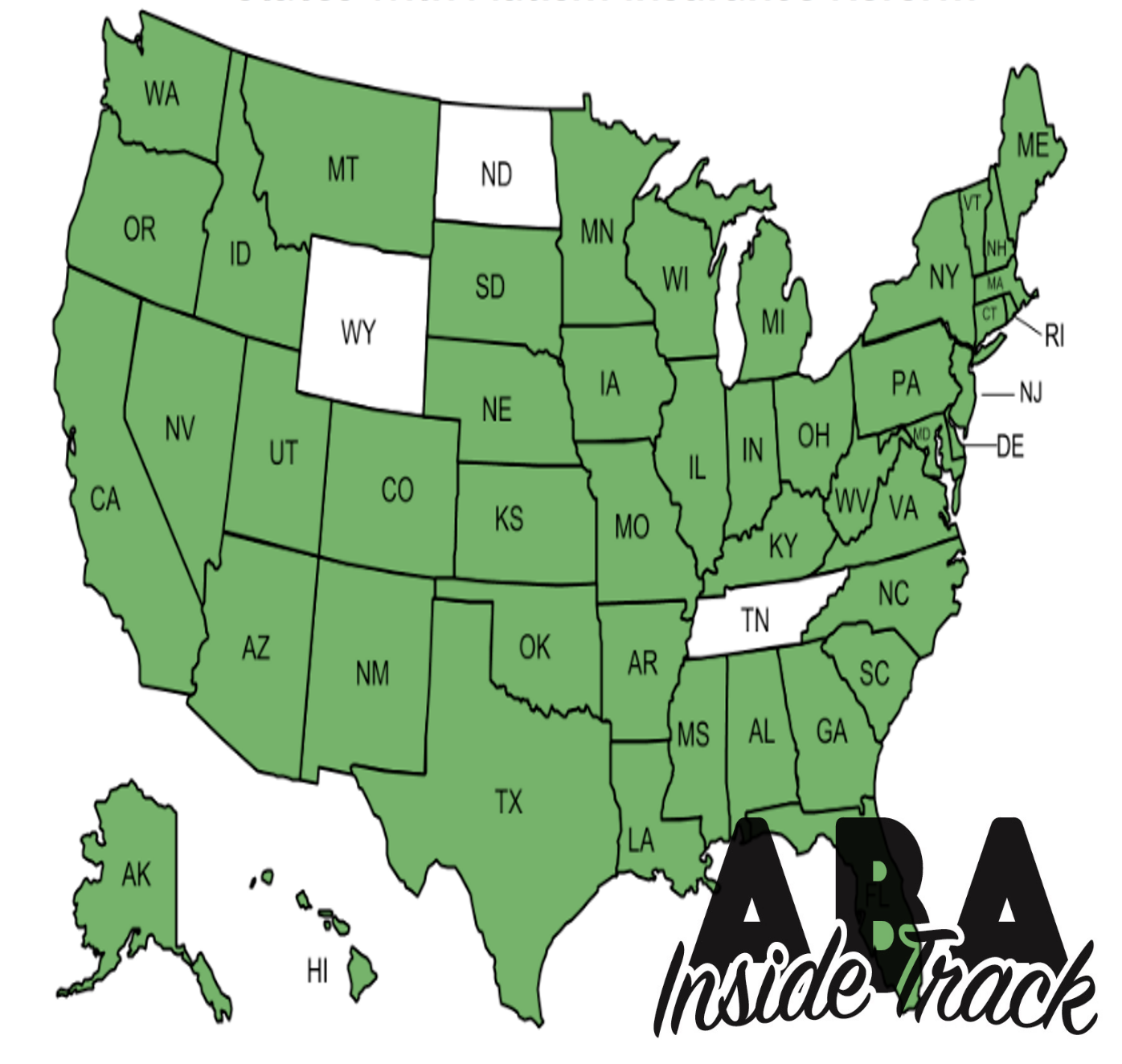
bonusNot a day goes by that the treatment and care for children with autism and their families isn't in the news. Sadly, many recent headlines have focused on the alarming challenges that these families face in looking for effective treatment (i.e., ABA) even with the sweeping changes to insurance coverage of autism treatment signed into law in nearly all the U.S. Luckily, we had an amazing opportunity to speak to Amy Weinstock of the Autism Insurance Resource Center about this and other topics related to insurance for autism treatment including a discussion of her important role in bringing this legislation to Massachusetts, her ongoing work to support families in understanding their rights under the law, and what all BCBAs need to know about insurance. And if you still have more questions after listening, why not contact the awesome people at the Autism Resource Center yourself?

Ep 58Episode 58 - School Refusal Behavior
Ah, the beautiful summer weather is finally upon us. And what better time to talk about how hard it is for some students to attend school. Is it bad teaching? Permissive parents? School anxiety? How the heck are we supposed to find out the function of school refusal behavior? Fortunately, Dr. Christopher Kearney and colleagues have been studying the assessment and treatment of school refusal behavior since the early 90's. And your pals here at ABA Inside Track are here to disseminate their research with our brand of deep discussion and tangents about Jackie's history of poor attendance due to Sailor Moon. Articles for next episode: Kearney, C.A. & Silverman, W.K. (1990). A preliminary analysis of a functional model of assessment and treatment for school refusal behavior. Behavior Modification, 14, 340-366. doi: 10.1177/01454455900143007 Kearney, C.A., Pursell, C., & Alvarez, K. (2001). Treatment of school refusal behavior in children with mixed functional profiles. Cognitive and Behavioral Practice, 8, 3-11. doi: 10.1016/S1077-7229(01)80037-7 Kearney, C.A., Chapman, G., & Cook, L.C. (2005). Moving from assessment to treatment of school refusal behavior in youth. INternational Journal of Behavioral Consultation and Therapy, 1, 46-51. Kearney, C.A. (2008). School absenteeism and school refusal behavior in youth: A contemporary review. Clinical Psychology Review, 28, 451-471. doi: 10.1016/j.cpr.2007.07.012 If you're interested in ordering CEs for listening to this episode, click here to go to the store page. You'll need to enter your name, BCBA #, and the two episode secret code words to complete the purchase. Email us at [email protected] for further assistance.
Episode 58 Preview
So, when does, "Mommy, I don't wanna go to school" move beyond a frustrating way to start the day to a serious problem? Next week, we're talking all about the phenomenon of school-refusal behavior and what you can do to help. In the meantime we bring up some life-affirming quotes and get a glimpse at Rob's most prized possession. Articles for next episode: Kearney, C.A. & Silverman, W.K. (1990). A preliminary analysis of a functional model of assessment and treatment for school refusal behavior. Behavior Modification, 14, 340-366. doi: 10.1177/01454455900143007 Kearney, C.A., Pursell, C., & Alvarez, K. (2001). Treatment of school refusal behavior in children with mixed functional profiles. Cognitive and Behavioral Practice, 8, 3-11. doi: 10.1016/S1077-7229(01)80037-7 Kearney, C.A., Chapman, G., & Cook, L.C. (2005). Moving from assessment to treatment of school refusal behavior in youth. INternational Journal of Behavioral Consultation and Therapy, 1, 46-51. Kearney, C.A. (2008). School absenteeism and school refusal behavior in youth: A contemporary review. Clinical Psychology Review, 28, 451-471. doi: 10.1016/j.cpr.2007.07.012

Ep 57Episode 57 - Do Humans Prefer Contingencies?
This week we're researching the age-old question: Will I be happier by doing stuff or just waiting for the world to reward me? In behavioral terms, we're discussing whether humans prefer contingent or noncontingent reinforcement. After going over two excellent research articles exploring this question through the use of the ever-popular concurrent-chains procedure, Jackie and Diana expose their crazy, right-wing politics to assess the U.S. welfare system while our favorite liberal progressive, Rob, watches in horror. Articles discussed this episode: Luczynksi, K.C. & Hanley, G.P. (2009). Do children prefer contingencies? An evaluation of the efficacy of and preference for contingent versus noncontingent social reinforcement during play. Journal of Applied Behavior Analysis, 42, 511-525. doi: 10.1901/jaba.2009.42-511 Hanley, G.P., Piazza, C.C., Fisher, W.W., Contrucci, S.A., & Maglieri, K.A. (1997). Evaluation of client preference for function-based treatment packages. Journal of Applied Behavior Analysis, 30, 459-473. doi: 10.1901/jaba.1997.30-459 If you're interested in ordering CEs for listening to this episode, click here to go to the store page. You'll need to enter your name, BCBA #, and the two episode secret code words to complete the purchase. Email us at [email protected] for further assistance.

Episode 57 Preview
You enter a hall full of all of your favorite things. The old knight of the Crusade beckons you to him. "Among you are the greatest delights known to humanity. You may engage in whip-cracking tricks to earn them. Or, I can give you one every now and again. You must choose...but choose wisely." And in that moment, you realize: you should have listened to that episode of ABA Inside Track about whether humans prefer contingencies. Suddenly, you awaken in a cold sweat and look at the calendar. "Oh, thank Skinner," you gasp. "It's only the preview episode! There's still time to subscribe!" Then, with visions of Diana, Jackie, and Rob podcasting in your head, you slip off, back to dreamland. Articles for next episode: Luczynksi, K.C. & Hanley, G.P. (2009). Do children prefer contingencies? An evaluation of the efficacy of and preference for contingent versus noncontingent social reinforcement during play. Journal of Applied Behavior Analysis, 42, 511-525. doi: 10.1901/jaba.2009.42-511 Hanley, G.P., Piazza, C.C., Fisher, W.W., Contrucci, S.A., & Maglieri, K.A. (1997). Evaluation of client preference for function-based treatment packages. Journal of Applied Behavior Analysis, 30, 459-473. doi: 10.1901/jaba.1997.30-459

Ep 56Episode 56 - Behavioral Gerontology
This week we're running the gamut of issues facing older adults with dementia. We've got an article about hoarding items, an article about running a functional analysis, and an article about making people feel happy. Spoiler alert: ice cream shops are an evidence-based way to bring joy. But we could have told you that. Articles discussed this episode: Donaldson, J.M., Trahan, M.A., & Kahng, S. (2014). An evaluation of procedures to increase cooperation related to hoarding in an older adult with dementia. Journal of Applied Behavior Analysis, 47, 410-414. doi: 10.1002/jaba.112 Trahan, M.A., Donaldson, McNabney, M.K., & Kahng, S. (2014). The influence of antecedents and consequences on the occurrence of bizarre speech in individuals with dementia. Behavioral Interventions, 29, 286-303. doi: 10.1002/bin.1393 Moore, K., Delaney, J.A., & Dixon, M.R. (2007). Using indices of happiness to examine the influence of environmental enhancements for nursing home residents with Alzheimer's disease. Journal of Applied Behavior Analysis, 40, 541-544. doi: 10.1901/jaba.2007.40-541 If you're interested in ordering CEs for listening to this episode, click here to go to the store page. You'll need to enter your name, BCBA #, and the two episode secret code words to complete the purchase. Email us at [email protected] for further assistance.
Episode 56 Preview
We're going beyond our years for next week's discussion all about research on behavioral gerontology. But first, in errata, it's the return of the language master! And Diana is going nuts for a new eco-friendly straw. Articles for next episode: Donaldson, J.M., Trahan, M.A., & Kahng, S. (2014). An evaluation of procedures to increase cooperation related to hoarding in an older adult with dementia. Journal of Applied Behavior Analysis, 47, 410-414. doi: 10.1002/jaba.112 Trahan, M.A., Donaldson, McNabney, M.K., & Kahng, S. (2014). The influence of antecedents and consequences on the occurrence of bizarre speech in individuals with dementia. Behavioral Interventions, 29, 286-303. doi: 10.1002/bin.1393 Moore, K., Delaney, J.A., & Dixon, M.R. (2007). Using indices of happiness to examine the influence of environmental enhancements for nursing home residents with Alzheimer's disease. Journal of Applied Behavior Analysis, 40, 541-544. doi: 10.1901/jaba.2007.40-541

Ep 55Episode 55 - Interteach w/ Dr. James Soldner
Ever feel like college and graduate classes are too boring for our modern times? Wish there were a way to improve the lecturing experience? Well, you're in luck because special guest Dr. James Soldner agrees and visits the show to share the magic of Interteaching. We'll run down his research on the subject and get a crash course on how this behavioral teaching methodology can be implemented for maximum effectiveness. And, no, we're not talking about the awesome, old cop show "Inter-Teach". Articles discussed this episode: Querol, B.I.D., Rosales, R., & Soldner, J.L. (2015). A comprehensive review of interteaching and its impact on student learning and satisfaction. Scholarship of Teaching and Learning in Psychology, 4, 390-411. doi: 10.1037/stl0000048 Soldner, J.L., Rosales, R., Crimando, W., & Schultz, J.C. (2017). Interteaching: Application of an empirically supported behavioral teaching method in distance rehabilitation education. Rehabilitation Research, Policy, and Education, 31, 372-386. doi: 10.1891/2168-6653.31.4.372 Rosales, R., Soldner, J.L., & Zhang, L. (2018). An evaluation of the pair discussion component of interteaching. The Psychological Record, 68, 71-79. doi: 10.1007/s40732-018-0269-0 If you're interested in ordering CEs for listening to this episode, click here to go to the store page. You'll need to enter your name, BCBA #, and the two episode secret code words to complete the purchase. Email us at [email protected] for further assistance.

Episode 55 Preview
Two big things to keep in mind as we prepare for a full-length episode on interteaching with special guest, Dr. James Soldner. First, we find out the results of April's Autism Awareness fund drive to raise money for Autism Compassion Africa. Let's just say that we don't think Whitney's school in Ghana will be running low on chairs anytime soon! Second, Rob goes Hollywood and takes the rest of the gang with him. Note for audio listeners: Do yourself a favor and go to YouTube or the Facebook page to get the full version of the Interteach TV show video. We really think it's worth it! Articles for next episode: Querol, B.I.D., Rosales, R., & Soldner, J.L. (2015). A comprehensive review of interteaching and its impact on student learning and satisfaction. Scholarship of Teaching and Learning in Psychology, 4, 390-411. doi: 10.1037/stl0000048 Soldner, J.L., Rosales, R., Crimando, W., & Schultz, J.C. (2017). Interteaching: Application of an empirically supported behavioral teaching method in distance rehabilitation education. Rehabilitation Research, Policy, and Education, 31, 372-386. doi: 10.1891/2168-6653.31.4.372 Rosales, R., Soldner, J.L., & Zhang, L. (2018). An evaluation of the pair discussion component of interteaching. The Psychological Record, 68, 71-79. doi: 10.1007/s40732-018-0269-0