
A Little Bit Of Science
449 episodes — Page 3 of 9

The End Of Science: Will We Ever Discover Everything?
It’s the end of the science as we know it! And I feel fine! But seriously though, is it? As a global community, we are investing 10 times more money and resources into scientific research than we did in the 1950s, yet the number of groundbreaking discoveries is dwindling. We’ve gone to the moon. We’ve discovered massive black holes. We’ve split the atom and peered through high-resolution microscopes to observe those tiny little quarks. Sure, we’re still making advancements, but a lot of science these days is refining past discoveries. We’re not really uncovering anything new. In fact, most of the Nobel Prizes awarded since the 1990s have been awarded for scientific work that went on in previous decades. So is scientific pursuit just slowing down? Or, are we nearing the end of scientific discovery altogether? CHAPTERS: 00:00 The slowing pace of scientific discovery 03:29 Historical claims of the end of science 07:46 John Horgan’s book: The End of Science 10:11 A Debate: Will we reach the end of science? 12:09 More spending and fewer scientific discoveries 15:30 Big mysteries of science remain 16:46 Blurring the lines of science and technology 18:56 The arrogance of physics 23:15 The Wholesome Verdict: Rod vs Will 23:45 What’s next on The Wholesome Show 28:32 Listener shoutouts SOURCES: Is science about to end? by Sabine Hossenfelder John Horgan interview on The End of Science Was I Wrong about “The End of Science”? By John Horgan Lord Kelvin and the End of Physics, Which He Never Predicted Albert Michelson, notes at the Inauguration of the Ryerson Physics Laboratory Everything That Can Be Invented Has Been Invented by David J Katz Papers and patents are becoming less disruptive over time by Michael Park, Erin Leahey and Russel J Funk in Nature Are we witnessing the end of science? In The Guardian See omnystudio.com/listener for privacy information.

So did you get a root? Tales, definitions and loopholes for defining sex
Everyone loves a good loophole. From a clever workaround that outsmarts the tax man to exploiting a glitch in a video game (Sega Mega Drive all the way), there's something undeniably thrilling about circumventing the system. It taps into our innate desire for freedom, creativity, and that little touch of rebellion. While avoiding tax bills and gaining high scores on Sonic the Hedgehog can certainly get us going, some people have discovered loopholes that arouse a more intimate type of pleasure. We’re talking about sex. But what exactly constitutes sex? For a lot of people, the term is open to interpretation, especially if you’re trying to stay a virgin to please the Lord or deny your infidelity. We all remember Bill Clinton’s famous speech about not having “sexual relations”. Does this mean that oral sex isn’t sex? And what about anal sex? For some, there is a poophole loophole, while others consider looking at pornography and deep kissing as an act of sex. Regardless of what you consider sex to be, there seem to be a lot of grey areas as cultural, religious and contextual factors thrust their way into the conversation. Is sex only considered sex if you reach the big O? And what if it's just the tip or a little bit of shaft? Two dicks, no dicks, plastic-covered dick? Who has to do what with what to whom for it to be considered sex in your mind? CHAPTERS: 00:00 The Bill Clinton scandal 03:09 Defining a sex act 05:26 Majority say oral sex isn’t sex 08:10 Age-related sex loopholes 11:27 Choosing a definition of sex that suits you 13:06 Sex with a condom isn’t sex? 15:12 God only cares about ejaculation 17:54 Soaking: Mormon sex loopholes 23:53 Japanese loopholes for prostitution 25:18 Studies on sexual substitution 28:37 A rare case of pregnancy from anal sex 30:50 What’s next on The Wholesome Show PREVIOUS EPISODES MENTIONED: The Strange Things People Have Smuggled Into Space https://www.youtube.com/watch?v=JpLAU59m61M The Secret Spy Science Of Poo https://www.youtube.com/watch?v=3f528jx5Wgo SOURCES: What Is Sex? - Defining Sexual Intercourse and What It Feels Like 11 Sexual Activities That People Don't Count As "Having Sex" Sex | Get the Facts. Three Really Big Sex Loopholes In The Old Testament | Martin Hughes Sex Loopholes That Some Mormons Are Exploiting To Have Pre-Marital Sex | Sexography https://www.exmormon.org/phorum/read.php?2%2C245879= https://www.exmormon.org/phorum/read.php?2%2C245879= See omnystudio.com/listener for privacy information.
Workplace Infantilisation: Incompetent Employees or Toxic Management?
Remember as a kid, having to wear that uncomfortable school uniform every single day? We were told when to sit, when to stand, when to eat, when to play, even when we were allowed to go to the toilet. Myriad rules to crush us into oppressive obedience! Now imagine a similar scenario in your workplace. Employees are given insultingly basic commands and training that even the most sheltered individual would have learned simply in the school of life. There’s a term for it: Workplace Infantilisation. Workers denied their agency and wisdom from experience in favour of child-like over-proceduralisation. And no, workplace infantilisation is not a term for child labour, pathological smuggling of employee’s children into the office, or a worker boasting an adult diaper fetish. Infantilisation in the workplace is basically when your boss treats you like a child. Explicit instructions for straightforward tasks, insinuating that you don’t have the common sense to figure it out. They make rules for things that well-adjusted adults don’t need rules for (like you’re not allowed to masturbate on someone else's desk.) Well duh. You use your own desk; we’re not animals! But is workplace infantilisation genuinely happening on a significant scale? Or is it merely a vent for worker frustrations over the minutiae of bureaucratic tape? SOURCES: https://core.ac.uk/download/pdf/288384634.pdf Postmortal Society: Towards a Sociology of Immortality The infantilization of the worker : r/antiwork https://www.linkedin.com/feed/update/urn:li:activity:6535470294486839296/ “I deeply resent how we've infantilized the workplace”: A manager's manifesto goes viral Treat Employees like Adults CHAPTERS: 00:00 Understanding the concept of workplace infantilisation 03:02 Harvard Business Review claims 04:37 Language, tone and building trust 07:41 Reality check: Is workplace infantilisation just a feeling? 09:21 Being an adult is understanding context 11:30 Defining infantilisation: Treating someone as a child 14:54 Controversial symptoms of workplace infantilisation 16:45 What does Google Scholar say? 20:01 Evidence of workplace infantilisation 23:11 Context matters See omnystudio.com/listener for privacy information.

Does Sheep Murmuration Explain England's 19th Century Sheep Panic?
Mother Nature, in all her brilliance, has birthed some fascinating phenomena. Take the magical skies of the Aurora Borealis in Iceland for example, or the bioluminescent Maldives shores where the ocean lights up like neon blue fairy lights. Here in Australia, we have Lake Hillier, where the water is the colour of a strawberry milkshake. In England of course, they have the synchronised sheep panic at 8pm. Wait… what? Although one of the lesser known phenomena (you might even say “un-herd” of), unexplained sheep panic caused quite a stir in Oxfordshire England in the late 19th century. On November 3, 1888, tens of thousands of sheep in a 200 square mile radius in Oxfordshire suddenly went bonkers at 8pm. It was as if some unseen terror had gripped them all simultaneously. Can you hear the X-files theme music playing?See omnystudio.com/listener for privacy information.

AI Girlfriend Chatbots, UFO Cosplay Drones, and Dihydrogen Monoxide
Back in the day, before robots and the internet, guys and gals who longed for the company of a significant other had one move up their sleeve: pluck up the courage to leave the house and talk to another human. Nowadays-ish, people search for love from home aided by computers and a social media background check (thanks Wayback Machine). Nowadays proper, the pool from which to select a lover has expanded to include artificial intelligence. In today’s post-ChatGPT age, AI girlfriend chatbots are on the market but you better keep it hush-hush… apparently, OpenAI don’t want you to meet their digital darlings, especially Tiffany or Nadia. Speaking of intelligence, the former director of the Pentagon’s All-domain Anomaly Resolution Office (AARO), Sean Kirkpatrick, squashed our dreams in a recent interview, candidly admitting that UAP sightings (Unidentified Aerial Phenomena - we don’t call them UFOs anymore) were likely just top secret military intelligence drones. Awesome. So why make such a big deal about releasing the UFO files? We don’t buy it. They’re definitely hiding something. On the topic of misinformation, in 1997, 14-year-old junior high school student Nathan Zohner warned his fellow students about a dangerous substance called dihydrogen monoxide, or DHMO. It’s colourless, odourless, tasteless and yet kills thousands of people every year through accidental inhalation. Prolonged exposure to its solid form causes severe tissue damage and in its gaseous form, DHMO causes severe burns. It’s found in cancers and infected wounds, and large quantities have been confirmed in every river, stream, lake and reservoir in America. But most terrifying is that everyone who drinks DHMO goes on to eventually die. How can this be legal?? CHAPTERS: 00:00 The Rise of AI Girlfriends 03:06 Open AI bans romantically oriented chatbots 05:27 The Loophole for sex-related content 09:06 Sean Kirkpatrick squashes UFO dreams 10:31 Spherical drones with cubes inside 11:58 The Dangers of Dihydrogen Monoxide 14:07 Twisting the facts to weaponise water PREVIOUS EPISODE MENTIONED: Smart Toilets, Brain Pics, Corpse Comfort, Nuclear Moon, Space Fashion, and Super Conductivity SOURCES: OpenAI Struggling to Destroy Onslaught of AI Girlfriends Pentagon’s Ex-Alien Hunter Admits a Lot of UFO Sightings Are Secret Military Crafts How A 14-Year-Old Boy Convinced His Class To Ban Dihydrogen Monoxide | IFLScience See omnystudio.com/listener for privacy information.

The Emu War: A Deep Dive Into Australia's Feathered Fiasco
After the horrors of World War I, the Australian Federal Government gave thousands of discharged veterans money, land and the promise of a bright and happy agricultural life in the Wheatbelt region of Western Australia. Life as a farmer wasn’t easy, but at least these veterans had seen the last of the battlefield. Or so they thought. The war was over but followed soon after by the great depression in 1929. Hoping to ease the pressure and literally put bread on the table for Australians, the Federal Government promised subsidies to the new farmers to increase their crop production. Wheat prices began to fall and farmers were left wanting when the subsidies never came. The farmers were screwed. And on top of all of this, they found themselves in a battle with an unexpected adversary, pillaging their wheat and destroying their rabbit fences: the emu. As if plummeting wheat prices and broken promises weren't enough, the veterans-turned-farmers found themselves neck to ample neck with a literal army of emus. 20,000 birds had descended upon the wheat fields (coincidentally smack bang in the middle of their migration route), wreaking havoc on crop yields and perimeter infrastructure. The solution was, of course, clear to these battle-hardened farmers: Guns. Lots of guns. CHAPTERS: 00:00 The Hardest Animals to Kill with a Gun 02:36 The Plight of World War I Vets Turned Farmers 05:06 The Arrival of the Emus 07:58 The Farmers' Plea for Machine Guns 12:04 Let the Emu War Begin 15:50 First Battle Tactics and Failures 17:34 Emus: Tough as Lead 21:47 Australian Parliament discusses Emu Wars 24:38 The War Continues until 1960 28:56 Bounty Put in Place to End the War 30:02 The Emu War Becomes a Movie SOURCES: Looking back: Australia's Emu Wars - Australian Geographic by Jasper Garner Gore October 18, 2016 19 Nov 1932 - "EMU WAR" DEFENDED. - Trove Emu War - Wikipedia BBC Earth - The Great Emu War in Western Australia was a... | Facebook Australia's Emu War spawns feature film, jokes and memes 90 years on - ABC News Australia’s emu war: John Cleese outrun in race to shoot movie of how flightless birds thwarted army’s machine guns Australia Once Lost a War With the Mighty Emu | by Matthew Gault | War Is Boring | Medium Are Emus Dangerous? (Reasons They Attack + How To Avoid) | Birdfact Trailer Drops for Monster Fest 2023 Official Selection THE EMU WAR See omnystudio.com/listener for privacy information.

John Chau's Fatal Mission For God To Earth's Most Isolated Tribe
In our modern society, most people live their lives lurching from fix to fix from the digital syringe; relying on social media and telecommunication advances to feel connected to the world around them. Facetime, Instagram, LinkedIn, we froth it. Well, most people do. Some people want absolutely nothing to do with not only modern technology but with the rest of the world in general. Around the globe, there are 100 or more "uncontacted" tribes, Indigenous peoples who avoid all contact with outsiders. Many of these people groups are in places like Brazil, Venezuela and Peru, probably hoping the beautiful rainforest they call home doesn’t get completely decimated by the white man. Over the years, outsiders have made some attempts to build connections with such tribes, in the hopes of understanding their cultures and respecting their way of life (well, we’d like to think that was their intention anyway). But the title of the most “uncontacted” people today goes to the Sentinelese people, an isolated tribe living on North Sentinel Island located off the coast of India. And if weren’t for the noteworthy, and quite frankly, arrogant efforts of John Chau, a devout Christian missionary in 2018, we doubt we would have ever heard of them. CHAPTERS: 00:00 Uncontacted tribes around the globe 05:09 Most uncontacted tribe today: The Sentinelese 08:40 British Royal Navy kidnap Sentinelese children 10:09 Anthropologist TM Pandit’s expeditions to North Sentinel 14:35 Indigenous rights groups protest to protect the Sentinelese people 17:21 John Chau’s zealous Christian faith 22:01 Chau’s education and preparations for adventure 26:09 Missionary Training in the Andaman Islands 28:30 Chau panics during his encounter with the Sentinelese 32:11 Waterproof Bible saves Chau but not for long 37:26 Stop trying to convert everyone to Christianity SOURCES: 5 of the Most Isolated Peoples on Earth | Discover Magazine by Stephen C. George Nov 28, 2021 The life and death of John Chau, the man who tried to convert his killers by J Oliver Conroy 3 Feb 2019 The Sentinelese: Who Are The Most Isolated Uncontacted Tribe On Earth? | IFLScience Tom Hale 15 June 2023 The man who spent decades befriending isolated Sentinelese tribe by Swaminathan Natarajan 27 Nov 2018 Andamans: US man's death puts spotlight on 'tribal tourism' North Sentinel Island: How can the Sentinelese people avoid contact with the outside world? - ABC News by Liam Butterworth 22 Nov 2018 Background - The Sentinelese See omnystudio.com/listener for privacy information.

Mary Shelley, Taphophobia and Life-Preserving Coffins
We’re all afraid of something. Many people live with significant anxiety due to their fear of things such as heights, flying, public speaking, the number 8 for example (Octophobia - it’s a real thing). But one fear puts disproportionately more heebies in our jeebies: taphophobia, or the fear of being buried alive as a result of being incorrectly pronounced dead. To a mad few, it may seem a genuine irrational fear (like omphalophobia - the fear of belly buttons) but at least some solace can be taken in the fact that it is exceedingly rare… right? There wouldn’t be an episode if that was the case! Perhaps being trapped 6 feet under is more reality than nightmare. This was certainly the case in centuries past. In the early 19th century, when Mary Shelley wrote Frankenstein, it was remarkably common for people to be accidentally buried alive. It happened so frequently in fact, that some clever people came up with innovative escape coffins to help the poor buried people get out. CHAPTERS: 00:00 Taphophobia: The fear of being buried alive 01:00 Resuscitation Techniques in the 1700s 03:26 The Story of Mary Wollstonecraft 07:01 The Influence of Contemporary Science on Frankenstein 10:20 What differentiates the living from the dead 15:50 The Language of Life and Death in Frankenstein 17:15 Historical Methods of Determining Death 18:01 The Distinction Between Absolute and Apparent Death 21:22 Historical Cases of Premature Burial 27:39 Innovative Solutions to Avoid Premature Burial 29:46 The Life Preserving Coffin: A Solution to Premature Burial 37:01 The Modern Perception of Death PREVIOUS EPISODES MENTIONED: World's Most Kissed Face: Why CPR Doll Resusci-Anne Looks Like A French Girl The Resurrectionists! The Vague Silver Lining of Tobacco SOURCES: The Science of Life and Death in Mary Shelley’s Frankenstein – The Public Domain Review By Sharon Ruston What are life-preserving coffins? – How It Works Taphophobia and ‘life preserving coffins’ in the nineteenth century - Marco Cascella, 2016 Life-preserving Coffin in Doubtful Cases of Death | Hagley Digital Archives Mary Shelley - Wikipedia See omnystudio.com/listener for privacy information.

Jose Delgado's Alternative To Lobotomy: The Stimoceiver Implant
The 20th century was a golden era for ethically dubious brain studies. In 1950, Dr Jose Delgado had a vision to control aggressive behaviour using a device surgically implanted in the brain known as the Stimoceiver. How science fictiony is that?! Delgado's journey toward creating a peaceful human race started with a bully macaque monkey who had been terrorising his cage mates. After successfully pacifying the angry monkey with the Stimoceiver, Delgado took the bull by the horns, quite literally. In 1963, a pivotal moment unfolded as Delgado tested the limits of the Stimoceiver in a dramatic experiment in the bull fighting arena. The public spectacle that followed thrust Delgado into the spotlight, drawing both admiration and ethical concerns. Delgado’s desire to create a "psycho-civilized society" caused some discomfort, with critics fearing the implications of the technology in the wrong hands. Whether controversial or revolutionary, Delgado's work remains a testament to the power of asking "What if..." PREVIOUS EPISODES MENTIONED: The Terrible History of The Lobotomy Transcranial Magnetic Stimulation SOURCES: The Man Who Fought a Bull With Mind Control | Discover Magazine By Jack El-HaiMar 22, 2016 Tribute to Jose Delgado, Legendary and Slightly Scary Pioneer of Mind Control - Scientific American Blog Network By John Horgan on September 25, 2017 Jose Manuel Rodriguez Delgado | Neuropsychopharmacology José Manuel Rodríguez Delgado - Wikipedia ‘Matador’ With a Radio Stops Wired Bull by John A. Osmundsen - New York Times, May 17, 1965 Neuroanatomy, Amygdala - StatPearls - NCBI Bookshelf Timothy C. Marzullo (2017) The Missing Manuscript of Dr. Jose Delgado’s Radio Controlled Bulls. J Undergrad Neurosci Educ. 2017 Spring; 15(2): R29–R35. Paul A. Offit (2017) Pandora's Lab: Seven Stories of Science Gone Wrong. National Geographic See omnystudio.com/listener for privacy information.

St Lidwina: The Patron Saint Of Ice Skating (and Chronic Pain)
There are a lot of patron saints out there in the Catholic multiverse. They have saints for every day of the year and then some. We’ve all heard of the more famous saints like St. Paul, St. Peter and St. Patrick. What, no Saint Gary? Pfft. But then there are some lesser-known saints, but by no means less holy. Take St. Bernardino for an example. He travelled all over Italy and preached to the public instead of reading boring sermons in church. He became known as one of the greatest orators of his time, drawing big crowds with his captivating sermons. Sounds great, until you learn that he preached anti-Semitism, the brutal persecution of homosexuality, and the occasional witch hunt. Nevertheless, his gift of the gab led him to be venerated as the saint of marketing, communications and PR. No joke. Then there’s St. Lawrence, who while being executed by the Romans (by being cooked on the grill) allegedly exclaimed after quite some time, “I'm done on this side, turn me over” and became the saint of cooks, chefs, and comedians. You just can’t make this stuff up. And then some saints are very niche indeed. Like St. Lidwina of Schiedam, the patron saint of ice skating. At age 15, she fell over ice skating and broke her rib, which one source ominously states was the beginning of her martyrdom. No matter what medical intervention was applied, her rib just did not heal. She became progressively paralysed, soon unable to walk, her body slowly deteriorating to the point where she was confined to bed for the rest of her life. But paralysis was just the beginning. Soon after her injury, gangrene set in and spread across her entire body. She had three large open wounds on her body where maggots feasted on her rotting flesh. She barely ate anything, surviving mostly on the Eucharist and had literally zero sleep for days, weeks, and even months on end. Then she began to shed. Skin, bones, parts of her intestines. Some stories suggest that she may have even puked out some bone. Her parents kept the offcasts in a vase, which would give off a sweet odour, making her quite popular with the townspeople. All she could do was meditate on the ‘gift’ of pain and suffering that God had given her. At about 25 years of age, Lidwina began to experience ecstasies and visions and apparently, many miracles took place at her bedside, gaining her the reputation as a healer and holy woman. But despite her blissful spiritual experiences, Lidwina continued to suffer every imaginable pain. She had intense headaches, toothaches, fever, dropsy, (generalised swelling), she couldn’t see out of her right eye, and her left eye was so weak that any light caused her pain. She was one big sore from head to foot and greatly emaciated. What a life. Not only did she become the patron saint of ice skating, but she was also canonized as the patron saint of the chronically ill. And, as it turns out, Lidwina is thought to be one of, if not the first documented cases of multiple sclerosis. Perhaps all that suffering was not so much God’s will, but an awful degenerative disease of the nervous system. But to live in that amount of pain, she must have received help from St. Drausnius, the patron saint of invincible people. Or maybe she prayed to St. Genesius, the saint of torture (as well as clowns, actors, lawyers and many other random things). What else will they come up with? Patron saint of the internet? (Spoiler, they already have) PREVIOUS EPISODES MENTIONED: Dying For It: A Scientific Look At Death During Sex SOURCES: St. Lidwina St Lydwine of Schiedam Lidwina, Wikipedia Does the history of multiple sclerosis go back as far as the 14th century? R Medaer (1979) Acta Neurol Scand. 1979 Sep;60(3):189-92. 10 Most Bizarre Patron Saints in Catholicism 25 Patron Saints of Really Random Things See omnystudio.com/listener for privacy information.

Biosphere 2: Sloppy Steve Bannon's Claim To Climate Fame
When we think of champions in the battle against climate change, names like Greta Thunberg, David Suzuki, and David Attenborough come to mind. But would you ever associate former US President Donald Trump with climate action? Probably not. But, his 2016 presidential campaign manager, Steve Bannon - you know the former investment banker, Hollywood executive, the guy who’s continuously being charged and convicted of crimes - well, he played a surprising role in an incredible scientific endeavour which has been aiding in climate change research for decades. You think you know someone. The story goes back to the 1970’s at an ‘intentional community’ in New Mexico called Synergia Ranch. Whether or not it was a fancy name for a hippy cult, Synergia Ranch became a breeding ground for ideas about creating a self-contained, ecologically sustainable environment. Co-founder John Allen, an ecologist and playwright, dreamed of blending high-tech and ecological principles to create a self-sustaining wonderland. Allen believed that the earth was already as good as dead, so he wanted to build a big ass terrarium where plants, animals and humans could thrive. But he needed cash. Heaps of it. Enter stage right, Allen’s billionaire buddy, Texas oil tycoon, Edward Bass. Bass contributed a staggering $150 million (petty cash really) and became the Chair of the Space Biosphere Ventures company which administered and managed the whole project. In 1991, Allen’s dream was realised and the construction of the Biosphere 2 was complete - biosphere 1 is Earth. Makes sense. A 3.14-acre terrarium with 6,500 windows, reaching nearly 28 meters in height and sealed by a 500-ton welded stainless steel liner. Containing a small ocean, mangrove wetlands, tropical rainforest, Savannah grassland, and a fog desert, Biosphere 2 was the solution for the survival of humanity. The goal was to house eight "biospherians" who would live entirely within this self-contained ecosystem, growing their own food, recycling waste, and demonstrating that humans could potentially survive in space. Could they really pull this off? Or would the whole thing turn into green slime? Well, there were a few challenges. Within two weeks, they’d broken the rules by sending one biospherian to the hospital (she chopped off her finger) and she sneakily brought back some supplies. They also tuckered into their emergency food supplies way sooner than expected and then around the 8-month mark, oxygen levels were dangerously low because of an explosion of oxygen gulping bacteria in the soil. You’d think there’d be excess CO2 because of that, but no, it chemically bonded with the concrete in the structure. You can’t make this shit up. Hummingbirds and honeybees died, crops went unpollinated, bugs attacked what remained and cockroaches reigned supreme. It was a hot mess. Needless to say, Biosphere 2 wasn’t getting good press. Bass had already put in another $50 million into the project and needed to get the finances under control. Enter stage left, Steven Bannon, who was managing his own investment banking firm at the time. Bannon was interested in Biosphere 2’s potential and, after failed attempts to secure venture capital, Bannon proposed a bold marketing plan: sell biospheres to governments worldwide and build Biosphere 3 as a Las Vegas casino and resort. Can you imagine… gambling amongst the corpses of hummingbirds. Anyway, Bass agreed, and the solution was to remove John Allen from control and appoint Bannon as acting CEO. But Bannon's takeover in April 1994 was nothing short of dramatic. In an audacious move, accompanied by U.S. marshals, Bannon entered Biosphere 2 and purged the entire management team just as the second team of biospherians moved in. It was a shit show. Ecologist, Abigail Alling and engineer, Mark Van Thillo, two passionate defenders of the project, were concerned about safety but were arrested after trying to break the system's safety valves and open the doors. What followed was a complex legal battle, with the jury eventually finding in favour of Alling and Van Thillo, awarding them $600,000. The second team of biospherians tried to continue the mission, but it was cut short. In 1995, Bannon brokered a deal with Columbia University to manage Biosphere 2 and focus on using the giant terrarium for climate research instead of the original experiment. In 2003, the University of Arizona took over, and today Biosphere 2 continues its important mission as a climate research facility. Like a time machine, it allows scientists to simulate future climate scenarios and study their impact on various ecosystems. It’s bloody fantastic. But we’re still gobsmacked that Steve Bannon was the guy who made all this happen. PREVIOUS EPISODES MENTIONED: Fired For Slow Travel: A Chat With Climate Scientist Gianluca Grimalda SOURCES: Trump’s Campaign CEO Ran a Secretive Sci-Fi Project in the Arizona Desert – Mother Jones The Lost History of One of the World’s Strangest Science Exp

A Very Scary Christmas: Fierce Folklore, Macabre Meals and Ghastly Gifts
Christmas, the most wonderful time of the year. Festive feasting on sweet delicacies, children filled with wonder, awaiting Santa’s visit on Christmas Eve. Unless of course, you subscribe to some of the lesser-known Northern European traditions. Then Christmas is downright horrifying. Hans Trapp for example. After being excommunicated from his local catholic church, Hans Trapp roamed the countryside disguised as a scarecrow, obsessed with the idea of tasting human flesh. He lured a young shepherd boy to his death, cooked him over a fire and just when he was about to eat him, God struck him down with lightning. He’s dead now, but legend has it that at Christmas time, Hans Trapp goes from door to door looking for tasty young children. There’s also Krampus, a demonic half-goat Christmas monster who kidnaps children and either drowns them, eats them or drags them to hell. Okaaay. And we mustn’t forget Grýla, a giant ogre who lives in a cave and emerges at Christmas to hunt for children to cook into a stew. Nothing says Merry Christmas like child cannibalism apparently. Speaking of eating, not every country is into Christmas cookies. Some cultures prefer more unique delicacies, like the Russian favourite, Holodets, AKA meat jelly. It’s not the most appealing looking (or sounding) thing. The Soviets could work a little harder on their branding and aesthetics. Or how about some Lutefisk? It’s made from aged fish and caustic lye. You basically turn the fish into poison, then add enough water so it’s edible. Oh, and it corrodes silver. But if you want to go fancy this Christmas, how about you try Kiviyak, a classic recipe from Greenland. You take about 500 auks (you know those birds that look like a mini penguins). Then you stuff them, beaks, feathers and all, into the hollowed-out carcus of a seal. Cover it in grease, put it in a hole and cover it with rocks for three to 18 months while it ferments. Delicious. Now for those more inclined toward festive pastries, you better hope there’s enough butter, unlike the great Norwegian butter crisis of Christmas in 2011. The Nordic brethren got a little crazy when butter shortages left them imagining Christmas without their buns and biscuits. There were supermarket stampedes, butter smuggling arrests, and desperate Norwegians paying up to 50 pounds per stick. Much like the great Hawaiian toilet paper shortage in 1971. By the time Christmas rolled around, Hawaii was a post-apocalyptic scene of people guarding their TP supplies with their lives We all know Christmas is about giving, and what better gift than Hasbro javelin darts. These outdoor missile darts were fun for the whole family in the 1960s until the ER visits started ramping up. There were also a few deaths. Let’s just say these things could pierce skulls, and in one case, they definitely did. Another super fun toy was the Wego kite tubes, a giant ring you tie to the back of a speedboat. Certainly not your average floatation device, Wego resulted in riders losing consciousness, breaking vertebra, rupturing eardrums and puncturing lungs. That product got recalled and quickly became illegal to use in the USA and Canada. So, whatever you’re into at Christmas, maybe steer away from deadly toys, poisonous food and terrifying your children with tales of cannibalism. Also, let’s hope you get some new clothes for Christmas so you don't get eaten by an evil giant cat. It’s an Icelandic thing. SOURCES: Swedes arrested for butter smuggling Let us Celebrate the Anniversary of Norway's Infamous Butter Crisis Just Tickled - January 13, 1997 The Worst Christmas Shortages in History Remembering The Short Lived And Deadly “Kite Tube” Craze by Francis Xavier September 3, 2019 The seven most terrifying Christmas traditions around the world, The Guardian https://disgustingfoodmuseum.com/disgusting-christmas-foods/ https://commonplacefacts.com/2021/09/26/flubber-toy-flop/ https://www.washingtonpost.com/history/2020/03/29/toilet-paper-shortage-hawaii/ https://www.safehome.org/news/most-dangerous-toys/ https://unofficialnetworks.com/2019/09/03/remembering-the-short-lived-and-deadly-kite-tube-craze/ https://www.vox.com/21796404/12-days-of-christmas-explained See omnystudio.com/listener for privacy information.
The Asbestos Coverup: "Let 'Em Work, Then They Can Rest In Peace"
Dr Anthony Lanza had quite an impressive career. Amongst many things, he discovered the cause of the lung disease, silicosis, and founded the discipline of industrial hygiene, making workplace environments more safe for employees. He was also a beloved teacher and researcher at New York University in the final years of his career. What a guy. But when he died in 1964, Dr Lanza's far less laudatory secret career came to light and he had a lot of haters. Over the last 2 episodes of our asbestos series, we’ve heard about the miracle of asbestos and the horrors of asbestos. But when did we learn how bad the stuff was? In Ancient Roman times, Pliny the Elder recommended not to buy asbestos mine slaves because they died pretty young. (Good advice I guess ??). So maybe they knew a thing or two back then. But let’s fast forward to more modern times because that’s when the health risks associated with asbestos started emerging in the academic and medical literature. The first asbestosis death that was officially linked to asbestos exposure was in 1924. A few other asbestos-related deaths were happening around that time too so in 1929, asbestos companies commissioned our friend Dr. Lanza to run an industrial hygiene survey of several of their asbestos plants and factories. After conducting a bunch of physical examinations and X-rays, Dr Lanza found that asbestosis was rife in the workers. But instead of gently breaking the news to them that they would die a slow, horrible death, he decided it was better to not tell them anything and instead tell the executives. Hmmm. Maybe not so nice. Later, Dr Kenneth Smith was working at one of the big asbestos companies, Johns-Manville, and a bunch of workers with early signs of asbestosis came to see him. What did he do? Well, he told the company executives to hide the results from the workers, for their own good of course. And because he really cared about the worker’s well-being, he suggested the executives purchase a shredding machine to destroy any ‘confidential’ correspondence. Dr Smith then became the medical director at Johns Manville. He was a keeper. So, by 1943, big asbestos companies knew that asbestosis was definitely a thing. But how bad was it? They decided to commission Dr Lanza again, but this time to do an animal trial. The study showed that 81.8% of the mice they experimented on developed lung tumours upon asbestos exposure. However, that study was considered inconclusive (81.8%!) and much too problematic to take to the public. Better destroy the study altogether and say everything’s fine. Just smile and wave. A bit further down the track, the asbestos industry was forced to put warning labels on bags and crates of asbestos. And they did. In the smallest font they possibly could. And when sending crates of asbestos overseas, they just removed the warning label altogether. It wasn’t until 1964, some 40 years after the official recorded death, at Irving Selikoff’s international conference on the Biological Effects of Asbestos that the link between asbestos exposure and cancer was firmly established. And in 1978,18 years later, a series of documents from the asbestos companies came to light. They were described by a bunch of lawyers as being like the Pentagon papers for the asbestos industry, revealing studies they had done, what they knew about the dangers and what they had done to cover it up. No doubt the asbestos executives regretted not buying a shredder. PREVIOUS EPISODES MENTIONED: From Toothpaste and Cigarettes: The Lesser Known Uses Of Asbestos Wittenoom: Australia's Asbestos Chernobyl Wiped Town Off The Map SOURCES: Defending the Indefensible, by Jock McCulloch and Geoffrey Tweedale New Data on Asbestos Indicate Cover-Up of Effects on Workers, by Bill Richards in The Washington Post Shooting the Messenger: The Vilification of Irving J. Selikoff, by Jock McCulloch and Geoffrey Tweedale in International Journal of Health Services The Real Asbestos Horror Story, Spider Johnson The silence: the asbestos industry and early occupational cancer research--a case study, in Am J Public Health See omnystudio.com/listener for privacy information.

Wittenoom: Australia's Asbestos Chernobyl Wiped Town Off The Map
Australia is a wondrous country with endless sights to see. The Great Barrier Reef, Sydney Opera House, Bondi Beach, the vast sunburnt deserts... and a tiny town in Western Australia where, if you breathe, your chances of dying a horrible death will be vastly increased. Wittenoom, considered Australia's version of Chernobyl, is a site that no one should visit (and yet some still do). Back in the 1930s, before Wittenoom was even a town, a young man named Lang Hancock kicked off a mining boom after discovering a beautiful blue rock: premium-grade blue asbestos. At first, the asbestos mining was more like fossicking on the surface, but things really kicked off when CSR (a famous Australian sugar refining company!) bought the mine and decided to take things underground. After World War II, the demand for asbestos grew due to the lack of imports so the Australian government decided to help CSR and make their mine go gangbusters. They even built them a town with a post office, hospital, police station, state school (and likely many pubs). They wanted everyone to go live in Wittenoom so they could mine the crap out of it. The problem is, mining sucks. It’s one of the worst jobs ever. Crawling through small, dark tunnels, miners would be covered in cuts all over their bodies, dust filling up their lungs and eyeballs. The whole mine was one giant dust cloud. CSR tried to fix it with some Rotoclone dust-collecting units, but they lasted for a grand total of 64 operating hours because the asbestos dust corroded them. The mining part was bad, but the next stage of the process was even worse. Once the rock had been extracted, it was sent to the mill to be smashed into tiny fragments. Then it had to be bagged, where workers would be covered head to toe in asbestos fibres. After the bagging, they had to do something with the leftover stuff, the asbestos tailings. What did they do with that? Oh, they just dumped it wherever they could, even in the kids’ sandpits. Sometimes the kids would chew on the asbestos tailings as a substitute for chewing gum. Hey, it corrodes metal fans, what harm could it do to kids? Needless to say, Wittenoom was a shit place to live. The town was covered in dust all the time, so much so that the Royal Flying Doctors knew exactly where the town was from 100km away because of the giant blue plume of smoke. Little did the people of Wittenoom know what was to unfold was worse yet. There are basically two diseases that asbestos causes and they go from bad to worse. The first is asbestosis, which is chronic scarring of the lungs. Death usually comes from something like heart failure because it’s so damn hard to breathe. For those who don’t die, their fate is to survive through decades of horrible pain. The other thing that can happen is mesothelioma, which is cancer in the lining of your organs. It is truly a horrible way to die and all it takes is one asbestos particle to do it. Throughout the 1950s and 60s, more and more cases of asbestosis and mesothelioma began to emerge. In 1960, Dr. McNulty did a series of chest X-rays of the Wittenoom mine workers and one quarter of them were affected. Asbestos related diseases cause approximately 4,000 deaths every year in Australia, with one person dying every 12 hours from mesothelioma. But nothing anyone did caused the mining to stop… it just wasn’t profitable anymore. Eventually in 1966, they closed the mine (only because they could import asbestos for cheaper) and in 1978 the Western Australian government decided to phase out the town. It took decades for this to happen though, gradually closing down businesses, schools and pubs. Now it’s a wasteland but there was one faithful resident who refused to leave until finally she was evicted in 2022 by a team wearing full protective gear and face masks. So, unless you want to risk dying a slow and painful death, maybe don’t go visit the largest contaminated site in the Southern Hemisphere. PREVIOUS EPISODES MENTIONED: From Toothpaste To Cigarettes: The Lesser Known Uses Of Asbestos SOURCES: Asbestos caused psychiatric injury, The Age Chilling image shows group of miners competing in an asbestos shovelling contest...and all of them except one died from exposure to the deadly mineral, Daily Mail Demolition of asbestos town Wittenoom starts, as government warns visitors to stay away, ABC Last homes in asbestos-riddled Wittenoom to be demolished, but some want to stay, ABC Memories of Wittenoom, a once-thriving but asbestos-riddled town that led to more than 1,000 deaths, ABC More than 2,000 people from Wittenoom died of asbestos-related diseases. A powerful andcompelling requiem brings their story to the stage, The Conversation Permanent Memorials, Asbestos Diseases Society of Australia Sistemazione and death: the role of the Wittenoom asbestos mine in the lives and deaths of Italian transnational workers, by Angela DI Pasquale That’s iron, he said, The Australian Women’s Weekly The discovery of the association bet

From Toothpaste To Cigarettes: The Lesser Known Uses Of Asbestos
Asbestos. Do you feel like coughing just thinking about it? Most of us shudder to hear the word - it’s a substance that has caused hundreds and thousands of horrible, painful deaths. And yet it’s one of the most goddamn amazing things on the planet. We’ve all heard about the horrors of asbestos. But what about the miraculous side of it? Think about it - it’s a rock that you can make clothes out of, and banknotes for that matter. It’s wild. A weaveable, fire-resistant, rot-resistant rock. There’s literally nothing else like it on the planet. With all our advances in science and modern manufacturing techniques, we still haven’t been able to come up with something to match it. The use of asbestos skyrocketed in the industrial era, but there are actually signs of this magical rock being used all the way back in 4000 BC. Some people even found asbestos fibres in stone age debris, dating back some 750,000 years ago (but that could be just coincidental - there were a lot of rocks being used back then amirite). For ancient peoples, asbestos was so magical that it seemed to belong more to the realm of fairy tales than to real life. Some believed that it was derived from the wool of the mythical fire-resistant salamander or the feathers of the phoenix. Others confidently claimed that it was spun from the long, silky fur of rats that lived inside volcanoes. Okay, the stories are a bit far-fetched, but they were onto something. Asbestos is freaking magical. In the Middle Ages, asbestos was considered the party trick of kings. Not only did it protect against medieval spells, but it helped with magic tricks too. King Charlemagne apparently had an asbestos tablecloth, and when his guests had finished eating, he would rip the tablecloth off and throw it in the fire. In the blaze, the cloth would turn fiery red, but not burn. He’d take it out and say (in medieval French), “Look, clean!” Now that’s a party trick. And apparently, it was so impressive that it even stopped a war from happening. Nobody messes with King Charlemagne and his magic tablecloth. Now we all know the boring modern uses of asbestos such as building materials, roofing, fireplaces etc. Boring. We want to know the more creative uses for this magical rock. Well, how does asbestos toothpaste sound to you? Or an asbestos cigarette for that extra lung-scarring flavour. And if you’re working with asbestos and are worried about inhaling the fibres, not to worry - just pop on a face mask… made out of asbestos. To really get the Christmas season going, perhaps these holidays, you could decorate your tree with fluffy asbestos artificial snow! (Don’t do this.) So much fun for the kids (for now). PREVIOUS EPISODES MENTIONED: Iroquois Theater Blaze: The Tragic Fire That Ignited The Evolution Of Exit Lights SOURCES: Asbestos, on How Products are Made Asbestos: Geology, Mineralogy, Mining and Uses by Robert L Virta for the US Dept of theInterior ASBESTOS IN THE ROMAN EMPIRE, UNRV.com Charlemagne's Asbestos Tablecloth Mystery AsbestosClaims.Law History of Asbestos on asbestos.com How to be a Movie Star: Elizabeth Taylor in Hollywood 1941-1981 by William J Mann The Legend of Oscar-Winning Producer-Showman Mike Todd by Michael Callahan When Asbestos Was a Gift Fit for a King See omnystudio.com/listener for privacy information.

From Baking To Hating: Tradwives and Terrorism with Dr Kristy Campion
Imagine a slower pace of life: Growing your own vegetables, spending more time with the children, the smell of freshly baked sourdough wafting through your well-kept home, no pesky job or financials to worry about. That does sound lovely, doesn’t it? And then while your healthy kids are playing in their mud kitchen, you hop online to chat with your tradwife friends about how to ban immigration, ban abortion, and breed out the blacks. Wait, what?! To be fair, it’s quite a leap to go from baking bread to white supremacy. But there seems to be a connection between these wholesome and traditional values and something far more sinister. For some women, the tradwife movement is as simple as being tired of the rat race and genuinely wanting to spend more time with the family and less time at work. But for the more suggestible traditionalist women out there, it is a pathway to the bigoted alt-right; to the white nationalists espousing racism, misogyny, and heterosexism, sometimes to the point of explicitly advocating violence and terrorism. And because we can’t quite understand what the hell sourdough has to do with terrorism, we’ve invited special guest Dr Kristy Campion on the show to discuss the links between the tradwife movement and the alt-right. Dr Campion is a Senior Lecturer and Discipline Lead of Terrorism Studies at the Australian Graduate School of Policing and Security at Charles Sturt University. For the past two years, her research has focused heavily on right-wing extremism in Australia, and whilst investigating why there were so many women in a movement inherently dismissive of women’s rights, the tradwife connection became apparent. We’re all for everyone making their own choices and living life the way they want to. If you want to stay at home with the kids and cook and clean and greet your husband at the door with a cocktail, go for it! If you want to oppose feminism, disagree with women voting, and think women don’t belong in the workforce, whatever floats your boat! (Even if we think that is a stupid boat to float). But it’s when these hate-filled world views fuel attempts to force other people into alignment via means of violence that things get a bit… Trumpy. An intriguing aspect of extremism, similar to religion, is its attraction for individuals who crave certainty. For people who desire an existence devoid of doubt and ambiguity, with blame for all of life’s problems placed squarely on undeserving populations, the rabbit hole of extremism is all too easy to fall down. Dr Campion chats to us about the unexpected rise in conspiratorial activity during COVID and an age predisposition towards the baby boomers due to their non-existent digital filter. She also imparts a bleak truth in that at some point, you aren’t responsible for a friend's or a loved one’s beliefs. But fear not! The answer lies in reinvigorating our appreciation of democracy; a rebrand for the 21st century so that democracy once again slaps! If the youth get reacquainted with the pros of democracy and the freedoms and order it affords, then the desire to leave the mainstream lessens and extremism becomes salty af. SOURCES: Defining Ecofascism: Historical Foundations and Contemporary Interpretations in the Extreme Right, In Terrorism and Political Violence, by Kristy Campion Women in the Extreme and Radical Right: Forms of Participation and Their Implications, in Social Sciences, by Kristy Campion Steve King's rape comments reveal the misogyny at the heart of white supremacist ideology, NBC News, by Mona Eltahawy Alt-right women and the "white baby challenge" [Excerpted from "Proud Boys and the White Ethnostate: How the Alt-Right is Warping the American Imagination" by Alexandra Minna Stern (Beacon Press, 2019). Reprinted with permission by Beacon Press.] Why Are Gen Z Girls Attracted to the Tradwife Lifestyle?, The Public Eye, Spring/Summer 2021 by Mariel Cooksey See omnystudio.com/listener for privacy information.

Nellie Bly Feigned Insanity To Expose Abuse In A Madhouse
What are girls good for? Well, in the 1800s, the answer to that question was plain as day: birthing children and keeping house. In fact, in 1885, the Pittsburgh Dispatch published a column declaring that a woman who worked outside the home was "a monstrosity”! This outrageously sexist column sparked a fiery response from one hell of a young woman. Born Elizabeth Cochran and known later and more famously as Nellie Bly, at age 21 wrote back a response under the pseudonym "Lonely Orphan Girl”. Something in Nellie’s passionate letter appealed to the newspaper editor, George Madden, who eventually offered her a full-time job writing on issues affecting working women. Unfortunately, the factory owners got their knickers in a knot about her writing (likely calling out sexist behaviour) so she was reassigned to where women belong - fashion, society, gardening and the like. Screw that! In a time when women were treated atrociously, Nellie fought back. Unhappy with her assignment to the lifestyle section, she embarked on a mission that would change the course of journalism forever. After a 6-month stint in Mexico reporting as a foreign correspondent during Porfirio Diaz’s tyrannical dictatorship (at age 21, mind you), Nellie decided it was time for the big smoke. Off to New York City she went, facing rejection after rejection from every newspaper (well, she was a woman) until finally she talked her way into the offices of Joseph Pulitzer's newspaper, the New York World. It was here that she began her remarkable foray into the as-yet-unknown career of investigative journalism. Her first mission: expose the appalling treatment of patients in the Blackwell Island Insane Asylum. A casual stroll around the exterior and interview with a staffer would simply not do for Nellie’s standards. She opted for undercover, which meant feigning insanity to get herself committed… and hopefully returning home. With careful consideration, and a promise from her editor to get her out, Nellie accepted the mission and took to practising her crazy eyes in the mirror, spooking herself out with ghost stories and brushing up on her acting skills. But could she really convince doctors, police officers and judges that she was insane? Surely they would do thorough tests and discover inconsistencies that would expose her? Well, unsurprisingly, the doctors and courts were all too willing to send a woman to the loony bin back then. All she had to do was act a bit confused and not blink for a while and they were convinced. She was declared “positively demented”! Off she went with a one-way ticket to the Women's Lunatic Asylum on Blackwell’s Island. Now we can all imagine what Nellie was subjected to while under good and proper care in a mental asylum in the 1800s. Cold rotten food, a harsh scrubbing at bath time from a fellow legitimately insane inmate deputised by staff, dunked in freezing water in what sounded like waterboarding; good and proper care. The thing is, once Nellie was admitted to the asylum, she no longer kept up the insane act. In fact, according to her records (yes, her editor came good on the promise to get her out - phew!) plenty of the women in there seemed sane. Yet such non-insane behaviour was met with a suspicion of trickery from staff, only further confirming their judgements of these poor women, condemned to a life of inhumane treatment. What a catch-22! After her exposé on Blackwell Island, New York City spent $50k 19th-century dollars on the management of institutions housing people with mental illness. Other trailblazing journalists (pejoratively called “stunt girl journalists”) followed in her footsteps, using undercover reporting to effect change and shed light on critical human rights issues. Nellie Bly was an incredible woman! Oh, and she turned Around The World In Eighty Days into fact and set the world record for travelling around the world (72 days) and would later become a patented industrialist, novelist, national women’s hall of fame inductee, and posthumously inspired songs, musicals and movies. PREVIOUS EPISODES MENTIONED: Shit Yourself Healthy: Quack Doctor Prescribed The Squirts For Everything SOURCES: Ten days in a Mad-house, by Nellie Bly Nellie’s Milestones NEW-YORK CITY ASYLUM FOR THE INSANE (WOMAN) BLACKWELL'S ISLAND See omnystudio.com/listener for privacy information.

Radithor: The Jaw-Dissolving Radioactive Energy Drink of the Roaring 20s
Ebenezer “Eben” McBurney Byers was the personification of the Roaring Twenties: Chairman of his own company, private box at the baseball, golf pro, ladies' man - total Great Gatsby vibes. Unfortunately, Eben had a fall one day leaving him with an injury that dented his athletic prowess. Conventional treatment failed and so his physiotherapist, Dr. Charles Moyar, suggested he try RadiThor, an energy drink advertised as “Pure Sunshine in a Bottle” and accompanied, as quackery always is, by the usual panacea claim. Eben loved it. He was back in fine form and for the next two years, he drank two or three bottles of RadiThor every day. But what was in this miracle drink? Well, not a lot. Just some triple distilled water and at least 1 microcurie each of radium-226 and radium-228. That means radioactive water for those non-nuclear savvy folks. So let’s look at the research showing the safety and efficacy of radium water… *crickets*. From 1918 to 1928, RadiThor was manufactured by the Bailey Radium Laboratories, owned by William Bailey, a con man known for peddling various miracle cures like Las-I-Co, which promised “Superb Manhood” for those identifying as a “man in name only”. Naturally, Bailey added “aphrodisiac” to the long list of RadiThor’s promised effects, claiming it improved blood supply to the pelvic organs and had tonic effects on the nervous system resulting in vast improvements downstairs. This claim was perfectly timed given the early 20th-century hysteria surrounding the amazing benefits of “Mild Radium Therapy”, and some ground-breaking radioactive research claiming that mild radium exposure increased passion amongst water newts. Knowing what we know now, how did Eben fair after voraciously imbibing RadiThor? Not well. Not well at all. It started with headaches and jaw pain, and rapidly progressed to widespread toothaches. X-rays showed that Eben’s body was slowly decomposing from the bones out as a result of his massive radium toxification. Decomposition was most severe in his lower skull, after two salvage facial operations, he was left completely without a jaw (!) and missing all but 6 teeth (there’s a picture in the video on YouTube… not for the faint-hearted). In April 1932, Eben Byers died of radium poisoning and was buried in a lead coffin. Unsurprisingly, a cry went out to investigate RadiThor and other radium concoctions, and the swift collapse of all the radioactive patent medicines quickly followed. But somehow, radium water manufacturer William Bailey never stopped insisting RadiThor was safe. In fact, he drank more than Eben did and was “as fit as a fiddle.” He suffered no legal consequences for selling the stuff and died a very wealthy man. Fun epilogue, 20 years after Bailey died (of bladder cancer), medical researchers exhumed him and discovered that his skeleton was absolutely ravaged by radiation. How he managed to avoid radiation poisoning whilst alive remains a mystery. Perhaps in formulating his energy drink, he shouldn’t have taken the word “energy” quite so literally. PREVIOUS EPISODES MENTIONED: Charles-Édouard Brown-Séquard and The Origin of Performance Enhancing Drugs! SOURCES: Energy Drinks: An Assessment of Their Market Size, Consumer Demographics, Ingredient Profile, Functionality, and Regulations in the United States 29 Apr 2010 by M.A. Heckman, K. Sherry, E. Gonzalez De Mejia The Quack Medicine RadiThor 27 Jun, 2022 by Rupert Taylor TIME magazine - Medicine: Radium Drinks 11 Apr, 1932 When ‘energy’ drinks actually contained radioactive energy 3 Nov 2016 by Timothy J. Jorgensen Radium Cures, Museum of Quackery William J.A.Bailey & RadiThor, Wikipedia NEWSLETTER NO. 20 - Medical Collectors Association The Radium Water Worked Fine Until His Jaw Came Off ... Cancer Researcher Unearths A Bizarre Tale of Medicine And Roaring '20s Society Nov 1991 by Ron Winslow See omnystudio.com/listener for privacy information.

Is Sex With A Robot Cheating? What The Research Shows
The notion of a humanoid machine was developed way back in the early 20th century. We’ve come a long way since then, integrating robots into every crevice of our lives. And we mean, every crevice. We’ve got robot vacuum cleaners, retail robots, manufacturing robots and military robots. But what about the sexy robots? The masturbots? The love machines? Well, we were asked a stimulating question by a listener about this particular breed of bots: Is sex with a robot cheating? As it turns out, there is peer-reviewed research on the topic and where ethics, research and sexy robots meet, you’ll always find The Wholesome Show. Now there are a few robots out there designed for giving (and receiving) sexual pleasure. The RealDollx from Abyss comes with realistic breastplates and a functioning vagina. But if you’re really in need of some loving, the Harmony line of sexbots boasts a mind-blowing X-Mode for your wildest sexual desires. These robots incorporate technology like numerous sensors, feedback, animated facial expressions, and even vaginal “arousal” detection that reacts to touch and escalates the intimacy until climax. Enthusiasts of such delightful devices are known as iDollators, Synthetiks, or robosexuals, and sometimes see their dolls as life partners rather than mere sex toys. Like Brick Dollbanger (perhaps not his real name) who, becoming disillusioned with the dating scene, formed a collection of 4 robots to keep him company. Or a French woman named Lilly, who 3D-printed her own inMoovator robot and sleeps with it every night. And we can’t forget Davecat who has “married” his computerised companion and even has a mechanised mistress too! So if these people have genuine intimate relationships with their robots, would it constitute cheating if they also had a human spouse? While some might consider sex with robots merely elaborate masturbation, others vehemently disagree with some believing thoughts and dreams of another human (or humanoid) constitute infidelity. In one survey, 42% of people viewed a spouse turning to a robot for stimulation during marriage as cheating, while 31% disagreed, and 26% were unsure. Younger respondents were more open to the idea (kids these days!). Part of the conundrum, however, is that we struggle to classify what sex with a robot actually is and therefore, whether or not it is cheating. For those who think not, what if your partner brought home a sex robot that was customised to look like their ex-partner? And for those who think it is cheating, would you classify the use of dildos or fleshlights as cheating? Yet another spectrum for us to navigate in this rich tapestry of life. Ultimately, it comes down to your personal definition of infidelity within your relationship. Talk to your partner (your human one) and get clear on each others’ thoughts before dabbling with a digital dong, mounting the mechanised manhood, or tickling the techno taco. And hey, if you’re gonna go for it, why not push the envelope with the mind-blowing X-mode? SOURCES: Emotional Intimacy and the Idea of Cheating on Committed Human–Human Relationships with a Robot, by Julie Carpenter Harmony sex robots with 'mind-blowing' new X-MODE to finally hit the market THIS MONTH Married to a Doll: Why One Man Advocates Synthetic Love, by Julie Beck RealDoll's first sex robot took me to the uncanny valley, by Christopher Trout See omnystudio.com/listener for privacy information.
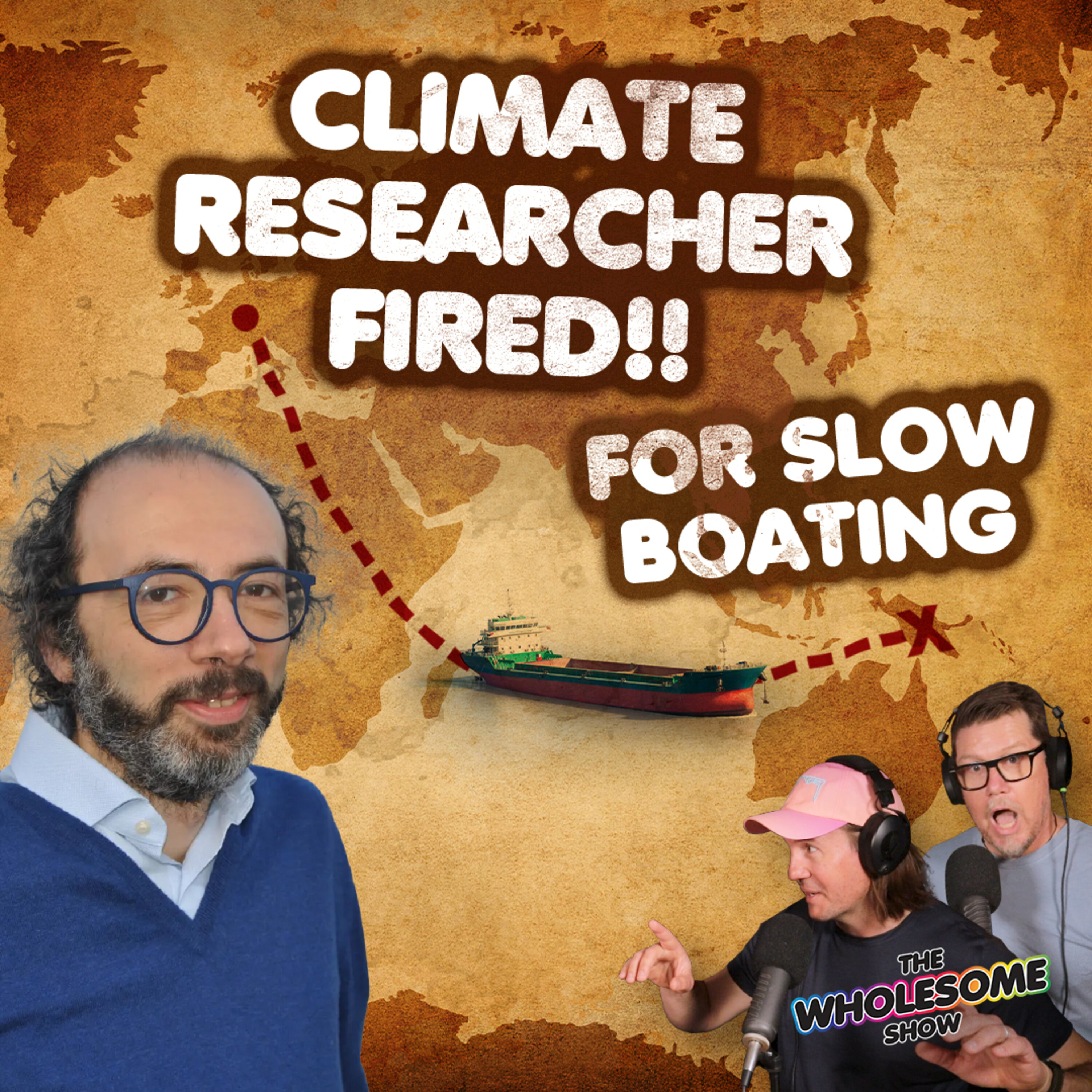
Fired For Slow Travel: A Chat With Climate Scientist Gianluca Grimalda
Picture this: you're on a cargo ship in the middle of the Pacific Ocean, surrounded by a vast expanse of water when suddenly, you feel a sharp pain. No, it's not a metaphorical pang of regret for opting for the slow boat rather than the quick and painless intercontinental flight; it's an actual mite bite. Welcome to the wild world of Gianluca Grimalda, a climate scientist with a penchant for slow travel and an unwavering commitment to the environment… machete-wielding gangsters, bed bugs, job loss and all. While some of us fret about recycling and turning off lights, for Gianluca, hopping on a plane is morally unacceptable as it accounts for 90% of his carbon footprint. Planes emit a whopping 2.5% of total CO2 emissions and are responsible for 4% of effective radiative forcing - a closer measure of the impact of global warming. And with literally 6 million people taking flights every single day (not to mention the thousands of empty planes airlines fly across our skies to keep their flight paths safe), those figures aren’t going to land any time soon. So what’s the solution for a dedicated German-based scientist whose fieldwork is located on the other side of the world Bougainville, Papua New Guinea? Slow travel, of course! Gianluca has had an impeccable 13-year record of conscientious objection to flying, opting for slower, more sustainable methods of travel. We’re joined by Gianluca himself today to hear about his epic journey from Papua New Guinea back home to Germany, avoiding planes and choosing ferries, cargo ships, trains, and coaches as his mode of travel. All while attempting to avoid pirates, war-torn countries, visa debacles and with this ultimatum from his boss… fly back now or lose your job. Gianluca's primary mission in Papua New Guinea is to study how people adapt (or don’t) to climate change. Coastal communities there have already relocated inland due to sea-level rise and drought-induced famines. Climate change isn't just a concept in the distant future, it's affecting them now. And rather unfairly we might add, as they tread remarkably lightly on their patch of the planet. So he made a promise to the people of Bougainville. Gianluca would reduce his carbon footprint as much as possible. Even if it meant losing his job (which he did). What a freaking legend. You might say that the best way to reduce carbon emissions would be to not travel at all. Why not take that to the extreme and kill yourself? That would sort out your emissions nicely. But considering the incredible work Gianluca is doing in these remote communities to raise awareness of what’s really happening to our planet, the reason WHY they have no crops and WHY their coastal communities have had to relocate inland… Gianluca concludes the benefit far outweighs the cost. “The more mad option, than losing my job over a single plane flight, is to return to business as usual as if earth’s resources are unbounded.” GIanluca’s commitment to his conservationist morals is nothing short of amazing. Leading by example, he hopes people who come across his amazing story will question both their need for air travel and their broader everyday decisions amidst a climate crisis actively impacting people right now. SOURCES: Climate change and flying: what share of global CO2 emissions come from aviation? Our World in Data Climate expert ‘sacked’ after refusing flight to Germany over carbon emissions, The Guardian How Many Flights Per Day Take Off and Land, Trip.com See omnystudio.com/listener for privacy information.

Richard Walter: America’s Dollar-Store Sherlock Holmes
The 1980s had some memorable fads and crazes—hair metal bands, neon leotards, the Walkman… and criminal profiling! By the mid-1980s, profilers were regularly consulting with the FBI to solve challenging cases and the job was attracting big personalities. Soon after, criminal profiling became a pop-culture sensation, thanks in large part to the 1991 blockbuster, The Silence of the Lambs. One big name, and even bigger ego, in the criminal profiling world, was Richard Walter. Walter had an impressive resume, claiming to have reviewed thousands of murder cases, written criminology papers, lectured at universities, and served as an expert witness on hundreds of trials. Having worked as a staff psychologist at a prison in his earlier years, Walter had a profound understanding of the criminal mind. And he loved telling everyone about it. In 1982, Walter served as an expert witness on a trial that convicted Robie Drake of second-degree murder and sentenced him to more than 40 years in prison. Walter was able to convince the jury that an accidental shooting followed by panicked stabbing and body hiding was all based on a sexually perverse rampage by Drake in the name of piquerism (the sexual interest in penetrating the skin with sharp objects). What was the end of Drake’s freedom became the beginning of Walter's new career as a criminal profiler. Walter loved nothing more than cheeseburgers, cigarettes, reducing all motives down to sexual perversion, and being the centre of attention. Toward the end of 1989, Walter befriended Frank Bender, a forensic sculptor, and Bill Fleischer, an ex-FBI agent with a penchant for murder. The three of them hit it off and formed The Vidocq Society, named after Eugène-François Vidocq, a 19th-century French criminal turned detective who is considered the father of modern criminology. Before long, The Vidocq Society was helping the FBI and county police solve cold cases left, right and centre and they were a hit with the media too. There was even a book written about the club, leveraging heavily off Walter’s impressive resume. One case in the book which Walter claimed credit for solving was the famous Australian murder case of former beauty queen, Anita Cobby. But when lead investigator, Ian Kennedy, was questioned about Walter’s involvement in the case, he had never heard of him. The same goes for the case of Paul Bernard Allain. Walter very quickly concluded that Allain’s boss had murdered him in a homosexual affair gone wrong. However, even cursory fact-checking revealed Allain didn’t appear in any legal documents or publicly recorded databases. Walter’s rebuttal: “Oh, I work on many super secret, high-profile cases that you can’t find anything out about”. Also for the record, Walter seemed to have a bit of a preoccupation with linking murders to sex crimes or homosexuality. Homosexual panic was his default motive. Now, back to Robie Drake. While serving his time in jail, Drake started doing his own profiling on Walter and asked for his case to be reviewed citing numerous lies from Walter about his own expertise. The courts eventually reviewed the case only to find further evidence against Drake (remember, Drake was definitely guilty) and extended his sentence to a further 10 years in prison BUT it was discovered that Walter had perjured himself. This triggered several other cases reliant on Walter’s expert testimony to be revisited. And as of this year, at least three murder convictions have been overturned. So how much of Walter’s resume was slightly padded versus a bold-faced lie? Why did he avoid detection and/or punishment? How many wrongful convictions and overly severe sentences remain out there? And tell me, listener, have the lambs stopped screaming? SOURCES: The Case of the Fake Sherlock - Richard Walter was hailed as a genius criminal profiler. How did he get away with his fraud for so long? 11 April 2023 The Vidocq Society: Murder on the menu Telegraph UK 21 November 2008 Drake a free man after 32 years | Local News | lockportjournal.com By Amy Wallace 6 Nov, 2014 See omnystudio.com/listener for privacy information.
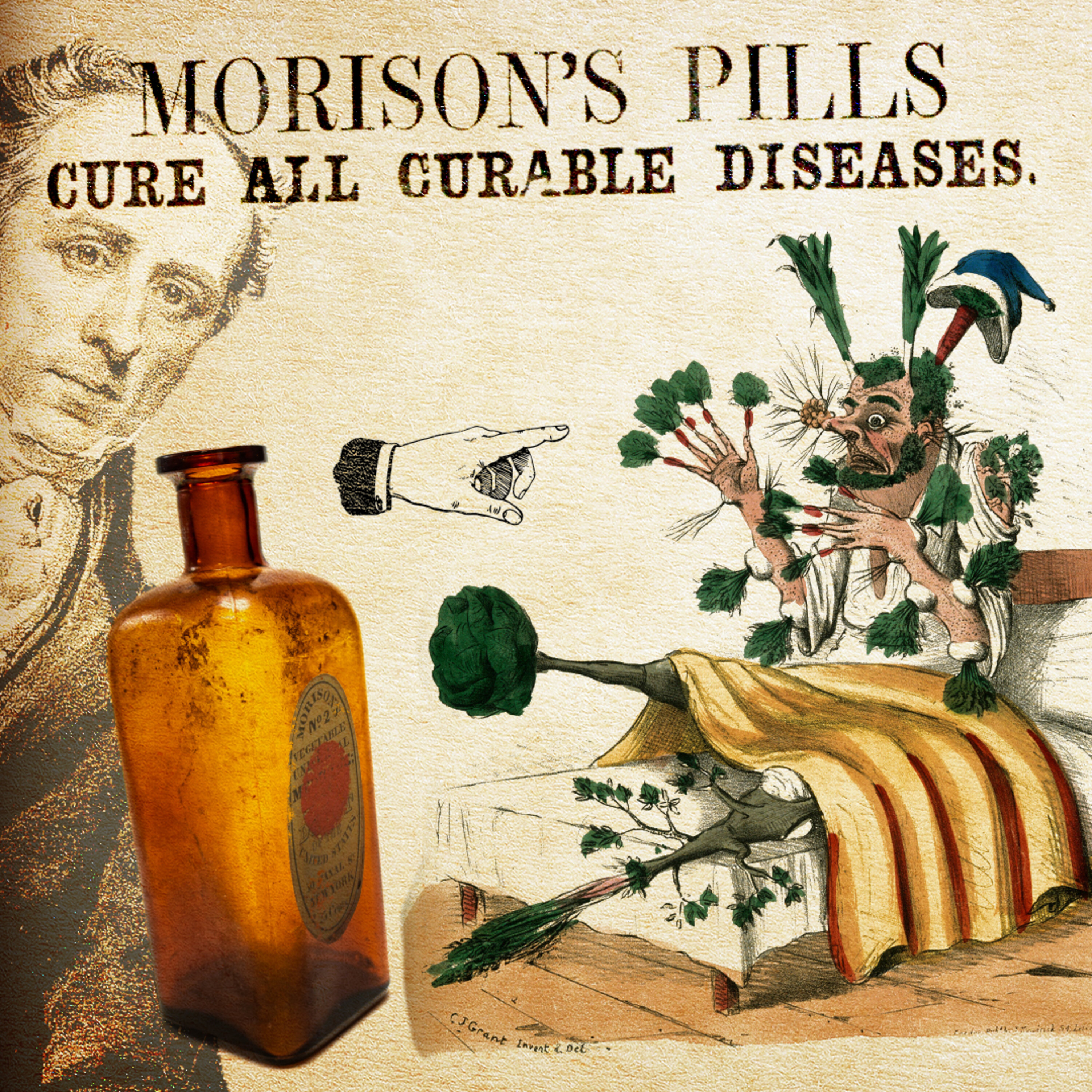
Shit Yourself Healthy: Quack Doctor Prescribed The Squirts For Everything
What do people who have a dull singing voice, contract syphilis, and die suddenly have in common? Well, according to a book (with the longest title EVER) published in the 18th century by James Morison, the answer was quite simple. Not enough poo. Born in Aberdeenshire in 1770, James Morison was a bit blocked up. Well, more than a bit. For 35 years, he lived in inexpressible suffering. Having tried every course of treatment known to the medical establishment at the time and still no relief, Morrison’s agony forced him to take matters into his own hands. Using a secret mix of herbs and spices, including aloe, a Mexican climbing plant, cream of tartar and myrrh, Morrison took to medicating himself in the form of little pills. Turns out they had quite the laxative effect and soon enough, he was feeling like a new man! Nice and empty. Morison kept his cure a secret for a while, sharing his squirty poo pills with some friends now and then. But within a few years, he decided that everyone, young and old, ailment or none, needed to take his medicine. He boasted that the squirts would cure everything. And we mean everything. So in 1825, he went to market selling his Vegetable Universal Medicine. Pills to purge yourself healthy! With claims to cure anything and everything from teething to whooping cough and sudden death, Morison started a crap-yourself-to-health campaign that went far and wide. The universal medicine was sold everywhere. You couldn't go into any apothecary, pharmacy, or even a library in England and not see Morrison's poo pills. Not only did Morison claim that his pills would cure absolutely anything, he stressed that people shouldn’t stop taking them when they felt worse, but rather, increase their doses! The more shit the better. And you should take the medicine even if you don’t suffer from any ailment. Give yourself diarrhoea just in case. Spoiler alert, this guy was a quack. Just in case you didn’t pick that up. But despite Morison's belief that you could take 40 of the pills without any ill effects, you guessed it, there were some unfortunate deaths. See, Morison sold the pills to agents who pretended to be doctors who then sold them to everyday people. One ‘agent’ named Robert Salmon was convicted of manslaughter for administering over a thousand pills over the course of 20 days to a man named John Mackenzie... for knee pain. He had taken 72 pills the day before he died a presumably excruciating death. With another 12 deaths investigated a year later, the medical establishment, whom Morison thought were a bunch of idiots, fought back fiercely. But although Thomas Wakley, editor of The Lancet, spearheaded a campaign to discredit Morison's pills and theories and warn the public about the dangers of Morison's "cure-all" remedy, The Universal Medicine pills still remained popular until the 1920s. Did Morison ever pay for his outlandish and irresponsible claims? And hey, we all love a good purge. But perhaps in the case of turds, it’s possible to have too much of a good thing. SOURCES: Morisoniana, by James Morison Graphic battles in pharmacy, Wellcome Collection James Morrison: The Doctor Who Made His Patients Poop Themselves To Death, by James Felton Meet James Morison, The 19th-Century Quack Doctor Who Tried To Cure Everything With Laxatives, by Marc Hartzman The pills that cured all ills; James Morison the Hygeist (1770-1840), Kensal Green Cemetery by David Bingham See omnystudio.com/listener for privacy information.

Accidental Incest: The Lesser Known Consequence Of Prolific Sperm Donation
A lesson every kid needs to learn is how to share. Little ones usually want everything for themselves, but as we grow and mature, we learn that sharing is caring. But there are some who have perhaps taken sharing too far. Sperm donation. It’s a massive industry, helping hundreds of thousands of families enter into the joy of parenthood. Whether it's for altruistic reasons, the inherent desire to spread their wild oats, or just to earn some quick cash (2 minutes is all it takes), many men choose to donate. But for whatever reason, some men seem to like living that donor lifestyle a little too much, popping off as much as they can to germinate their genes far and wide. However, the consequences of rampant sperm donation can lead to unexpected and troubling encounters, especially when donors father multiple children who may unknowingly swipe right on their sibling. This happened to the offspring of a Dutch donor known as “Louis”, who was suspected of having 200 offspring, some of whom encountered each other on Tinder. Imagine this scenario: British twins separated at birth, adopted into different families, and then, unbeknownst to them, they got married. To each other. It might sound like the plot of a daytime soap opera, but it actually happened. Of course, there are rules around how much sperm one man can donate. But the rules vary from country to country and they’re not very well enforced. And for the eager beavers out there, there are ways around regulations that might impede the narcissistic spread of their seed. For one thing, they could become a fertility specialist like Dr. Jan Karbaat, who swapped out the juice cups and fathered at least 68 children, violating Dutch rules. There are also private donation clinics that not only pay a little more but just take your word for it that you’re not donating anywhere else. But the mega sperm donor award goes to Jonathan Meijer, who didn’t seem to care for regulations and is believed to have fathered hundreds of children through sperm donation. His actions came to light when the Dutch Donor Child Foundation filed a lawsuit against him for increasing the risk of accidental incest. After being blacklisted from donating in the Netherlands (he lightened his load in 11 clinics), Meijer took on a nomadic donor life, donating sperm in multiple countries and privately over the internet, often using assumed or fake names to bypass restrictions. He has confirmed children in Australia, Italy, Serbia, Ukraine, Germany, Poland, Hungary, Switzerland, Romania, Denmark, Sweden, Mexico, and the USA. Meijer saw his donations as acts of love. He was, after all, a blonde musical Viking. So what’s stopping more of these mini Meijers from hooking up with each other? And would you buy a cup of juice from a random person at a train station? SOURCES: Sperm Donor Who Fathered About 550 Children Faces Lawsuit for Increasing Risk of Accidental Incest | Complex by JOSE MARTINEZ Mar 31, 2023 Jonathan Meijer, father of up to 600 children, banned from donating sperm by Dutch court - ABC News The Case of the Serial Sperm Donor - The New York Times By Jacqueline Mroz Feb 1, 2021 Unknowing twins married, lawmaker says - CNN.com I fathered 800 children, claims sperm donor - BBC News By Natalie Morton & Sarah Bell 13 January 2016 Did a pair of twins really get married by mistake? | Family | The Guardian By Jon Henley Jan 15 2008 See omnystudio.com/listener for privacy information.

The Collapse And Concealment of the "Unbreakable" Banqiao Dam
By the second half of the 20th century, humans were captivated by the idea of taming nature, making their mark on the world with colossal concrete structures. They’d gone absolutely - sorry about this - dam mad. From democrats to dictators, the latest craze for politicians around the globe was to build dams. And for good reason! Dams are used to produce hydroelectricity, provide irrigation, protect against floods and give more work for more citizens. What could be bad about a dam? Well, many many things. Yes, dams are great. But they’re also vast potential weapons of mass destruction - and they’re sitting right above our cities all around the world. Chairman Mao, the leader of the Chinese Community Party, was one who hopped on the dam bandwagon. He decided to focus his dam efforts on the Huai River, which was particularly subject to flooding, and build the Banqiao Dam. But from word go, there were some problems. The vice premier at the time said that worrying about flooding was counter-revolutionary and reactionary. Flood protection was for wusses. Instead, they wanted to focus efforts on harnessing the POWER of the water for irrigation and hydroelectricity. During the construction of the dam, one brave hydrologist named Chen Xing dared to speak up about the fact that the dam didn’t have enough sluice gates installed. Kinda a problem in the event of a flood. But he was labelled a right-wing opportunist and fired. Or sent to a labour camp for reeducation. The waters are murky on that detail. Around the same time, the Chinese government was also chopping down forests all over the place to make way for steel manufacturing. And as we know, deforestation equals changes in weather patterns and more extreme flooding. Sigh. But despite the warning signs, the dam was built in the early 1950s. It was declared to be an iron dam that could not be broken. Strong enough to withstand a one in 1000 year flood event (a storm that would unleash about 0.5 meters of rain over 3 days). And then, in August 1975, along came Typhoon Nina, creating a monstrous weather pattern that dumped three times as much water as that dreaded 1000-year event. In a few days, Banqiao dam was at capacity. So they opened up the sluice gates. Oh damn, they were too cheap and didn’t listen to Chen Xing so there weren’t enough of them. The water kept rising. Next idea - sandbags? Despite the army’s efforts to control the water (yes, they tried sandbags on top of the dam wall), the dam was soon pulverised by hundreds of billions of litres of water. Disaster struck. An inland tsunami 10 metres high and 11 kilometres wide travelled down into the valley at 50 km/h, wiping out the 9,600 citizens in the town of Daowencheng. Everything and everyone in its way was destroyed. Famine, infections and epidemics followed in the horrendous aftermath. It’s estimated that the Banqiao dam collapse killed up to 250,000 people. But here’s the thing - this all happened during a time when the Communist Party of China had a lot of control over the media... And they didn’t want anyone to know about their dodgy dam. So how long before the world knew the truth about what really happened that day? Surely nobody would deliberately collapse a dam. Would they? PREVIOUS EPISODES MENTIONED: The Potato Blight (There Is No Such Thing As A Natural Disaster) SOURCES: 230,000 Died In A Dam Collapse That China Kept Secret For Years in Ozy Reflections on Banqiao by Fiona Macleod The Catastrophic Dam Failures in China in August 1975 by Thayer Watkins The Fatal Engineering Flaws Behind the Deadliest Dam Failure in History in Popular Mechanics The Largest Act of Environmental Warfare in History by Steven I Dutch Typhoon Nina–Banqiao dam failure, in Britannica See omnystudio.com/listener for privacy information.

Behind The Ig Nobel Prizes With Founder Marc Abrahams
Every once in a while, somebody does something in the name of science that turns out to be really useful. Their research changes the world, a eureka moment catapults them onto the world stage for making scientific history. They might even be awarded a Nobel prize. But what about the science we don’t hear about? We don’t often witness the shock, the surprise, and, most importantly, the humour behind the scenes in moments of discovery. The things people set out to do that really matter to them and turn out to be hilarious. Like personally building and testing a suit of armour that would protect you from grizzly bears. Or analysing the forces required to drag sheep across various surfaces, and discovering that it's easier to drag a sheep downhill. Or one of our personal faves - a bomb that, if deployed, would make enemy soldiers become irresistibly sexually attracted to each other. Now that’s the kind of science we love to talk about. And that’s exactly why the Ig Nobel prize exists. This prize is not about making the best or most impactful discovery. The Ig Nobel Prize is awarded to someone who has done something that makes people laugh and then think. It’s bringing the jokes back into science! In this episode, we’re joined by the man himself, the founder of the Ig Nobel Prize, Marc Abrahams, to talk about where the idea for the prizes came from and some of the funny things people have done in their pursuit of science. To be clear, none of the Ig Nobel Prize winners set out to win an Ig Nobel Prize. They were all legitimately trying to discover something that they believed was important. They just didn’t know whether it would be utterly worthless or so incredible that it would change the world. The point is, it’s science. Like the Psychology Prize that was awarded to German scientist, Fritz Strack, for discovering that holding a pen in your mouth makes you happier… and then disproving himself and realising that it actually doesn't. Lol. And the Medical Education Prize that went to Japanese doctor, Akira Horiuchi, for his lessons learned from self-colonoscopy in the sitting position. Rest assured, if you're on a desert island and you do need to do a colonoscopy by yourself, it can be done! One thing that’s really cool about the Ig Nobel prizes is that if an entry doesn’t fit into an existing category, they just invent a new one. It’s wonderful to think about curiosity and play coming back into the centre of the scientific process and that every day people are being recognised for their wacky and wonderful discoveries. Did we mention that the reward for the 2023 Ig Nobel Prize winners was a ten trillion dollar bill? MORE FROM IMPROBABLE RESEARCH: Website: https://improbable.com/ 2023 Ig Nobel Ceremony: https://www.youtube.com/watch?v=P9UQi0ORXv4 PREVIOUS EPISODES MENTIONED: The Heroes and Idiots of Scientific Self-Experimentation! https://www.youtube.com/watch?v=PJ-e0Ld-p0w The Life and Times of Alfred Nobel https://omny.fm/shows/the-wholesome-show/the-life-and-times-of-alfred-nobel Smart Toilets, Brain Pics, Corpse Comfort, Nuclear Moon, Space Fashion, and Super Conductivity https://youtu.be/WJhxFtrO9Mo?si=c7HCXK4I0wVSxqU7&t=580 SOURCES: https://improbable.com/ig/2023-ceremony/ https://improbable.com/ig/about-the-ig-nobel-prizes/ https://improbable.com/ig/winners/ See omnystudio.com/listener for privacy information.
Snap, Crackle, Peep! Cereal box cartoons are watching your kids
Cereal, the food of the gods. Who can resist the crunchy, sugary deliciousness in a box? Kids (admit it - adults too) would eat it for every meal if they had the chance. But have you ever wondered why you choose the cereal that you do? Did one in particular catch your eye? See, there’s a heck of a lot of money that goes into marketing, especially products made for kids, and especially cereal. Fruit Loops, Coco Pops, Frosties - what do they all have in common? Those happy spokes characters on the box suggest to us how delicious the cereal is with their inviting facial expressions! It’s almost like they’re gazing right into your eyes telling you to pick them up and put them in your trolley. Now one group of people who understand the importance of eye contact are marketers. And there’s a very specific reason why cereal companies place their sugary breakfast food (if we can call it food) on the lower shelves: prime real estate for kids with hungry eyes. A 2015 study led by Professor of Marketing, Brian Wansink, aimed to take an even closer look at ways in which cereal companies could persuade children to beg their parents for their products. The study was aptly named “Eyes in the aisles: Why is Cap’n Crunch looking down at my child?” It’s a great name, we’ll give them that. They already knew about the warm and fuzzy feelings spokes characters ignited in kids. What they wanted to know was, what precise angle did they need to draw their eyeballs to create direct manipulative eye contact with children in the grocery store? You’d think marketing to kids would just be a matter of whacking a bunch of colour on a box and stamping it with a happy cartoon character. But no. Apparently it comes down to trigonometry. The study was a bit outrageous really. A stupidly complicated three-step process to determine the exact eye contact angle, followed by a very loose interpretation of data and some fairly unsubstantiated claims. Like, there are actual problems in the world. And then there's this. But hey, they say breakfast is the most important meal of the day (you know who actually invented that saying? Dr. John Harvey Kellogg! Father of breakfast cereals! How’s that for an undeclared bias!?). So, do cereal sales actually increase if a spokes character locks eyes with a child in the cereal aisle? Or does the creepy eye contact make you feel watched, observed, judged and subsequently want to make a healthier choice? Perhaps carob-flavoured steel-cut oats instead. Also, what does a cereal box have in common with a Hindu god? PREVIOUS EPISODES MENTIONED: Food Hacks or P Hacks: The Dodgy Insights of Brian Wansink SOURCES: Musicus, A., Tal, A., & Wansink, B. (2015). Eyes in the aisles: Why is Cap’n Crunch looking down at my child? Environment and Behavior, 47(7), 715–733. https://doi.org/10.1177/0013916514528793 Cap'n Crunch is staring at your kid for a reason https://www.cnet.com/science/capn-crunch-is-staring-at-your-kid-for-a-reason/ https://www.science.org/content/article/meet-data-thugs-out-expose-shoddy-and-questionable-research IMAGE CREDITS: Toucan Sam: By Kellogg’s - Original publication: Froot Loops Marketing. Source: https://www.frootloops.com/en_US/meet-toucan-sam.html, Fair use, https://en.wikipedia.org/w/index.php?curid=69321050 Coco Pop Monkey: By Kellogg’s. Fair Use. Source: https://www.kelloggs.com/en-za/products/coco-pops.html Tony The Tiger: By Kellogg’s, Daryl Graham - [1], Fair use, https://en.wikipedia.org/w/index.php?curid=57229360 Snap, Crackle and Pop: By Kellogg’s. Fair Use. Source: https://www.creativereview.co.uk/snap-crackle-pop/ Cereal Box Wallpaper in Thumbnail: Armando Olivo Martín del Campo, CC BY-SA 4.0 https://creativecommons.org/licenses/by-sa/4.0, via Wikimedia Commons See omnystudio.com/listener for privacy information.
Dying For It: A Scientific Look At Death During Sex
While some people shuffle off this mortal coil in rather ordinary ways, there are those adventurous souls who seem hell-bent on making the grim reaper scratch his head in confusion. Like drowning in a pool of beer, throwing dynamite out the window of a moving vehicle (but forgetting to roll the window down), tripping on your world record breaking beard, and death during sex. Yes, that’s right. As much as we all like getting it on, there are some people throughout history who literally went out with a bang. Like Pope John XII for example. He had his work cut out for him. Not only was he just 17 when he landed the gig as the supreme boss of the Catholic Church, but he also liked the ladies. A lot. Call him sensual, adulterous or depraved, but this guy knew how to have a good time right up until the moment of his death. Either he died of a stroke, was beaten to death with a hammer or was thrown out the window by the husband of the woman he was having… a good time with. What else would the richest and most powerful man-child of Rome be doing? Apparently, death in the saddle isn’t all that uncommon. Former Australian Prime Minister Billy Snedden succumbed to his fate during an adrenalin-filled evening with his son’s ex-girlfriend. There’s also 79-year-old Nelson Rockefeller, former US Vice President, who stayed back to work on a “project” with his 25-year-old research assistant. What a shame… He thought he was coming, but he was actually going. In 1974, Paris’ most respected senior churchman and the author of fourteen books on sexual morality, Cardinal Jean Danielou, also carked it on the stairs of a brothel. But of course, he was just on his way to offer “comfort” to a nice young lady in an official capacity only. There was also Felix Fauré, the President of France at the end of the 19th century who slipped away for some special time with his mistress. Let’s just say it didn’t end well… for either party. He died mid-act of a cerebral haemorrhage and she was left with nothing but trauma-induced lockjaw, requiring surgical removal of Felix’s lil’ friend from her mouth. Does this kind of thing just happen to old dudes who can’t handle the heat? Or are there other explanations for why some lovers seem to ride all the way to the pearly gates? Well, turns out you’re more likely to die from the deed if it’s an unfaithful one. Also doing dumb stuff like sex on balconies or in a car filling up with carbon dioxide. So how common is it for people to die while doing it? Would it be less deadly if we did it more? And wait, Viagra is implicated?! Word of caution to all those young (and old) lovers out there: Don't get naked near lions, steer clear of homemade electrical pleasure aids, and maybe don’t do it on a billiard table. SOURCES: 5 people who died during sex and 100 other terribly tasteless lists by Karl Shaw Association of Episodic Physical and Sexual Activity With Triggering of Acute Cardiac Events in JAMA by Issa J Dahabreh and Jessica K Paulus Lots of People Die Every Year During or After Having Sex. A Pathologist Explains Why on ScienceAlert Sexual and Cardiovascular Correlates of Male Unfaithfulness in The Journal of Sexual Medicine by Alessandra Fisher et al Thunderclap headache with Orgasm: A case of Basilar Artery Dissection in Clinical Communications by Elizabeth Delasobera See omnystudio.com/listener for privacy information.
Medical Cannibalism: Biting Into The History Of Corpse Medicine
One question that pervaded the minds of early European physicians was not whether we should eat human flesh, but rather which part and how much. While cannibalism might conjure up images of wild savages, it turns out medical cannibalism was all the rage back in the day... and continues to be (say what?!). The “healthy” consumption of humans goes a long way back, like in the 11th century when people started eating bits of Egyptian mummies. Nothing like a bit of powdered mummy to upgrade your muesli. They were a sought-after medicinal ingredient, rising from the dead to cure the living. By the 17th century, mummies were seen as a panacea - an entire apothecary cabinet wrapped in dry brown flesh. Delicious! The problem was there weren’t enough mummies to go around. So of course, the cunning European entrepreneurs decided to mummify executed criminals, slaves and poor people to create more magical healing goo. Think of it like a quick pickle you might do at home versus the proper jar you might buy at the store. Jamie’s 15-minute mummy. They even had special recipes. Apparently, it’s as simple as salting a corpse, cooking it in your corpse-compatible oven and grinding it into a powder. German physician, Johann Schroeder had a very precise recipe. The main ingredient was a “24-year-old unspotted redhead who had been executed and died a violent death”. After cutting the flesh, a lovely sprinkle of myrrh and aloe and soaking in spirits to keep the smell away. But medical cannibalism wasn’t just about consuming mummies. 15th-century Italian scholar, priest and philosopher, Marsilio Ficino, taught that elderly people hoping to regain the spring in their step should “suck the blood of a clean and happy adolescent”. And when fresh blood was hard to come by, a Franciscan apothecary even had a lovely blood marmalade recipe from 1679. Human fat was also a go-to healing ingredient. The executioner would deliver it by the pound to the apothecary, known to jubilantly cry out, “More cushion for the potion!” Okay, we made that tagline up, but who could resist such a morbid pun? Bones, what with all their desiccated denseness, were surely not a target for this cannibalistic quackery… WRONG! The human skull was wildly popular. 17th-century English physician, John French, offered at least two recipes for distilling skulls into spirits capable of curing stomach troubles, epilepsy and getting rid of the passion of the heart. Obviously. There was also coffin water to cure warts, and yes, even dried poo applied to the eyes via a powder was said to heal cataracts. Those crazy Euros had really tapped into the magical power of gross things. So when did all this madness end? You might be surprised to hear that it continues TO THIS VERY DAY! PREVIOUS EPISODES MENTIONED: Faecal Microbiota Transplants! Anthropophagy! (It Means Cannibalism)! SOURCES: The Gruesome History of Eating Corpses as Medicine, Maria Dolan, May 6, 2012 The gory history of Europe’s mummy-eating fad, Erin Blakemore May 2, 2023 A Brief History of Medical Cannibalism: Curing what ails us with mummy, blood jam, and human fat, Bess Lovejoy November 7, 2016 European ‘Corpse Medicine’ Promised Better Health Through Cannibalism, Natalie Zarrelli, October 31, 2017 See omnystudio.com/listener for privacy information.
From Jazz to Beheadings: Landis' 1920s Psych Experiment
Ahhh 1920s psychology… back when you could do anything in the name of science. Like traumatising a baby or making people believe they'd killed someone. The good old days. Picture this: It's 1924, and Carney Landis, a psych graduate student at Minnesota University, has an ambitious idea. He wanted to determine if humans had universal facial expressions for various emotions. Now in order to do this, he needed to recruit his fellow graduates, who were more than willing to be subjected to Landis’ various experiments. At first, it started out quite tame. A bit of jazz music, a bit of Bible reading, but no pattern of repeatable facial expressions emerged with such basic stimuli. Time to turn up the dial, bringing in new stimuli to elicit fear, disgust, sadness, and pain. Yes, that was his goal. Remember this is 1920s psychology. No rules. In comes pornographic images (likely contraband pictures of ankles and armpits) and to really get things going, some medical photos of people with horrendous skin conditions. Ewww. But still no average response. Now Landis brought in the big guns. Literally. He fired surprise gunshots in the hopes of getting some kind of universal response… But still nothing! What about getting them to stick their hand in a bucket without knowing what was inside?! It could be anything! It was in fact a bucket full of live frogs with a little surprise down the bottom - electrical wires that produced a shock. The man was a genius. Have we mentioned that one of the test subjects was a 13-year-old patient with psychological issues and high blood pressure? All above board. Carry on. Just when you’re thinking Landis would’ve packed it all in and given up on the elusive average facial expression response, he escalated the stimuli even further. Participants were presented with a live mouse and a sharp knife. Have a listen/watch to find out what he made them do (remembering the 13-year-old was roped into the study too). So did Landis reveal any universal facial expressions in response to his ever-escalating stimuli? Or did the aftermath of this classic 1920s psych experiment leave only electrocuted frogs, blown eardrums, and traumatised children? While Landis's experiment was extremely subpar on the ethical front, it does raise intriguing questions about our ability to read emotions. Humans possess a nuanced understanding of each other's emotions as seen through facial expressions alone, even if we can't pinpoint the exact facial patterns that we are picking up on. Thanks, no thanks, Landis. SOURCES Landis, C. (1924). Studies of emotional reactions. I. 'A preliminary study of facial expression." Journal of Experimental Psychology, 7(5), 325–341. https://doi.org/10.1037/h0076072 CARNEY LANDIS | American Journal of Psychiatry The psychology experiment that involved real beheadings The Carney Landis Experiment | Bizzarro Bazar See omnystudio.com/listener for privacy information.
Iroquois Theater Blaze: The Tragic Fire That Ignited The Evolution Of Exit Lights
Believe what you will about the Gods, karma, the universe, whatever! There are some rules that even atheists should follow. Never call your boat “unsinkable”. Don’t call your machine gun “peace-producing”. And DO NOT, for the love of Shakespeare, describe your playhouse as “absolutely fireproof”. It seems that whenever arrogance takes precedence over public safety, the gods have something to say about this hubris. This episode is as horrific as you might guess, but it does make us wonder just how horrible things have to get before we make change. When the doors of the Iroquois Theater opened in 1903, it was said to be the most beautiful in all of Chicago. A masterpiece adorned with mahogany and glass doors, marble and gold pillars, and a grand central staircase. Boasting a seating capacity of 1,600 people on three levels, the Iroquois promised a night of enchantment to all. Better still, it was declared in playbills and advertising to be “absolutely fireproof”. People back then were justifiably worried about theatre fires so the architect studied every previous theatre disaster to avoid anything happening at the Iroquois. His solution and therefore justification for making such a confident (some might say arrogant) claim was a state-of-the-art asbestos curtain. If there was a fire, the stagehands would simply lower it down on stage. And as if that wasn’t enough, they also had handy Killfyre tubes (think of a poster tube with bicarb soda in it) as if they’d even be needed. But opposition to this hubris came in the form of the editor of Fireproof Magazine. Despite its claims, the Iroquois was far from fireproof. Lack of proper exits, exposed reinforcement, and inadequate firefighting equipment became glaring issues. There were also no sprinklers, alarms, telephones or water connections and only one common (albeit opulent) stairway, despite Chicago fire ordinances that required separate stairways and exits for each balcony. Caution to the wind, the fateful day arrived for the matinee performance of "Mr. Blue Beard." The audience, mostly women and children, excitedly filled every seat and occupied standing room everywhere else. As the show entered its second act, a spark from a stage light ignited drapery high above the stage. Stagehands whipped out their trusty Killfyre tubes only to find they couldn’t toss the powder high enough. Next up, the fail-safe asbestos curtain… snagged on the way down. And then it very quickly became apparent that the fire could not be contained. Panic ensued and audience members bolted from their seats toward whatever exit they could find. But you’d need the gods on your side to find an exit in the Iroquois Theater. The forward-thinking architect deliberately hid them, citing a more pleasing aesthetic. Once eventually found, the scorched patrons were greeted with a puzzling DaVinci-code-style mechanism to unlock the doors. Worse still, the doors opened inward and some were even fake, painted-on doors. There was one upper-level fire escape, but it lacked an exterior ladder down to the ground. Two large flues on the rooftop where the smoke and flame could have vented out were boarded shut. It was as if Lucifer himself designed the Iroquois. An estimated 575 people died that day and at least thirty more over the following weeks. As word of the staggering death toll spread, the city was overcome by collective mourning followed by a swift closing of all playhouses and implementation of stricter fire safety measures (enter that green glowing exit sign we’ve all seen everywhere). But was anyone held responsible for this horrifying event? SOURCES: Chicago death trap: The Iroquois Theater fire of 1903, by Nat Brandt People Thought Machine Guns Might Prevent Wars, in The Atlantic The Iroquois Theater Disaster Killed Hundreds and Changed Fire Safety Forever in Smithsonian Magazine The Tragedy of the Iroquois Theater Fire, on WTTW See omnystudio.com/listener for privacy information.
Increase The Productivity of Your Open Plan Office With "The Isolator"
Open plan workplaces. How do we feel about them? Now, we’re all up for modernism and advancement but when it comes to actually being able to get work done, open-plan workplaces SUCK. And there’s a lot of science to back that up. Basically, nobody gets shit done if they’re distracted all day long. There’s nothing worse than really being in the zone and then your colleague decides it’s an appropriate time to tell you about the annoying wart on their foot. No privacy, no quiet space to actually think and don’t get us started on the germ factor. So how the hell are people meant to survive in the workplace without murdering everyone around them? One proposed solution was for employers to enforce quiet time for a few hours daily. No crunchy snacks allowed! Or perhaps grow a hedge around your desk so people don’t even know you’re there. Or how about your very own enormous, spine-crushing, privacy helmet? Enter The Isolator invented by Hugo Gernsback in 1925. Gernsback was a Luxembourgish-American inventor, writer, editor, engineer, designer, businessman, and magazine publisher. He was a machine and boy did he go to town with this invention. The Isolator was designed to minimise visual reach, granting the wearer absolute concentration on whatever they were doing. Picture a helmet that looks like a cross between Darth Vader's headgear and a Victorian diving bell. Despite its steampunk aesthetic, the main issue was that the helmet was so sealed that it would fill with recycled carbon dioxide, causing people to get sleepy. Not to worry. He fixed that issue by adding an oxygen tank extension to the front, making it one humungous noise-cancelling diving bell helmet. Very appealing. Unsurprisingly, Gernsback’s middle finger solution to open-plan offices didn’t get the uptake he might have expected. Workers would just have to continue to put up with the cesspool of TMI, obnoxious laughter and disease-ridden sneezes from their colleagues. Well, not if the Ukrainian design company, Hochu Rayu, has anything to do with it. Introducing the "Helmfon," a blend of "helmet" and "phone" that burst on the scene in 2017. It's not just noise-cancelling; it's a compact isolation chamber with a microphone, Bluetooth, camera, and room for your smartphone. A personal oasis of focus in the midst of a bustling office environment. Solitude in the midst of chaos. Every introvert’s dream. So are distracted and disease prone workers finding solace in these oversized tech-nerd’s-dream helmets? Perhaps the only solution is to just get rid of bloody open office spaces altogether. PREVIOUS EPISODES MENTIONED: Open Plan Offices! Stats Porn! SOURCES: Why the Inventor of the Cubicle Came to Despise His Own Creation HISTORY Open plan offices are bad for business BI. 8 Proven Ways to Stay Focused in A Busy Office Staying Focused in a Noisy Open Office 7 Fullproof Ways to Block Out Noisy Coworkers for Good Zenbooth. 10 proven hacks for laser-guided focus in a busy office Creative Boom This Vintage Anti-Distraction Helmet Looks Like a Creepy Horror Show Prop This Isolation Helmet Completely Blocks Out Workplace Distractions The Isolator – A bizarre helmet from 1925 designed to improve work productivity The Vintage News Hochu-rayu See omnystudio.com/listener for privacy information.
Project Huemul: The First Nuclear Fusion Hoax
Imagine harnessing the power of the sun using nothing more than high school science lab equipment and household ingredients. Desktop cold fusion - it would be the biggest invention of the century! Well, that's exactly what Professors Stanley Pons and Martin Fleischmann thought they’d discovered in 1989. After experimenting with a palladium cathode in a simple heavy water electrolysis cell, they observed an unexpected rise in temperature. Confusingly, they concluded the solution was nuclear fusion! (Try saying that 3 times fast) Pons and Fleischmann were so excited that they even made an announcement to the press before having their studies peer-reviewed. Unfortunately, they didn't get the standing ovation they hoped for. On the contrary, their sensational cold fusion announcement was met with an even colder reception. The scientific community quickly doused their fusion fire, proving their 'invention of the century' to be a dud. But this wasn’t the first nuclear fusion hoax and it wasn’t even the biggest. Let’s go back to 1951 to a secret laboratory in a forest on an island in a lake high in the mountains. Sounds awesome already doesn’t it? It was here that Argentine dictator, Juan Perón, made the grand proclamation that his country had successfully liberated the energy of nuclear fusion. His man behind the magic was none other than Ronald Richter, a scientist with a dubious past and an even more dubious passport. Perón gave Richter free rein to build a nuclear fusion device, with dreams of providing unlimited power (cue Perón drooling) and transforming Argentina into a world scientific leader. After his first laboratory was destroyed by a fire, Richter demanded a more protected location away from spies and potential sabotage. So the construction of a 12-metre-wide, 4-metre-thick concrete cylinder began in a location deep within the country's interior on Huemul Island - aka Project Huemul - literally plunging the nation into a brick and cement shortage! Unfortunately, when it was complete, Richter noticed a crack on the outside which rendered the entire reactor useless and ordered for it to be torn down. Determined to soldier on, Richter began experiments in a much smaller 2-metre reactor. Lithium, hydrogen and sparks were flying everywhere and on 16 February 1951, Richter claimed he had successfully demonstrated fusion. And what do all good scientists do once they demonstrate something for the first time? They tear down their experimental setup and refuse to replicate! Richter razed his cold(ish) fusion reactor to the ground to make yet another one. In the end, Richter’s work was deemed as nothing short of a grand farce, but even these flops had their place in science history. They sparked a flurry of activity in the scientific community, leading to funded projects and continued research in the field of controlled fusion including the invention of the Figure 8 Stellerator (tell me that doesn’t sound like a 1950s women’s exercise device). Whether you are right or (unequivocally) wrong, science has learned something! SOURCES: El Secreto Atomico De Huemul, by Mario Mariscotti Proyecto Huemul: The Prank That Started It All, by Robert Arnoux The Cornell Cold Fusion Archive, by Bruce Lewenstein See omnystudio.com/listener for privacy information.
Lights, Camera, Olfaction: Smell-o-Vision Actually Existed
If you think cinema is just audiovisual entertainment, hold onto your popcorn folks, because today we're diving into an aromatic abyss of olfactory oddity when Hollywood engaged in the battle of the smellies. This isn't just a whiff of the absurd, but an honest-to-goodness tale of when Hollywood tried to tickle our nostrils along with our imagination. So did cinematic innovation cut the mustard or was it all just passing wind? Imagine going on a date to the cinemas, delighting your senses with panoramic views of Spain and then suddenly getting hit by a waft of, is that shoe polish? Welcome to "Holiday in Spain," a 1959 film that painted a whole new 'scent-scape' in the world of cinema. The film successfully broke the fourth wall, or should we say, the nose wall, by incorporating smell into the cinematic experience. It marked the introduction of Smell-O-Vision, a technology that promised an olfactory rollercoaster ride to audiences. The idea behind Smell-O-Vision was as audacious as it sounds. It aimed to titillate your smell buds (that's a thing, right?), offering a multi-sensory cinematic experience, basically treating your nose to a buffet of fragrances. But like many audacious ideas, it was easier said than done. Audiences expecting to be immersed in an aromatic plot found themselves amidst a mix of mistimed scents and a bouquet of confusion. But Smell-O-Vision wasn’t the only stinky boy in town. In a plot twist that could only happen in the '50s, Smell-O-Vision found itself nose-to-nose with its competitor, Aromarama. The late 1950s witnessed a stank-off between these technologies, each promising a sensory experience that would make your nose twitch. The fragrant face-off left audiences bemused, amused, and more than a little bit congested. Despite promising a revolutionary cinema experience, Smell-O-Vision didn't quite pass the smell test. "Holiday In Spain," the first Smell-O-Vision film, became a testament to the technology's flaws rather than its potential, ultimately evaporating from theatres as quickly as the scents it pioneered. Nevertheless, the idea of scent-enhanced cinema continued to tease the industry, making occasional cameos in films like "Polyester," which used a ‘scratch-and-sniff’ gimmick known as Odorama. Despite the smell-tacular failure of Smell-O-Vision, the dream of a multi-sensory cinema hasn't entirely vanished. From the whiff of an ambitious 'iSmell' concept in the 1990s to the 'smelling screen' of 2013, olfactory cinema continues to be a holy grail for some brave souls. But as we stand on the precipice of this aromatic abyss, one thing is clear - the journey to successfully integrate smell with cinema is proving to be one tough cookie to sniff out. And so, while we might not yet be able to smell our way through a film, we can at least tip our hats to Smell-O-Vision for the nostril novelty it brought to the cinematic table. Would you really want to smell everything you see on screen? Perhaps buttery popcorn and your date’s alluring aroma are more than enough to delight your senses. SOURCES: SCENT OF MYSTERY – Dennis Schwartz Reviews https://dennisschwartzreviews.com/scent-of-mystery/ The people who want to send smells through your TV - BBC Future https://www.bbc.com/future/article/20210104-the-reason-why-you-cant-smell-television-shows-yet DVD Savant Blu-ray Review: Holiday in Spain https://www.dvdtalk.com/dvdsavant/s4658spai.html Smell-O-Vision - Wikipedia https://en.wikipedia.org/wiki/Smell-O-Vision The Lingering Reek of Smell-O-Vision - Los Angeles Times https://www.latimes.com/business/la-tm-oops6feb05-story.html Scent of Mystery - Variety https://variety.com/1959/film/reviews/scent-of-mystery-1200419630/ "Scent of Mystery", the First and Only Use of Smell-O-Vision : History of Information https://www.historyofinformation.com/detail.php?entryid=4539 Behind the Great Wall (1959) - Charles Weiss, Carlo Lizzani | Synopsis, Characteristics, Moods, Themes and Related | AllMovie https://www.allmovie.com/movie/behind-the-great-wall-v229098 Michael Todd Jr., 72, a Creator Of Smell-o-Vision for Movies - The New York Times https://www.nytimes.com/2002/05/08/arts/michael-todd-jr-72-a-creator-of-smell-o-vision-for-movies.html Polyester (film) - Wikipedia https://en.wikipedia.org/wiki/Polyester_(film) Smell-o-vision screens let you really smell the coffee | New Scientist https://www.newscientist.com/article/mg21729105-900-smell-o-vision-screens-let-you-really-smell-the-coffee/ Japanese scientists create 'Smell-O-Vision' screen - CNET https://www.cnet.com/culture/japanese-scientists-create-smell-o-vision-screen/ https://www.newscientist.com/article/mg21729105-900-smell-o-vision-screens-let-you-really-smell-the-coffee/ixzz7Sw4dSahV See omnystudio.com/listener for privacy information.
Why The Japanese Coined "Karoshi": Death From Overwork
Everyone loves a good hack these days. It’s all about efficiency and finding ways to be even more productive. Well, that’s great for things like finding a quicker way to fold your clothes but when it comes to the workplace, the quest for more productivity can be taken a little too far. And by a little, we mean a lot. See, the aftermath of World War II left Japan in an economic disaster. Shigeru Yoshida, Japan’s prime minister at the time, prioritised rebuilding the economy by getting major corporations to offer their employees lifelong job security. All the employees had to do was give their loyalty in return. But over time, workplace loyalty has become more of a ‘til death do us part’ type thing. Quite literally. Surveys have shown that one in three Japanese men between the ages of 30 and 40 work more than 60 hours a week. Overtime is the norm. In fact, it’s not unusual for people to work 80 hours of overtime each week. Oh, did we mention that overtime is unpaid work? In the mid-1980s, nearly half of all the section chiefs and two-thirds of department chiefs in major companies in Japan were concerned they might DIE from overwork. And they weren’t just being dramatic: death by overwork is so common in Japan there’s an actual term for it: Karoshi. Heart attacks, strokes, diabetic coma, liver malfunction, you name it. All happening to young, overworked employees in the name of productivity. The first case was reported in 1969 when a 29-year-old man working in the shipping department of Japan's biggest newspaper died of a stroke. As you can imagine, death by overwork is something the Japanese government wasn’t too keen on investigating. I mean, can work really be the cause of death if the person wasn’t even getting paid for it?! Weren’t they just volunteering out of genuine loyalty to the company’s values? Who needs to see their children when they could be at work til 3am, right? Besides, people already waste too much time blowing their noses, walking to the toilet and wiping sweat off their brows! They couldn’t possibly work any less. But with young employees continuing to drop dead at their desks and families seeking compensation, the Japanese government took some, albeit small, measures to keep their employees happy… and more importantly, alive. Unfortunately, telling someone they can leave at 3pm on a Friday just means they’ll have a shit tonne more work on Monday. And the employees would probably be terrified of the ramifications if they actually left before midnight. So is work really worth dying for? And does death by overwork only occur in Japan or is it a worldwide phenomenon? Surely there’s a hack or two out there to stop this madness. PREVIOUS EPISODES MENTIONED: Anthropophagy! (It Means Cannibalism)! https://omny.fm/shows/the-wholesome-show/anthropophagy-it-means-cannibalism SOURCES: People fought for time off from work, so stop working so much, Fast Company Average Workweek by Country 2023, World Population Review What Is Karoshi? Behind Japan's 'Death by Overwork' Problem, Business Insider Karoshi-Death from overwork: Occupational health consequences of the Japanese production management (Sixth Draft for International Journal of Health Services - February 4, 1997) Jobs for life, The Economist Karoshi, Wikipedia See omnystudio.com/listener for privacy information.
The Monster Study: Gaslighting Orphans for Speech Science
The history of science is peppered with some pretty dubious research… grafting second heads onto dogs, growing bits of human brains inside mouse embryos, experiments with syphilis, and the list goes on. We have delivered many episodes on some pretty horrific things done in the name of science back in the day which is why we’re suitably discomforted by a study on orphan kids called “The Monster Study”. Born in 1906, Wendell Johnson stuttered grotesquely. He and his family went to great lengths to treat his stutter: sugar pills, a frightening (and disappointing) faith healer, and chiropractic work. At 16 he even attended a stuttering “school” where he chanted and swung dumbbells. None of it helped. Can’t think of why! Eventually, Johnson made his way to the University of Iowa to study English (he was more of a writing guy). Well, that university just so happened to be home to the most famous centre for stuttering research in the world. The coincidence! Diving into psychology for his master's study, Johnson became a speech pathologist because he needed one himself. The thing with speech is that you can’t test on animals so the students themselves became test subjects. They drew blood, hooked themselves to electrodes, and even shot guns off near each other's ears to see if it affected their stuttering. But it wasn’t all rogue science. Johnson made some significant observations through his early studies that convinced him that stuttering was conditioned; it was learned. Lead theories at the time were that the stuttering disorder originated in misdirected brain signals. But Johnson called bullshit. He was certain that stuttering was a learned behaviour. Damn those overreacting helicopter parents! So if stuttering was learned, that meant it could be unlearned but it also meant that it could be… taught. Enter the Monster Study, led by one of Johnson’s students, Mary Tudor. Luckily the university had an ongoing relationship with an orphanage where they could recruit unknowing research subjects. Well, that all seems above board. Within the orphanage, there were 10 kids who had an existing stutter. In weekly sessions, half of them were told to pay no attention to what others said about their speech and that they would grow out of it. The other half were told that their speech was terrible. Sigh. Another group of children who had normal speech were told they had symptoms suggestive of an impending stutter. They were told to never speak unless they could do it absolutely right! And then the last lucky group (again comprised of children with normal speech) were given compliments on their lovely enunciation. Sounds science-ish, right? Well, remember the kids who spoke normally and were scared into believing something was seriously wrong with their speech? Yeah, they stopped talking, performed worse in class, and became withdrawn and fractious. And although when they did speak, their speech was normal, they began to act like stutterers with inhibitive, sensitive and embarrassed demeanours. Feeling bad about her methods with these kids, Tudor went back to the orphanage to do some follow-up therapy. But it didn’t do much good. Her thesis sank immediately into obscurity but for a ghost life among Iowa speech pathology students; the university library its academic mausoleum. And then came the lawsuits. In 2003, three surviving orphans sued the State and University of Iowa for millions of dollars, citing among other things the infliction of emotional distress and fraudulent misrepresentation. Did the kids ever recover? And did Johnson end up finding a cause? Or is the road to stuttering paved with eagle-eared parents? PREVIOUS EPISODES MENTIONED: What The Hell Happened To The Left-Handers? Omnystudio https://omny.fm/shows/the-wholesome-show/what-the-hell-happened-to-the-left-handers Youtube https://youtu.be/Rfbr1YjRQ_I SOURCES: The Stuttering Doctor's 'Monster Study', Gretchen Reynolds March 16, 2003 https://www.nytimes.com/2003/03/16/magazine/the-stuttering-doctor-s-monster-study.html The “Monster” Study, Franklin H. Silverman, .I. Fluency disord. 13 (19881, 225-231) https://www.uh.edu/ethicsinscience/Media/Monster%20Study.pdf The Monster Study - Practical Psychology July 8, 2022 https://practicalpie.com/the-monster-study/ Why The Monster Study On Stuttering Was Unethical, Jeremy Dean https://www.spring.org.uk/2022/12/monster-study-stuttering.php See omnystudio.com/listener for privacy information.
How Your Shower Started As A Torture Device
In the 1700s, hydrotherapy was the panacea. John Wesley, the founder of the Methodist church, wrote in his book that cold water plunges could cure asthma, malaria, blindness, leprosy and even cancer (wait, did that say blindness?). But by the beginning of the 19th century, well-informed physicians wanted to get more precise about curing the insane. It was believed that one of the causes of mania was ‘hot brain’, a violent heat that boiled the blood and dried out the brain. Cooling the brain seemed an obvious solution. And so throughout the 19th century, various apparatus that harnessed therapeutic forces of water emerged to aid in “curing” the insane. And here we find the less relaxing and more barbaric origins of the shower. As we’ve discovered in many cases from that period of history, some people took it way too far. One guy who went to extremes was Dr Patrick Blair. He helped ‘cure’ a woman who was declared mad (for not wanting to have sex with her husband) by stripping and blindfolding her, tying her to a chair in a bathtub under a 35-foot high water tower, and submitting her to intense water pressure over her head, face, neck and breasts until she swore to become a loving, obedient and dutiful wife. So basically, torture. There was also Dr Benjamin Rush who made what he called a ‘tranquillizer chair’. This is where he’d strap down a patient, put a box around their head, and then begin to fill it from above, threatening them with death. He considered this a very effective strategy for resistant cases. This led others to come up with the brilliant idea of building asylums with built-in showers for administering treatment. Prisons quickly followed suit. Now, showers have come a long way since then. They became much less a torture apparatus and more of a convenience over the bathtub. The English Regency Shower, an invention far closer to our modern showers, came about in the early 1800s and by the 1870s, many houses began to have hot water pumped in through the fenestrated fixtures. But things really took off in the early 20th century, largely due to the advertising and soap industries, which capitalised on social anxieties about body odour and bad breath. Classic corporate greed preying on the dirty folk. But in the age of the microbiome, have we taken cleanliness too far? Could it be that we’re showering too much? Dermatologists will tell you that water alone strips away the oils in our skin that help to preserve moisture, leaving us susceptible to irritants and allergens. Is it time we rethink our daily cleansing rituals? Perhaps we should quit showers altogether! Like one guy in Iran who didn’t shower for over 60 years. His neighbours finally convinced him to wash and the poor guy died shortly after. Although there is one American President who had a special shower to keep him happy and healthy. It had nozzles to blast him like a fire hose in the dick, balls and butt. An odd interpretation of his second amendment rights but whatever wakes you up in the morning man! SOURCES: Australians are (nearly) global leaders in the shower stakes, in WA Today, by Ray Sparvell Bathing Habits by Country 2023, World Population Review Compulsive showering and marijuana use – the cannabis hyperemisis syndrome, in American Journal of Case Reports, by Fawwaz Mohammed, Kirby Panchoo, Maria Bartholemew and Dale Maharaj Cure-All: John Wesley throws some cold water on, well, everything. Lapham’s Quarterly. I Quit Showering, and Life Continued, in The Atlantic by James Hamblin L.B.J. Demanded White House Shower Be Fitted with Nozzles Aimed at His Nether Regions, According to New Book, in Vanity Fair, by Kia Makarechi Showering Has a Dark, Violent History, in The Atlantic by Sarah Zhang Showers: from a violent treatment to an agent of cleansing, in History of Psychiatry, by Stephanie C Cox, Clare Hocking and Deborah Payne You’re Showering Too Much, in The Atlantic by James Hamblin See omnystudio.com/listener for privacy information.
Ellen Langer Teaches Us To Think Ourselves Younger
Picture this: It’s the turn of the millennium. The dust from 9/11 is only just beginning to settle. Shrek, Rush Hour 2 and Donny Darko are packing cinemas. LeAnn Rimes, Shaggy, and Kylie Minogue top the Aria charts. Apple begins their technological invasion with the first iPod and honest little Johnnie Howard is the Prime Minister of Australia. Can you feel yourself back in that time? Can you picture what and who you used to wear/eat/do? Has immersing yourself in the events of 20 years prior made you feel any more youthful? Any more topped up with vim and vigour? Perhaps even more supple? This hypothesis formed the groundbreaking research of Harvard psychology Professor Ellen Langer: Could you reverse the age-related physical and mental decline by immersing yourself in the environment of your younger self? Can you shatter the societal expectation of aging and live a youthful life until expiry? Langer, a psychology PhD at the time, began her foray into mindset manipulation by designing a pot plant study conducted in a nursing home. She gave plants to two groups instructing one that they need to care for the plans and decide their location, and informing the other group that they are not required to do anything about their new indoor foliage. 18 months later, twice as many of the grey-haired green-thumbs were alive compared with the control group. This led Langer to formulate that a person’s setting could be manipulated to improve their physical and mental state and thus turn back the clock. Unable to send old people back in time, she brought an earlier time period to the old people! In 1981, Langer helped 8 men in their 70s shuffle off a van and into a converted monastery made to look identical to a 1959 house. And we mean identical - interior decor, wall art, music, books, magazines, photos… it was all impeccably period-accurate. None of this Starbucks-coffee-cup-in-a-Game-Of-Thrones-episode malarky! A control group also spent time in the monastery though in an area void of any nostalgic decor and both groups spent 5 days in their allocated settings. The results beggared belief! Both groups improved physically and mentally however the experimental group’s gains were much more significant with an impromptu touch football game erupting on the final day of the study played by these previously frail men. Enter the critics! You have to understand, the power-of-the-mind stuff was not trending back then as it is today. In the 1980s, positive thinking and environmental manipulation on this scale were scarcely above witchcraft! Ellen was academically harangued for her hopeful hypotheses and lost her inquisitive drive. That was until the BBC recreated the experiment in 2010 with Ellen consulting called “The Young Ones” (no, not that “The Young Ones”) again showing remarkable improvements in the senile subjects: wheelchairs swapped for canes, spines were straightened, egos rekindled, and Bafta Awards were nominated. Her own vim and vigour restored, Ellen went on to conduct hotel chambermaid experiments (chambermaids informed they did, in fact, do a lot of exercise in their job lost more weight than those who believed they didn’t), hair salon studies (recently did women happy with their new do had lower blood pressures compared with those sporting a tragedy), and flight simulator tests (subjects dressed as Maverick from Top Gun performed better on eyesight testing than those in schlub duds). So when next you reach for the collagen supplements, the botox needle, or even the scalpel, think of Professor Langer and turn back the clock instead by ditching those societal expectations, believe you are in fact younger, and remember who you were 20 years ago. SOURCES: Better Believe It - A psychology professor’s quest to explain—and demonstrate—the power of the mind over our health. Dec 2022 Ellen Langer: expert on, and victim of, the illusion of control March 9, 2015 9:20 AM by Andrew What if Age Is Nothing but a Mind-Set? Bruce Grierson. Oct. 22, 2014 Ellen Langer – Wikipedia Rodin J, Langer EJ. Long-term effects of a control-relevant intervention with the institutionalized aged. J Pers Soc Psychol. 1977 Dec;35(12):897-902. doi: 10.1037//0022-3514.35.12.897. PMID: 592095. Rodin, J., & Langer, E. J. (1978). Erratum to Rodin and Langer. Journal of Personality and Social Psychology, 36(5), 462. https://doi.org/10.1037/h0084387 Hotel Maids Challenge the Placebo Effect January 3, 2008 Crum AJ, Langer EJ. Mind-set matters: exercise and the placebo effect. Psychol Sci. 2007 Feb;18(2):165-71. doi: 10.1111/j.1467-9280.2007.01867.x. PMID: 17425538. Ellen Langer Harvard See omnystudio.com/listener for privacy information.
World's Most Kissed Face: Why CPR Doll Resusci-Anne Looks Like A French Girl
What is it with the French and kissing? They certainly know a thing or two about romance. Imagine being serenaded with an accordion and indulging in a chocolate croissant overlooking the Eiffel Tower. Who wouldn’t want to lean into an old-fashioned smooch? But not all kissing is romantic in nature. Sometimes it’s necessary to save a life. In fact, one girl has inadvertently saved countless lives by being the world’s most kissed face. It’s our pleasure to introduce to you the beautiful Resusci-Anne. Let’s go back almost 150 years ago when the lifeless body of an unidentified teenage girl was pulled from the Seine River. A tragedy indeed. At the morgue, a medical assistant was struck by the girl's serene expression and the hint of a smile that was playing on her lips. He was so struck in fact, that he decided to immortalise her tragic beauty by commissioning a death mask of her face. It was all the rage back then. Napoleon, Victor Hugo, and Beethoven, all added a mask of plaster of Paris to their posthumous beauty regime. The young woman's enigmatic face became a muse for artists, novelists and poets alike. She inspired paintings and tragically romantic stories and earned the moniker “drowned Mona Lisa” or “the unknown woman of the Seine”. Soon she became a sensation in turn-of-the-20th-century Europe but her influence extended well beyond her time. Fast forward to 1956 America. Two anesthesiologists, Peter Safar and James Elam, had heard of a promising new technique for keeping patients alive called cardiopulmonary resuscitation (CPR). The problem was, they were struggling to find volunteers to practise on owing to the fact that cracked ribs and organ damage are likely sequelae of the technique. In fact, some say that you’re doing it wrong if you DON’T break ribs. Coma patients, spouses, and even each other, no torso was off limits to the CPR inventors for practising this new life-saving technique. Though as you could imagine, this cohort of willing torsos was severely limited. Hearing about this new reviving technique, Norwegian toymaker, Asmund Laerdal, saw an opportunity to help. He’d previously lent his soft-plastic manipulating skills to the military by creating plastic models of wounds used for training military medics. They even squirted out fake blood. Awesome. But one of his best-selling toys was a baby doll named Anne. So, he offered to make a life-size adult Anne doll for the sole purpose of CPR training. Back then, nearly all doctors were male so Laerdal and Lind decided they would feel more comfortable "kissing" a female doll. So now they had a body on which trainees could practice their life-saving (and bone-breaking) CPR. And her face? Well, while visiting relatives, Laerdal spotted the serenely smiling death mask of the aforementioned "unknown woman of the Seine" on their wall. And so, he created a CPR mannequin with the face of a dead 19th-century French girl, still known today as Resusci Anne. It’s estimated that 300 million people worldwide have been trained in CPR, most of them having “kissed” her beautiful face. But could a dead person really look that beautiful? The fact that her face was so serene made it hard to believe that she was a victim of drowning. Usually, people get pretty panicky, swollen and decomposed in that situation. It’s not pretty. So who was this immortalised beauty? A long-lost twin who’d embarked on a love affair with a rich suitor and eloped to Paris? How very French. Or perhaps a Hungarian actress who was murdered by her lover! And what’s this all got to do with Michael Jackson? SOURCES: National EMS Museum: The Evolution of Resusci-Annie BBC News: Resusci Anne and L'Inconnue: The Mona Lisa of the Seine by Jeremy Grange How Stuff Works: How the CPR Doll Developed From a Famous Parisian Death Mask Live Science: How a girl's 'death mask' from the 1800s became the face of CPR dolls Laerdal Medical: SimMan 3G PLUS - Clinical Features See omnystudio.com/listener for privacy information.
Swill Milk: How Bad Did Old Timey Milk Actually Get?
**Warning, this episode is both very gross and very sad.** Take us back to the good old days when the air was clean, the grass was green and the cows were happy. The milk tasted better back then. Straight from the cow, gallons of creamy goodness for all to drink. But while Granny’s farm may have been fine, milk wasn’t always some magical pure product. In fact, there was a time when milk was goddamn disgusting. Let’s go back to the 1800’s when there were hundreds of whiskey distilleries in New York State. Some lunatic had the great idea to feed the leftover rank grain goop to the cows. Weirdly, they noticed that the cows increased their secretion of milk afterwards. Thus began the distillery dairies. All across America and Europe, dairies joined forces with distilleries, serving the boiling slurry, or swill, which was said to be acidic enough to corrode iron, to their cows. Day in, day out, with no water or harder grass to chew on, the poor cows were chained up in a windowless metal shed right next to the distilleries. They were definitely not happy. Needless to say, the cows got bloody sick. With ulcerated sores all over their body, including on their udders, many cows' teeth went rotten and fell out from the hot acidic food. Most lost their tails, some lost their hooves and sometimes their legs would fall off. But every day the distillery milkers would come, no matter the condition of the cow, to get their goddamn milk. Milk is a generous term here. The resulting liquid was described by Robert Hartley, a man who wrote a book to expose the horrors of these distillery dairies, as having an unnatural, bluish tint or riddled with reddish brown pus. But surely people wouldn’t drink it if it looked so bad. Well, that’s where the dairymen got clever. Not only did they add a bit of river water to make the milk go further, but they also discovered you could fix the colour by adding flour, plaster of Paris, chalk - either of them would do the trick. Now, to get that lovely yellowish creamy layer that the people crave, just a dash of pureed calf brains. Apparently, it really did look like cream but it coagulated when poured into hot coffee. (We just threw up in our mouths). And if the milk was threatening to sour, dairymen added formaldehyde to stop the decomposition. Yep. Formaldehyde. You can just imagine the health department inquiries. One investigation discovered insect larvae in the milk (likely from the river water). Others found milk containing sticks, hair, blood, pus and manure. In fact, one estimate said that people consumed more than 2,000 pounds of manure in a given year. As you can guess, many people got sick and died. So why were people still drinking the damn stuff? And why wasn’t anything being done about these horrific distillery dairies? No one listened to Robert Hartley or took notice of his book. So it was up to Frank Leslie. Frank found a particularly pus riven bottle of milk on his doorstep one morning that was udderly disgusting so he decided it was time for a shake down. See, Frank was a newspaper guy and after analysing the specimen, he dispatched his corps of reporters and artists to the head-quarters of the poison. He wanted everyone to know the truth about what was happening in those disgusting metal sheds. The milkmen started getting turned away. Angry mobs began to form outside distillery dairies and milk carts. Unfortunately, the distilleries were a powerful lobby group and successfully blocked any serious inquiry into the dairies and stymied calls for reform. Classic. But by 1862, thanks to Frank Leslie’s work, regulations finally came in banning the swill milk trade. Another 50 years and a slaughterhouse scandal after that, the Pure Food Act was signed and later on in the 1930’s, pasteurization became a standard procedure. No more formaldehyde, no more pus, no more manure. So, anyone thirsty? SOURCES: An historical, scientific, and practical essay on milk, as an article of human sustenance: with a consideration of the effects consequent upon the present unnatural methods of producing it for the supply of large cities, by Robert Hartley Dr. Hurty vs Embalmed Milk, by Haley Brinker Health benefits of Raw Milk on Australian Raw Milk Movement How we Poison Our Children, in the New York Times May 13 1858 The 19th-Century Fight Against Bacteria-Ridden Milk Preserved With Embalming Fluid, by Deborah Blum The 19th-Century Swill Milk Scandal That Poisoned Infants With Whiskey Runoff, by Tyler Moss The Dangers of Raw Milk: Unpasteurized Milk Can Pose a Serious Health Risk, by the US FDA The Surprisingly Intolerant History of Milk, by Daniel Fernandez The Swill is Gone, by Bee Wilson Toddler dies, four children seriously ill after drinking raw cow's milk, by Marissa Calligeros of The Age See omnystudio.com/listener for privacy information.
Unexplained Aerial Phenomena! (It's The New Name For UFOs!) (RECAST)
Humans have always been fascinated by the unexplained. Bigfoot, the Loch Ness monster and, one of the most intriguing unknowns that has captured our imagination for centuries, the possibility of extraterrestrial life. UFO sightings, crop circles, close encounters with aliens and even abductions have been reported for decades. And until recently, the people making these claims were considered nutjobs. They’d watched too many X-files episodes and had gone bonkers. But then in 2016, Hillary Clinton went on the Jimmy Kimmel show and told us about UAP’s. Unexplained Aerial Phenomena. Apparently, UAP’s and their potential threat to national security is a topic that’s been discussed behind closed doors for decades. Obama dismissed it as a joke but Clinton pulled the cat out of the bag. Washington lobbyists Steve Bassett and John Podesta are advocating for the disclosure of government information on unexplained phenomena that could prove the existence of intelligent life outside Earth. This raises the question, what the heck has the government been hiding? Usually, they’re so transparent! And if the people charged with governing our nations know that UAP’s (who are we kidding…they’re UFO’s) are indeed a threat to national security, it’d be great to know what’s being done about it. We wouldn’t mind knowing if we have distant cousins on another planet or if ET was based on a true story. Perhaps the nutjobs we wrote off so cavalierly gave UFO’s a bad name. And because it became such a taboo topic, it’s prevented serious scientific study and rational discussion. But surely with technological advances and a bit more openmindedness, we’re at a point now where we’re willing to probe further into the unknown and investigate the few examples of unexplained aerial phenomena that exist. Things do seem to be changing. Under recent US Navy protocol, navy pilots and sailors will no longer be considered crazy for reporting UAPs. In fact, a recent survey of 62 astronomers found that over 4% of them reported seeing things they could not explain. And physicist, Enrico Fermi, argued that amongst the 300 billion stars in the galaxy, there could be thousands of intelligent civilisations in the universe. We’re not alone people. Hillary Clinton told us so. Perhaps the reason she didn’t get elected was because she promised to release information about Area 51, a secret hub where the US government stores classified information about aliens and UFO’s. Now if that’s not a killer Hollywood script, we don’t know what is. SOURCES: Live Science: Former Head of Pentagon's Secret UFO Program Has Some (Strange) Stories to Tell New York Times: Hillary Clinton Gives U.F.O. Buffs Hope She Will Open the X-Files CNN Politics: Clinton campaign chair: ‘The American people can handle the truth’ on UFOs The Conversation: Are we alone? The question is worthy of serious scientific study & The Conversation: Why is the Pentagon interested in UFOs? See omnystudio.com/listener for privacy information.
John Cade's Discovery of Lithium (RECAST)
Lithium. Anyone who had a heartbeat in the 90s knows that Nirvana song backward. Speaking of, Rod’s claim to fame is meeting Kurt Cobain and the boys but that’s a story for another time. The lithium we speak of today is the light, flammable, silvery white metal found naturally in nearly all rocks. It rose to fame as the star ingredient in the first man-made nuclear reaction. But lithium is no one-hit-wonder. Lithium is also a medication that helps to stabilise the moods of millions of people with bipolar disorder. How the heck did anyone discover that? Did someone take the term “eat rocks” literally? Well, in the early 20th century, lithium was seen as a bit of a "cure-all". It was even in the original 7-Up recipe! But when it comes to using lithium to treat bipolar, the credit must go to Dr John Cade. Born in country Victoria in 1912, as a young boy, Cade actually lived in a number of asylums. He wasn’t a patient though. His father was a doctor who worked in the Mental Hygiene Department so the whole family lived together on campus. Every single day, he observed mentally ill patients and Cade eventually studied medicine and became a psychiatrist. However during World War II, while serving in Singapore as a surgeon, he became a prisoner of war for three and a half years. During this time, he obviously endured a brutal existence, but he also made some very interesting observations. See, up until that point, the standard wisdom was that serious mental illness was caused by a poor upbringing, bad morals and the like. Too much grunge music perhaps. But what Cade observed during those harrowing years in the POW camp, was that serious mental illness can be caused by biological changes. So upon returning to Australia, he got to work. Cade had a theory that mania and depression were caused by excess and deficiency of a naturally occurring substance in the body. The solution was of course… urine! Being the supportive woman she was, Cade’s wife, Jean, started accumulating jars. Buttloads of them. Cade convinced her that if his research came to nothing, they could use them for pickling. Sooo many pickles. And yes, she stored them in the fridge. Eww. Then, Cade got a bunch of guinea pigs and injected the urine into their abdominal cavities. Sadly, they all died. He thought perhaps the two toxic substances in urine, urea and uric acid might work in tandem to make the urine of manic patients more toxic. He just needed some way to convert urea into a substance that he could more easily manipulate. Enter lithium. Now, Cade needed to check if lithium was causing any confounds, so he injected the guinea pigs with a lithium carbonate solution. They didn’t die. In fact, they became docile and super chill. So he did what any dedicated scientist would do. He tested it on himself. In 1948, after not dying of lithium poisoning, Cade decided it was safe to give 10 of his patients the same treatment. One of his patients had been psychotic for more than 30 years and after two months of treatment, he walked out of the asylum back to his old job, perfectly sane. In fact, 5 out of the 10 people Dr Cade treated had improved enough to return to their homes and families. Nothing had been seen like it in mental health before. But what about side effects? Unfortunately, Cade was unaware that too much lithium is toxic and his pioneering patient died in 1950 due to lithium toxicity. Devastated, Cade abandoned his experiments with lithium, passing the chill pill over to psychiatrists Mogens Schou and Poul Baastrup to characterise its safety profile. Thanks to them all, this ubiquitous element, easily processed into medication and never patented by pharmaceutical companies, remains both cheap and invaluable as a treatment for troubling mental health diagnoses. In 1980, Dr Cade died with many honours, including medical units, fellowships, and awards being named after him. SOURCES: News.com.au: Finding Sanity: How an Australian doctor discovered the first drug to treat mental illness ABC: The history of lithium, and its remarkable impact on mood disorders ABC: Remembering John Cade, the Australian doctor who tamed bipolar disorder Live Science: What Is Lithium? Wikipedia: Lithium Nature: Lithium: the gripping history of a psychiatric success story PsychCentral: What Is Lithium-Induced Nephrogenic Diabetes Insipidus? Drugs.com: Lithium: 7 things you should know See omnystudio.com/listener for privacy information.
The Seamen Getting Stuck In A Good Book
19th century industrial revolution times meant brilliant machines, inventions and factories. Workers were leaving rural areas en masse to find work in the city. Bloody hard, low paid and dangerous work mind you. And not only was the work shitty, but there was literally shit everywhere. Pollution, human excrement. Even dead horses on the streets. But the worst work of all? Well, that was down on the docks where the ships came in. Every day, floods of seamen would wash in from foreign parts. A “release binge of seamen” one writer termed it; and with their vulgar tongues and unruly behaviour, straight to the pubs and brothels they’d go! Enter the religious, do-gooder busybodies, the reformers (picture Ned Flanders with a waistcoat and tophat). Knowing they couldn’t convince the seamen to come to church, they formed the American Seamen’s Friends Society and came up with the next best thing: Floating libraries! Administered by the seaman librarian every Sunday morning, the library (a red wooden crate filled with books) would be opened for the sailors to peruse and borrow. But could books really turn these rascally seamen into upright citizens? The theory of the Seamen’s Friends Society was that by reading elevating, high-minded literature, the sailors would come to abandon their drinking, rooting and swearing, and choose the godly life. Whilst at sea, seamen were a captive audience with low standards. They were either doing horrible, brutal, dirty work (ever peeled a whale?), or bored out of their brains with nothing to do. So prior to the floating libraries, seamen entertained themselves by rearranging the contents of a sea chest (Marie Kondo eat your heart out) or reading a year-old newspaper over and over and over again, including every word of every advertisement. So of course, the books couldn’t be any old books. Obviously, the seamen were completely void of all virtue, knowledge and self-control! They must only be allowed to read books that were carefully curated by the American Seamen’s Friends Society - meaning mostly Bibles, Bible dictionaries, volumes of sermons, books warning against infidelity and universalism, a little science and history, and because the Seamen’s Friends Society genuinely wanted the seamen to be happy, they threw in a few books that should be of interest to them, like almanacs and shipwrecks. Really? Bit of a dick move there. So did the books help? Well, as we said, the seamen were desperate for entertainment so they lapped them up. But some books were more popular than others and God forbid, anyone receive any product and/or service without being asked to “complete our quick survey”. The Seamen’s Friends Society collected data on what books the sailors enjoyed. It turns out they were less about God and shipwrecks and more about adventure, automobiles and engines. So long as the book was about things on the land and not on water, they were into it. And what of the Bibles that would lure these foul seamen into the kingdom of God? All the other books were dog-eared and had evidence of seamen all over them (smirk) but the Bibles? Barely touched. To the credit of these do-gooder reformers, they came to realise that instead of trying to shove religious texts down the sailor's throats, it was better to simply provide a little joy and recreation into their lonely lives at sea. Did the floating libraries help the seamen to stop swearing and commit their lives to Christian ways? Probably not. But boy did it give them something nice and wholesome to do. PREVIOUS EPISODE MENTIONED: Arctic Cold Case Solved: Who Was First To The North Pole? SOURCES: The New York Times’ CIRCULATING LIBRARIES OF THE SEA FOR NEARLY HALF A MILLION SEAMEN; An Elaborate System, in Vogue for More Than Fifty Years, by Which 3,000 Libraries Are Kept Afloat. New York Times. David M Hovde’s Sea Colportage: The Loan Library System of the American Seamen's Friend Society, 1859-1967, in Libraries and Culture See omnystudio.com/listener for privacy information.
Gloria “Toxic Lady” Ramirez Evacuates Emergency Ward With Odour
You know how in sci-fi films, there’s always some freak accident in a biotech lab, leaving hundreds of people dead and authorities in a state of pandemonium? Take the highly praised anime short film, Stink Bomb, for example. A flu-ridden lab technician swallows an abandoned pill on his boss’s desk presuming (reasonably, right?) that it could only be flu medicine. Turns out it just so happens to be part of an experimental bioweapons program, causing his body to omit vapours that are lethal to everyone around him. The enigmatic movie ends with everyone dead. It’s worth the watch actually. So, turns out that Stink Bomb was actually based on a true story. Say WHAT? Riverside General Hospital, southern California, on Feb 19, 1994. At 8 am, ambulance drivers rushed 31-year-old Gloria Ramirez into trauma room 1. She presented with shallow and rapid breathing and her heart was beating way too fast, causing her blood pressure to take a nosedive. After a cocktail of drugs and respiratory assistance, nothing was working. When the hospital staff yanked off her t-shirt to get ready to defib, they observed an oily sheen covering Ramirez’s body coupled with a fruity, garlicky odour. Hmmmm. They took some blood and that too had an interesting stench for different reasons. Not only that but upon closer inspection of the syringe, Gloria’s blood contained straw-coloured flecks. Okay, that doesn’t seem like it’s a good thing. Suddenly, the nurse who drew Gloria’s blood started feeling faint and like her face was burning. The respiratory therapist was unable to control her limbs. They started dropping like flies. The medical resident who had eyeballed the syringe started shaking in waves, having repeated apnea episodes. She actually ended up spending 2 weeks in intensive care, suffering from hepatitis, pancreatitis, and avascular necrosis, (a condition in which bone tissue is starved of blood and begins to die). Hectic. More and more staff started falling ill so the boss doctor, Humberto Ochoa, evacuated the emergency room into the parking lot. There, the fallen staff’s clothes were removed and sealed in bags in case they had been contaminated with some kind of poisonous gas. This is legit sci-fi film material. Now, while all the sick people were outside naked with burning faces and uncontrolled limbs, a skeleton crew stayed in the trauma room and worked to revive Gloria with multiple defib attempts. Sadly, she was declared dead at 8:50 and her body was isolated in another room. What the HELL was going on? Was it a gas leak? A mass hysteria event? Maybe the hospital was the site of a secret meth lab! Hey, meth was big business in Riverside County in the 90s. But these are all just theories. We need real science-based answers. Time to wheel out the computer-guided combined gas chromatograph spectrometer. (That’s an Adam West Batman episode right there). Incredibly, even after exhaustive toxicological studies and investigations by serious experts from at least two institutions, they couldn’t find anything that would have stink bombed the emergency department. So what the heck happened? Friends, it’s time to get real science nerdy. We’re talking David Duchovny and Gillian Anderson-level nerdy. Did you know just half a gram of dimethyl sulphate can kill a person in 10 minutes? Don’t ask how science knows that. Oh, and you know how sci-fi films usually have some crazy person with a whiteboard and red string trying to figure out what’s going on? Yeah, this story has that too (but in the form of a scrapbook). Previous episodes mentioned: A Million And One Uses For Sperm! The Dancing Plague of 1518! The Sexist Science Behind Animal Testing SOURCES: Discover Magazine: Analysis of a Toxic Death A possible chemical explanation for the events associated with the death of Gloria Ramirez at Riverside General Hospital Patrick M. Grant, Jeffrey S. Haas, Richard E. Whipple, Brian D. Andresen Forensic Science International 87 (1997) 219–237 IFL Science: The Death Of "The Toxic Lady" Remains An Unsolved Medical Case New York Times: Fumes at hospital baffles officials Straight Dope: What’s the story on the “toxic lady”? Wikipedia: https://en.wikipedia.org/wiki/Death_of_Gloria_RamirezSee omnystudio.com/listener for privacy information.
Arctic Cold Case Solved: Who Was First To The North Pole?
We all love a good race. The competition, the rivalry, the winner revelling in their victory at the finish line. But some races don’t have a clear winner. In fact, some destinations aren’t all that clear either. In the early 1900s, the race to the North Pole was in full swing and there were two competing claims as to who got there first. The problem is, the North Pole is tricky to get to, it’s tricky to notice when you’re there and it’s also very tricky to confirm that you’ve been there in the first place. Oh, and it also doesn’t stay still. It’s a moving target with a promise of frostbite. Now, on September 2 1909, the front page of the New York Herald boasted that the North Pole was discovered by Dr Frederick A Cook, a lovely man, but also known to be wildly full of shit. It’s been shown that he clearly faked his claimed ascent of the highest mountain in North America. Okay mate. Five short days later, The New York Times declared that the first person to reach the North Pole was in fact one Robert Peary, a shall we say, less lovely, man whose one mission in life was to obtain fame. There was no one else more focused on Arctic exploration than Robert Peary. Heck, he’d dig up indigenous graves, steal remains and fake funerals to achieve his glory. And yes, he actually did that. Well, perhaps he wasn’t as pigheaded as it sounds. He DID have a faithful African American field assistant join him on his adventures. Or maybe that was because he knew he wouldn’t have to share his honours with a black man. Yeah, he was probably a bigot. So... who actually got to the North Pole first? Throughout history, there have been many attempts to reach Santa’s homeland. One keen explorer was supposedly murdered by his chief scientist along the way. Another got caught in pack ice and drifted aimlessly for almost 2 years. 2 whole years. Yikes. But Cook and Peary both lived to tell the tale. They even wrote about their journey’s in their top-secret diaries. Now Cook and Peary were by no means strangers. In fact, they started out as companions and voyagers together, until it became clear that Peary was a bit obsessed with getting all the glory. So they went their separate ways and they took wildly different approaches to their race to the North Pole. Cook was described as being part of a new wave of explorers. Taking a keen interest in the indigenous people he came across in the Arctic, he learned their dialects and adopted their diet. Walrus anyone? He left for the pole in February 1908 with a party of nine natives and 11 light sledges pulled by 103 dogs. His plan was to follow an untried but promising route. Peary, on the other hand, took a more imperialistic approach. Chasing fame at any cost, he cared for the local people's well-being, but only to the extent that it might be useful to him. In July 1908, Peary left on his voyage to the Pole with a very large party indeed, including over 40 Inuit men, women and children, 70 tonnes of whale meat, the meat and blubber of 50 walruses, tonnes of coal, and nearly 50 heavy sledges and 246 dogs. Now, both men claimed to reach the North Pole. But what happened on their return is where the story really gets interesting. See, along the arduous way home, Cook met an American Hunter named Harry Whitney who offered him a trip back on a boat that was coming for him at the end of the summer. But Cook thought it would be faster to sledge another 700 miles down to a Danish trading post and catch a ship from there. (We’d opt for the boat, but each to their own.) Given he was travelling light, Cook left all his heavy luggage in Whitney’s safe keeping, including 3 trunks of his very precious equipment and expedition records. Eventually, Cook reached the trading post where he wired the details of his successful mission to the New York Herald! Hooray! In a weird quirk of fate, the boat Whitney was waiting for was none other than Robert Peary’s ship, returning from his own exciting polar expedition. There was no way in hell Peary was going to transport the trunks filled with proof that Cook had gotten to the North Pole first! So, Whitney had no other choice but to stash the trunks somewhere safe. Somewhere on the rocks in northern Greenland should do it! When Peary heard that the newspapers were boasting Cook’s triumph, he was furious! As soon as he could, he sent news to The New York Times that he was in fact the first to reach the North Pole. The media was in a frenzy. They even put out polls (polls on the Pole?) for people to vote on the man who should get the glory. Most people were on team Cook, until Peary started his campaign, critiquing Cook’s lack of evidence (those darn missing trunks) and spreading the word about his dodgy mountain climbing claim (fair point). Meanwhile, Peary refused to show anyone his own diary. Was he hiding something? None of that seemed to matter because President Taft signed a bill recognising Peary as the first Arctic explorer to reach the North Pole. Well if the pr
The Sexist Science Behind Animal Testing
In very intelligent and intricate ways, scientists can be a bit dumb sometimes. Imagine a golden retriever as a stand-in for Brad Pitt. They’re both mammals, they’re both beautiful, and they both eat food. We can’t possibly see anything wrong with this situation. Not too far from this absurd example is how the scientific community has thought about animal testing. Sure, mice and humans are both mammals, and both are beautiful (to their mother) but inside and out, there are some pretty big differences. Did you know mice can’t spew? Apparently, their diaphragms are a bit wimpy and their stomachs are too bulbous. If we were mice, we’d be offended! Anyhoo, that probably explains why vomiting didn’t crop up as a side effect during animal tests of drugs like Rolipram; a drug showing promising results in the fight against depression until human trials resulted in non-stop vomiting. Years of research and millions of dollars were literally flushed down the toilet because researchers ass-u-me’d that humans were the same as mice. Another thing mice can’t do is have a stroke. They’re robust little critters, aren’t they, what with their plaque-free blood vessels? Unfortunately, this meant 114 potential stroke therapies initially tested on animals failed in human trials. But that’s how it goes with science: 10% of the time you win, the other 90% you find nothing and keep scratching your head. This doesn’t explain, however, why scientific research is so goddamn sexist. Regardless of pronouns and gender identity, biologically speaking, males and females are different. Research from more recent years shows that even on a cellular and genetic level, biological sex matters. Let’s hear that again… “on a cellular and genetic level, biological sex matters”! And yet, many studies that we still reference for medical interventions today don’t take this into consideration. Since 1923, if not earlier, scientists have excluded female animals in trials, even when studying effects on issues that only affect women. The argument was “fluctuating hormones would render the results uninterpretable”. But wait, what about the male mice who, when housed together, establish a dominance hierarchy boosting testosterone levels of the alphas to 5 times that of the betas? But that’s not hormonal, right? That’s just dudes being dudes. Clearly, science hasn’t removed itself from the patriarchy. So if sexism runs rampant in animal testing labs too, what are we going to do about it? Thankfully, major funders of scientific research including the US National Institutes of Health, which handles 80,000 grants a year, now have a requirement that the research they fund take into account sex as a biological variable (or at least have a very good reason why not). So, from genetically modified lab rats to simulations and AI, accompany us down the rabbit hole into some of the less well-publicised tales from the world of animals as proxy people, and join in a collective facepalm at the pervasiveness of sexism. Previous episodes mentioned: - Gain of Function Research and the Lab Leak Hypothesis! (& YouTube link) - What Do We Do With The Immortal Quadrillionaires? SOURCES: The Atlantic - Medicine has a rate problem (It’s stranger than you think) Cambridge Quarterly of Healthcare Ethics - The Flaws and Human Harms of Animal Experimentation Nature - Males still dominate animal studies The Guardian - Use of male mice skews drug research against women, study finds (by Hannah Devlin Science correspondent @hannahdev) CNN - Lab rats are overwhelmingly male, and that’s a problem (by Katie Hunt) NPR - Drugs That Work In Mice Often Fail When Tried In People The Conversation - Of mice and men: why animal trial results don’t always translate to humans European Animal Research Association - Animal research saves lives. So why do opponents say it is ineffective? Vox - Science has been in a “replication crisis” for a decade. Have we learned anything? Nature - 1,500 scientists lift the lid on reproducibility See omnystudio.com/listener for privacy information.
Quack Eye Doc "Fixes" Eyeballs With Sun And Magnifying Glass
There are some things we know not to do. Crossing the road without looking, not wearing a seatbelt…and looking at the sun. A fairly intrinsic lesson we all learned at some unidentifiable point in our lives. But some people throughout history have rallied against this fundamental human law. One of them is an orange quack who ruled America for a brief, nightmarish period of time. Another is an eyeball guy (an actual ophthalmologist) William Horatio Bates, born in 1860. But did this guy start out as a rule-breaking, sun-staring charlatan? It seems Master Bates had a fairly normal life until 1902 when he went missing for six weeks. He was found not on his home continent of North America but across the ocean in England, claiming no recollection of his former life. Later in his life, he went missing for eight years (EIGHT years!). This was back in the days when it was still possible to completely fall off the face of the Earth. After these curious episodes, Bates' life resumed a rhythm of somewhat normalcy, at least to the untrained eye (see what we did there?). But in his field of ophthalmology, where he had once been considered a luminary, Bates stepped off the deep end. This well-revered ophthalmologist developed a distinct hatred of glasses. That’s basically eye doctor blasphemy! He’s lucky a mob didn’t come to raid his house Simpsons style. Now, at this point in his career, Bates authored an entire book centred around his rejection of glasses. His mission was to cure people without them. And regardless of how noble of a mission this was, Bates had a couple of theories that, to be crystal clear, were absolute garbage. Our friend Bates was convinced that eyeball exercises such as palming (yes, that term makes us nervous too) could cure eyesight… mkay. And the final exercise he recommended for 20/20 vision, sans glasses? Oh yes, have a bit of a stare at the sun. Just stare right into the centre of that laser beam old boy, you’ll be fine. It’s like something out of an old-school Batman episode where the evil villain has finally captured Adam West. I mean, this solution is just as bad, if not worse, than other eye treatments that have been suggested across history. Ground up sapphires anyone? Some amniotic fluid perhaps? Even better, his theory asserted that if you went blind using his methods, it was all just a mental illusion. Couldn’t possibly be the giant laser beam you were staring into. It’s all in your head! So, what happened to Bates’ methods? Did he manage to seduce people with the promise of a return to 20/20 vision? And what actually happens to your eyeballs when you stare at the sun? Previous Episode mentioned: The History and Science of Raw Food! SOURCES: A unifying experience, The Guardian Dr W H Bates Dies, An Eye Specialist, New York Times 11 July 1931 Science Says Why We Can't Look at the Sun, Scientific American Staring at the Sun (U2 song), Wikipedia The cure of imperfect sight by treatment without glasses, by William H Bates The Mysterious Disappearance—and Strange Reappearance—of Dr. William Horatio Bates, Mentalfloss The optical theories of W H Bates, Journal of the American Medical Association 81:2 See omnystudio.com/listener for privacy information.
Good and Bad Ways to Find A Lost City
Indiana Jones is a cool guy. An archaeologist, an adventurer who tore shit up, stumbled his way through tunnels and over invisible bridges to uncover priceless ancient artefacts. But that’s Hollywood. In real life, ancient discoveries happen in far less exciting ways…Or do they? The typical archaeological toolbox includes dental picks, trowels, brushes and measuring tapes. No archaeologist would blow an ancient city to smithereens. Right? And only in the movies would someone accidentally lean on a wall to unveil the world's oldest known library. Right? Incorrect. Both those things happened. And a lot of other cool shit too. Much like Indiana, Heinrich Schliemann had a passion for the ancient. Born in 1822, he grew up listening to his corrupt Lutheran pastor father telling the Homeric stories of the Iliad and the Odyssey. As a young boy, he believed he would be the one to not only prove the city of Troy was real, but to actually find it. Incredibly, he did find it, buried deep beneath the Turkish city of Hisarlik. Unfortunately, he had run out of patience after his lifelong search and decided to use dynamite, exploding and destroying the actual Troy of the actual story. So now we know where Achilles and Hector fought. But we also know we will never see it because Schliemann blew it up. What a guy. Another lost city founded by Alexander the Great was discovered by Charles Masson, an interesting character who was obsessed with finding ancient coins. But apparently, Alexander the Great doesn’t have much historical value because that site is now underneath Bagram Air Base. Yep, they covered it in concrete. Where does modern science come into the picture? Uncovering history can’t all be disasters and accidents! Well, let’s head to Greece to the ancient city of Helike where disaster struck (earthquake lights might have been involved. Yes earthquake lights are a thing). Due to soil liquefaction, this thriving city got swallowed, sinking deep beneath the ground. Thanks to technology, in 1994, a magnetometer survey of an inland lagoon revealed the outlines of a buried building. Once the site was excavated (without dynamite), a large Roman building with standing walls was found. Cobblestones, clay roof tiles, pottery, legit old stuff. So if you’re on the hunt for a lost city, when you find it, please, for the love of Pharaoh, don’t blow it up. Maybe ask the locals. They might be able to lead you in the right direction - to Atlantis perhaps! And what the hell do chickens have to do with discovering lost cities? Tune in for all this and much much more. SOURCES: 5 Ancient Lost Cities That Were Rediscovered, the Collector Derinkuyu: Mysterious underground city in Turkey found in man’s basement, on Big Think GlobalXplorer° How to Find a Lost City, by Edmund Richardson, on The History Reader The Life of Heinrich Schliemann, the Discoverer of Troy, in Greek Reporter Mr Masson and the lost cities: a Victorian journey to the edges of remembrance, in Classical Receptions Journal Turkey's underground city of 20,000 people, BBC Image credits Earthquake lights Derinkuyu See omnystudio.com/listener for privacy information.
The Body Of Christ, Or Rather, Just The Tip: The Tale Of Jesus' Foreskin
For centuries, religious relics have been the only means by which devout followers could interact with the divine. Let us journey into some of the gross holy relics. The bones of saints, the milk of the virgin Mary, perhaps a little finger of St Thomas. St Francis Xavier’s toes were a big hit too. This saint died of exhaustion in 1552 after converting communities across Asia and leaving myriad churches in his wake. One devoted woman visiting his corpse bent to kiss his foot, bit off his toe and took it back to Portugal to display it in her own chapel. Cuz that’s normal. Even the nipples of a pious Hungarian princess became the subject of pilgrimages. Elizabeth of Thuringia devoted her life to helping the poor and died all too young at the hands of her brutal caretaker. It seems a tragic death makes one even more holy because mobs of Catholics couldn’t get enough of her. Just one strand of hair, a fingernail, perhaps a nibble of a nipple? But why stop at blood, toes and nipples? What about something even more precious? Like Jesus Christ’s foreskin. The holy prepuce. The divine turtleneck. Now that’s a relic that would put a ring around your head. Legend has it that Jesus’ foreskin has been responsible for perfumed mists, freak storms and the rings of Saturn. One account suggested that rubbing it upon the eyelids of the blind could make them see. So, foresight? Now, JC’s circumcision was mentioned in the Bible and it’s depicted in numerous famous paintings, but no one talked about what happened to the offcuts. Many churches throughout Europe have claimed to be in ownership of the holy foreskin… but where is it really? Like art travelling between galleries, early reports trace JC’s tip from a Byzantine Empress to King Charlemagne to Pope Leo III. They say it went from Rome to England and back to Rome again, found in Calcata in 1557. It was hidden in the cell of a captured German soldier who flogged it during the sacking of Rome. So sneaky. By the way, we know this particular foreskin actually belonged to JC himself because Saint Bridget of Sweden had a vision of the Virgin Mary in the late fourteenth century who told her it was. Solid evidence. Now, as time moved forward, science became more popular and the church became a tad self-conscious about JC’s private parts. Under pressure to banish Catholic practices that could be seen as culturally backward, the Vatican issued a decree in 1900 threatening ex-communication to anyone who wrote about the holy foreskin. Harsh but fair. But then in the 1960s, a bunch of hippies made a big deal about it again. The turtleneck was back in fashion! Calcata’s local priest, Father Dario Magnoni took to storing the holy bangle in a box under his bed or in the back of his wardrobe. Hmmm. But then, before the Feast of the Holy Circumcision in 1983 (it was a kinda big deal back then), Father Magnoni discovered it was GONE. No one wanted to talk about it. People in the village were upset. Rumours were rampant. Did the Vatican steal Jesus’ foreskin so people would shut up about the Saviour’s penis? What TF happened to the holy turtleneck? SOURCES: The World’s Grossest Catholic Relics https://historycollection.com/worlds-grossest-catholic-relics/16/ NOTE – the pictures Rod showed Will came from here The Holy Foreskin: Where is the Last Piece of the Body of Christ? https://www.historicmysteries.com/holy-foreskin/ Whatever Happened To Jesus Christ's Foreskin? https://www.wired.com/2006/12/whatever-happen/ How Jesus' foreskin became one of Christianity's most-coveted relics — and then disappeared https://www.cbc.ca/radio/ideas/how-jesus-foreskin-became-one-of-christianity-s-most-coveted-relics-and-then-disappeared-1.6002421 The Holy Prepuce: A Lesser Known Relic of Jesus Christ https://ucatholic.com/blog/the-holy-prepuce-a-lesser-known-relic-of-jesus-christ/See omnystudio.com/listener for privacy information.
Everyone Loves A Slinky And Other Accidental Toys
Some of the best things in life were never meant to be. Just think of your favourite food, breed of dog or childhood toy - some of these were the result of accidents and batshit crazy experiments. The good old fashioned slinky was accidental, superficially bland and, yes, a little bit dangerous. Let’s go back to one particularly scintillating afternoon in the office of Richard James, a mechanical engineer working on his device to monitor horsepower. Boring, right? Until he knocked over a spring! Fascinated by what happened next - a perfect walking motion down a stack of books - Richard James knew he was onto something. Eureka! The OG slinky. Now, a lot of work goes into turning an engineer’s spring into a beloved toy. The metal gauge, the length - every aspect of this toy was carefully considered in the precise manner that only an engineer’s mind could perform. And as for the name, well that took particular dedication from Richard’s wife, Betty. She nailed it. But would anyone be interested in this toy? Of course, kids are the harshest toy critics, so clever Richard enlisted help from the local neighbourhood kids for one vital step in Slinky success - product testing. Richard’s next task was to get the toy stores to stock his new, strangely simple toy. After much haranguing, Richard got the Slinky into just one store in Philadelphia and came up with a neat in-store marketing schtick. And then he sold a tonne of Slinkies and became a millionaire? Well, not quite. Richard and Betty didn’t quite walk away with the spring in their step you’d imagine. Evangelical Christian sects and slumping sales were just some of the challenges they faced. As for the sales, well that didn’t quite go how we’d all expect, given that the Slinky is still around today. Like all toys, the simple Slinky has its fair share of dangers. Can toys be murderous? And will ChatGPT reveal any un-wholesome truths about the Slinky? SOURCES: Art of Play: The History of the Slinky Encyclopedia.com: James, Betty & James, Richard Wikipedia: Richard T. James, Betty James, Slinky Today I Found Out: THE SLINKY WAS ORIGINALLY INTENDED TO BE USED AS A TENSION SPRING IN A BATTLESHIP ENGINE HORSEPOWER METER Smithsonian Magazine: The Accidental Invention of the Slinky New York Times: Betty James, Who Named the Slinky Toy, Is Dead at 90 ABC Eye Witness News: Woman uses Slinky to keep squirrels from bird feeder CBS News: Slinky Trivia The Straight Dope: Did the inventor of the Slinky join a cult in Bolivia? LinkedIn: The Somewhat Shocking Story of the Slinky by Richard Sharp The Atlantic: The Story of the Slinky. How one klutzy move launched a toy empire List25.com: 25 Most Dangerous Kids’ Toys Ever Made See omnystudio.com/listener for privacy information.
Smart Toilets, Brain Pics, Corpse Comfort, Nuclear Moon, Space Fashion, and Super Conductivity
The whole of science is stuffed full of delicious stories, and we really want to tell you every damn one of them. But we know our little human brains can’t absorb too much at one time. So today we’re introducing our new line of Wholesome SnacksTM, where we bring you a selection of new and tasty tales that have been consumed, concentrated and reconstituted just for you. Get your bib out because, in today’s snack pack, we’ve got some real doozies for you. Our first short story starts with the first map of an entire insect brain - specifically, the brain of a fruit fly larvae. Scientists recently created the most advanced brain map to date, slicing the baby fruit fly brain into thousands of individual tissue samples and mapping connections neuron by neuron. It took….quite a while. The findings were pretty interesting and unexpected - here’s to hoping we see scientists move on to even more exciting species in the near future. You’re next, mice! So, have you ever thought about how you might keep warm in your grave during winter? Well High Gate Cemetery, Britain’s most famous resting place, is apparently considering heated graves to protect stonework in extreme weather. Sudden changes in temperature can result in unacceptable damage, such as the cracked tiles on Julius Beer’s tomb. God forbid the mausoleums look messy - we’ve got celebrities in here, people! Now on to medical data. Would a smart toilet leak your private info? According to Stanford University, there’s a version of a smart toilet in the lab that can look up your biomarkers and monitor signs of disease. But there are ethical and legal considerations to this, like the possibility of your data transmitted online being hacked. So someone might discover your urine flow is a bit light, or your potassium is low and you need to eat more bananas. Who cares? But information such as the toilet user being pregnant or having cancer getting leaked? Not ideal. Today in space news - Rolls Royce has secured funds to research how micro nuclear reactor technology might power a moon base. It’s exciting to see this research-backed as we prepare to send humans to the moon for the first time in more than 50 years. But mostly we’re interested to see these reactors decked out with all the Rolls Royce trimmings - leather lining, cup holders, perhaps a control panel in mahogany and if they’re really lucky they’ll get a coveted sneaky RR umbrella? Still in space - the puffy moon suits worn by the Apollo astronauts half a century ago are no longer space couture, so NASA has unveiled a new spacesuit design for the return to the moon. While they haven’t always had a great record for addressing their problems with sexism (remember the tampon fiasco in the 1980s?), NASA’s new Axiom Extravehicular Mobility Unit is more flexible and actually designed to fit both men and women. It also looks pretty cool and we have the picture to prove it. And finally in historic achievement news, researchers at the University of Rochester have created a superconducting material at both a temperature and pressure low enough for practical applications. In other words, you don't have to super chill it, squish it or keep it in the super fridge. Superconductivity can give us more efficient electronics and better medical imaging. Or even better - levitating high-speed trains. You’re gonna love these weird and wonderful news bites from around the globe - so wrap your ears around these morsels and dig in!See omnystudio.com/listener for privacy information.