90 Miles from Needles: the Desert Protection Podcast
156 episodes — Page 4 of 4
S1 Ep 2Saving the Dixie Valley Toad
EDiscovered only in 2017, the Dixie Valley toad is found only in one 400-acre hot spring wetland in remote Nevada. Guess where a giant geothermal corporation is ready to build a wetland-draining power plant? We talk to Patrick Donnelly of the Center for Biological Diversity about this wild species threatened by the energy industry, and the Center's campaign to save the toad. Learn how you can help!Support our show!: https://90milesfromneedles.com/patreonSee omnystudio.com/listener for privacy information.Become a desert defender!: https://90milesfromneedles.com/donateSee omnystudio.com/listener for privacy information.
S1 Ep 1Welcome to 90 Miles from Needles! Our inaugural episode
EIn this first episode, Chris and Alicia head out to Sand Draw, a beautiful and vibrant bit of desert dry wash woodland in the Mojave Desert that almost became an industrial sacrifice zone for the energy industry. It's a good place to see why the desert needs protection, what's at stake, and that desert protectors can win. We mention Paul Loeb's book Soul of a Citizen, which is available here: https://www.paulloeb.org/soul-of-a-citizen/ . Highly recommended, especially if you're wondering whether you have it in you to become an activist. Note that Loeb doesn't use the word "citizen" in the sense of someone born in a certain place or with a theoretical legal right to be in a place: it's all about community involvement. Speaking of community involvement, we'd like to thank the folks who called in and left us voicemail messages with their views about desert protection. You sparked some great conversation. Support our show!: https://90milesfromneedles.com/patreonSee omnystudio.com/listener for privacy information.Become a desert defender!: https://90milesfromneedles.com/donateSee omnystudio.com/listener for privacy information.

Season 0 Episode 4: About Chris Clarke
trailerIn this episode, Alicia points out that despite Chris's delusions of popularity, there are people who don't know who he is. Hilarity ensues. Transcript Season 0, Episode 4: Who is Chris? Chris Clarke: This podcast is made possible by our supporters at Patreon, who give us the resources we need to produce each episode, you can join their ranks at 90milesfromneedles.com/patreon. Alicia Pike: So Chris, when you invited me to be a part of this podcast, I naturally assumed I would need an introduction, but I figured everybody knew who you were. You have a storied background in being a desert defender. I figured everybody’d just naturally, like, “oh, it's Chris Clarke.” I don't necessarily think that's true. I think out of the 7 billion people on this planet, there are a few who don't know who you are. CC: Good point. What should we do about that? AP: Maybe we should do a little special introduction to Chris Clarke. [Intro music] Bouse Parker: The sun is a giant blow torch aimed at your face. There ain't no shade nowhere. Let's hope you brought enough water. It's time for 90 Miles from Needles, the desert protection podcast, with your hosts, Chris Clarke and Alicia Pike. AP: So who are you, Chris? CC: I am just this guy. I live near Joshua tree with my wife, Lara and my dog, Heart and 14,000 fathead minnows in a former swimming pool. Are there specific things you think we ought to talk about? AP: I think your background in ways that you've been building momentum to get to where you are today. CC: Well, my first visit to the desert, I was six years old. It was the summer, 1966. I have a few really vivid memories of it. I remember camping at Park Moabi, south of Needles on the Colorado River and being sick. Because it had just been so hot and I'd been drinking gallons of really bad theoretically fruit flavored stuff, an inauspicious introduction to the desert. But there were things like going to Petrified Forest National Monument — at the time it was before it was a national park — and seeing petrified logs and the Painted Desert, which was absolutely breathtaking. Even as a little kid, I was like, “wow, this exists?” It was so different from the small towns of upstate New York, where I grew up. 16 years later, I was 22 years old and heading to California, sitting in a Greyhound bus that was heading west on interstate 80, going across the Great Salt Desert at night, and just got a sense of something immense and awesome out there. And the next day Northern Nevada looked incredibly desolate to me, cause my eyes had not yet adapted to the west, and It was terrifying at the same time, it was really intriguing. And now of course, Northern Nevada looks like a tropical rainforest to me, cause it's just all really lush sagebrush and junipers and Pines and things like that. A couple of years after that, uh, my girlfriend at the time was heading to law school and we were doing the tour of campuses and left the bay area, got to Mojave pretty late at night, stopped in a restaurant that's no longer there for dinner. It was. Amazingly picturesque even in the dead of night, woke up with a start because my girlfriend had fallen asleep at the wheel and then woken up after about a second and hit the brakes reflexively. And we piled out of the car. There were Joshua trees and saguaros growing together, and there was a coyote standing in the middle of the road, laughing at us, and it was just intoxicating. And I got propelled into it by some cursing and brake noise. And all of a sudden I was in this magical land. It was amazing to me. I just couldn't believe what was there. I mean, I knew that desert existed, but my introduction to the desert was just life altering. AP: I'm struck thinking about this listening. I've heard some of these stories before, but yeah, I grew up in the desert. San Diego doesn't look like it desert, but I knew from a very young age that we had planted a bunch of Palm trees and paved over what was Chaparral and it, you know, basically desert. And all the road trips I took with my mom as a kid were to Arizona and Nevada seeing other parts of California that it's all desert. Like I've never known anything else. And it's striking to me to think you came here from lush green water-rich woods back east. And I grew up in this dry desert environment. And I feel like I can fall in love with nature wherever I go, but I'm just realizing that I'm taking it for granted, that I grew up in the desert and have always cherished the Chaparral as that's home to me, that that smell to this day, whenever petrichor hits the air, I'm transported to my childhood and just being wandering around in the canyons and just being free. And in my church. CC: Nice. Yeah. I mean, it was, it really took some time to get acquainted with how the desert is supposed to look. And I think one of the reasons that's a hot button issue for me when people bring their assumptions from elsewhere to the desert is because I know I did it. And not that I want
Season 0 episode 3: Joshua Trees are Trees
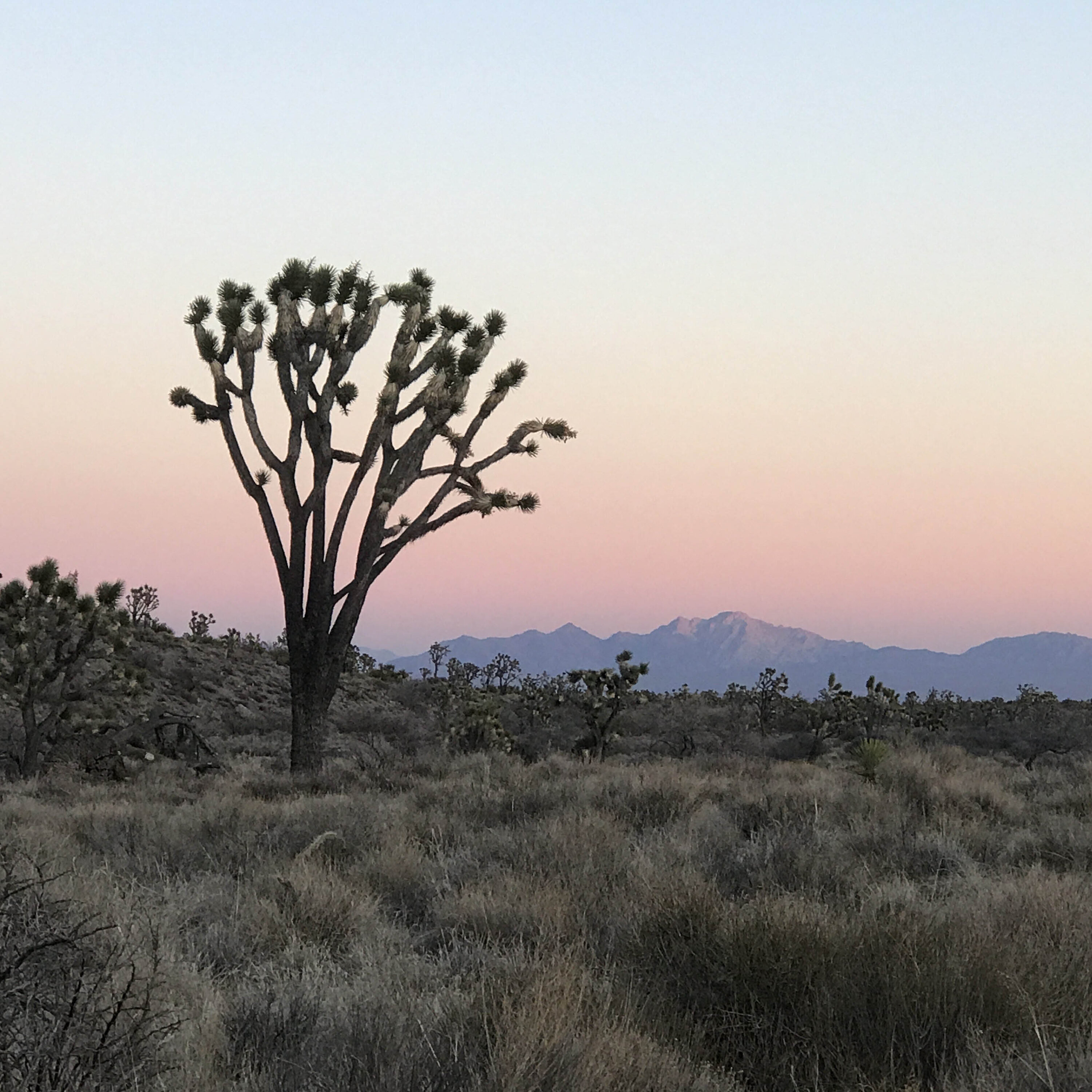
trailerHello friends! Transcript of this episode is at 90milesfromneedles.com In this Season Zero short episode, Chris and Alicia discuss the commonly shared urban legend that Joshua trees are not really trees. This is a topic that has gotten on Chris's nerves before. Spoiler: They're trees. Chris cites a biologist on Twitter with a handy definition of tree. Here's the guy. Thanks, Tom. With regard to whether the trees are one or two species, or members of what family? Here's something Chris wrote a while back. Since then, the US Fish and Wildlife Service has decided to treat the trees as belonging to two species: Yucca brevifolia for the western trees (closest to LA) and Yucca jaegeriana for the eastern trees (closest to Las Vegas.) Finally, the teaser reference to "touching Joshua trees" is inspired by a different bit of folklore spread on social media that touching Joshua trees is both illegal and harmful to the tree. To which we would reply that if you can't touch a tree without harming it or breaking the law, you need to rethink the way you are living your life. The trees do have weaker branches than hardwoods and such, though, so lay off with the climbing and hammock-hanging. Thanks for listening! We're really looking forward to our formal launch in January. Support our show!: https://90milesfromneedles.com/patreonSee omnystudio.com/listener for privacy information.Become a desert defender!: https://90milesfromneedles.com/donateSee omnystudio.com/listener for privacy information.

Trailer 2, Season 0: Introducing Alicia Pike
trailerOn a visit to Bonanza Spring, threatened by the Cadiz corporation's plan to mine desert groundwater for profit, Alicia Pike talks about what she hopes to bring to 90MFN as cohost.Support the show (https://www.patreon.com/ninetymilesfromneedles)Support our show!: https://90milesfromneedles.com/patreonSee omnystudio.com/listener for privacy information.Become a desert defender!: https://90milesfromneedles.com/donateSee omnystudio.com/listener for privacy information.
Season 0 Episode 1: Trailer for 90 Miles from Needles
trailerA brief description of what we'll be doing with the podcast, partly to answer questions and partly to get practice with our equipment. All flaws and glitches included for transparency's sake.Transcript (Chris C. speaking):I'm in a low pass in the Bigelow Cholla Garden Wilderness. The Bigelow Cholla Garden sounds like a place only a fool would visit. The Bigelow Cholla Garden is a garden in the same sense that the Devil's Playground is a playground. But I'm looking out over the panorama to the Southeast that includes the Stepladder Mountains, the Turtle Mountains, the Chemehuevi Mountains, the Whipples in the far distance; aside from the breeze, just... quiet. [music intro]About 15 years ago when I had a blog. Do you remember blogs? I remember blogs. About 15 years ago on my blog, I asked readers what we were fighting for. It turned out to be a difficult question to answer. Back in 2005 or so we all knew what we were fighting against. Bush was in the white house. The US military was involved in two land wars that we knew of.There were increasing infringements on civil rights. There were plenty of things that we were fighting against. And one day I just realized that I didn't know what we were fighting for. So I asked that question on my blog and readers had a lot of answers but every answer that said "we are fighting for X" was essentially fighting against something."We are fighting for an end to the war." "We are fighting to stop attacks on women's rights, on civil rights." There were a few people that suggested it was a rather privileged question that we have so many things to fight against that thinking about what we're fighting for, thinking about the kind of society and the kind of world we want to build is a privilege and a luxury. And honestly, I found it a little hard to argue with that. But still, I thought if we don't have in mind the kind of world we want, we're not going to do as good a job of fighting against the things we don't want. Since I moved to the desert, since I became involved in protecting the desert, that question no longer bothers me. I know what I'm fighting for. The Southwestern deserts in north America are the largest stretch of ecologically functional habitat left in north America, south of the tundra.They are a wealth of biological diversity. They possess some of the oldest living things on the planet. There are plants living in the desert that are self-aware. Every time we look at the desert, we find new species. And from a cultural political point of view, the native cultures that grew here in the desert that we settlers and descendants of settlers get our best to displace are still intact, still have an intact relationship with land, still have that cultural connection to the mountains, the washes, the springs. The landscape is a living thing. It has integrity. It has an importance that has little to do with human beings though not nothing. It's a landscape in which we are not the most important species, but despite what some would have you think we do belong here in a way. But less tangibly than all of those things, the desert is a place where one can find renewal, both in the desert and in one's self. The desert is a place where you can see the ecological processes going on in deceptive simplicity. And by understanding a bit more, noticing a bit more, you can feel a bit more connected. The desert is a place where you can go and feel unimportant, and yet huge. There are many things worth fighting for in this world. The desert is what I'm fighting for. And the people that call it home. By putting together the podcast 90 Miles from Needles, what I want to do is bring that desert to you. The sounds, the experiencSupport the show (https://www.patreon.com/ninetymilesfromneedles)Support our show!: https://90milesfromneedles.com/patreonSee omnystudio.com/listener for privacy information.Become a desert defender!: https://90milesfromneedles.com/donateSee omnystudio.com/listener for privacy information.