The Loudness Floor: How Britain's Biggest Podcasts Master for Apple, Spotify and a Noisy Bus
From The News Agents to Goalhanger's sleep shows, British producers are quietly settling on a mastering compromise between BBC broadcast standards and the way you actually listen — on a bus, with one AirPod, at 8.07 in the morning.
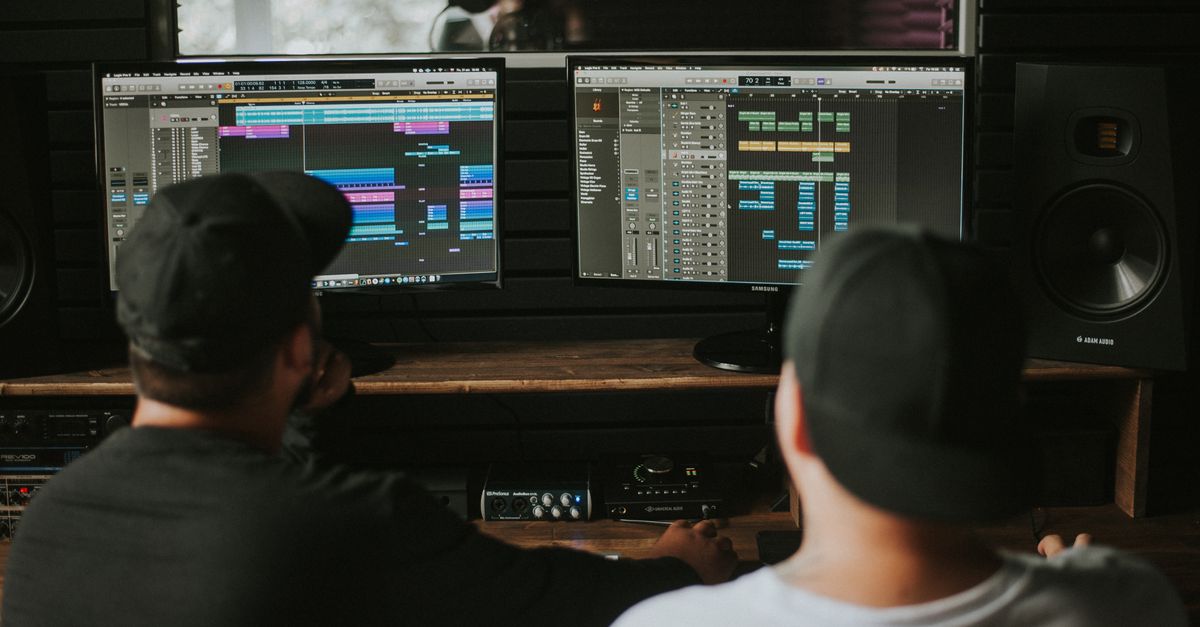
You hop from The News Agents to a Goalhanger history show on the 8.07 to King's Cross, and there's a tiny moment in your headphones where you instinctively reach for the volume wheel. Sometimes it's down a couple of clicks. Sometimes — more often — it's up. That little ergonomic reflex is the audible signature of mastering choices that almost nobody outside a small room of producers usually talks about.
Loudness mastering is the last quiet decision a podcast makes before it leaves the building. It sits between the edit and the upload, and it's where producers translate sound into a number that streaming platforms — and your ears — will accept. The number is LUFS, and British podcasting has spent the last few years settling into an awkward compromise between BBC broadcast conventions, American streaming defaults and the simple reality that most of us listen on the move.
This is a tour of that compromise. We'll look at what the platforms actually target, what the better British producers are doing about it, and why a daily news podcast cut for the morning commute needs to sound different from a narrative documentary you'll hear in bed.
What LUFS actually measures
LUFS stands for Loudness Units relative to Full Scale, and the easiest way to think of it is as a perceptual average. Where peak meters measure the loudest instant in a file, LUFS measures how loud the whole thing sounds to a human ear over time. Quiet sections drag the number down; sustained dialogue at conversational level brings it up.
A few useful reference points before the platforms get involved:
- A whispered ASMR podcast might integrate at around −24 LUFS.
- A clean conversational two-hander sits somewhere near −18 LUFS.
- A daily news show punched up for commuters lands around −14 LUFS.
- BBC Radio 4 broadcasts to the EBU R128 standard of −23 LUFS, which is why the Today programme on FM sounds quieter than the Newscast feed on your phone — the broadcast has more headroom for the dynamic range a radio listener will tolerate.
There's also a 'true peak' measurement, expressed as dBTP, which controls how close the loudest sample comes to digital clipping. Most podcast producers aim for −1 dBTP as a ceiling, partly to avoid clipping after lossy encoding and partly to leave room for platform loudness adjustments to push the file louder without distorting the result.
What the platforms target
Streaming services don't really care what number you upload. They normalise. If you hand Spotify a podcast mastered at −18 LUFS, the platform will lift it by 4 LU on playback to match its internal target. If you give Apple a podcast at −12 LUFS, it will pull it back down. The catch is that loudness adjustment is only half the story — when a platform turns your file up, the noise floor goes with it, and so does whatever ambient hum or breath sound you didn't quite notice in the studio.
Here is roughly where the major platforms a British producer cares about sit in 2026, based on each platform's published guidance and producer documentation currently circulating in the trade:
| Platform | Integrated loudness target | True peak ceiling | Notes |
|---|---|---|---|
| Apple Podcasts | −16 LUFS | −1 dBTP | The de facto standard most UK independent producers master to |
| Spotify (podcasts) | −14 LUFS | −1 dBTP | Normalises louder than Apple; can flatten dynamics |
| Amazon Music | −14 LUFS | −2 dBTP | Conservative ceiling, especially on Echo devices |
| YouTube (video podcasts) | −14 LUFS | −1 dBTP | Aligned with music; punishes quiet dialogue passages |
| BBC Sounds | −16 LUFS | −1 dBTP | Aligns with Apple convention rather than broadcast R128 |
| BBC Radio 4 (linear broadcast) | −23 LUFS | −1 dBTP | EBU R128; the reason FM news sounds calmer than your phone feed |
Three things jump out of that table. The first is that there is no single number. The second is that the BBC's podcast arm has quietly chosen the streaming convention rather than its own broadcast standard — which is why a BBC Sounds exclusive sounds noticeably hotter than the same voice on FM. The third is that Spotify is the outlier most British producers worry about, because lifting a podcast by 2 LU will reveal anything the edit was hoping to hide.
The British compromise
The room where most of this gets decided is, in practice, the post-production suite of one of four or five production houses: Goalhanger, Global's Persephonica, Audio Always in Manchester, Crowd Network, and Sony's Somethin' Else. Each has its own house mastering chain, and the differences are audible if you A/B them on a decent pair of over-ear headphones.
Goalhanger's flagships — The Rest is History, The Rest is Politics, The Rest is Football — sit close to −16 LUFS integrated with a loudness range of around 6 LU. That's a tight, conversational master that translates well to a phone speaker on a train and survives Spotify's normalisation without smearing. Producers who've worked on the shows describe a deliberate choice to leave a little headroom — to let Tom Holland's quiet, considered phrasing breathe a little against Dominic Sandbrook's more declamatory passages.
The News Agents and the rest of the Global daily news shows go harder. They tend to land closer to −15 LUFS with a loudness range under 5 LU, which is the audio equivalent of writing for the commute: every word must arrive intact through a single AirPod with bus noise underneath. The cost is that the same shows can feel exhausting on a quiet evening listen at home.
At the other end of the spectrum, sleep and meditation podcasts published in Britain — Get Sleepy, Nothing Much Happens — are mastered for the bedroom. −20 to −22 LUFS is common, with deliberately wide dynamic range to let the voice fade into the room. These shows are also the ones most likely to carry a quiet warning at the top advising listeners not to set their device to maximum, because they know Spotify's normalisation will exaggerate everything below the target.
Then there are the comedy shows, which are their own engineering problem. Off Menu with Ed Gamble and James Acaster is a useful case study. Laughter peaks and sudden volume spikes during a riff can blow past true-peak ceilings if the limiter isn't doing real work. Producers on shows in that lane tend to apply gentle multi-band compression to flatten the crowd-laughter overshoot without squashing the conversational baseline. Adam Buxton — famously self-edited in Adobe Audition — leans the other way, preserving more dynamic range and trusting listeners to find the volume themselves.
The mid-roll problem
There is one mastering question that has nothing to do with the podcast itself and everything to do with how listeners experience it: dynamic ad insertion. A podcast mastered cleanly at −16 LUFS will be interrupted, several times per episode, by ad creative produced anywhere between −12 and −18 LUFS depending on who supplied it.
Better hosting platforms — Acast, Megaphone, Spotify's Megaphone-derived ad stack — now offer ad loudness normalisation at the point of insertion, but coverage is patchy. Several smaller programmatic networks still hand off creative that has not been LUFS-matched to the host show. The audible result is the loudness pop that listeners describe, often unkindly, in podcast app reviews.
The cleaner British operators are responding in two ways. Goalhanger and Persephonica produce house-read ad creative to the same LUFS target as the show itself, so The Rest is History's Marks & Spencer read sits inside the conversation rather than next to it. Where programmatic insertion is unavoidable, some producers leave a small audible breath before the ad break — a quiet marker that says, in effect, 'the engineering is about to change.'
The tools doing the actual work
Among British independent producers in 2026, the practical mastering chain has converged on a handful of recognisable tools:
- Auphonic for one-button loudness targeting, especially on smaller shows
- iZotope RX for noise reduction, click removal and the de-essing pass that comes before the limiter
- FabFilter Pro-L 2 or Pro-MB for the final loudness and true-peak ceiling
- Hindenburg PRO as a DAW for those who came in via radio
- Adobe Audition for the Audio Always lineage and many BBC freelancers
- Reaper for the price-conscious narrative producer
The interesting move at the bigger houses is the slow drift toward bespoke offline mastering scripts — Python wrappers around ffmpeg's loudnorm filter, with two-pass measurement to guarantee a precise integrated target. It's not glamorous and it doesn't make a podcast more interesting. It does make the show sound the same on the third episode of the day as the first, which matters more than producers like to admit.
Where this all goes
The most likely near-term change is that platforms will start publishing their normalisation behaviour more openly. Apple has hinted at it in developer documentation. Spotify has not. Until they do, the British podcast craft answer is the one that's already quietly settled: master to Apple's number, leave the true peak well below the ceiling, and accept that Spotify will press the volume up a fraction whatever you do.
The deeper craft point is the one that gets lost in the engineering. A podcast that respects its listener doesn't just hit a number. It chooses a number that fits the way the show will be heard — at the gym, in the bath, on a Northern Line carriage at 8.40 in the morning, in the dark with a partner asleep next to you. The best British producers we listen to have made that choice consciously, and you can hear it in the steady, even hand on the volume wheel that you don't notice you're not adjusting.