Breaking Math Podcast
204 episodes — Page 3 of 5
82. A.I. and Materials Discovery - an Interview with Taylor Sparks
Transcripts of this episode are avialable upon request. Email us at [email protected]. In this episode Gabriel Hesch interviews Taylor Sparks, a professor of material science and engineering, about his recent paper on the use of generative modeling a.i. for material disovery. The paper is published in the journal Digital Discovery and is titled 'Generative Adversarial Networks and Diffusion MOdels in Material Discovery. They discuss the purpose of the call, the process of generative modeling, creating a representation for materials, using image-based generative models, and a comparison with Google's approach. They also touch on the concept of conditional generation of materials, the importance of open-source resources and collaboration, and the exciting developments in materials and AI. The conversation concludes with a discussion on future collaboration opportunities.Takeaways Generative modeling is an exciting approach in materials science that allows for the prediction and creation of new materials. Creating a representation for materials, such as using the crystallographic information file, enables the application of image-based generative models. Google's approach to generative modeling received attention but also criticism for its lack of novelty and unconditioned generation of materials. Open-source resources and collaboration are crucial in advancing materials informatics and machine learning in the field of materials science.Help Support The Podcast by clicking on the links below: Start YOUR podcast on ZenCastr! Use my special link ZenCastr Discount to save 30% off your first month of any Zencastr paid plan Visit our PatreonHow is Machine Learning being used to further original scientific discoveries?

In Memory of Sofia Baca, Cofounder and cohost of Breaking Math
In October of 2023, Sofia Baca passed away unexpectedly from natural causes. Sofia was one of the founders and cohosts of the Breaking Math Podcast. In this episode, host Gabriel Hesch interviews Diane Baca, mother of Sofia Baca as we talk about her passions for creativity, mathematics, science, and discovering what it means to be human. Sofia lived an exceptional life with explosive creativity, a voracious passion for mathematics, physics, computer science, and creativity. Sofia also struggled immensely with mental health issues which included substance abuse as well as struggling for a very long time understand the source of their discontent. Sofia found great happiness in connecting with other people through teaching, tutoring, and creative expression. The podcast will continue in honor of Sofia. There are many folders of ideas that Sofia left with ideas for the show or for other projects. We will continue this show with sharing some of these ideas, but also with sharing stories of Sofia - including her ideas and her struggles in hopes that others may find solace in that they are not alone in their struggles. But also in hopes that others may find inspiration in what Sofia had to offer. We miss you dearly, Sofia.

81: Correct. Now Try Again (Multiple Approaches to the Same Problem)
Join Sofía Baca and her guests, the host and co-host of the Nerd Forensics podcast, Millicent Oriana and Jacob Urban, as they explore what it means to be able to solve one problem in multiple ways.This episode is distributed under a Creative Commons Attribution-ShareAlike 4.0 International License. For full text, visit: https://creativecommons.org/licenses/by-sa/4.0/[Featuring: Sofía Baca; Millicent Oriana, Jacob Urban[Help Support The Podcast by clicking on the links below: Try out ZenCastr w/ 30% DiscountUse my special link to save 30% off your first month of any Zencastr paid plan Patreon YouTube Breaking Math WebsiteEmail us for copies of the transcript!
80: Physical Dimension (Dimensional Analysis)
The history of mathematics, in many ways, begins with counting. Things that needed, initially, to be counted were, and often still are, just that; things. We can say we have twelve tomatoes, or five friends, or that eleven days have passed. As society got more complex, tools that had been used since time immemorial, such as string and scales, became essential tools for counting not only concrete things, like sheep and bison, but more abstract things, such as distance and weight based on agreed-upon multiples of physical artifacts that were copied. This development could not have taken place without the idea of a unit: a standard of measuring something that defines what it means to have one of something. These units can be treated not only as counting numbers, but can be manipulated using fractions, and divided into arbitrarily small divisions. They can even be multiplied and divided together to form new units. So where does the idea of a unit come from? What's the difference between a unit, a dimension, and a physical variable? And how does the idea of physical dimension allow us to simplify complex problems? All of this and more on this episode of Breaking Math.Distributed under a CC BY-SA 4.0 International License. For full text, visit: https://creativecommons.org/licenses/by-sa/4.0/[Featuring: Sofía Baca; Millicent Oriana, Jacob Urban]Help Support The Podcast by clicking on the links below: Try out ZenCastr w/ 30% DiscountUse my special link to save 30% off your first month of any Zencastr paid plan Patreon YouTube Breaking Math WebsiteEmail us for copies of the transcript!
79: 1 2 3 (Counting)
Help Support The Podcast by clicking on the links below: Try out ZenCastr w/ 30% DiscountUse my special link to save 30% off your first month of any Zencastr paid plan Patreon YouTube Breaking Math WebsiteEmail us for copies of the transcript!Join Sofia Baca and Nerd Forensics co-host Jacob Urban as they discuss all things counting!Counting is the first arithmetic concept we learn, and we typically learn to do so during early childhood. Counting is the basis of arithmetic. Before people could manipulate numbers, numbers had to exist. Counting was first done on the body, before it was done on apparatuses outside the body such as clay tablets and hard drives. However, counting has become an invaluable tool in mathematics itself, as became apparent when counting started to be examined analytically. How did counting begin? What is the study of combinatorics? And what can be counted? All of this and more, on this episode of Breaking Math.This episode is distributed under a Creative Commons Attribution-ShareAlike 4.0 International License (full text: https://creativecommons.org/licenses/by-sa/4.0/)[Featuring: Sofia Baca; Jacob Urban]
78: Perpetual Notion (Entropy and Thermodynamics)
As you listen to this episode, you'll be exerting mental effort, as well as maybe exerting effort doing other things. The energy allowing your neurons to continually charge and discharge, as well as exert mechanical energy in your muscles and chemical energy in places like your liver and kidneys, came from the food you ate. Specifically, it came from food you chewed, and then digested with acid and with the help of symbiotic bacteria. And even if that food you're eating is meat, you can trace its energy back to the sun and the formation of the earth. Much of this was established in the previous episode, but this time we're going to explore a fundamental property of all systems in which heat can be defined. All of these structures had a certain order to them; the cow that might have made your hamburger had all the same parts that you do: stomach, lips, teeth, and brain. The plants, such as the tomatoes and wheat, were also complex structures, complete with signaling mechanisms. As you chewed that food, you mixed it, and later, as the food digested, it became more and more disordered; that is to say, it became more and more "shuffled", so to speak, and at a certain point, it became so shuffled that you'd need all the original information to reconstruct it: reversing the flow of entropy would mean converting vomit back into the original food; you'd need all the pieces. The electrical energy bonding molecules were thus broken apart and made available to you. And, if you're cleaning your room while listening to this, you are creating order only at the cost of destroying order elsewhere, since you are using energy from the food you ate. Even in industrial agriculture where from 350 megajoules of human and machine energy, often 140 gigajoules of corn can be derived per acre, a ratio of more than 400:1, the order that the seeds seem to produce from nowhere is constructed from the energy of the chaotic explosion from a nearby star. So why are the concepts of heat, energy, and disorder so closely linked? Is there a general law of disorder? And why does the second law mean you can't freeze eggs in a hot pan? All of this and more on this episode of Breaking Math.Distributed under a CC BY-SA 4.0 License (https://creativecommons.org/licenses/by-sa/4.0/)[Featuring: Sofia Baca; Millicent Oriana, Jacob Urban]Help Support The Podcast by clicking on the links below: Try out ZenCastr w/ 30% DiscountUse my special link to save 30% off your first month of any Zencastr paid plan Patreon YouTube Breaking Math WebsiteEmail us for copies of the transcript!
77: An Interview with Christopher Roblesz of MathNMore
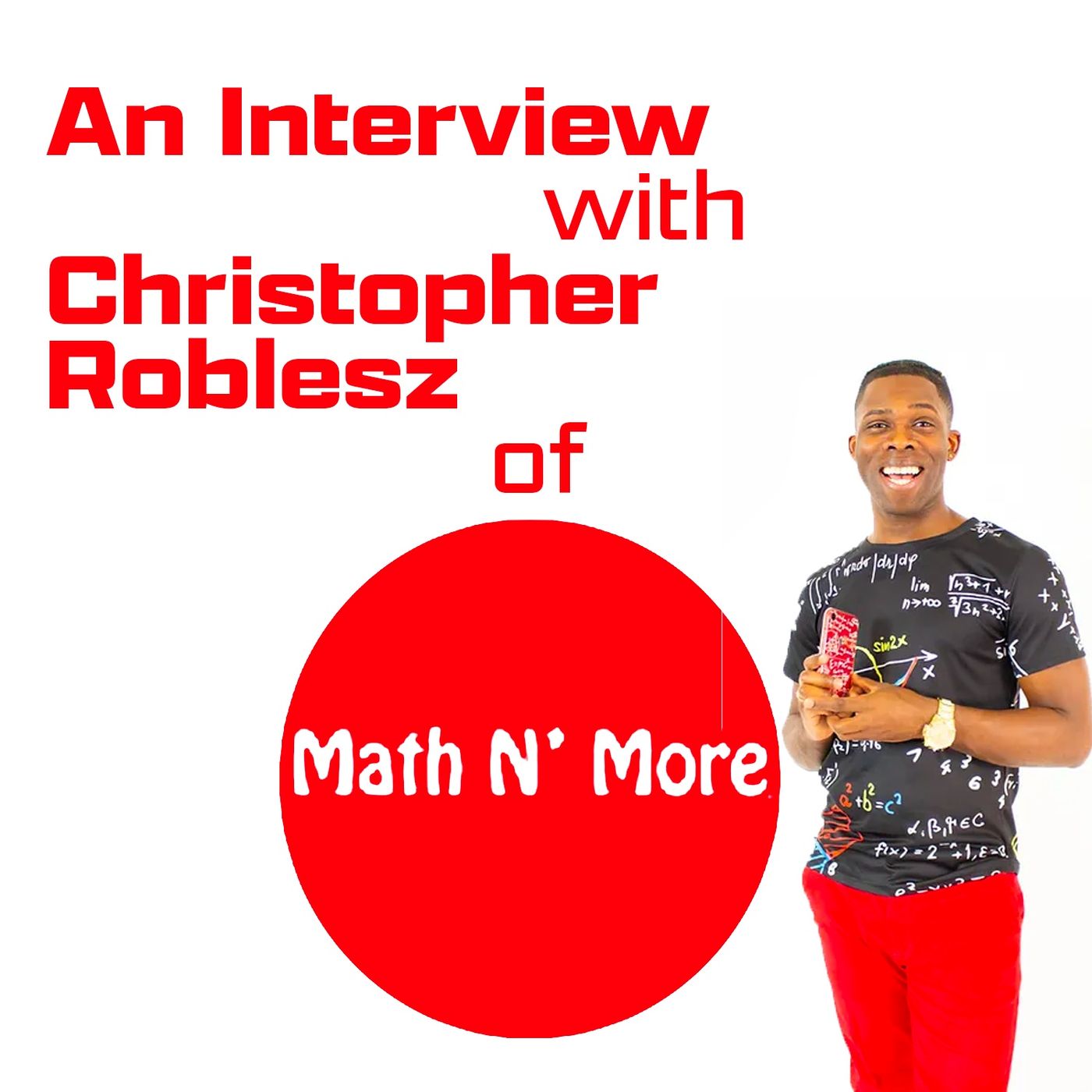
Christopher Roblesz is a math educator who, until the pandemic, worked as a teacher. It was his experiences during the pandemic, and his unwavering passion for preparing disadvantaged youth for STEM careers, that eventually led him to developing mathnmore, a company focused on providing an enriched educational experience for sstudents who are preparing for these careers.More on energy and entropy next time!All of this and more on this interview episode of Breaking Math![Featuring: Sofia Baca; Christopher Roblesz]
S5 Ep 176: Joule Pay for This! (Energy)
Join Sofia Baca and her guests Millicent Oriana from Nerd Forensics and Arianna Lunarosa as they discuss energy.The sound that you're listening to, the device that you're listening on, and the cells in both the ear you're using to listen and the brain that understands these words have at least one thing in common: they represent the consumption or transference of energy. The same goes for your eyes if you're reading a transcript of this. The waves in the ears are pressure waves, while eyes receive information in the form of radiant energy, but they both are still called "energy". But what is energy? Energy is a scalar quantity measured in dimensions of force times distance, and the role that energy plays depends on the dynamics of the system. So what is the difference between potential and kinetic energy? How can understanding energy simplify problems? And how do we design a roller coaster in frictionless physics land?[Featuring: Sofia Baca; Millicent Oriana, Arianna Lunarosa]This episode is distributed under a Creative Commons Attribution-ShareAlike 4.0 International License. Full text here: https://creativecommons.org/licenses/by-sa/4.0/
75: Existential Physics with Sabine Hossenfelder (Author Interview)
An interview with Dr. Sabine Hossenfelder about her second book Existential Physics. Sabine is host of the famous youtube show Science with Sabine.
74: Lights, Camera, Action! (3D Computer Graphics: Part I)
The world around us is a four-dimensional world; there are three spatial dimensions, and one temporal dimension. Many of these objects emit an almost unfathomable number of photons. As we developed as creatures on this planet, we gathered the ability to sense the world around us; and given the amount of information represented as photons, it is no surprise that we developed an organ for sensing photons. But because of the amount of photons that are involved, and our relatively limited computational resources, it is necessary to develop shortcuts if we want to simulate an environment in silico. So what is raytracing? How is that different from what happens in games? And what does Ptolemy have to do with 3D graphics? All of this and more on this episode of Breaking Math.
73: Materialism: a Material Science Podcast Podcast Episode (Interview with Taylor Sparks)
Physical objects are everywhere, and they're all made out of molecules, and atoms. However, the arrangement and refinement of these atoms can be the difference between a computer and sand, or between a tree and paper. For a species as reliant on tool use, the ability to conceieve of, design, create, and produce these materials is an ongoing concern. Since we've been around as humans, and even before, we have been material scientists in some regard, searching for new materials to make things out of, including the tools we use to make things. So what is the difference between iron and steel? How do we think up new things to make things out of? And what are time crystals? All of this and more on this episode of Breaking Math.This episode is released under a Attribution-NonCommercial 4.0 International (CC BY-NC 4.0) license. More information here: https://creativecommons.org/licenses/by-nc/4.0/[Featuring: Sofía Baca, Gabriel Hesch; Taylor Sparks]
72: The Lifestyles of the Mathematical and Famous (an Interview with Author Robert Black)
Robert Black is an author who has written a six-book series about seven influential mathematicians, their lives, and their work. We interview him and his books, and take a peek into the lives of these influential mathematicians.Addendum: Hey Breaking Math fans, I just wanted to let y'all know that the second material science podcast is delayed.[Featuring: Sofía Baca; Robert Black]
71: What's the Matter? An Interview with Chris Cogswell of the Mad Scientist Podcast (Material Science)
Matter is that which takes up space, and has mass. It is what we interact with, and what we are. Imagining a world without matter is to imagine light particles drifting aimlessly in space. Gasses, liquids, solids, and plasmas are all states of matter. Material science studies all of these, and their combinations and intricacies, found in examining foams, gels, meshes, and other materials and metamaterials. Chris Cogswell is a material scientist, and host of The Mad Scientist Podcast, a podcast that takes a critical look at things ranging from technological fads, to pseudoscience, and topics that deserve a critical eye. On the first of a pair of two episodes about material science, we interview Chris about his experience with studying material science, and ask questions about the subject in general.Links referenced by Chris Cogswell:- https://www.youtube.com/watch?v=bUvi5eQhPTc is about nanomagnetism and cool demonstration of ferrofluid- https://www.youtube.com/watch?v=4Dlt63N-Uuk goes over nanomagnetic applications in medicine- http://yaghi.berkeley.edu/pdfPublications/04MOFs.pdf Great review paper on new class of materials known as MOFs which are going to be very important in coming years- https://www.youtube.com/watch?v=IkYimZBzguw Crash course engineering on nanomaterials, really good introduction to the field- https://www.youtube.com/watch?v=t7EYQLOlwDM Oak Ridge national lab paper on using nano materials for carbon dioxide conversion to other carbon molecules- https://www.youtube.com/watch?v=cxVFopLpIQY Really good paper on carbon capture technology challenges and economics[Featuring: Sofía Baca, Gabriel Hesch, Meryl Flaherty; Chris Cogswell]--- This episode is sponsored by · Anchor: The easiest way to make a podcast. https://anchor.fm/appSupport this podcast: https://anchor.fm/breakingmathpodcast/support
70.1: Episode 70.1 of Breaking Math Podcast (Self-Reference)
Seldom do we think about self-reference, but it is a huge part of the world we live in. Every time that we say 'myself', for instance, we are engaging in self-reference. Long ago, the Liar Paradox and the Golden Ratio were among the first formal examples of self-reference. Freedom to refer to the self has given us fruitful results in mathematics and technology. Recursion, for example, is used in algorithms such as PageRank, which is one of the primary algorithms in Google's search engine. Elements of self-reference can also be found in foundational shifts in the way we understand mathematics, and has propelled our understanding of mathematics forward. Forming modern set theory was only possible due to a paradox called Russel's paradox, for example. Even humor uses self-reference. Realizing this, can we find harmony in self-reference? Even in a podcast intro, are there elements of self-reference? Nobody knows, but I'd check if I were you. Catch all of this, and more, on this episode of Breaking Math. Episode 70.1: Episode Seventy Point One of Breaking Math Podcast[Featuring: Sofía Baca, Gabriel Hesch; Millicent Oriana]

70: This Episode Intentionally Left Blank
This episode description intentionally left blank! As in completely on purpose. Fun Fact! The creators of the Breaking Math Podcast, Sofia and Gabriel always thought it was funny that many books that we've read - even going back to our childhood - had a page in it with the sentence printed, "This Page Intentionally Left Blank." Like- okay; what does this 'intentionally left blank page' add to the reading experience? Does anyone know? Oh look here! There is a wikipedia page on it. Huh. Now I know. Now we know. And knowing is half the battle! Sofia would frequently leave post-it notes on Gabe's laptop saying, "This Post-it note intentionally left blank." Because . . . . why? Sofia would often leave a twitter or facebook post that declared "This post intentionally left blank." And now - we release an entire podcast episode that is intentionally left blank. Are we trolls? NO! We prefer to think of ourselves as artists in the style of Banksy making a statement!
69: An Interview with Michael Brooks, Author of "The Art of More: How Mathematics Created Civilization"
Michael Brooks is a science writer who specializes in making difficult concepts easier to grasp. In his latest book, Brooks goes through several mathematical concepts and discusses their motivation, history, and discovery. So how do stories make it easier to learn? What are some of the challenges associated with conveying difficult concepts to the general public? And who, historically, has been a mathematician? All of this and more on this episode of Breaking Math. Songs were Breaking Math Intro and Outro by Elliot Smith of Albuquerque. This episode is published under a Creative Commons 4.0 Attribute-ShareAlike-NonCommercial license. For more information, visit CreativeCommons.org [Featuring: Sofía Baca, Gabriel Hesch, Meryl Flaherty; Michael Brooks]t
P12: O My God (Big O Notation)
There are times in mathematics when we are generalizing the behavior of many different, but similar, entities. One such time that this happens is the use cases of Big O notation, which include describing the long-term behavior of functions, and talking about how accurate numerical calculations are. On this problem episode, we are going to discuss Big O notation and how to use it.This episode is licensed by Sofia Baca under a Creative Commons Attribution-ShareAlike-NonCommercial 4.0 International License. For more information, visit CreativeCommons.org.[Featuring: Sofía Baca]
68: LOL!!! SO RANDOM (Random Variables)
The world is often uncertain, but it has only been in the last half millennium that we've found ways to interact mathematically with that concept. From its roots in death statistics, insurance, and gambling to modern Bayesian networks and machine learning, we've seen immense productivity in this field. Every way of looking at probability has something in common: the use of random variables. Random variables let us talk about events with uncertain outcomes in a concrete way. So what are random variables? How are they defined? And how do they interact? All of this, and more, on this episode of Breaking Math.Interact with the hosts:@SciPodSofia@TechPodGabeOr the guest:@KampPodMilliePatreon here: patreon.com/breakingmathpodcastFeaturing music by Elliot Smith. For info about music used in ads, which are inserted dynamically, contact us at [email protected][Featuring: Sofía Baca, Gabriel Hesch; Millicent Oriana]
67: Wrath of Math (Mathematics Used Unwisely)
Mathematics is a subject that has been used for great things over time: it has helped people grow food, design shelter, and in every part of life. It should be, then, no surprise that sometimes mathematics is used for evil; that is to say, there are times where mathematics is used to either implement or justify regressive things like greed, racism, classism, and even genocide. So when has math been used for destructive purposes? What makes us mis-apply mathematics? And why can oversimplification lead to devastation? All of this, and more, on this episode of Breaking Math.Theme song is Breaking Math Theme by Elliot Smith of Albuquerque.This episode is distributed under a Creative Commons Attribution-ShareAlike-NonCommercial 4.0 International License. For more information, go to CreativeCommons.org--- This episode is sponsored by · Anchor: The easiest way to make a podcast. https://anchor.fm/appSupport this podcast: https://anchor.fm/breakingmathpodcast/support
P11: Feeling Lucky? (Probability and Intuition)
Join Sofía Baca with her guest Millicent Oriana from the newly launched Nerd Forensics podcast as they discuss some apparent paradoxes in probability and Russian roulette.Intro is "Breaking Math Theme" by Elliot Smith. Ads feature "Ding Dong" by Simon Panrucker[Featuring: Sofía Baca; Millicent Oriana]--- This episode is sponsored by · Anchor: The easiest way to make a podcast. https://anchor.fm/appSupport this podcast: https://anchor.fm/breakingmathpodcast/support
66: Hayhoe, Let's Go! (An Interview With Climate Scientist Katharine Hayhoe)
Katharine Hayhoe was the lead author on the 2018 US Climate Assessment report, and has spent her time since then spreading the word about climate change. She was always faced with the difficult task of convincing people who had stakes in things that would be affected by acknowledging the information in her report. In her newest book, “Saving Us: A Climate Scientist’s Case for Hope and Healing in a Divided World”, she discusses the challenges associated with these conversations, at both the micro and macro level. So who is Katherine Heyhoe? How has she learned to get people to acknowledge the reality of climate science? And is she the best, or worst, person to strike up a discussion about how the weather’s been? All of this, and more, on this episode of Breaking Math. Papers Cited: -“99.94 percent of papers agree with the scientific consensus.”More info: https://journals.sagepub.com/doi/10.1177/0270467617707079This episode is distributed under a CC BY-NC 4.0 International License. For more information, visit creativecommons.org.Intro is "Breaking Math Theme" by Elliot Smith. Ads feature "Ding Dong" by Simon Panrucker[Featuring: Sofía Baca, Gabriel Hesch, Meryl Flaherty; Katherine Heyhoe, Elliot Smith]

P10: Chivalry is Dead (Knights and Knaves #1)
One tells a lie, the other the truth! Have fun with Sofía and Meryl as they investigate knight, knave, and spy problems!Intro is "Breaking Math Theme" by Elliot Smith. Music in the ads were Plug Me In by Steve Combs and "Ding Dong" by Simon Panrucker. You can access their work at freemusicarchive.org.[Featuring: Sofia Baca; Meryl Flaherty]
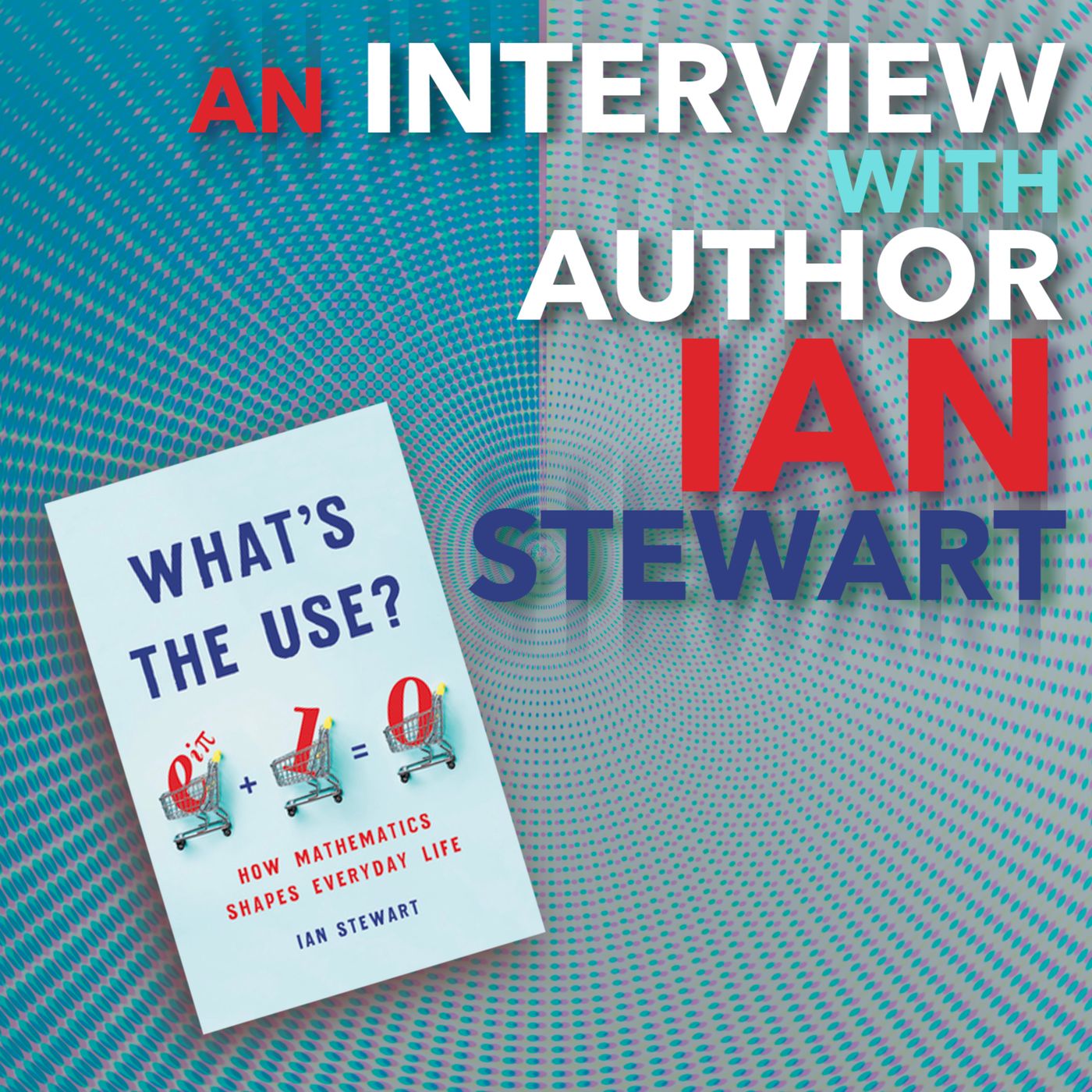
65: An Interview with Author Ian Stewart (Book About Everyday Math)
Welcome to another engaging episode of the Breaking Math Podcast! Today's episode, titled "What is the Use?," features a fascinating conversation with the renowned mathematician and author, Professor Ian Stewart. As Professor Stewart discusses his latest book "What's the Use? How Mathematics Shapes Everyday Life," we dive deep into the real-world applications of mathematics that often go unnoticed in our daily technologies, like smartphones, and their unpredictable implications in various fields.We'll explore the history of quaternions, invented by William Rowan Hamilton, which now play a critical role in computer graphics, gaming, and particle physics. Professor Stewart will also shed light on the non-commutative nature of quaternions, mirroring the complexities of spatial rotations, and how these mathematical principles find their correspondence in the natural world.Furthermore, our discussion will encompass the interconnectivity within mathematics, touching upon how algebra, geometry, and trigonometry converge to paint a broader picture of this unified field. We also discuss the intriguing concept of "Fearful Symmetry" and how symmetrical and asymmetrical patterns govern everything from tiger stripes to sand dunes.With references to his other works, including "Professor Stewart's Cabinet of Mathematical Curiosities" and "The Science of Discworld," Professor Stewart brings an element of surprise and entertainment to the profound impact of mathematics on our understanding of the world.So stay tuned as we unlock the mysteries and the omnipresent nature of math in this thought-provoking episode with Professor Ian Stewart!
64: What Projection Is This? (Map Projections)
The world is a big place with a lot of wonderful things in it. The world also happens to be spherical, which can make getting to those things a challenge if you don't have many landmarks. This is the case when people are navigating by sea. For this reason, map projections, which take a sphere and attempt to flatten it onto a sheet, were born. So what is a map projection? Why are there so many? And why is Gall-Peters the worst? All of this, and more, on this episode of Breaking Math.Theme was written by Elliot Smith.This episode is distributed under a Creative Commons 4.0 Attribution-ShareAlike-NonCommercial International License. For more information, visit CreativeCommons.org.--- This episode is sponsored by · Anchor: The easiest way to make a podcast. https://anchor.fm/appSupport this podcast: https://anchor.fm/breakingmathpodcast/support
RR36: The Most Boring Episode Ever (Rerun: Math Games)
This is a rerun of one of our favorite episodes! We hope that you enjoy it if you haven't listened to it yet. We'll be back next week with new content! Thank you so much for listening to Breaking Math!Math is a gravely serious topic which has been traditionally been done by stodgy people behind closed doors, and it cannot ever be taken lightly. Those who have fun with mathematics mock science, medicine, and the foundation of engineering. That is why on today's podcast, we're going to have absolutely no fun with mathematics. There will not be a single point at which you consider yourself charmed, there will not be a single thing you will want to tell anyone for the sake of enjoyment, and there will be no tolerance for your specific brand of foolishness, and that means you too, Kevin.Theme by Elliot Smith.
63: Broken Voting Systems (Voting Systems and Paradoxes)
Voting systems are, in modern times, essential to the way that large-scale decisions are made. The concept of voicing an opinion to be, hopefully, considered fairly is as ancient and well-established as the human concept of society in general. But, as time goes on, the recent massive influx of voting systems in the last 150 years have shown us that there are as many ways to vote as there are flaws in the way that the vote is tallied. So what problems exist with voting? Are there any intrinsic weaknesses in group decision-making systems? And what can we learn by examining these systems? All of this, and more, on this episode of Breaking Math.Licensed under Creative Commons Attribution-ShareAlike-NonCommercial 4.0 International License. For more information, visit CreativeCommons.org.
62: The Atom Bomb of Information Operations (An Interview with John Fuisz of Veriphix)
Forecasting is a constantly evolving science, and has been applied to complex systems; everything from the weather, to determining what customers might like to buy, and even what governments might rise and fall. John Fuisz is someone who works with this science, and has experience improving the accuracy of forecasting. So how can forecasting be analyzed? What type of events are predictable? And why might Russia think a Missouri senator's race hinges upon North Korea? All of this and more on this episode of Breaking Math.The theme for this episode was written by Elliot Smith.[Featuring: Sofía Baca, Gabriel Hesch; John Fuisz]
61: Look at this Graph! (Graph Theory)
In mathematics, nature is a constant driving inspiration; mathematicians are part of nature, so this is natural. A huge part of nature is the idea of things like networks. These are represented by mathematical objects called 'graphs'. Graphs allow us to describe a huge variety of things, such as: the food chain, lineage, plumbing networks, electrical grids, and even friendships. So where did this concept come from? What tools can we use to analyze graphs? And how can you use graph theory to minimize highway tolls? All of this and more on this episode of Breaking Math.Episode distributed under an Creative Commons Attribution-ShareAlike-NonCommercial 4.0 International License. For more information, visit CreativeCommons.org[Featuring: Sofía Baca, Meryl Flaherty]--- This episode is sponsored by · Anchor: The easiest way to make a podcast. https://anchor.fm/appSupport this podcast: https://anchor.fm/breakingmathpodcast/support
P9: Give or Take (Back-of-the-Envelope Estimates / Fermi Problems)
How many piano tuners are there in New York City? How much cheese is there in Delaware? And how can you find out? All of this and more on this problem-episode of Breaking Math.This episode distributed under a Creative Commons Attribution-ShareAlike-Noncommercial 4.0 International License. For more information, visit creativecommons.orgFeaturing theme song and outro by Elliot Smith of Albuquerque.[Featuring: Sofía Baca, Meryl Flaherty]
60: HAMILTON! [But Not the Musical] (Quaternions)
i^2 = j^2 = k^2 = ijk = -1. This deceptively simple formula, discovered by Irish mathematician William Rowan Hamilton in 1843, led to a revolution in the way 19th century mathematicians and scientists thought about vectors and rotation. This formula, which extends the complex numbers, allows us to talk about certain three-dimensional problems with more ease. So what are quaternions? Where are they still used? And what is inscribed on Broom Bridge? All of this and more on this episode of Breaking Math.This episode is distributed under a CC BY-SA 4.0 license. For more information, visit CreativeCommons.org.The theme for this episode was written by Elliot Smith.[Featuring: Sofía Baca, Meryl Flaherty]
59: A Good Source of Fibers (Fiber Bundles)
Mathematics is full of all sorts of objects that can be difficult to comprehend. For example, if we take a slip of paper and glue it to itself, we can get a ring. If we turn it a half turn before gluing it to itself, we get what's called a Möbius strip, which has only one side twice the length of the paper. If we glue the edges of the Möbius strip to each other, and make a tube, you'll run into trouble in three dimensions, because the object that this would make is called a Klein flask, and can only exist in four dimensions. So what is a fiber? What can fiber bundles teach us about higher dimensional objects?All of this, and more, on this episode of Breaking Math.[Featuring: Sofía Baca, Meryl Flaherty]
58: Bringing Curvy Back (Gaussian Curvature)
In introductory geometry classes, many of the objects dealt with can be considered 'elementary' in nature; things like tetrahedrons, spheres, cylinders, planes, triangles, lines, and other such concepts are common in these classes. However, we often have the need to describe more complex objects. These objects can often be quite organic, or even abstract in shape, and include things like spirals, flowery shapes, and other curved surfaces. These are often described better by differential geometry as opposed to the more elementary classical geometry. One helpful metric in describing these objects is how they are curved around a certain point. So how is curvature defined mathematically? What is the difference between negative and positive curvature? And what can Gauss' Theorema Egregium teach us about eating pizza?This episode distributed under a Creative Commons Attribution ShareAlike 4.0 International License. For more information, go to creativecommons.orgVisit our sponsor today at Brilliant.org/BreakingMath for 20% off their annual membership! Learn hands-on with Brilliant.[Featuring: Sofía Baca, Meryl Flaherty]
P8: Tangent Tango (Morikawa's Recently Solved Problem)
Join Sofía and Gabriel as they talk about Morikawa's recently solved problem, first proposed in 1821 and not solved until last year!Also, if you haven't yet, check out our sponsor The Great Courses at thegreatcoursesplus.com/breakingmath for a free month! Learn basically anything there.The paper featured in this episode can be found at https://arxiv.org/abs/2008.00922This episode is distributed under a Creative Commons Attribution-ShareAlike 4.0 International License. For more information, visit CreativeCommons.org![Featuring: Sofía Baca, Gabriel Hesch]
P7: Root for Squares (Irrationality of the Square Root of Two)
Join Sofía and Gabriel as they discuss an old but great proof of the irrationality of the square root of two.[Featuring: Sofía Baca, Gabriel Hesch]Patreon-Become a monthly supporter at patreon.com/breakingmathMerchandiseAd contained music track "Buffering" from Quiet Music for Tiny Robots.Distributed under a Creative Commons Attribution-ShareAlike 4.0 International License. For more information, visit creativecommons.org.
57: You Said How Much?! (Measure Theory)
If you are there, and I am here, we can measure the distance between us. If we are standing in a room, we can calculate the area of where we're standing; and, if we want, the volume. These are all examples of measures; which, essentially, tell us how much 'stuff' we have. So what is a measure? How are distance, area, and volume related? And how big is the Sierpinski triangle? All of this and more on this episode of Breaking Math.Ways to support the show:Patreon-Become a monthly supporter at patreon.com/breakingmathThe theme for this episode was written by Elliot Smith.Episode used in the ad was Buffering by Quiet Music for Tiny Robots.[Featuring: Sofía Baca; Meryl Flaherty]
P6: How Many Angles in a Circle? (Curvature; Euclidean Geometry)
Sofía and Gabriel discuss the question of "how many angles are there in a circle", and visit theorems from Euclid, as well as differential calculus.This episode is distributed under a CC BY-SA 4.0 license. For more information, visit CreativeCommons.org.Ways to support the show:Patreon-Become a monthly supporter at patreon.com/breakingmathThe theme for this episode was written by Elliot Smith.Music in the ad was Tiny Robot Armies by Quiet Music for Tiny Robots.[Featuring: Sofía Baca, Gabriel Hesch]
56: More Sheep than You Can Count (Transfinite Cardinal Numbers)
Look at all you phonies out there.You poseurs.All of you sheep. Counting 'til infinity. Counting sheep.*pff*What if I told you there were more there? Like, ... more than you can count?But what would a sheeple like you know about more than infinity that you can count?heh. *pff*So, like, what does it mean to count til infinity? What does it mean to count more? And, like, where do dimensions fall in all of this?Ways to support the show:Patreon-Become a monthly supporter at patreon.com/breakingmath(Correction: at 12:00, the paradox is actually due to Galileo Galilei)Distributed under a Creative Commons Attribution-ShareAlike 4.0 International License. For more information, visit CreativeCommons.orgMusic used in the The Great Courses ad was Portal by Evan Shaeffer[Featuring: Sofía Baca, Gabriel Hesch]
55: Order in the Court (Transfinite Ordinal Numbers)
As a child, did you ever have a conversation that went as follows:"When I grow up, I want to have a million cats""Well I'm gonna have a billion billion cats""Oh yeah? I'm gonna have infinity cats""Then I'm gonna have infinity plus one cats""That's nothing. I'm gonna have infinity infinity cats""I'm gonna have infinity infinity infinity infinity *gasp* infinity so many infinities that there are infinity infinities plus one cats"What if I told you that you were dabbling in the transfinite ordinal numbers? So what are ordinal numbers? What does "transfinite" mean? And what does it mean to have a number one larger than another infinite number?[Featuring: Sofía Baca; Diane Baca]Ways to support the show:PatreonBecome a monthly supporter at patreon.com/breakingmathThis episode is released under a Creative Commons attribution sharealike 4.0 international license. For more information, go to CreativeCommoms.orgThis episode features the song "Buffering" by "Quiet Music for Tiny Robots"
54: Oodles (Large Numbers)
There are a lot of things in the universe, but no matter how you break them down, you will still have far fewer particles than even some of the smaller of what we're calling the 'very large numbers'. Many people have a fascination with these numbers, and perhaps it is because their sheer scale can boggle the mind. So what numbers can be called 'large'? When are they useful? And what is the Ackermann function? All of this and more on this episode of Breaking Math[Featuring: Sofía Baca; Diane Baca]Ways to support the show:PatreonBecome a monthly supporter at patreon.com/breakingmathMerchandisePurchase a Math Poster on Tensor Calculus at our facebook store at facebook.com/breakingmathpodcast
53: Big Brain Time (An Interview with Peter Zeidman from the UCL Institute of Neurology)
Neuroscience is a topic that, in many ways, is in its infancy. The tools that are being used in this field are constantly being honed and reevaluated as our understanding of the brain and mind increase. And it's no surprise: the brain is responsible for the way we interact with the world, and the idea that ideas hone one another is not new to anyone who possesses a mind. But how can the tools that we use to study the brain and the mind be linked? How do the mind and the brain encode one another? And what does Bayes have to do with this? All of this and more on this episode of Breaking Math.[Featuring: Sofía Baca, Gabriel Hesch; Peter Zeidman]PatreonBecome a monthly supporter at patreon.com/breakingmathThis episode is distributed under a CC BY-SA 4.0 license. For more information, visit CreativeCommons.org.

52: Round (Circles and Spheres)
Spheres and circles are simple objects. They are objects that are uniformly curved throughout in some way or another. They can also be defined as objects which have a boundary that is uniformly distant from some point, using some definition of distance. Circles and spheres were integral to the study of mathematics at least from the days of Euclid, being the objects generated by tracing the ends of idealized compasses. However, these objects have many wonderful and often surprising mathematical properties. To this point, a circle's circumference divided by its diameter is the mathematical constant pi, which has been a topic of fascination for mathematicians for as long as circles have been considered.[Featuring Sofía Baca; Meryl Flaherty]Patreon Become a monthly supporter at patreon.com/breakingmath
P5: All Your Base Are Belong to Us (Fractional Base Proof)
Join Sofia and Gabriel on this problem episode where we explore "base 3-to-2" — a base system we explored on the last podcast — and how it relates to "base 3/2" from last episode.[Featuring: Sofía Baca; Gabriel Hesch]
51: Episode "-2,0,1" (Bases; Exotic Bases)
A numerical base is a system of representing numbers using a sequence of symbols. However, like any mathematical concept, it can be extended and re-imagined in many different forms. A term used occasionally in mathematics is the term 'exotic', which just means 'different than usual in an odd or quirky way'. In this episode we are covering exotic bases. We will start with something very familiar (viz., decimal points) as a continuation of our previous episode, and then progress to the more odd, such as non-integer and complex bases. So how can the base systems we covered last time be extended to represent fractional numbers? How can fractional numbers be used as a base for integers? And what is pi plus e times i in base i + 1?This episode is distributed under a CC BY-SA 4.0 license. For more information, visit CreativeCommons.org.[Featuring: Sofía Baca; Merryl Flaherty]Ways to support the show:Patreon Become a monthly supporter at patreon.com/breakingmath
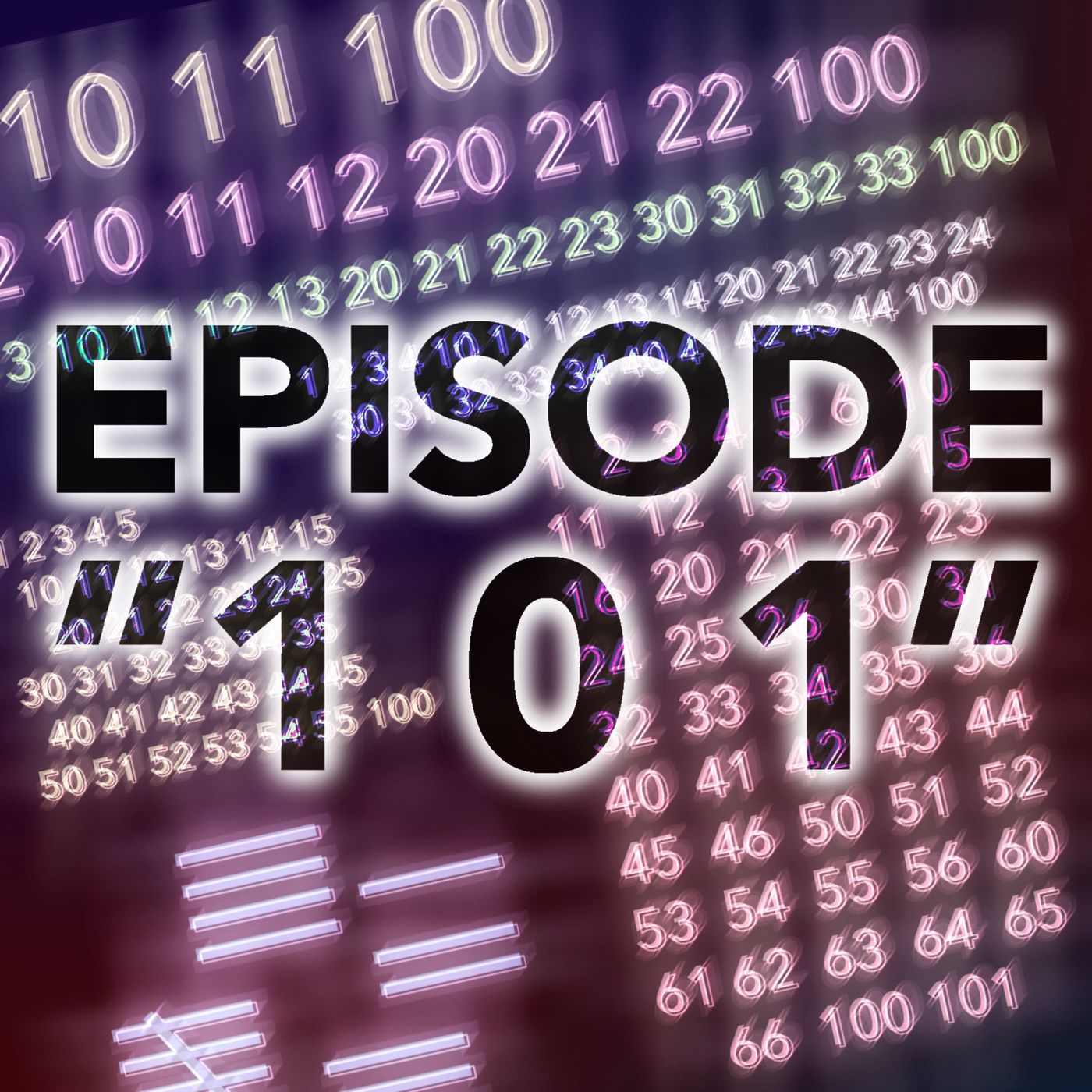
50: Episode "101" (Bases)
Numbering was originally done with tally marks: the number of tally marks indicated the number of items being counted, and they were grouped together by fives. A little later, people wrote numbers down by chunking the number in a similar way into larger numbers: there were symbols for ten, ten times that, and so forth, for example, in ancient Egypt; and we are all familiar with the Is, Vs, Xs, Ls, Cs, and Ds, at least, of Roman numerals. However, over time, several peoples, including the Inuit, Indians, Sumerians, and Mayans, had figured out how to chunk numbers indefinitely, and make numbers to count seemingly uncountable quantities using the mind, and write them down in a few easily mastered motions. These are known as place-value systems, and the study of bases has its root in them: talking about bases helps us talk about what is happening when we use these magical symbols.
49: Thinking Machines II (Techniques in Artificial Intelligence)
Machines have been used to simplify labor since time immemorial, and simplify thought in the last few hundred years. We are at a point now where we have the electronic computer to aid us in our endeavor, which allows us to build hypothetical thinking machines by simply writing their blueprints — namely, the code that represents their function — in a general way that can be easily reproduced by others. This has given rise to an astonishing array of techniques used to process data, and in recent years, much focus has been given to methods that are used to answer questions where the question or answer is not always black and white. So what is machine learning? What problems can it be used to solve? And what strategies are used in developing novel approaches to machine learning problems? This episode is distributed under a CC BY-SA 4.0 license. For more information, visit CreativeCommons.org. For more Breaking Math info, visit BreakingMathPodcast.app [Featuring: Sofía Baca, Gabriel Hesch] References: https://spectrum.ieee.org/tag/history+of+natural+language+processingWays to support the show:-Visit our Sponsors: theGreatCoursesPlus.com/breakingmath Get a free month of the Great Courses Plus while supporting this show by clicking the link and signing up! brilliant.org/breakingmath Sign up at brilliant.org, where breaking math listeners get a 20% off of a year's subscription of Brilliant Premium!Patreon Become a monthly supporter at patreon.com/breakingmathMerchandise Purchase a Math Poster on Tensor Calculus at our facebook store at facebook.com/breakingmathpodcast--- This episode is sponsored by · Anchor: The easiest way to make a podcast. https://anchor.fm/appSupport this podcast: https://anchor.fm/breakingmathpodcast/support
48: Thinking Machines (Philosophical Basis of Artificial Intelligence)
Machines, during the lifetime of anyone who is listening to this, have advanced and revolutionized the way that we live our lives. Many listening to this, for example, have lived through the rise of smart phones, 3d printing, massive advancements in lithium ion batteries, the Internet, robotics, and some have even lived through the introduction of cable TV, color television, and computers as an appliance. All advances in machinery, however, since the beginning of time have one thing in common: they make what we want to do easier. One of the great tragedies of being imperfect entities, however, is that we make mistakes. Sometimes those mistakes can lead to war, famine, blood feuds, miscalculation, the punishment of the innocent, and other terrible things. It has, thus, been the goal of many, for a very long time, to come up with a system for not making these mistakes in the first place: a thinking machine, which would help eliminate bias in situations. Such a fantastic machine is looking like it's becoming closer and closer to reality, especially with the advancements in artificial intelligence. But what are the origins of this fantasy? What attempts have people made over time to encapsulate reason? And what is ultimately possible with the automated manipulation of meaning? All of this and more on this episode of Breaking Math. Episode 48: Thinking Machines References: * https://publicdomainreview.org/essay/let-us-calculate-leibniz-llull-and-the-computational-imagination * https://spectrum.ieee.org/tag/history+of+natural+language+processing https://en.wikipedia.org/wiki/Characteristica_universalis https://ourworldindata.org/coronavirus-source-data This episode is distributed under a CC BY-SA 4.0 license. For more information, visit CreativeCommons.org. [Featuring: Sofía Baca, Gabriel Hesch]Ways to support the show:Patreon Become a monthly supporter at patreon.com/breakingmath
P4: Go with the Flow (Conceptual Calculus: Related Rates of Change)
Join Gabriel and Sofía as they delve into some introductory calculus concepts.[Featuring: Sofía Baca, Gabriel Hesch]Ways to support the show:Patreon Become a monthly supporter at patreon.com/breakingmath
47: Blast to the Past (Retrocausality)
Time is something that everyone has an idea of, but is hard to describe. Roughly, the arrow of time is the same as the arrow of causality. However, what happens when that is not the case? It is so often the case in our experience that this possibility brings not only scientific and mathematic, but ontological difficulties. So what is retrocausality? What are closed timelike curves? And how does this all relate to entanglement?This episode is distributed under a CC BY-SA 4.0 license. For more information, visit CreativeCommons.org.[Featuring: Sofía Baca, Gabriel Hesch]
P3: Radiativeforcenado (Radiative Forcing)
Learn more about radiative forcing, the environment, and how global temperature changes with atmospheric absorption with this Problem Episode about you walking your (perhaps fictional?) dog around a park. This episode is distributed under a CC BY-SA license. For more information, visit CreativeCommons.org.[Featuring: Sofía Baca, Gabriel Hesch]--- This episode is sponsored by · Anchor: The easiest way to make a podcast. https://anchor.fm/appSupport this podcast: https://anchor.fm/breakingmathpodcast/support
46: Earth Irradiated (the Greenhouse Effect)
Since time immemorial, blacksmiths have known that the hotter metal gets, the more it glows: it starts out red, then gets yellower, and then eventually white. In 1900, Max Planck discovered the relationship between an ideal object's radiation of light and its temperature. A hundred and twenty years later, we're using the consequences of this discovery for many things, including (indirectly) LED TVs, but perhaps one of the most dangerously neglected (or at least ignored) applications of this theory is in climate science. So what is the greenhouse effect? How does blackbody radiation help us design factories? And what are the problems with this model?This episode is distributed under a CC BY-SA license. For more information, visit CreativeCommons.org.[Featuring: Sofía Baca, Gabriel Hesch]--- This episode is sponsored by · Anchor: The easiest way to make a podcast. https://anchor.fm/appSupport this podcast: https://anchor.fm/breakingmathpodcast/support